It’s a feeling every crypto owner dreads: that heart-in-your-stomach moment when you realize you can't get into your wallet. The password you were so sure of isn't working, the hard drive with your wallet file just died, or your hardware wallet is simply… gone.
Before you let the panic take over, take a deep breath. Getting your funds back is often entirely possible. This guide is here to walk you back from the ledge and give you a clear, practical plan, starting with figuring out exactly what went wrong.
From Panic to a Plan
That immediate wave of anxiety is a universal experience in the crypto world. But right now, clarity is your best friend, not fear. The first real step toward getting your assets back is understanding how you lost access in the first place.
And this isn't some rare, abstract problem. It happens all the time, with massive amounts of money on the line. In the first half of one recent year alone, over $3.1 billion in crypto was lost worldwide. A staggering 59% of that—a cool $1.83 billion—was due to access-control exploits where attackers took advantage of weak security. You can dig into more of these trends over at CryptoPotato.
Identify Your Scenario
So, let's figure out what you're dealing with. Before you start trying random solutions, you need to diagnose the problem. The right recovery path depends entirely on the root cause.
Your situation probably falls into one of these common buckets:
- Forgotten Password or PIN: The wallet file or hardware is safe, but you just can't remember the credentials.
- Lost Hardware Wallet: Your physical Ledger, Trezor, or other device has gone missing.
- Corrupted Wallet File: The software wallet file on your computer (like a
wallet.dat) is damaged and won't load. - Inaccessible Device: The phone or computer that holds your wallet is broken, lost, or has been completely wiped.
Think about a classic scenario I've seen countless times: someone's laptop suddenly gives up the ghost, and their software wallet goes down with it. They assume their Bitcoin is lost forever. But after they calm down and methodically retrace their steps, they remember backing up their wallet to an old USB drive they tossed in a drawer years ago. What felt like a total catastrophe was solved by a simple act of organized recollection.
Your first job is not to panic, but to become a detective. Systematically retrace your steps, check old devices, and review your notes. The key to your lost crypto wallet is often hidden in your own history.
This guide will help you shift from that initial shock to a structured, recovery-focused mindset. By giving you immediate clarity and concrete steps, you can start taking back control and begin the process of reclaiming what’s yours.
The First Place to Look: Your Seed Phrase
Alright, before we get into the heavy-duty recovery tools, let’s take a breath. The most powerful key you have to get back into your wallet isn't some fancy software—it's a simple string of 12 to 24 words.
You know what I'm talking about: your seed phrase, sometimes called a recovery phrase.
This isn't just a password. It's the master key to your funds on the blockchain itself. Think of it as the DNA of your wallet. With this phrase, you can regenerate your private keys and access your crypto from almost any compatible wallet app. If you can find it, you’ve basically solved the problem.
Okay, Where Did You Put It?
This is where you need to put on your detective hat. Cast your mind back to when you first set up your wallet. The app definitely flashed a big, bold warning telling you to write down your seed phrase and keep it somewhere safe. So, where did that safe place end up being?
Let's jog your memory with some of the usual suspects:
- Good Old-Fashioned Notebooks: Have you checked that journal you use for important notes? Maybe a planner or a specific notebook you set aside for security stuff?
- Password Managers: It's worth searching through your 1Password or LastPass vault. Try searching for terms like "crypto," "seed phrase," "MetaMask," or the name of the coin you're trying to access.
- Seriously Secure Storage: Did you go the extra mile with a fireproof safe, a safety deposit box at the bank, or one of those metal seed storage plates? If so, now's the time to check it.
- Encrypted USB Drives: Think about any thumb drives you use for sensitive files. It could be sitting in a plain text file on one of them.
Seriously, don't rule anything out. I’ve heard stories of people finding their phrases scribbled on the back of an old receipt, tucked inside a book, or even saved in a draft email they never got around to sending. Just be methodical and check everything.
Before you go on a full-blown search, it helps to identify exactly what you're dealing with. Here’s a quick-reference table to help you match your problem to a starting point.
Common Wallet Access Issues and First-Line Solutions
| Symptom | Potential Cause | Immediate Action |
|---|---|---|
| Can't log into wallet app | Forgotten password/PIN | Find your 12-24 word seed phrase. You can use it to restore the wallet on a new device. |
| Old computer/phone broke | Device is inaccessible | Your crypto isn't on the device, it's on the blockchain. Find the seed phrase to import your wallet elsewhere. |
| Wallet app won't open | Software bug or corruption | Don't panic. Your funds are safe. Get your seed phrase and restore it in a different, compatible wallet. |
| Have a long string of characters | Saved a private key | This is good! This key controls a single address. Use the "Import Account" feature in a wallet like MetaMask. |
| No idea where to start | Complete memory loss | Start by searching physical locations (notebooks, safes) and digital vaults (password managers) for any crypto-related notes. |
This table should give you a clearer path forward. Finding that seed phrase is almost always the quickest way back in.
A Quick Example: Putting It Into Practice
Let's say your old laptop died, and your MetaMask wallet was on it. The good news is you just found your 12-word seed phrase written in a notepad. The recovery process is actually pretty simple.
You'd just download MetaMask on your new computer, choose the "Import an existing wallet" option, and type in those 12 words.
But here’s where you have to be careful. Precision is everything. One wrong word, or even putting the words in the wrong order, will create a brand new, completely empty wallet. Every word must be spelled correctly, in the right sequence, with a single space between them.
If you want to get a better handle on why this phrase is so important and how it works, our detailed guide on the wallet recovery phrase breaks it all down.
What if You Find a Private Key Instead?
Sometimes, you might not find a full seed phrase but a single private key. This is just a long, random-looking string of letters and numbers.
While a seed phrase restores your entire wallet with all its accounts, a private key only gives you access to a single address. It's still a massive win. Most wallets, including MetaMask, have an "Import Account" function where you can paste this key directly to get access to the funds at that address.
Bottom line: Finding either your seed phrase or a private key is your best shot at getting back in without a headache.
What to Do When Your Seed Phrase Is Gone
Okay, so the seed phrase is gone. Really gone. It's a gut-wrenching feeling, and honestly, this is the point where most people throw in the towel, writing off their crypto as lost forever.
But hold on. If you have anything else to work with—a partial phrase, an old wallet.dat file, even a password you think you remember—the game isn't over. Not by a long shot. We're now stepping into the world of advanced recovery. It's a big leap from just turning your house upside down looking for a piece of paper, but it's a path that has absolutely reunited people with their locked-up funds.
Exploring Advanced Recovery Tools
When your master key (the seed phrase) is missing, you have to get creative with the clues you do have. This usually means leaning on some powerful software to either fix broken data or run through every possible combination to find the missing piece.
- Wallet File Repair: Got an old, corrupted wallet file? Things like a
wallet.datfile from Bitcoin Core can sometimes be repaired. Specialized tools can piece the file's structure back together, making it usable again. - Brute-Force Software: If a forgotten password is the culprit, brute-force tools can be your best friend. They methodically test thousands, or even millions, of password combinations per second. It’s a power-hungry process, but it works, especially if you have a vague idea of what the password might have been.
- Partial Seed Phrase Reconstruction: This is a common one. Maybe you have 10 of your 12 words but two are smudged or missing. Instead of guessing manually, certain tools can plug in every possible valid word into the empty slots until they hit the right combination and unlock your wallet.
A word of caution: these methods require some technical confidence. More importantly, you have to be smart about security. Running sketchy software from a random forum is a great way to get malware. Stick to reputable, open-source tools or bring in a professional you trust.
This little decision tree sums up the situation perfectly.
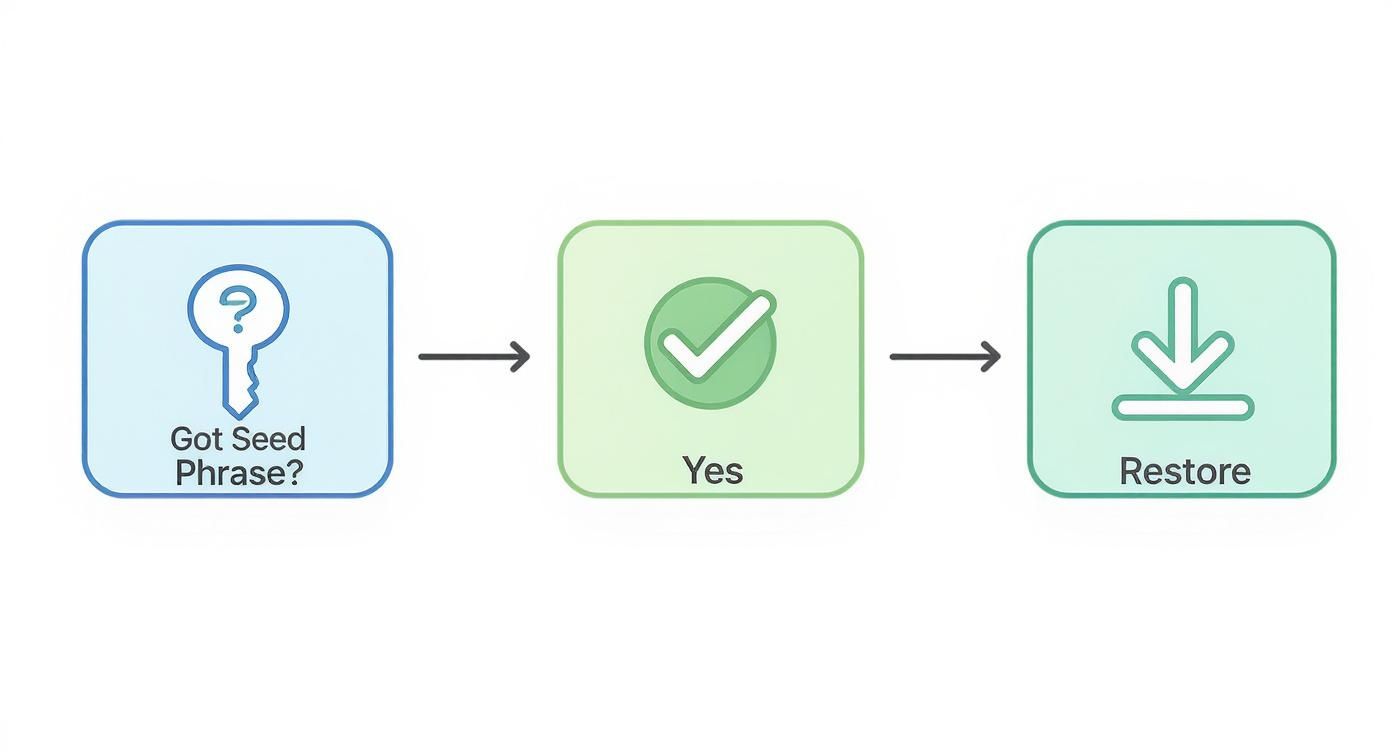
It highlights a core truth in crypto: if you have the seed phrase, you have a straight shot to your assets. Everything we're talking about now is for when that direct path is blocked.
The Rise of AI-Powered Recovery Services
Lately, a new and incredibly powerful option has emerged: AI-powered recovery services. These platforms use seriously sophisticated algorithms to crack recovery cases that would be practically impossible for a person to solve on their own.
Think about a real-world scenario. A user has only 10 of their 12 seed words. Trying to guess the two missing words and their correct order by hand would take an eternity—you're talking millions of permutations. An AI-driven service, on the other hand, can intelligently slash the number of possibilities by analyzing wallet algorithms and common word patterns, often cracking the code in a tiny fraction of the time.
AI recovery isn't magic. It's just math and pattern recognition on a massive scale. It’s built to find that digital needle in a haystack by making sense of partial data, figuring out likely password structures, and even reconstructing access from corrupted file fragments.
These services are also proving invaluable for pulling data off physically damaged hard drives or phones where normal data recovery just gives up. And unfortunately, the need is only growing. Crypto crime is a massive industry, with illicit wallets holding nearly $15 billion in cryptocurrency. As Chainalysis reports, the total value in wallets linked to illicit sources has topped $60 billion, which shows you just how much is at stake. You can dig into the findings on seizable crypto assets from Chainalysis for a deeper look.
Choosing a Crypto Recovery Service You Can Trust
When you've hit a wall trying to get back into your own crypto wallet, bringing in a professional can seem like the only move left. But this is where you have to be extremely careful. The space is flooded with both legitimate experts and outright scammers, and telling them apart is everything.
Making the wrong choice here doesn't just mean you fail to get your funds back—it could mean losing them for good.
The crypto world is, sadly, a playground for fraudsters. In 2024 alone, a mind-boggling $2.2 billion was swiped from various platforms. That number should tell you everything you need to know: approach anyone offering help with a healthy dose of skepticism and a solid plan to vet them.
Red Flags You Cannot Ignore
Your first job is to weed out the bad actors. Scammers are brilliant at preying on panic and desperation, using tactics designed to make you act before you think. Keep an eye out for these massive warning signs.
The biggest red flag of all? A demand for upfront payment. Real, professional services work on a success-based fee. They get paid after they successfully recover your funds, not before. Anyone asking for cash before the job is done is almost certainly trying to take you for a ride.
Just as bad are those ironclad guarantees of success. Crypto recovery is messy and complicated; there are no certainties. An honest expert will give you a realistic assessment of your chances, not a 100% promise designed to get you to sign on the dotted line.
The absolute deal-breaker? A request for your complete seed phrase or private keys. A reputable service will never ask for the keys to the kingdom. They use non-custodial methods that don't require you to hand over direct control of your assets.
Hallmarks of a Trustworthy Service
Okay, so we know what to avoid. Let's flip the script and talk about the green flags—the signs that you're dealing with a legitimate, professional operation.
Here’s what you should be looking for:
- Success-Based Pricing: Their fee structure is simple: no recovery, no fee. They take a percentage of the recovered funds, which perfectly aligns their goals with yours.
- A Public Track Record: You should be able to find real, verifiable reviews from past clients on independent sites. Nothing speaks louder than a history of happy customers.
- A Non-Custodial Approach: They should be able to walk you through their process, and that process should never involve you sending them your private keys or full seed phrase. You should remain in control.
Essential Questions to Ask Any Potential Service
Before you commit to anything, you need to do your own homework. Treat this like an interview, because that's exactly what it is. You're hiring someone for a very, very important job.
Go into the conversation armed with these questions:
- What is your fee structure? (You're listening for a clear, success-based model).
- Can you show me case studies or client testimonials? (Ask for proof of their past work).
- Walk me through your recovery process. (They should be able to explain their methods without asking for your sensitive data).
- How do you protect my information? (A professional outfit will have a clear, documented security and privacy policy).
Taking the time to properly vet a potential partner is the most important step you can take. For a bit more background, our overview of professional cryptocurrency recovery services offers more context on what to expect. An informed choice here is your best defense against making a bad situation even worse.
Building a Bulletproof Wallet Security Plan
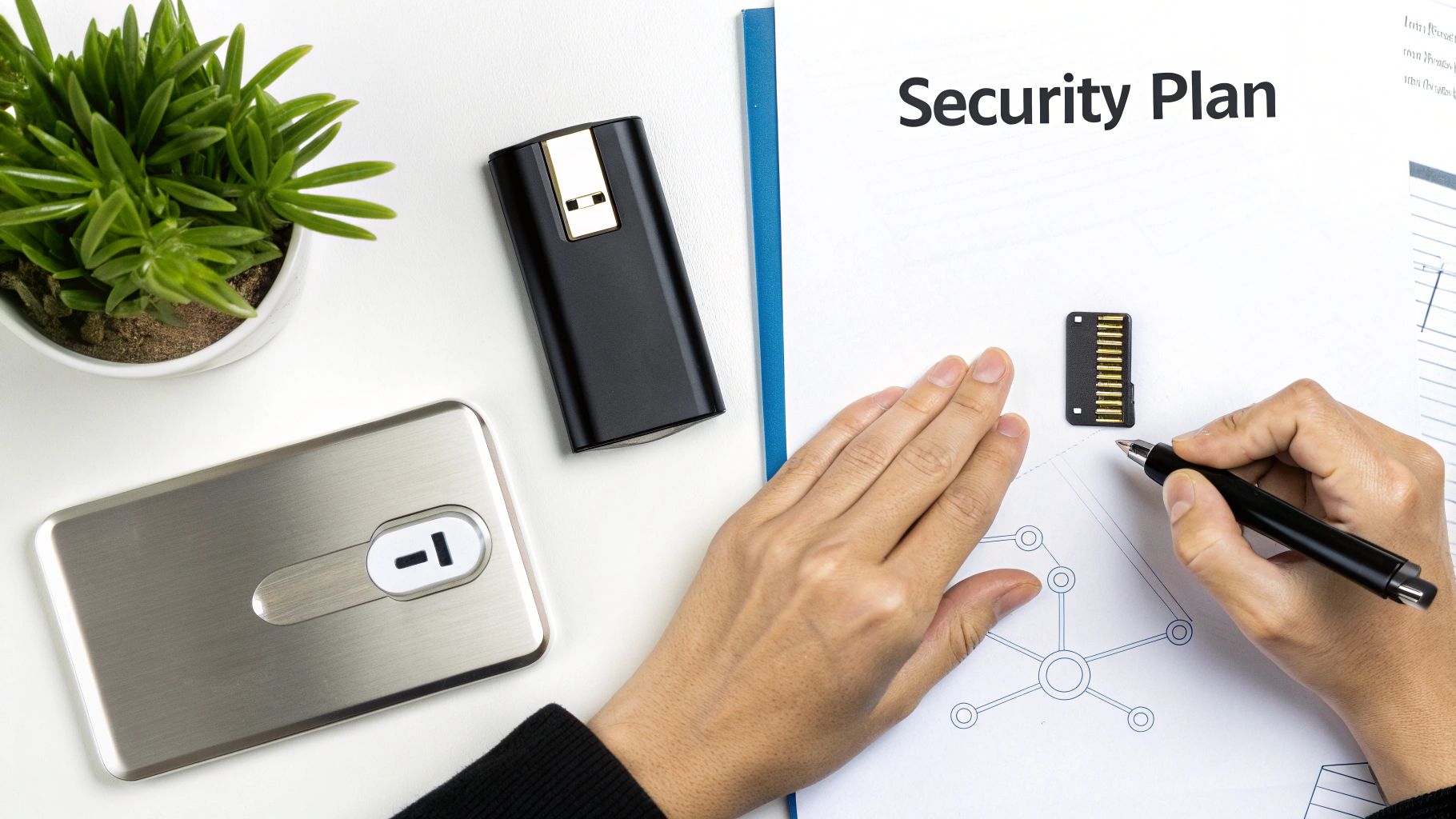
That feeling of dread when you think you've lost access to your crypto? It’s awful. Once you’ve recovered your funds, the absolute first thing on your mind should be making sure you never have to go through that again.
Now's the time to graduate from scribbling your seed phrase on a sticky note. We're talking about building a real, multi-layered security plan. This isn't just about preventing hacks; it’s about creating a resilient system that protects you from accidents, theft, and even your own forgetfulness. The goal is to design a setup where no single point of failure can wipe you out.
This is more important than ever. Crypto theft isn't random—it follows the money. Regions with high crypto adoption are hotbeds for scammers and thieves. The United States, for example, consistently leads in reported losses for both Bitcoin and altcoins, which tells you that more activity directly translates to more risk. For a closer look at these trends, check out the mid-year crypto crime update from Chainalysis.
Reinforce Your Seed Phrase Storage
Your seed phrase is the master key to everything. Storing it on paper is like leaving the key to a bank vault under the doormat. Paper burns, gets soaked, and fades. It’s time for a serious upgrade.
Think about making your backup truly indestructible:
- Stainless Steel Plates: Forget paper. Products like Cryptosteel or Billfodl let you stamp or arrange your seed phrase on metal tiles. These things are built to survive fire, floods, and just about anything else you can throw at them.
- Encrypted USB Drives: Storing your phrase in a text file on a regular USB stick is asking for trouble. A much better approach is a hardware-encrypted drive (like an IronKey or Aegis Padlock) that demands a physical PIN to even get in. This wraps your physical backup in a powerful layer of digital security.
A classic mistake I see is people keeping all their fancy new backups in the same place. Don't do it. The whole point is distribution. Keep one in a fireproof safe at home and stash another in a totally separate, secure location like a safe deposit box.
Distribute Control with Multi-Signature Wallets
If you’re ready to level up your security, it's time to talk about multi-signature (multisig) wallets. A standard wallet has a huge weakness: if someone gets your one private key, it's game over. Multisig completely changes this dynamic.
A multisig wallet requires more than one key to sign off on a transaction, which basically eliminates single points of failure.
Picture this: you set up a 2-of-3 multisig wallet. This creates three private keys, but you only need any two of them to move your funds. You could keep one key on your laptop, a second on a hardware wallet, and the third etched on a steel plate in a safe.
This setup gives you incredible peace of mind. If a hacker compromises your computer, they still can't touch your crypto because they only have one of the two keys needed. If you lose your hardware wallet, you're still safe. It’s the difference between a simple padlock and a bank vault with multiple keyholders. Losing access to one piece of the puzzle doesn't have to be a catastrophe.
Common Questions About Lost Wallet Recovery
When you're staring at a locked wallet, your mind starts racing with questions. It's a stressful spot to be in, and the uncertainty can be the worst part. Let's tackle some of the most common concerns I hear from people in this exact situation, so you know what to expect and can move forward with a clear head.
Can a Wallet Be Recovered Without a Seed Phrase?
This is the big one, the question everyone asks. The honest answer is a firm "it depends."
If you set up your wallet without ever writing down a seed phrase—which is unusual, but possible—then recovery is next to impossible without the original device and password. Think of the seed phrase as the ultimate master key; without it, you're locked out for good if the primary lock (your device/password) is also gone.
But here's the good news. If you did have a seed phrase and simply lost it, but you still have the wallet file (like a wallet.dat) and a vague memory of the password, then you're absolutely in the game. Advanced tools can brute-force the password or even repair a corrupted wallet file to get you back in. In these cases, the seed phrase isn't the only way in, just the simplest.
How Long Does the Recovery Process Take?
The timeline for getting your crypto back can vary wildly. It all comes down to what you have to work with.
- With a Seed Phrase: This is the best-case scenario. Recovery is practically instant. You just import your phrase into a new wallet, and your funds should appear in minutes.
- With a Wallet File and Password Guess: This is where it gets tricky. It could take a few hours or stretch into several weeks. The two biggest factors are how complex your forgotten password was and the sheer power of the computer running the recovery software.
- With a Partial Seed Phrase: If you have most of the words but a few are missing, AI-driven services can often fill in the blanks within 24 to 72 hours. The exact time depends on how many words are missing and where they were in the sequence.
- With a Damaged Device: This is the most unpredictable path. Physical data recovery from a dead hard drive could take weeks, or even months if it requires specialized clean-room lab work.
Key Takeaway: The more clues you can provide, the faster this will go. Every little piece of information—a possible password, a partial phrase, an old backup file on a dusty USB stick—dramatically cuts down the time needed to get you back in.
Is It Safe to Use a Recovery Service?
Handing over your problem to a professional can be incredibly safe, but you have to pick the right one. A trustworthy service will never ask you for money upfront or demand your full private keys. Their entire business model should be based on success—they only get paid a percentage after your funds are safely back in your control.
Do your homework. Look for independent reviews, ask them to explain their security protocols, and make sure they use non-custodial methods. A legitimate expert helps you unlock your own wallet without ever taking direct control of your assets. Choosing the right partner here is critical; you don't want to add another layer of risk to an already stressful situation.
If you've hit a wall and need professional help, Wallet Recovery AI uses a secure, AI-enhanced process for a huge range of wallets. Our team works on a confidential, success-based model to help you get your assets back. You can learn more about how we do it at https://walletrecovery.ai.
Leave a Reply