Think of professional password recovery services as the digital equivalent of a high-security locksmith. When you’re locked out of something simple, like your email, the automated "forgot password" link works just fine. But what happens when you've lost the password to an encrypted cryptocurrency wallet holding a small fortune, or a critical business backup? There’s no reset button for that.
That's where the specialists come in. Their job isn’t to reset your password—it’s to find the original one. Using a combination of powerful hardware and clever guesswork, they systematically test millions or even billions of potential combinations based on any clues you can provide.
Understanding Professional Password Recovery Services
It's easy to confuse what these services do with the standard password reset features we see every day. They're worlds apart. A reset link on a website simply erases your old password and lets you create a new one, usually after verifying your identity through email or SMS.
A professional recovery service, on the other hand, is for situations where no reset mechanism exists. The data is locked behind strong encryption, and the only way in is with the original password. Losing it means losing everything—unless you can find the key.
When Do You Need a Recovery Service?
Most of us won't ever need this kind of help. But for those who do, the stakes are incredibly high. You might need to call in an expert if you're facing one of these scenarios:
- Lost Cryptocurrency Wallet Passwords: You’ve got the file—a
wallet.datfor Bitcoin or an Ethereum keystore—but the password you thought you remembered just isn't working. - Inherited Digital Assets: A loved one has passed away, leaving behind a crypto wallet or encrypted files, but no password notes to be found.
- Forgotten Password Manager Keys: The master password for your 1Password or LastPass vault is gone, locking you out of dozens or even hundreds of accounts.
- Encrypted File Access: You have essential business records or personal photos locked in a VeraCrypt container or an encrypted ZIP file, and the password is a complete blank.
In every one of these cases, brute force and educated guessing are the only paths forward.
A professional service takes the fragments of memory you have—parts of old passwords, names of pets, important dates—and uses them to build a highly targeted, intelligent search. They turn the impossible task of guessing from infinite options into a solvable puzzle.
Let's break down the fundamental differences.
Standard Resets vs Professional Recovery
It's crucial to understand that these two are designed for entirely different problems. One is for convenience; the other is for disaster recovery.
| Feature | Standard 'Forgot Password' Link | Professional Recovery Service |
|---|---|---|
| Goal | Replace the old password with a new one. | Discover the original, forgotten password. |
| Process | Automated identity verification (e.g., email). | Computational analysis & targeted brute-force. |
| Use Case | Everyday accounts (social media, email, etc.). | Encrypted files with no reset option (crypto wallets). |
| Data Impact | Access is restored, but the old key is gone. | Access is restored without altering original data. |
| Required Info | Access to your recovery email or phone. | Any memory fragments of the original password. |
Essentially, when the automated systems can't help you, that's when a professional recovery service becomes your only option.
The Growing Need for Expert Help
As our digital lives get more complex, so do the ways we lock them down. This has created a massive need for specialized recovery solutions. The market for this kind of software and service was valued at around USD 1.6 billion and is expected to climb to USD 6.7 billion by 2033. You can dig into the numbers in this password recovery market trends report.
This isn't just a niche industry anymore. It’s a direct response to a growing problem: our most valuable assets are increasingly digital, and the security protecting them is often a single point of failure—a password stored only in our memory. These services provide a critical safety net, bridging the gap between permanent loss and successful recovery.
How the Digital Recovery Process Works
It's easy to think of professional password recovery as some kind of digital black box. You hand over an encrypted file, cross your fingers, and hope for the best. But the reality is far from magic—it's more like methodical detective work, combining serious computing power with the most important tool of all: your own memories.
The whole thing kicks off with a simple, secure consultation, not a request for your credit card. Any reputable service will start by just listening to your situation, figuring out what kind of file you're dealing with (like a crypto wallet or a locked document), and explaining their success-based fee. This first step is all about building trust and making sure everyone's on the same page.
This quick visual shows how a locked file goes from inaccessible to recovered with the right help.
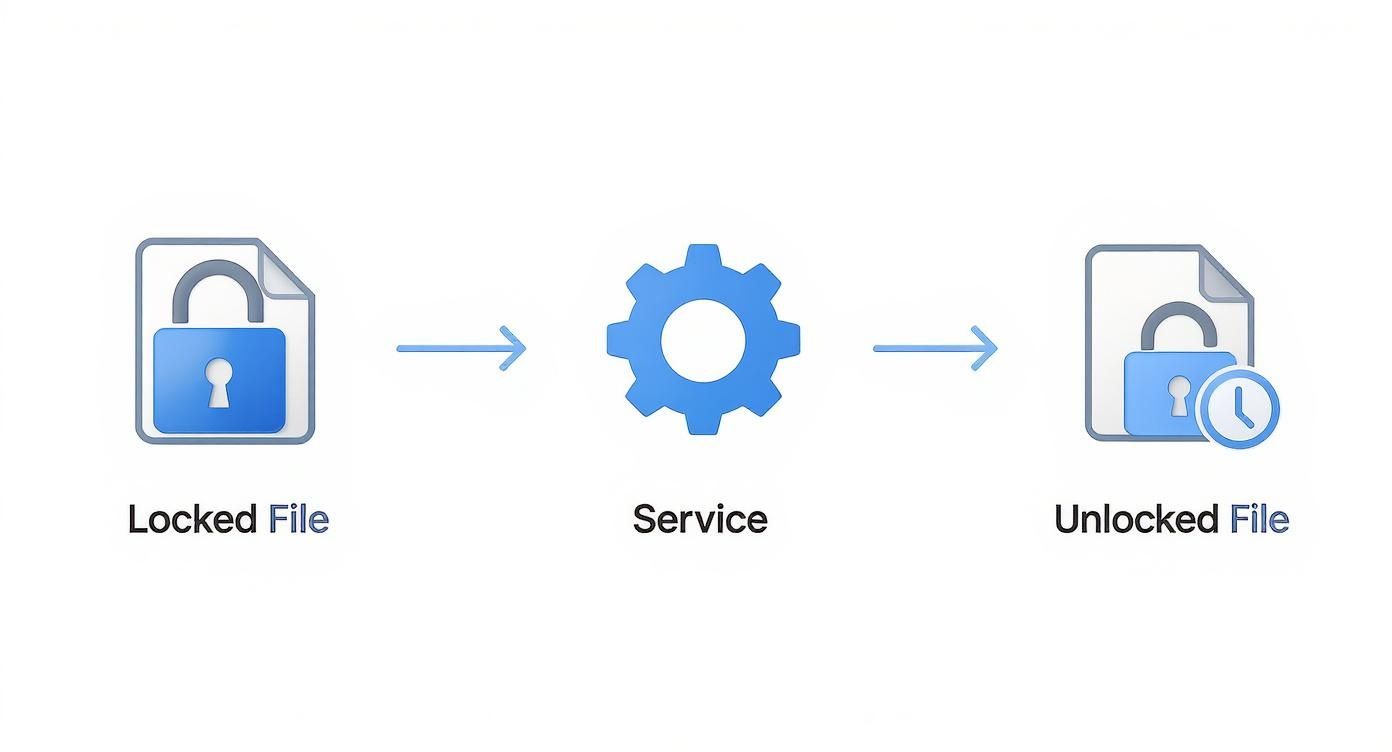
As you can see, the service is the bridge, using specialized tools and techniques to get your file open again.
Gathering the Digital Clues
Once you decide to move forward, the most critical phase begins: gathering your "memory fragments." This is where you become the lead detective in your own case. The recovery team will ask you to dig deep and list every possible password clue you can think of, no matter how small or random it seems.
Honestly, your input is the fuel that makes the whole recovery engine run. It's like a detective having a list of suspects; without it, they’d just be wandering around in the dark.
Your memories are the single most important part of this whole process. A forgotten pet’s name, an old anniversary, or even a common typo you make could be the one key that cracks the code and unlocks your assets.
We're often looking for fragments like:
- Core Words: Names of family, pets, favorite bands, or characters.
- Significant Numbers: Birthdays, anniversaries, old addresses, or lucky numbers.
- Patterns and Structures: The usual way you build passwords (e.g.,
Word!YearorName123$). - Old Guesses: Any passwords you've already tried are actually super helpful because they reveal your thought patterns.
This information is what lets the recovery team stop guessing blindly and start searching intelligently.
The Technical Recovery Phase
With your clues in hand, the real technical work begins. Professionals use custom-built hardware and powerful software to test millions—sometimes billions—of password variations. This isn't just random button-mashing; it's a highly targeted attack based on the memory fragments you provided. For a deeper look into the mechanics, you can learn more about how to find lost passwords and the strategies involved.
The two main methods used are:
-
Dictionary Attacks: This approach uses huge lists of common words, phrases, and passwords from known data breaches, then mashes them up with the numbers and symbols you provided. For example, if you mentioned the name "Max" and the year "1995," the system would test combinations like
Max1995,Max!95,M@x1995!, and literally thousands of other variations. -
Brute-Force Attacks: When a dictionary attack doesn't cut it, we move to a brute-force approach. But it's not a completely blind guess. The system is configured to test character combinations that follow the patterns you described, like a capital letter followed by six lowercase letters and two numbers. This narrows the search from practically infinite possibilities down to a massive—but manageable—set of options.
Throughout this stage, a good service will keep you in the loop with regular progress updates. You shouldn't be left wondering what’s going on.
Successful Recovery and Secure Handover
The moment a matching password is found, you'll get the good news. The team will use it to unlock your file, double-check that the contents are accessible, and make sure everything is intact.
Once success is confirmed, the final step is the secure handover. You'll be given the correct password, and only then is the success-based fee due. After that, all copies of your encrypted file and the password clues you sent over are permanently and securely wiped from their systems. Your privacy is protected from beginning to end.
Choosing a Service You Can Actually Trust
Handing over an encrypted file, especially one holding a significant amount of your assets, is a massive leap of faith. It’s not something to take lightly. The very nature of password recovery requires you to trust an outside party with what could be life-changing data.
This makes choosing a reputable, security-focused provider the single most important decision in this entire process. The stakes are just too high. A trustworthy service isn't only one that gets results; it's one that puts the absolute protection of your data first, from the moment you contact them until long after the job is done. Your main goal is to find a partner who will treat your digital assets with the same care you would.

This growing need for secure recovery is showing up in the market numbers, too. The global password manager market, which is a close cousin to recovery services, is projected to hit USD 3.75 billion next year and could reach USD 8.28 billion within five years. As more of our lives go behind password-protected walls, the demand for safe ways to get back in naturally rises with it. You can explore detailed insights into this market growth if you want to dig into the data.
Your First Line of Defense: A Legal Agreement
Before a single byte of your data is touched, a professional service should put a legally binding Non-Disclosure Agreement (NDA) on the table. Think of this as their formal, written promise that everything you share—from your encrypted file to personal password clues—will be held in the strictest confidence.
An NDA is non-negotiable. It contractually forces the service to protect your information and legally blocks them from sharing, using, or even peeking at your data for anything other than the recovery attempt. If a service hesitates to provide an NDA or tries to downplay its importance, that’s a huge red flag. Walk away.
Isolating the Threat With Air-Gapped Systems
So, how does a service actually protect your file from hackers while they're working on it? The gold standard is using air-gapped systems.
Picture a high-security computer that has never been connected to the internet. Ever. It has no Wi-Fi, no Bluetooth, and no network cables plugged in. It is physically and completely isolated from the outside world.
This complete digital isolation is critical. By running the entire recovery process on an air-gapped machine, the service ensures your encrypted file is 100% shielded from remote attacks and online threats.
An air-gapped system creates a digital vault for your data during the recovery attempt. It eliminates the risk of online breaches, ensuring that the only focus is on cracking the password, not fending off external attacks.
This one security measure drastically cuts down the risk and is a key sign of a service that truly cares about protecting its clients. For highly sensitive files, especially in the crypto world, this is a must-have. You can learn more about how this works by exploring professional cryptocurrency recovery services that build their entire process around these kinds of hardcore security protocols.
Proving Secure Data Handling From Start to Finish
A company’s security practices shouldn’t be a secret. They should be transparent and something you can verify. You have every right to ask detailed, pointed questions about how your data is handled at every single stage.
A trustworthy provider will have clear, confident answers. Here are the critical questions you need to ask:
- How do you receive my encrypted file? They should be using a secure, end-to-end encrypted channel for the transfer. Standard email is a definite no-go.
- Where is my data stored during the recovery? The only right answer involves offline, encrypted storage on their air-gapped systems.
- What happens to my data after the recovery attempt? Whether they succeed or not, they must have a strict protocol for securely wiping every copy of your file and any password clues you provided.
- Who has access to my information? Access should be on a strict need-to-know basis, limited only to the one or two people directly involved in your case.
By demanding clear answers and looking for proof of these measures, you can confidently tell the difference between a professional partner and a potential disaster.
Here's the rewritten section, designed to sound completely human-written and match the expert tone from the examples.
What Kinds of Wallets and Files Can You Actually Recover?
When people hear “password recovery,” their minds usually jump straight to crypto wallets. It makes sense—with billions locked away behind forgotten passwords, it's a huge and painful problem. But the skills of a professional recovery service go way beyond just Bitcoin and Ethereum.
Think of it this way: we’re like digital locksmiths for almost any kind of encrypted file that doesn’t have a simple "reset password" button. If a file is locked down with a password you created, there's often a way back in.
Cracking Open Cryptocurrency Wallets
The crypto world is a wild place with a ton of different wallets, and each one is a unique puzzle. A good recovery service has seen them all and knows the specific file types and encryption quirks inside and out.
Most of the wallets we work with fall into a few main buckets:
- Software Wallets: These are the apps running on your desktop or phone. We spend most of our time working with files like
wallet.datfrom Bitcoin Core, the JSON keystore files from Ethereum wallets like MetaMask or MyEtherWallet, or the custom data files used by popular wallets like Electrum and Exodus. - Hardware Wallets: Devices from Ledger and Trezor are fantastic for security, but they aren't foolproof. While we can’t magically find a lost 24-word seed phrase, we can absolutely help crack a forgotten passphrase (the "25th word") that unlocks a hidden wallet on the device.
- Major Blockchains: Our main focus is naturally on the big players like Bitcoin (BTC) and Ethereum (ETH), which includes that whole universe of ERC-20 tokens. But any reputable service will support a long list of other popular chains, too.
The single most important thing is the encrypted wallet file itself. A legitimate service will never ask for your seed phrase. Our job is to crack the password locking that file, using the clues you remember to guide our tools.
It's Not Just About Crypto
Crypto recovery gets all the headlines, but the same powerful brute-force techniques can be a lifesaver for other critical digital files. People lock down all sorts of sensitive personal and business data, and losing that password can be just as catastrophic as losing a crypto wallet.
This is where you see the real breadth of what a professional recovery service can do.
Here’s a quick rundown of the most common asset types we see and the situations that bring people to us.
Supported Asset Types and Common Recovery Scenarios
| Asset Type | Examples | Common Recovery Scenario |
|---|---|---|
| Software Wallets | Bitcoin Core wallet.dat, MetaMask JSON, Exodus |
Forgotten password for a wallet created years ago. |
| Hardware Wallets | Ledger, Trezor | Lost the optional "25th word" passphrase. |
| Password Managers | 1Password, LastPass, KeePass | Can't remember the master password to the entire vault. |
| Encrypted Archives | WinRAR, 7-Zip, Encrypted ZIP | Lost password to an old, important archive of photos or documents. |
| Disk Encryption | VeraCrypt, TrueCrypt | Forgotten the password to a secure container holding sensitive files. |
| Office/PDF Files | Word, Excel, PDF | Password-protected a critical business or personal document and lost the key. |
Ultimately, whether it's a crypto wallet or a simple encrypted file, the core principle is the same.
If you have the original encrypted file and even a faint memory of how you structured the password, a professional can build a highly targeted attack to get your data back. It’s all about having the right tools and the experience to know how to use them.
When you're desperate to get your crypto back, it's easy to miss the warning signs. But in an industry built entirely on trust, learning to tell a genuine expert from a scammer is the most important thing you can do.
The sad truth is, where there's desperation, there are predators. They'll promise you the moon, but all you'll end up with is an empty wallet and a lot of heartache. This guide is here to help you spot the phonies and choose a service you can actually trust.
It’s no secret that digital asset security is a huge market. It’s projected to jump from USD 2.9 billion to a massive USD 12.16 billion in just eight years. While most of this growth comes from legitimate companies, it also attracts sharks looking to cash in on people in a tight spot. If you want to dig into the numbers, you can review the full password management market forecast here.
The Biggest Red Flags to Watch For
Scammers aren't usually very original. They tend to rely on the same old tricks, and once you know what to look for, they're pretty easy to spot.
Here are the immediate deal-breakers:
-
They demand money upfront. This is the biggest, brightest red flag you'll see. Legitimate services work on a success-based fee model. We only get paid after your funds are successfully recovered. Anyone asking for cash before they’ve done a thing is just planning to run with your money.
-
They guarantee a 100% success rate. No one can honestly promise that. A recovery's success depends almost completely on the quality of the password hints you can provide. A real professional will give you a realistic assessment of your chances, not a fairy-tale promise they can't keep.
-
They ask for your seed phrase or private keys. This is like handing a stranger the keys to your house, your car, and your safe deposit box. A real recovery service only needs your encrypted file (like a
wallet.dat) and your password guesses. We never need your unencrypted seed phrase.
Let me be crystal clear: Any service that asks for your seed phrase is not a recovery service—it's a theft service. There is absolutely no reason for them to have that information. Ever.
How to Vet a Legitimate Service
Okay, so you know what to avoid. But what should you look for? A real, professional operation will have nothing to hide and will make it easy for you to check them out.
Start with their online footprint. Do they have a professional website with clear, detailed explanations of their process, security measures, and fees? Or does it look like something slapped together in an afternoon? Look for real testimonials or case studies that show they’ve actually helped people.
Next, demand transparency. A trustworthy service will gladly explain their entire workflow, from how they handle your data securely to the air-gapped machines they use for the recovery attempt. They should be able to answer all your security questions without hesitation and provide a proper Non-Disclosure Agreement (NDA) before you send them a single file.
Finally, just trust your gut. If something feels off—if the communication is rushed, unprofessional, or pushy—it’s time to walk away. A genuine expert understands the stress you're under. They'll be patient, professional, and will work to earn your trust every step of the way.
Answering Your Questions About Password Recovery
When you're staring at a locked wallet or an encrypted file you can't open, your mind is probably racing with questions. It's a stressful spot to be in, and the last thing you want is more uncertainty. Before you trust anyone with your assets, you need straight answers about how this all works.
Let's cut through the noise. Here are the clear, no-nonsense answers to the questions we hear every single day from people just like you.
How Much Is This Going to Cost Me?
This is usually the first question out of anyone's mouth, and for good reason. The answer gets to the very heart of how a trustworthy recovery service should operate: you should never, ever pay a dime upfront.
Any reputable expert in this field works on a "no success, no fee" basis. It's that simple. We only get paid if we successfully recover your password and you get your assets back. If we can't crack it, you owe us nothing. Zero.
The fee itself is almost always a percentage of the recovered funds, which for crypto wallets typically falls between 10% and 20%. Where your case lands in that range depends on a few things:
- How Tough Is the Case? A simple password where you have strong clues is on the lower end. A super-complex password with only a few vague memories? That requires a ton of computational power and time, pushing the fee higher.
- What's the Value? The total value locked in the wallet can also play a role in the percentage.
- What Kind of File Is It? If we're not talking about crypto—say, a locked password manager or an encrypted business archive—we'll usually agree on a flat fee ahead of time instead of a percentage.
A professional service will be 100% transparent about the fee structure before any work starts. This success-based model means our goals are perfectly aligned with yours. It completely removes the financial risk from your shoulders.
What Are the Chances of Success?
I'll be blunt: anyone who guarantees a 100% success rate is lying to you. That's a massive red flag. The success of a recovery attempt isn't really up to the service—it's almost entirely dependent on the quality of information you can provide.
Your memories are the keys to the kingdom.
The more accurate your "memory fragments" are—the little bits and pieces of the password you think you remember—the higher our chances. Think of it like a detective solving a crime. The more solid clues they have, the faster they can pinpoint the culprit. Vague clues mean a much longer, and often less successful, investigation.
A real professional will give you a realistic assessment of your chances during your first chat, which should always be free. We'll listen to the clues you have, look at the type of encryption we're up against, and give you an honest take on whether we think we can pull it off.
What Do You Need From Me to Get Started?
We keep things incredibly simple and secure. To kick off a recovery attempt, we only need two things:
- The Encrypted File: This is the locked thing itself. For Bitcoin, it’s usually a
wallet.datfile. For Ethereum, it’s often a JSON keystore file. It could also be an encrypted ZIP archive or something similar. - Your Password Clues: This is just a list of every possible piece of the password you can dredge up from your memory. Don't filter anything out; no detail is too small.
This list of clues is the fuel for our entire operation. It should include everything you can possibly think of:
- Names of pets, kids, or favorite movie characters
- Important dates, like birthdays and anniversaries
- Old addresses or phone numbers
- Inside jokes or common phrases you use
- Your typical patterns, like
Password!2023orJohnDoe123$ - A list of guesses you've already tried on your own
What's critical is what we don't need. You should never be asked to share things like an unencrypted private key or your 12-word seed phrase. A legitimate service works only with the encrypted file and your password guesses. Period.
How Long Is This Going to Take?
The timeline can be all over the map, from just a couple of hours to several weeks—or in really tough cases, even longer. It all comes down to the password's complexity and how good your clues are.
I like to use a beach analogy. Imagine you're trying to find one specific grain of sand. If you know the general ten-foot-by-ten-foot area where it might be (strong clues), you could find it pretty quickly. But if all you know is that it's "somewhere on the beach" (weak clues), the search could take an eternity.
Here’s a rough breakdown:
- Quick Work (Hours to Days): If you give us strong, accurate clues for a fairly simple password (think under 10 characters with a predictable structure), we can often get it back very fast. The search is highly targeted.
- The Usual (Days to Weeks): For more complex passwords or when your clues are a bit fuzzy, the process naturally takes longer. Our systems need time to churn through tens of billions of possibilities.
- The Long Haul (Weeks to Months): For cases with extremely long, random passwords and only vague clues, the computational mountain we have to climb is enormous. Our hardware runs 24/7, but even then, it can take a serious amount of time to try everything.
No matter how long it takes, a good service will keep you in the loop with regular progress updates. You'll never be left wondering what's going on.
Are you locked out of your cryptocurrency wallet? The expert team at Wallet Recovery AI uses a secure, success-based approach to help you regain access to your digital assets. Don't let a forgotten password stand in your way. Get in touch with us today for a free, no-risk consultation.
Leave a Reply