Losing access to your crypto wallet is a gut-wrenching feeling. It’s like watching the door to your own bank vault slam shut, with the key nowhere to be found. That initial wave of panic is intense, but there's often a way back in. This is where crypto wallet recovery services come into play—a specialized lifeline for anyone who's forgotten a password, misplaced a seed phrase, or is staring at a dead piece of hardware.
The Panic of Lost Crypto and the Path to Recovery
That sinking feeling in your stomach when you realize you can't get to your crypto is something every investor dreads. Maybe it was a complex password you can't quite recall or a hardware wallet that just won't turn on. Whatever the cause, the result is the same: your assets are locked away, just out of reach. This guide is your map for getting through this incredibly stressful situation, offering clarity and real steps to get back in control.
It helps to think of your crypto wallet less like a container holding your funds and more like a unique, highly secure key that unlocks them on the blockchain. When that key gets lost or broken, you don't need a miracle; you need a master locksmith. Professional recovery services are exactly that. They bring together deep technical expertise and serious computational power to systematically piece your key back together.
Understanding the Need for Expert Help
So, why can't you just click a "Forgot Password?" link? Unlike your bank account, the world of decentralized finance puts all the security responsibility squarely on your shoulders. There’s no central help desk to call for a password reset. This feature—your total control—is a double-edged sword.
The real value of a recovery service is its ability to bridge the gap between human error and the unforgiving logic of blockchain security. They take a situation that feels impossible and turn it into a solvable technical problem.
The demand for these specialists has exploded as more and more people have gotten into crypto, and for good reason. The results speak for themselves. The crypto wallet recovery industry has seen legitimate firms report incredible success, with some recovering over $420 million for thousands of clients around the world. You can read more about these crypto recovery successes to see just how effective they can be. This doesn't just show how big the problem is; it proves that expert help really works.
These services are built to tackle a few common disasters:
- Forgotten Passwords: They use powerful hardware to run brute-force attacks, testing millions or even billions of password variations you might have used.
- Partial Seed Phrases: If you have most of your words but are missing a few or have them in the wrong order, they can programmatically figure out the missing pieces.
- Corrupted Wallet Files: They can perform digital forensics to repair a damaged wallet file and pull out the critical key data.
- Hardware Failure: For damaged hardware wallets, they can sometimes physically repair the device just enough to extract the private keys.
How Wallet Recovery Actually Works
Getting back into a locked wallet isn't some kind of digital magic. It's a highly methodical process that combines deep technical know-how, a bit of creative problem-solving, and a whole lot of computing power.
Think of your password or seed phrase as the combination to a digital vault. If you've forgotten that exact sequence, a crypto wallet recovery service is like a master safecracker. They don't just guess randomly; they systematically try logical combinations until the lock clicks open. But it's way more complicated than it sounds.
The whole process starts with you. Recovery specialists will gather every single clue you can remember, no matter how small. This could be fragments of a password, a partial list of your seed phrase words, the type of wallet you used, or even a rough idea of when you created it. Every piece of information you provide is crucial—it drastically narrows down the endless sea of possibilities, making the recovery attempt more focused and efficient.
This visual captures the journey perfectly—from that initial heart-stopping moment of panic to the relief that professional help can bring.
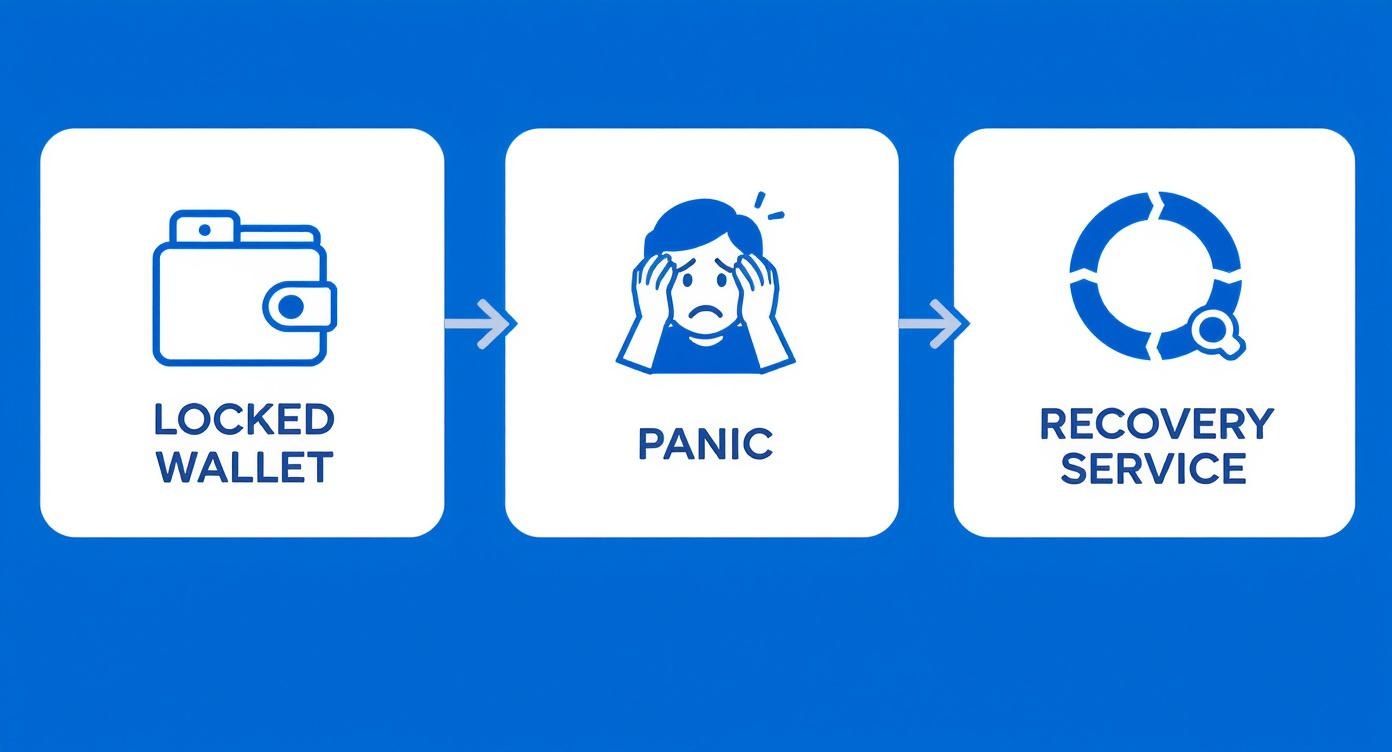
The infographic lays out a clear path, showing that reaching out for help is a logical next step when you realize you're locked out.
The Core Recovery Techniques
Once they have your clues, the experts fire up specialized software and powerful hardware to run highly targeted attacks. Don't let the word "attack" scare you; these aren't malicious hacks. They are controlled, methodical procedures designed to reconstruct your specific key.
The main methods they use are surprisingly straightforward when you break them down.
- Brute-Force Attacks: This is the go-to method for forgotten passwords. The service uses clusters of high-performance GPUs to cycle through millions, or even billions, of password variations per second. They base these attempts on the hints you gave them, like old passwords you've used or common patterns you tend to follow.
- Seed Phrase Reconstruction: Let's say you have a partial seed phrase—maybe 10 out of 12 words, or all the right words just in the wrong order. Specialized algorithms can systematically generate and test every possible combination until they land on the correct one.
- Digital Forensics: Sometimes the problem isn't a forgotten password but a corrupted wallet file or a damaged hard drive. In these cases, technicians use forensic tools to painstakingly piece together the damaged data, hunting for the raw private key information hidden within the file fragments.
The secret sauce behind a successful recovery is reducing the odds. Every personal clue you provide, however small it seems, eliminates trillions of wrong answers. This allows their powerful computers to focus their energy only on the most likely solutions.
Ultimately, the process is a partnership between human intelligence and machine muscle. The clues you remember guide the strategy, while the heavy-duty hardware does the grunt work of testing possibilities at a speed no human ever could. It’s a meticulous—but often successful—collaboration between your memory and their technology.
Common Reasons People Need a Crypto Wallet Recovery Service
Losing access to your crypto wallet is a gut-wrenching experience, but you're not alone. It happens in a handful of common ways, and knowing what you're up against is the first step toward getting your funds back.
From a simple memory lapse to a fried hard drive, the reasons people call us are surprisingly similar. Let's break down the most frequent scenarios.
The Classic Forgotten Password
This is, by far, the most common culprit. You set up a super-strong, unique password for your wallet file, feeling confident you’d never forget it. Fast forward a few months or years, and the details are a complete blur. Without that key, your encrypted wallet is just a digital paperweight.
This is where a professional service comes in. We don't just guess randomly; we systematically test millions of variations based on the clues you can remember—old passwords, pet names, important dates, you name it. It turns a frustrating guessing game into a structured, methodical process. For a head start, you can check out our own guide on how to find lost passwords.
Another big one? Losing your seed phrase. That crucial piece of paper with your 12 or 24 recovery words might have been mistaken for trash, destroyed in a flood, or just vanished into thin air.
When Physical Backups Let You Down
Even if you did everything right, physical backups can—and do—fail. A hardware wallet, often praised as the Fort Knox of crypto security, is still a physical gadget. It can get crushed, take an unfortunate swim, or just die from electronic failure.
This problem is bigger than you might think. Paper backups are just as fragile. In fact, some surveys show that 20-30% of people with cold wallets admit they don't have reliable backups. Many rely on a single slip of paper that's easily lost or destroyed, creating a massive single point of failure in their security. You can dig into more of these eye-opening cold wallet statistics on CoinLaw.io.
Here are a few real-world situations we see all the time:
- Corrupted Wallet Files: A power surge, a buggy software update, or a failing hard drive can scramble your
wallet.datfile. Suddenly, even the right password won't open it. - A Partial Seed Phrase: You might have 11 of the 12 words, or maybe you have all 24 words but can't figure out the right order. It's so close, yet so far.
- Dead and Buried Devices: Lots of early crypto adopters have old laptops or hard drives stashed away with wallets on them. The device won't turn on anymore, but the assets are still trapped inside.
Technical Gremlins and Human Error
Sometimes, it's not about losing something—it's about the tech fighting back. A botched firmware update can brick a hardware wallet. Entering the wrong PIN three times can trigger a self-destruct, wiping the device and leaving your seed phrase as the only path back in.
To give you a clearer picture, here’s a quick rundown of common wallet access issues and how recovery experts typically tackle them.
Common Wallet Access Issues and Recovery Approaches
| Problem | Common Cause | Primary Recovery Method |
|---|---|---|
| Forgotten Password | Memory lapse, poor password management | Brute-force attack using custom algorithms and user-provided clues (e.g., past passwords, personal details). |
| Lost or Damaged Seed Phrase | Physical loss, water/fire damage, accidental disposal | Mnemonic phrase recovery, attempting to reconstruct missing or out-of-order words using checksum validation. |
Corrupted wallet.dat File |
Improper shutdown, disk errors, software bugs | File repair techniques, attempting to salvage private keys from the damaged data structure. |
| Inaccessible Hardware | Failed hard drive, broken laptop, dead hardware wallet | Data recovery from the physical storage device to extract the encrypted wallet file for password cracking. |
| Hardware Wallet PIN Lock | Too many incorrect PIN attempts | Not directly recoverable on the device. Focus shifts to finding and restoring from the seed phrase backup. |
These are just a few examples, but they cover the vast majority of cases we encounter.
At the end of the day, every lockout boils down to one thing: the connection between you and your private keys has been broken. A recovery service acts as a specialized interpreter, using the fragments of information you still have to rebuild that broken link.
So whether your problem started with a simple mistake or a complex technical meltdown, the goal is always the same: to methodically break down the barrier standing between you and your crypto.
How to Spot Scams and Avoid Risk
When you're desperate to get your crypto back, that panic can make you a prime target for scammers. The world of crypto wallet recovery services unfortunately has its share of predators who are all too willing to exploit that vulnerability, promising the moon and delivering nothing but more financial heartache.
Your best defense is learning how to spot their tactics from a mile away.
The single biggest red flag? Upfront payment. A legitimate service works on a success-based model, often called a "no win, no fee" basis. They only get paid if they successfully recover your funds, and their fee is a pre-agreed percentage of what's recovered. Anyone asking for a big "service fee" or "processing charge" before doing a lick of work is almost certainly planning to take your money and vanish.
Another classic scam tactic is the promise of a 100% success guarantee. Real recovery work is complicated and never certain; success depends entirely on the clues you can provide. A reputable expert will be honest about the odds and will never make an absolute promise. Guarantees are just a sales pitch, not a reflection of reality.
The Information They Should Never Ask For
Knowing what a real service doesn't need is just as important as knowing what they do. A professional works with the clues you have—things like partial passwords, a jumbled seed phrase, or old wallet files. They will never, ever ask for information that gives them direct control over your assets.
Here are the critical things a trustworthy service will NEVER ask for upfront:
- Your full private keys. This is the master key to your entire wallet. Handing it over is like giving a stranger the deed to your house and the keys to your front door.
- Your complete wallet recovery phrase. This is just as critical as your private keys. If you already have it, you wouldn't need a recovery service in the first place. You can learn more about why you must protect your wallet recovery phrase in our detailed guide.
- Remote access to your computer. Scammers might claim they need to "run diagnostics" on your machine, but this is usually a ploy to install malware or steal other personal data.
The core principle of a secure recovery process is collaboration, not surrender. You should always maintain ultimate control of your assets. The service provides the computational power and expertise; you provide the clues.
Recognizing Predatory Behavior
Scammers thrive on fear and misinformation. It’s a huge problem. Illicit entities hold roughly $15 billion in on-chain value, and wallets tied to illicit sources control over $60 billion. To give you an idea of the scale, North Korea was behind about 35% of all known crypto thefts in 2024, often by stealing private keys and seed phrases. You can discover more insights about these seizable crypto assets at Chainalysis.com.
To protect yourself, keep an eye out for these common scammer behaviors:
- High-Pressure Tactics: They create a false sense of urgency, insisting you have to act right now before it’s too late.
- Anonymous Communication: They operate only through encrypted apps like Telegram or WhatsApp and have no public website, team info, or verifiable history.
- Vague Process Explanations: They can't—or won't—explain their methods clearly. A true expert can walk you through their approach without hiding behind confusing jargon.
By staying skeptical and keeping this mental checklist handy, you can navigate your search for help with confidence and avoid falling into a scammer's trap.
Alright, let's get this done. Once you've accepted the risks and decided to move forward, the next big hurdle is finding someone you can actually trust. The crypto space is full of sharks, and telling the legitimate recovery experts from the outright scammers can feel overwhelming.
But it doesn't have to be. There are a few dead giveaways that separate the pros from the predators.
The biggest one? How they get paid. Legitimate, confident services operate on a “no recovery, no fee” basis. Simple as that. They take on the risk and only get paid a pre-agreed percentage of the recovered crypto after they succeed. Their success is tied directly to yours.
Anyone asking for a big payment upfront is a massive red flag. Run the other way.
Check Their Reputation and How They Operate
A real recovery service has a history. They aren't hiding in the shadows. Look for a professional website, information about their team, and real testimonials—not just generic quotes. If their entire operation is run out of a Telegram or WhatsApp chat, be extremely cautious.
Transparency is also key. A real expert should be able to walk you through their process without trying to blind you with technical jargon. They'll set realistic expectations about your chances and keep you in the loop.
A genuine recovery partner works with you, not against you. They should make you feel informed and in control, using your clues to guide their work while ensuring you never lose ownership of your assets.
Think of it as a collaboration. You provide the puzzle pieces—the memory fragments and old files—and they bring the heavy machinery to put it all together. But you always hold the keys.
Always Get It In Writing
Never, ever start a recovery process without a formal contract. A handshake deal won't cut it when your life savings are on the line. A reputable company will insist on a proper service agreement to protect both of you.
This legal document should spell everything out in plain English, leaving no room for nasty surprises. Make sure it covers these points:
- Scope of Work: What, exactly, will they be doing to get your funds back?
- Fee Structure: The success fee percentage should be crystal clear, including how it's calculated.
- Confidentiality Clause: A rock-solid guarantee that your personal information stays private.
- Data Security: How will they handle your wallet files and other sensitive data? It needs to be secure.
To make this even clearer, it helps to see the differences side-by-side.
Comparing Legitimate vs. Scam Recovery Services
This simple checklist should help you spot the good guys and avoid the bad ones.
| Feature | Legitimate Service | Potential Scam |
|---|---|---|
| Payment Model | Success-based fee (no recovery, no fee). | Demands large upfront payment before work begins. |
| Success Rate | Provides realistic estimates; avoids absolute promises. | Guarantees 100% success to lure you in. |
| Transparency | Clear, documented process and open communication. | Vague or confusing explanations of their methods. |
| Agreement | Provides a formal, legally binding contract. | No contract or uses an informal agreement. |
| Public Presence | Professional website, verifiable reviews, and team info. | Anonymous, operates only on encrypted chat apps. |
At a time when you’re feeling vulnerable, it’s easy to fall for a convincing pitch. By using these criteria as your guide, you can confidently filter out the scammers and find a real partner to help you get your crypto back.
What to Expect From the Recovery Process
So, you’re thinking about bringing in the pros. Handing over your crypto problems to a recovery service can feel a bit daunting, but it’s actually a pretty straightforward process when you work with a legitimate company. Let’s walk through what really happens.
Knowing the steps can take a lot of the anxiety out of the situation and turn it into a clear, manageable project.
It all kicks off with a consultation. This is where you lay all your cards on the table. You'll share every scrap of information you can recall—bits of old passwords, a partial seed phrase you jotted down, the type of wallet it was, or even just the year you set it up.
Think of yourself as the key witness in a detective case. Your memories are the clues the experts need to crack it. Every little detail helps.
After that initial chat, any reputable service will give you a formal agreement. This isn't just a formality; it’s a crucial document that protects both you and them. It should clearly spell out the scope of work, the success-based fee (usually in the 10-20% range of whatever they recover), and a rock-solid confidentiality clause.
My advice? Never, ever move forward without a signed agreement in place.
The Recovery Attempt and Getting Your Funds Back
Once the paperwork is sorted, the real work begins. The recovery team takes the clues you provided and starts running powerful, custom-built software to try and unlock the wallet.
This is the part that requires some patience. It’s not instant. Depending on how complex the lock is, it could take days, weeks, or sometimes longer. A good service will keep you in the loop with regular updates so you're not left guessing.
If they get in—the moment you’ve been waiting for—the final steps are verification and transfer. The company will offer concrete proof they've accessed the wallet, maybe by signing a specific message with your private key or showing a small transaction.
Once you’ve confirmed they’ve succeeded, they'll guide you on moving the assets to a brand new, secure wallet that only you control. Only after your crypto is safely back in your possession do you pay the agreed-upon fee. It’s a transparent process designed to build trust from start to finish.
Some Common Questions We Hear About Wallet Recovery
Even after walking through the process, it's natural to have a few more questions pop up. Let's tackle some of the most common ones we get about crypto wallet recovery services.
Can You Really Recover a Completely Lost Seed Phrase?
If a 12 or 24-word seed phrase is gone for good—no notes, no files, no fragments—then the straight answer is no. Recreating it from thin air is mathematically impossible, and that's by design. It's the very foundation of your wallet's security.
But here's where recovery experts shine: we almost never start with absolutely nothing. The real magic happens when you have something to go on. Maybe you have a few of the words, or all the right words but in the wrong order. Perhaps you have a corrupted hard drive that you know once held the phrase. That's our starting point. We're forensic specialists, piecing together clues, not magicians pulling answers out of a hat.
What's This Going to Cost Me?
Any recovery specialist worth their salt operates on a contingency basis. You'll often hear this called a "no recovery, no fee" model, and it's the only way it should work. Their success is tied directly to yours.
You only pay a fee if they get your crypto back. This success fee is usually a percentage of the recovered funds, typically somewhere between 10% and 20%. The final number depends on how tangled the problem is and how much work it's going to take to solve. If a service ever asks for a big, non-refundable payment upfront, run the other way. That's a massive red flag.
The "no win, no fee" model is the industry standard for legitimate recovery experts. It ensures you only pay for results, protecting you from paying for a failed attempt.
What Kind of Information Do You Need From Me?
We need every scrap of information you can remember or find. Think of yourself as the primary witness to the case—your clues are the raw materials we use to rebuild access to your wallet.
This could be anything, including:
- A partial seed phrase or a list of words you think might be in it.
- A brainstormed list of passwords you commonly used around that time.
- The specific wallet you were using (like MetaMask, Ledger, or Electrum).
- A rough idea of when you first set up the wallet.
But let's be crystal clear on one thing: you should never be asked to hand over your full private keys or a complete seed phrase if you already have them. This is a collaborative effort to find missing pieces, not a handover of your assets.
If you're staring at a locked wallet, you don't have to figure this out on your own. The team at Wallet Recovery AI uses specialized, secure methods to help you get back into your accounts. Check out our confidential and success-based services at https://walletrecovery.ai.
Leave a Reply