
Your Trust Wallet phrase is, without a doubt, the most important piece of information you own in the crypto world. It's a 12-word master key that gives you—or anyone else who has it—complete and total access to all of your cryptocurrency.
It’s best to think of it less like a password and more like the deed to your house. Whoever holds that piece of paper has undeniable ownership. Getting this concept right is the first and most critical step to keeping your digital wealth safe.
Your Wallet’s Ultimate Master Key Explained

When you first set up your Trust Wallet, it generates a unique 12-word recovery phrase. You might also hear this called a seed phrase or mnemonic phrase. These aren't just a random jumble of words; they're a human-friendly version of an incredibly complex cryptographic key. This phrase is the blueprint your wallet uses to generate every single private key for every crypto you hold.
Let's break it down with an analogy. Imagine your Trust Wallet is a high-security bank vault. Inside that vault, you can have tons of different safety deposit boxes—one for Bitcoin, one for Ethereum, another for Solana, and so on. Each individual box has its own unique key (a private key). Now, trying to manage all those separate keys would be a complete nightmare.
This is where your Trust Wallet phrase shines. It isn't just one of the keys; it's the master key that can create and unlock every single safety deposit box in your vault, both now and any you add in the future.
How the Master Key Works
The magic behind this comes from a cryptographic standard called BIP39. This standard uses a specific list of 2048 English words. Your 12-word phrase is a random combination pulled from this list, creating a staggering number of potential combinations. It's so vast that guessing someone's phrase is statistically impossible.
When you punch that phrase into any compatible wallet, it runs a series of complex calculations to perfectly regenerate all of your private keys and addresses. This means you can lose your phone, your computer could crash, or you could delete the app entirely—but as long as you have those 12 words, you can restore your entire portfolio on a brand new device in minutes.
The core principle of self-custody is this: you are your own bank. Your Trust Wallet phrase is the key to that bank. If you lose it, the doors are locked forever. If someone else finds it, they can walk in and take everything.
This really gets to the heart of the matter. The recovery phrase grants you incredible freedom and control over your money, but it also places the full weight of responsibility squarely on your shoulders.
Why It Holds Absolute Power
Unlike a traditional bank account, there's no customer support line to call if you get locked out. You can't ask a company to reset your password or verify your identity. Trust Wallet is a non-custodial wallet, which means the company itself never sees, stores, or has access to your recovery phrase. This isn't an oversight; it's a fundamental security feature.
Here’s what that really means for you:
- Complete Control: You have the final say over every transaction. No one can freeze your account or block you from moving your funds.
- Total Responsibility: If that phrase is lost or stolen, nobody—not even the Trust Wallet team—can help you get your assets back. The funds are gone for good.
- Universal Access: The phrase isn't just for Trust Wallet. You can use it to import your wallet into other compatible cryptocurrency apps, giving you flexibility.
Understanding that your Trust Wallet phrase is the ultimate key is foundational. It’s not just a backup; it is the ownership of your digital assets. Protecting it isn't just a suggestion—it's the most important job you have as a crypto owner. Every security measure we'll talk about later in this guide is built on this one, vital concept.
How to Securely Store Your Recovery Phrase

Knowing what your Trust Wallet phrase is and why it's important is one thing. Actually securing it is what really counts. Proper storage is the only barrier standing between you and the complete, irreversible loss of your crypto. This isn't about being paranoid—it's about being practical and protecting yourself from very real threats that target digital information every single day.
The golden rule is straightforward but absolute: never store your recovery phrase digitally. This might feel a bit old-school in our digital-first world, but it's the single most important security step you can take. Your wallet might live online, but its master key needs to live exclusively in the physical world, under your control.
The Dangers of Digital Storage
The moment you save your phrase on any device connected to the internet, you're opening the door to a whole host of problems. Hackers are always finding new ways to get in, and a simple screenshot or text file on your computer is like a sitting duck.
Let’s look at a few common but incredibly risky habits:
- Screenshots: Snapping a picture of your phrase and leaving it in your phone’s photo gallery is a huge gamble. If your phone gets hacked, stolen, or your cloud photo account is breached, the thief gets the keys to your kingdom.
- Password Managers: While great for websites and apps, they are the wrong tool for this job. If your password manager gets compromised, the attacker has a direct line to the one thing that can drain your entire wallet.
- Cloud Drives: Tucking your phrase into a document on Google Drive, Dropbox, or iCloud is like leaving the deed to your house on a public park bench. These services are prime targets for phishing attacks and data breaches.
- Email or Messaging Apps: Sending the phrase to yourself might seem clever, but it creates a permanent, searchable digital breadcrumb that can be found if your account is ever compromised.
All these methods have one critical weakness: they’re online. A recent breach involving the Trust Wallet Chrome extension proved that malicious code can snatch seed phrases right out of the software, which is exactly why offline backups are non-negotiable.
The Right Way: Physical Offline Storage
The only truly secure way to store your Trust Wallet phrase is offline, on something physical that you control completely. This strategy, often called "cold storage," slams the door shut on online attack vectors.
Your main goal is to create a physical backup that's durable, private, and has a backup of its own. The process is simple, but it demands your full attention.
The 3-2-1 Rule of Backups: For serious security, aim to have 3 copies of your recovery phrase, on 2 different types of media, with 1 of those copies stored in a completely separate physical location.
This approach protects you from a single point of failure, like a house fire, flood, or a break-in at your primary location.
Creating Your Physical Backups
Here's a step-by-step guide to doing it right:
- Write It Down by Hand: Get a good pen and quality paper. Write down each of the 12 words clearly, numbering them from 1 to 12. Whatever you do, do not type it and print it.
- Double-Check and Triple-Check: Accuracy is everything. One misspelled word or a switched order renders the entire phrase useless. Compare your written copy to what's shown in your Trust Wallet app at least twice.
- Create Multiple Copies: Make at least two, and ideally three, identical handwritten copies. This gives you redundancy in case one gets lost, damaged, or destroyed.
Once you have your verified copies, the next challenge is storing them safely. Think about places secure from both theft and environmental damage. Good options include a fireproof safe, a bank's safe deposit box, or even a trusted family member's secure home. By keeping your copies in different geographical locations, you ensure a disaster in one spot won't wipe out all your backups.
Comparing Digital vs Physical Storage for Your Recovery Phrase
Deciding how to store your seed phrase is one of the most important security decisions you'll make. The table below breaks down the pros and cons of common methods to help you see why offline, physical storage is the only recommended path.
| Storage Method | Security Level | Primary Risks | Recommended For |
|---|---|---|---|
| Handwritten on Paper | High | Physical loss, fire/water damage, theft | Everyone. The baseline for secure storage. |
| Metal Plate Storage | Very High | Physical loss, theft (difficult to destroy) | Users seeking maximum durability against physical threats. |
| Password Manager | Very Low | Hacking, phishing, company data breach | Not recommended. Exposes phrase to online threats. |
| Cloud Drive (e.g., Google Drive) | Very Low | Hacking, phishing, unauthorized account access | Not recommended. A prime target for cybercriminals. |
| Screenshots / Photos | Very Low | Device theft, malware, cloud backup leaks | Not recommended. Extremely vulnerable to common attacks. |
| Email / Messaging Apps | Very Low | Account takeover, data breaches, phishing | Not recommended. Creates a permanent, insecure digital record. |
As you can see, the convenience of digital storage comes at an unacceptably high price. Physical, offline methods are the only way to truly secure your assets for the long term.
For those looking for the ultimate in durability, metal seed phrase storage plates provide top-tier protection against fire, water, and corrosion. You can explore the best metal seed phrase storage options in our detailed guide to find a solution that matches your security needs. In the end, whichever method you pick should give you peace of mind that your master key is safe from anything the world throws at it.
It’s one thing to know how to store your Trust Wallet phrase safely, but it’s another to understand the simple, everyday ways people lose everything. Catastrophic losses usually aren't the stuff of Hollywood hacking scenes. They’re far more mundane—a moment of carelessness, a simple misunderstanding, or a lapse in judgment.
Think of these stories as powerful, real-world lessons. They're the reason the security practices we've talked about aren't just suggestions; they're your lifeline in the world of self-custody.
Everyday Slips with Life-Altering Consequences
When you're your own bank, a tiny mistake can have massive, irreversible consequences. The most common ways people lose their crypto are almost laughably simple.
Just look at how easily it can happen:
- The "I'll Write It Down Later" Photo: You snap a quick picture of your phrase, planning to deal with it later. Fast forward a few months, and you’re clearing out old photos to free up space. You delete it without a second thought. Just like that, your key is gone for good.
- The Vanishing Note: You scribble the 12 words on a sticky note and stick it to your monitor or toss it in a drawer. It gets lost in a pile of papers, mistaken for trash, or disappears during a move.
- The Password vs. Phrase Mix-Up: This one is incredibly common. People think their wallet’s PIN or password is the same as their recovery phrase. When they upgrade their phone, they’re horrified to find their password does nothing to restore their funds, and they realize they never actually saved the 12-word phrase.
These scenarios drive home one critical point: your recovery phrase demands your full, deliberate attention from the moment you create it.
Your Trust Wallet phrase is an all-or-nothing key. A single misspelled word, a wrong order, or a lost copy is the digital equivalent of shredding the deed to your house. There is no partial credit and no recovery hotline.
This brutal reality is precisely why proactive, redundant backups are non-negotiable.
The Constant Menace of Phishing Scams
Beyond just losing your phrase, the biggest threat comes from deception. Scammers are relentless in their efforts to trick you into just handing it over. They prey on your emotions, creating a false sense of urgency or dangling a can't-miss reward to get you to act before you think.
Phishing attacks are often disguised as:
- Fake Support Agents: A scammer pops up in a Telegram or Discord group pretending to be a Trust Wallet admin. They offer to "help" you with a technical problem, but first, they need your recovery phrase to "resync your wallet."
- Lookalike Websites: You click a link in an email or social media post that takes you to a website that's a perfect clone of the real Trust Wallet site. It asks you to enter your phrase to "verify your account" or "claim a new airdrop."
- Trojan Horse Apps: You accidentally download a fake version of Trust Wallet from an unofficial source. The app looks and feels real, but it was built for one purpose: to steal your phrase the second you type it in.
The golden rule is absolute and has zero exceptions: No legitimate company, support agent, or developer will ever ask for your 12-word recovery phrase. Ever. If someone asks, they are a scammer. Period.
When Even the Pros Get Hit
Even if you do everything right, the tools you rely on can sometimes become the source of the problem. This was brutally demonstrated by a major security breach that came from the official Trust Wallet software itself.
The incident proved how malicious code, when slipped into a legitimate software update, can cause absolute devastation.
The Trust Wallet Chrome extension breach on December 24, 2025, was a harsh wake-up call for the whole community. Attackers managed to compromise version 2.68.0, injecting code that secretly stole the recovery phrases from users who unlocked their wallets. The attack siphoned roughly $7 million from 2,596 wallets. This disaster proves that even official software isn't foolproof and hammers home the supreme importance of a secure, offline backup. You can read more about this crypto theft attack on BleepingComputer.com.
Whether it's a simple accident, a clever scam, or a software vulnerability, your phrase is always a target. Treating it with the respect and caution it demands is your best—and only—defense.
That sinking feeling when you realize your Trust Wallet phrase is gone is something no crypto owner wants to experience. But panic is your enemy here. A cool head and a methodical approach will give you the best shot at getting your assets back.
Your very first move isn't to tear your house apart. It's to check your current access. Do you still have Trust Wallet installed and unlocked on your phone? If you do, breathe a sigh of relief. You're in the best possible position. Your funds aren't lost—you're just inside the vault without the key, and you can make a new copy.
First, Check Any Devices You Still Have Access To
If you can still open your Trust Wallet and see your funds, you can find your recovery phrase right there in the app's security settings. This feature is a lifesaver, built specifically for this exact scenario.
Here’s how to find your phrase in an active wallet:
- Open Trust Wallet on your device.
- Tap on the Settings icon (it usually looks like a gear).
- Go into Wallets and tap the three little dots next to the wallet you need access to.
- Select Manual Backup (sometimes it’s called "Show Recovery Phrase" or something similar).
- You’ll need to verify it’s you, so enter your PIN or use your fingerprint/Face ID.
- The app will show you your 12-word phrase. Immediately write it down on paper. Double-check every word. Store it somewhere safe and offline.
This quick check can end the crisis in a matter of minutes. But if you're logged out, or trying to access your wallet on a new device, the game changes completely.
When You're Totally Locked Out
If you don't have an active Trust Wallet session on any device, that Trust Wallet phrase is your only key. Because Trust Wallet is non-custodial, the company doesn't have a copy. They can't help you. This is where your options narrow down to two paths: find the original phrase you wrote down, or look into more advanced recovery methods.
It's a harsh reality, but it’s the price of true self-custody. Many users end up in this spot because of a few common mistakes.
This diagram shows some of the most frequent ways people lose access.
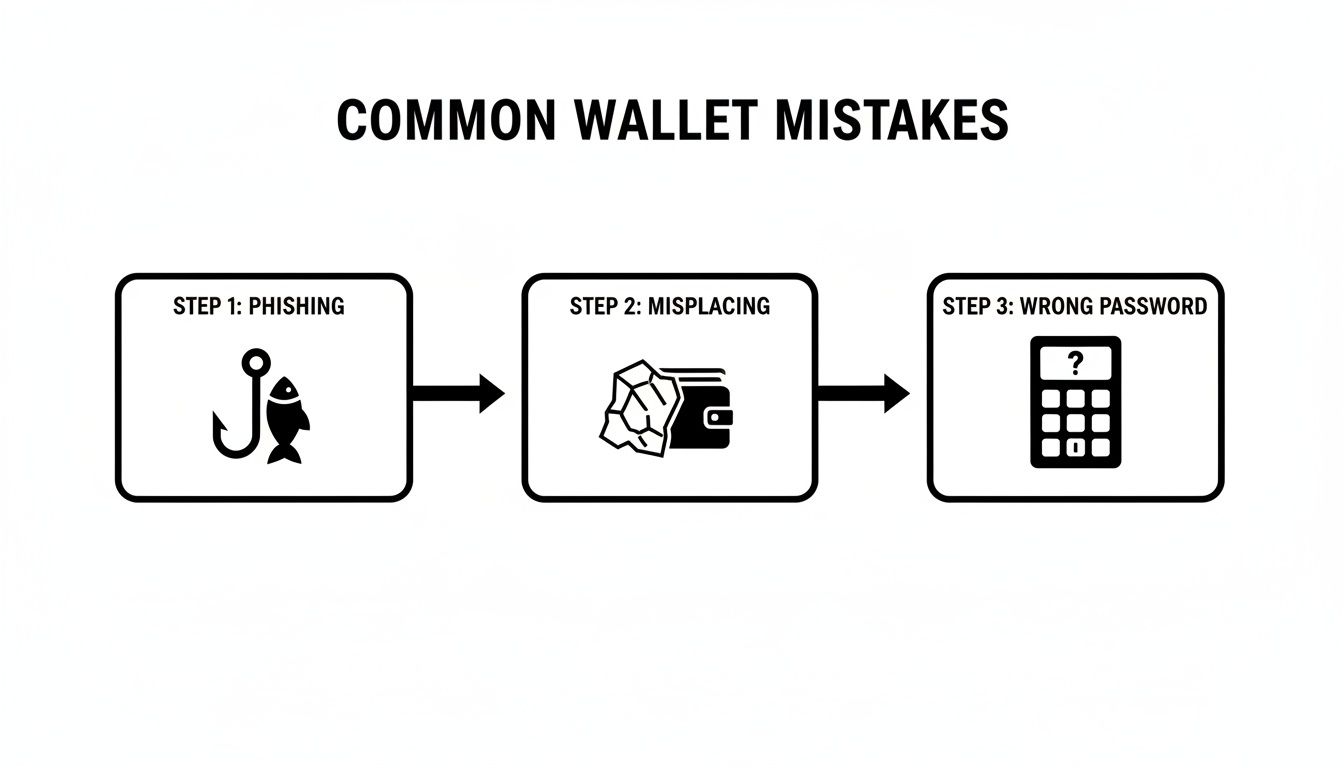
As you can see, it's not always about sophisticated hacks. More often, it's falling for a phishing link, misplacing the paper you wrote the phrase on, or forgetting a password.
The Bottom Line: If you're locked out, your only real hope is finding that original piece of paper. The only other option is turning to a professional service, but only if you have something to work with, like a partial phrase or corrupted digital file.
Could Professional Recovery Services Help?
When you’ve searched everywhere and come up empty, professional recovery services are a potential last resort. They aren't magicians, but they use some seriously powerful software and hardware to piece together clues you might have.
A recovery service might be able to help if you:
- Have most of the words but are missing one or two.
- Wrote down all 12 words but suspect the order is jumbled.
- Think you made a typo in one of the words.
- Saved the phrase in a digital file that's now corrupted.
These specialists use custom software to brute-force millions of potential combinations based on the partial info you give them. As crypto becomes more mainstream—with an estimated 30 percent of Americans expected to own crypto by 2026—these kinds of services are becoming more essential. Major security scares, like the Trust Wallet breach in December 2025, have made people hyper-aware of how critical phrase management is. You can see more data on this trend in the annual consumer report on Security.org.
Just be realistic. Success is never guaranteed, but for some, it’s the only hope left for recovering funds that would otherwise be gone forever.
How AI-Assisted Recovery Services Work
When you’ve hit a brick wall and can’t find your Trust Wallet phrase, professional recovery services can feel like a last resort. But these aren’t hackers using some secret backdoor. They’re data recovery specialists who throw immense computational power and incredibly clever algorithms at the problem to piece together fragmented information.
They work with the clues you give them, turning what feels like a hopeless situation into a calculated, methodical search.
Think of it like being a locksmith for a digital vault. If the master key is broken or you only have a piece of it, a locksmith doesn't just guess randomly. They use specialized tools and their deep knowledge of the lock's mechanics to reconstruct the key. In the same way, AI-assisted services use the fundamental rules of how wallets are created (the BIP39 standard) as their blueprint. This lets them slash the number of possibilities from astronomical down to something manageable.
The Logic Behind Smart Brute-Force and Algorithms
At the core of these services is a technique called brute-force, but it’s a whole lot smarter than just random guessing. A pure, blind brute-force attack on a 12-word phrase is pointless—you’d have better luck counting every atom in the universe. Instead, these services use a guided approach based on whatever scraps of information you can remember.
This is where your memory, no matter how foggy, becomes the most valuable asset you have. Every little piece of information you provide acts like a filter, instantly eliminating trillions of wrong paths and pointing all that computing power in the right direction.
Here's the kind of information that can fuel a successful recovery attempt:
- A Partial Word List: Even if you only have 10 or 11 of the 12 words, algorithms can systematically plug every possible word from the official 2,048-word list into the missing spots.
- A Jumbled Word List: Got all 12 words but have no idea what order they're in? Software can rapidly test the most likely arrangements first.
- Potential Typos: Maybe you wrote down "brief" instead of "grief." The system can check for common keyboard mistakes or words that sound similar.
- A Corrupted Digital File: If you saved your phrase in a file that’s now unreadable, specialists can sometimes pull out fragments of data that give the search a starting point.
The service's software takes these inputs and just churns through millions of combinations a second. With each attempt, it checks to see if the generated wallet address matches your public address. The moment it finds a match, you’ve found your phrase.
Turning Clues into Keys
Let’s say you remember 11 of your words but have no clue what the 7th one was. A recovery algorithm doesn't have to guess from infinity. It only needs to test the 2,048 words from the official BIP39 list in that one empty slot. For a powerful computer, that’s a task that takes just seconds.
The puzzle gets more complex with more missing pieces, but the principle is the same. The more accurate your clues, the better the odds.
A professional recovery service isn’t performing magic; it’s applying mathematics and raw processing power to solve a complex puzzle. The quality of your clues directly determines the chances of finding a solution.
This is why it’s so important to write down every detail you can recall, no matter how small or insignificant it seems.
The Industry and Its Success Rates
The idea of recovering a "lost" crypto key might sound a bit sketchy, but it has grown into a legitimate and crucial part of the crypto world. Success rates are often surprisingly high, usually because people are closer to the answer than they think—a single typo or a couple of swapped words are extremely common culprits.
This field is backed by real, tangible results. The crypto wallet recovery industry is now a significant sector, with firms showing impressive track records. Take Crypto Recovers, a Netherlands-based company, which successfully got clients back into wallets worth over $2.5 million in 2025 alone. Across the industry, success rates can climb above 99 percent in solvable cases, with some services having recovered a global total of more than $7.5 billion since 2020. You can read more about the growth of crypto recovery services on TradingView.com.
Most of these outfits work on a success-based commission, which is a great sign—they only get paid if you get your money back. These figures prove that for anyone with partial information, turning to a professional is a real and often successful option.
To get a better sense of how these operations work day-to-day, you might be interested in our deep dive on a professional wallet recovery service. It's a calculated risk that, for many, pays off big by restoring access to assets they thought were gone for good.
Your Top Trust Wallet Phrase Questions, Answered
Even after you get the hang of your Trust Wallet phrase, some questions always seem to pop up. It's totally normal. Getting straight answers is the key to managing your crypto confidently and avoiding those gut-wrenching mistakes we all hear about.
Let's clear up some of the most common points of confusion once and for all.
Can Trust Wallet Support Recover My Phrase for Me?
The short answer? Absolutely not. And that's actually a good thing.
Think of it this way: Trust Wallet is a non-custodial wallet. That's a fancy way of saying they are intentionally designed to never see, access, or store your 12-word recovery phrase. You, and only you, ever hold that master key. It's what gives you total control over your funds, protecting you from company hacks, sketchy employees, or any other outside interference.
The trade-off for having that much power is that you also have all the responsibility. Since they don't have your key, there's literally no technical way for them to help you get back in if you lose it. Anyone claiming to be from "Trust Wallet Support" who asks for your phrase is a scammer, full stop.
Is My Wallet Password the Same as My Recovery Phrase?
This is easily one of the most dangerous mix-ups in crypto. Your wallet password (or PIN, or Face ID) and your recovery phrase are two completely different things. Confusing them can cost you everything.
Let's break it down:
- Your Wallet Password/PIN: This is just for the app on your phone. It’s like the lock screen—it stops someone who grabs your device from opening the app and messing with your funds. It does not restore your wallet on a new phone.
- Your Recovery Phrase: This is the master key to your actual funds on the blockchain. It can bring your entire wallet back to life on any device, anywhere. It is the ultimate proof that you own your crypto.
Here's an analogy: The password is the key to the front door of your house (the app). The recovery phrase is the deed to the property itself. Losing your door key is an inconvenience. Losing the deed means you no longer own the house.
Can I Change or Update My 12-Word Phrase?
Nope. You can't edit, update, or change the 12-word phrase for a wallet that already exists. That specific sequence of words is cryptographically and permanently bonded to your wallet's private keys. It's a one-time thing.
But what if you think your current Trust Wallet phrase has been compromised, or you just want a fresh start? There’s a safe and straightforward way to handle that.
You just have to move house. Here’s how:
- Create a New Wallet: Open Trust Wallet and generate a completely new, separate wallet. This will give you a brand-new, unique 12-word phrase.
- Secure the New Phrase: Immediately write down and back up this new phrase using the offline methods we've talked about. Double-check it.
- Transfer Your Assets: Carefully send all of your crypto from the old, potentially compromised wallet to the addresses in your new, secure one.
Once the old wallet is empty, you can simply abandon it. This is the only real way to "change" your phrase—by moving your assets to a new wallet that has a different one.
How Can I Tell If a Recovery Service Is Legitimate?
When you’re desperate to get your crypto back, you become a magnet for scammers. While legitimate recovery services do exist, the space is filled with sharks. A bad one won't just fail; they'll steal your funds if they actually succeed in gaining access.
Here are the critical signs of a legitimate, professional recovery service:
- Success-Based Fees: A reputable pro will never ask for money upfront. Their fee should be a percentage of the recovered crypto, paid after you have your funds back. It's a "no win, no fee" model that proves they're on your side.
- Transparent Methods: They should explain their process clearly. They'll talk about using algorithms for brute-forcing, fixing typos, or reordering words you provide—not impossible nonsense like "hacking the blockchain" or using "secret backdoors."
- No Guarantees of Success: Honesty is key. A real expert will tell you recovery is never a sure thing and depends entirely on how much correct information you can provide. Anyone promising a 100% success rate before seeing your case is almost certainly a scammer.
- Focus on Privacy and Security: They should have a clear privacy policy and use secure communication channels. Most importantly, they will never ask you to send them your complete phrase if you happen to find it.
Vetting any service with this checklist will help you dodge the scammers and find a real partner who might actually be able to help.
At Wallet Recovery AI, we offer specialized, AI-assisted recovery services that put security and transparency first. If you have a partial phrase, a jumbled list of words, or a corrupted file, our team can safely assess your situation and walk you through your options. Learn more at https://walletrecovery.ai.
Leave a Reply