

When you're trying to figure out if Coinbase is right for you, it really boils down to one simple trade-off: you get incredible ease-of-use, but you pay a premium for it. The decision comes down to what you value more—convenience or low costs.
Is Coinbase a Good Choice for Crypto Investors in 2026?

There's no denying it: Coinbase has become the default on-ramp for millions of people dipping their toes into crypto. Its slick design and dead-simple verification make it the first, and often only, exchange many people ever use. That's a powerful position built on trust and an experience that strips away most of the scary technical stuff.
But here’s the catch for anyone getting serious about investing. The main Coinbase platform—the one everyone starts on—charges some pretty high fees for basic buys and sells. While their Coinbase Advanced platform has much more competitive rates, most newcomers never click over to it, leaving them stuck paying for simplicity.
The real question isn't just whether Coinbase is good, but whether it's the right fit for your needs. What works as a perfect first step for a beginner can quickly become an expensive habit for an active trader.
To make the right call, you have to look past the shiny interface. You need to weigh its strengths, like a huge list of supported coins, great liquidity, and top-notch security, against the reality of its retail pricing and the risks that come with any custodial exchange.
To give you a quick summary before we get into the details, here’s a high-level look at where Coinbase shines and where it falls short.
Coinbase at a Glance Pros vs Cons
This table breaks down the key advantages and disadvantages of using the platform.
| Area of Comparison | The Advantage (Pro) | The Disadvantage (Con) |
|---|---|---|
| User Experience | Exceptionally easy to use, ideal for beginners buying their first crypto. | Higher fees on the simple interface penalize users for convenience. |
| Security | Industry-leading security, with most assets held in offline cold storage. | As a custodial platform, you don't control your private keys ("not your keys, not your crypto"). |
| Available Assets | Supports a massive and growing list of cryptocurrencies and staking options. | Regulatory pressures could impact the availability of certain assets or services in the future. |
| Trading & Liquidity | Excellent liquidity ensures trades execute reliably at expected prices. | Business model is heavily reliant on trading volume, making it vulnerable to market volatility. |
Ultimately, this overview shows that Coinbase is a platform of trade-offs, and understanding them is the first step toward making an informed decision.
The Biggest Pro: It Just Works

Let's be direct: Coinbase's greatest strength is its sheer simplicity. For millions of people, it’s the on-ramp to crypto. They’ve done an incredible job of stripping away the technical jargon and clunky interfaces that make newcomers nervous. Buying your first Bitcoin feels less like navigating a complex financial market and more like using any other modern app.
That focus on a dead-simple user experience is why they've grown so massive. With that scale comes huge liquidity, which means your trades go through instantly at the price you see. When you weigh the pros and cons of Coinbase, that reliability is a massive plus, especially when markets get wild and smaller exchanges can freeze up.
More Than Just an Exchange
Coinbase isn't just a place to buy and sell. It has evolved into a full-fledged platform with a deep list of supported cryptocurrencies and built-in features like staking. You can earn rewards on your crypto right inside your account, making it a convenient, all-in-one hub for trading, earning, and cashing out to your bank.
The numbers speak for themselves. In 2025, Coinbase processed a staggering $5.2 trillion in trading volume, marking a 156% jump from the previous year and capturing 6.4% of the global crypto market. With roughly $300 billion in assets under its protection—including over 12% of all Bitcoin in circulation—it has become a pillar of the industry. You can dig into these stats and Coinbase's commodity balance on ainvest.com.
At its heart, the main pro of Coinbase is that it's a trusted place to start. It gives you a secure, insured sandbox to get your feet wet before you decide to take the plunge into self-custody.
But that’s where the hidden risk comes in. The same simplicity that makes Coinbase so attractive can give you a false sense of confidence. A user might feel ready to take the next step, withdrawing their funds to a personal wallet like MetaMask or a Ledger device, only to forget a password or lose their seed phrase.
This is the flip side of Coinbase's accessibility. It gets you in the door, but the path to true ownership requires more know-how. Once you make a mistake with a self-custody wallet, you're on your own. In a situation like that, a professional service like Wallet Recovery AI becomes your only real option for getting your funds back without giving up your privacy.
The Catch: High Fees and Market Volatility
Coinbase is incredibly easy to use, but that simplicity comes with a price tag—one that’s often much higher than you'd expect. For anyone new to crypto, the fees on the standard app can be a real shock, chipping away at your investment before it even has a chance to grow.
Think of it as a "convenience tax." You're paying a premium for that clean, one-click experience. When you're just starting out and making smaller buys, those fees can take a surprisingly big bite out of your total. It's one of the most common complaints you'll hear about the platform.
The Two-Tier Fee System You Need to Know About
Here's something a lot of users miss: those high fees aren't your only option. Coinbase actually has a second, more powerful platform called Coinbase Advanced. It uses a maker-taker fee model that's drastically cheaper, but many people either don't know it exists or get intimidated by its professional-looking trading interface.
This effectively splits the user base in two:
- Simple Interface: You get high, fixed fees that are easy to understand but very expensive over the long run.
- Advanced Trade: You get much lower, volume-based fees perfect for anyone who trades regularly or just wants to keep more of their money.
The biggest mistake casual investors make on Coinbase is paying for simplicity when a cheaper alternative is just a click away. Learning to use the Advanced platform for all your trades is the single best way to cut your costs.
The Problem with Market Swings
The other major drawback is how Coinbase’s entire business rides the crypto rollercoaster. Its income is tied directly to how much people are trading. When the market is hot, trading volume explodes and Coinbase thrives. When things cool down, that volume disappears.
This isn't just a problem for the company; it affects you, too. During bear markets, a lot of the retail excitement dries up. We saw this play out when Coinbase's retail trading volume plummeted from a high of $177 billion in Q4 2021 to just $43 billion in Q2 2025. You can dig into more of this data on Coinbase's user trends on Backlinko. This reliance on market hype creates a shaky foundation.
This creates a stressful cycle. When the market tanks, people panic. It's often in these moments that users rush to move their funds into a self-custody wallet like a MetaMask or Trezor for safety. But under pressure, it's all too easy to make a mistake—forgetting a password, losing a recovery phrase, or misplacing a file.
And that’s the real risk of self-custody. Once you're in control, the exchange can't help you. If you find yourself locked out by a lost password or a corrupted keystore file, your funds are stuck. That's when a confidential service like Wallet Recovery AI becomes essential, offering a way to regain access without ever having to rely on an exchange.
Evaluating Coinbase Security and Self-Custody Risks

If there’s one thing Coinbase is known for, it’s security. For anyone wary of crypto’s “wild west” reputation, the platform’s security-first approach is a huge selling point. It provides a safety net that has made it one of the most trusted names in the business.
A big part of that trust comes from how they store your assets. Coinbase keeps a huge portion—reportedly 98% or more—of all customer funds in cold storage. This simply means the crypto is held on devices completely disconnected from the internet, making it safe from the kind of online hacks that have brought down other exchanges.
They also enforce mandatory two-factor authentication (2FA) on all accounts and carry an insurance policy to cover the small percentage of funds held in online "hot wallets." It's a robust system. But all that security comes with a fundamental trade-off.
The Problem of "Not Your Keys, Not Your Crypto"
The biggest drawback of using any custodial platform, including Coinbase, is simple: you don't actually control your crypto. You're trusting Coinbase to hold it for you, much like a bank holds your cash. And while they have a great security track record, that trust introduces a risk that doesn't exist with self-custody.
This gets to the heart of the old crypto saying: "not your keys, not your crypto." When your funds are on an exchange, you don't hold the private keys. What you have is an IOU from Coinbase, a promise that they'll give you your crypto when you ask for it.
The most significant risk here is the potential for an account freeze. For any number of regulatory or security reasons, Coinbase can—and does—lock user accounts, sometimes without warning. You could wake up one day and find yourself unable to access your money.
This reality is what pushes many people toward self-custody wallets like a Ledger hardware device or a browser wallet like MetaMask. The problem is, this is where many people get into serious trouble. Moving assets off an exchange for the first time is nerve-wracking, and it’s easy to make a disastrous mistake like saving your seed phrase as a screenshot on your phone.
Once you take control of your own keys, the responsibility for securing your assets is 100% on you. There’s no customer support line to call if you lose your seed phrase or forget your password. For those trying to understand the security differences, you can learn more about how blockchain ownership works versus using a platform like Coinbase.
In these difficult situations, where a password is lost or a wallet file gets corrupted, professional recovery services are often the only path left to get your funds back.
Choosing the Right Coinbase Strategy for You
The real question isn't whether Coinbase is "good" or "bad," but how to use it as a tool for your specific needs. A strategy that makes sense for a first-time buyer would be a disaster for a frequent trader, and someone planning to hold for years has an entirely different set of priorities.
Most people get their start on the main Coinbase app, and that’s perfectly fine. Its simplicity is a huge plus, giving you a straightforward way to buy your first crypto without getting lost in a sea of charts and order books. Think of it as paying a small premium for a beginner-friendly experience—a worthwhile trade-off to get started safely.
For the Active Trader
Once you start buying and selling more often, your approach needs to change. If you're making frequent trades on the simple Coinbase app, you're just throwing money away on fees. The only logical next step is to move all your trading activity over to Coinbase Advanced.
While the interface looks a bit more intimidating at first, the fee structure is drastically lower. This means more of your capital stays in your pocket with every single trade.
For anyone trading regularly, moving to Coinbase Advanced isn't optional—it's essential. The high fees on the basic platform will eat into your profits and become a serious drag on your portfolio over time.
This isn't just a small optimization; it's a critical shift for any cost-conscious investor. The savings are real and will have a direct impact on your performance.
For the Long-Term Holder
If your plan is to buy crypto and hold it for months or years, you should treat Coinbase as an entry point, not a final destination. Its platform is one of the most reliable on-ramps for converting your dollars into assets like Bitcoin or Ethereum. The process is secure, and you can trust that your transaction will go through smoothly.
However, what you do after the purchase is crucial. The best strategy by far is to withdraw your assets to a non-custodial hardware wallet you control, like a Ledger or Trezor. This simple action moves the private keys—and therefore, the actual ownership of your crypto—from Coinbase to you.
This hybrid approach gives you the best of both worlds:
- Easy On-Ramp: You use Coinbase for what it does best—turning fiat currency into crypto assets in a secure and regulated environment.
- Ultimate Security: You then take self-custody of your assets, protecting them from any exchange-level risks like hacks, account freezes, or company failure.
Following this strategy lets you benefit from Coinbase's strengths while completely avoiding its single greatest weakness: you don't truly own your crypto until you control your own keys.
Moving Your Crypto to a Self-Custody Wallet
After weighing the pros and cons of Coinbase, you might decide that the ultimate security comes from holding your own keys. This means moving your funds to a self-custody wallet, where you aren't just a user with an IOU—you are the true owner of your assets. Taking this step gives you complete control, but it also makes you completely responsible for your own security.
The first move is to set up a non-custodial wallet. This could be a hardware wallet from a company like Ledger or Trezor, or a software wallet such as MetaMask. During the setup, you'll be given a seed phrase, sometimes called a recovery phrase, which is typically a list of 12 or 24 words. This phrase is the master key to everything in your wallet.
The Critical Rule of Self-Custody
Your number one job is to protect that seed phrase. Write it down—on paper or etched into metal—and store it in multiple secure, offline locations.
Under no circumstances should you ever:
- Take a screenshot of it.
- Save it in a text file on your computer.
- Store it in a password manager or cloud drive.
- Share it with anyone, even if they claim to be from support.
If you lose your seed phrase, you lose your crypto. It's a harsh reality and a common mistake that leads to permanent losses, underscoring the biggest risk of self-custody compared to leaving your assets on Coinbase.
This is a common path for many users. You start by simply buying on an app, then maybe move into trading, and finally, you become a long-term holder looking to secure your assets for good.
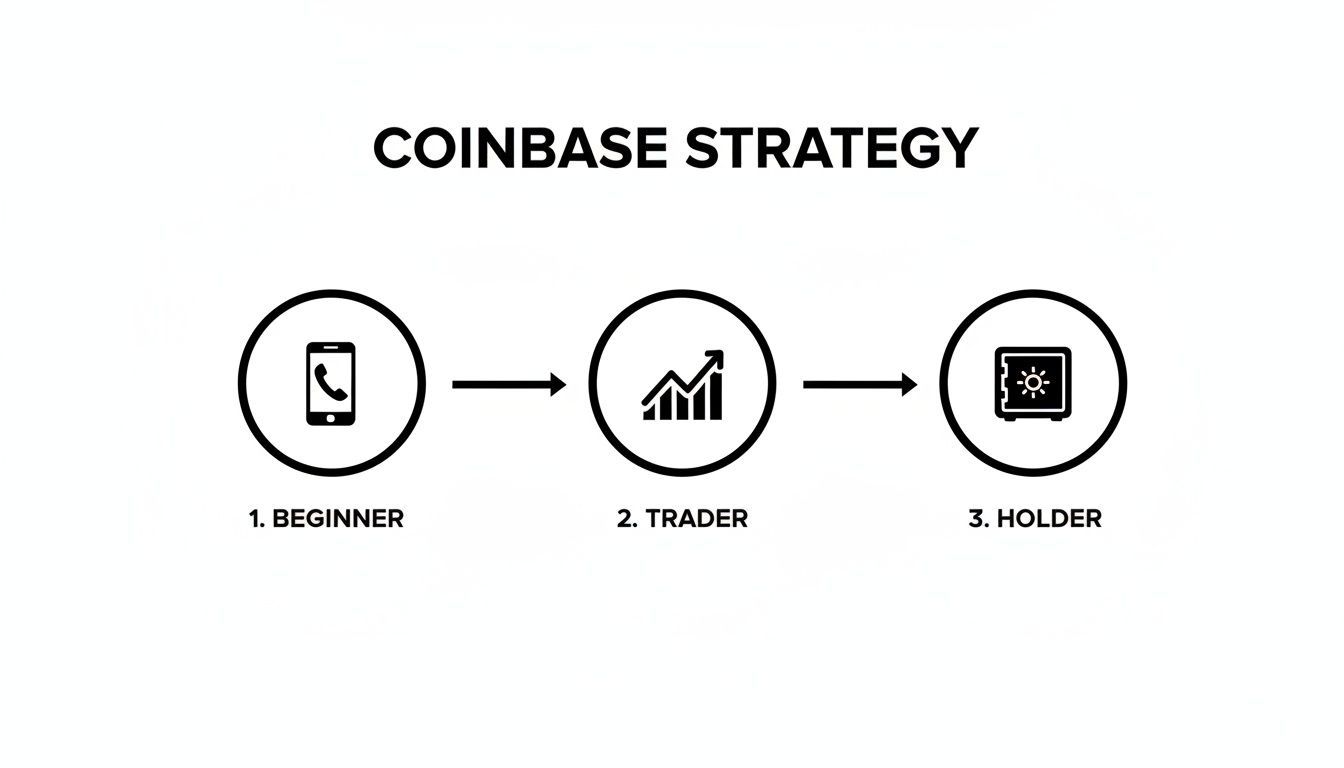
For a step-by-step walkthrough of the withdrawal process, you can read our guide on how to safely transfer crypto to a wallet.
When Self-Custody Goes Wrong
But what happens if you do everything right and still lose access? Maybe you forgot a wallet password, lost a hardware device, or are dealing with a corrupted file. In these cases, your seed phrase is your primary line of defense.
But what if you lose both your password and your seed phrase? Or if you're facing a complex problem like a corrupted keystore file? Your situation becomes critical. Standard recovery options won't work, and your funds will be locked away.
This is the point where you need specialized help. When you have truly exhausted every other option, a professional service like ours can be your last resort. We use advanced, offline techniques to regain access in complex situations without ever compromising your privacy, providing a responsible path back to your funds.
Frequently Asked Questions About Coinbase
After digging into the pros and cons of Coinbase, a few key questions always seem to pop up. Let's tackle them head-on to clear up any confusion and make sure you're managing your assets safely.
Is It Safe to Leave a Lot of Money on Coinbase?
This is a question I hear all the time. While Coinbase has a top-tier security reputation, the rule of thumb in crypto is simple: not your keys, not your coins.
Think of an exchange like a convenient checking account for trading and quick access. It's perfect for that. But for your long-term savings—your serious holdings—you want a vault. Self-custody is that vault. Moving your assets to a personal hardware wallet you control completely removes risks like account freezes or a catastrophic exchange-level failure.
What Is the Difference Between Coinbase and Coinbase Wallet?
It's easy to mix these two up, but they serve fundamentally different purposes based on who actually holds your crypto.
- Coinbase Exchange: This is the main platform for buying and selling. It's a custodial service, which means Coinbase holds the private keys to your assets for you.
- Coinbase Wallet: This is a separate, non-custodial app and browser extension. With the Wallet, you hold the private keys. This gives you full, direct ownership of your funds.
The exchange is like a bank account, while the Wallet is your own personal safe.
The core takeaway is this: on the Coinbase exchange, you are trusting them with your assets. With Coinbase Wallet, you are trusting yourself. Understanding this distinction is fundamental to navigating the crypto world safely.
I Lost Access to My Personal Wallet—What Can I Do?
Losing a password or seed phrase for a personal wallet is incredibly stressful. The first thing to do is exhaust all the obvious recovery options. Double-check any notes where you might have written down your seed phrase, try every password variation you can think of, and search your devices for any wallet backup files you might have saved.
Sometimes, though, that’s not enough. If you've truly hit a wall—maybe you're dealing with a forgotten password on an encrypted wallet or a corrupted file—your standard options run out. This is the point where a specialized service becomes the next logical step.
When you've exhausted every option, Wallet Recovery AI offers a confidential and secure path forward. Our advanced, AI-enhanced techniques are designed to recover assets from a huge range of wallets without ever compromising your privacy or data. If you've lost access to your crypto, learn how we can help restore it.
Leave a Reply