Losing access to your crypto wallet is a gut-wrenching experience. We've been there. The first instinct is often panic, but that's the last thing you should do. Rushing into the wrong recovery method can permanently lock you out, turning a solvable problem into a total loss.
This guide is your emergency checklist. It's designed to walk you back from the edge, helping you diagnose the problem calmly and methodically before you touch anything.
What To Do When You Lose Access to Your Crypto
That sinking feeling when you realize your wallet is inaccessible is something no crypto holder wants to experience. But before you start frantically trying old passwords or restoring from a half-remembered seed phrase, stop. Take a breath.
The single most critical phase of any recovery attempt is the initial diagnosis. Getting this wrong can be catastrophic. For instance, entering an incorrect seed phrase too many times on a hardware wallet like a Ledger or Trezor can trigger a security wipe, erasing the very keys you're trying to recover.
The goal right now is simple: secure your environment and gather every scrap of information you can find.
Diagnose Your Specific Situation
First things first, you need to play detective. What exactly is the problem? The answer determines your entire recovery strategy. Take a few minutes to think through what happened and jot down everything you remember, no matter how trivial it seems.
Most access issues fall into one of these buckets:
- Forgotten Password: You have your wallet file or software, but the password to unlock it is gone from your memory.
- Misplaced Seed Phrase: You've lost that crucial 12 or 24-word recovery phrase you wrote down when you set up the wallet.
- Corrupted Wallet File: Your software wallet, like a classic
wallet.datfile, is giving you errors and won't load, likely due to a hard drive glitch or a bad shutdown. - Hardware Wallet Failure: Your physical device is lost, stolen, broken, or simply won't turn on.
This is the point where you need to be honest with yourself about what you have and what you've lost.
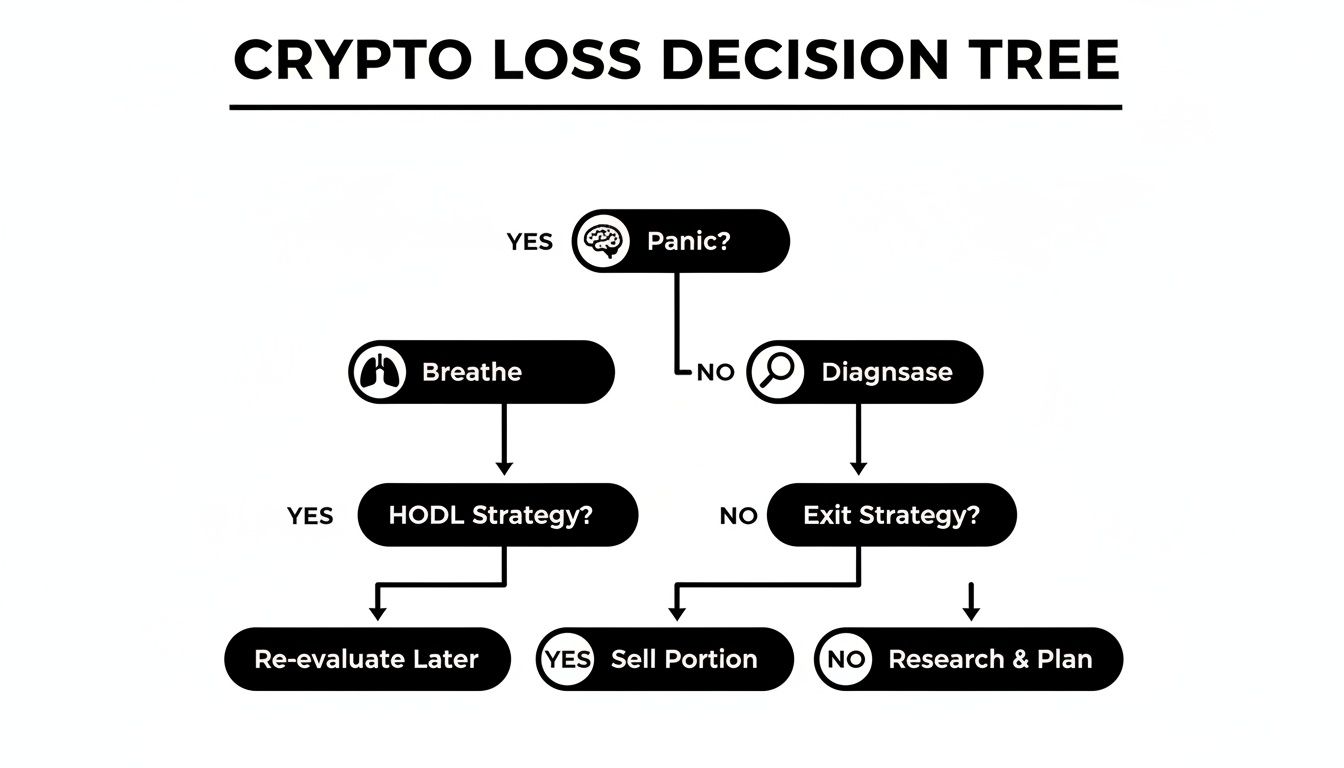
As the flowchart shows, the path forward starts with controlling the panic and moving into a logical, diagnostic process.
To help you pinpoint the issue, we've put together a quick checklist. Use this table to match your symptoms to the most likely cause and get a sense of what you're up against.
Initial Crypto Loss Diagnosis Checklist
| Symptom / Problem | Potential Cause | Primary Recovery Method | Urgency Level |
|---|---|---|---|
| Software prompts for a password you don't remember. | Forgotten Password | Brute-force/dictionary attack on the wallet file. | Medium |
| Can't find the paper/file with your 12/24 words. | Lost Seed Phrase | Finding the original seed phrase is the only option. | High |
| Wallet software shows an error like "corrupted data." | File Corruption | Restoring from a backup or using file repair tools. | High |
| Hardware wallet is physically damaged or lost. | Device Failure/Loss | Restoring on a new device using your seed phrase. | Critical |
| You remember the password but not the "25th word." | Forgotten Passphrase | This requires brute-forcing the passphrase itself. | High |
| Funds are visible but can't be sent. | Software Bug / Sync Issue | Re-syncing the blockchain or trying a different wallet software. | Low |
This table isn't exhaustive, but it covers the most common scenarios we see. Identifying your specific situation is the first major step toward a successful recovery.
Create a Recovery Dossier
Now that you have a clearer idea of the problem, it's time to build your "recovery dossier." This is just a fancy name for a dedicated file—stored securely offline—where you'll collect every single detail related to your lost wallet. Don't trust your memory. Write it all down.
Your dossier should include things like:
- Wallet Information: The exact name of the wallet (e.g., MetaMask, Ledger Nano S, Electrum).
- Password Clues: Any partial passwords, old passwords you've used elsewhere, common patterns, names of pets, important dates—anything you might have used.
- File Locations: The full path to any wallet files, like
wallet.dator UTC/JSON keystore files. Check old computers, USB drives, and cloud backups. - Device History: The approximate purchase date of your hardware wallet and any PINs you might have set.
The little details you gather now are the raw materials for a successful recovery. We've seen cases where a single forgotten detail, like a childhood street name used in a password pattern, was the key that unlocked hundreds of thousands of dollars. Be thorough here. It dramatically increases your chances.
Recovering Your Wallet on Your Own
Before you throw in the towel and call in the pros, you should know that many seemingly hopeless situations are salvageable. I’ve seen countless cases where a bit of methodical, patient work was all it took to get the funds back.
The last thing you want to do is rush and make things worse. So, let's take a deep breath and walk through the most effective strategies you can try yourself, from the basics to some more advanced software tricks. This is where you take back control.
The Seed Phrase Is Your Master Key
Your seed phrase is, without a doubt, the single most powerful tool you have. Whether you call it a recovery phrase or a mnemonic, this list of 12 to 24 words is the ultimate master key to your wallet.
Got the phrase? You’re in a great position. You can restore your entire wallet on a completely new device, even if your original computer or hardware wallet is long gone.
The process is usually straightforward. You’ll install the wallet software on a fresh, secure machine and look for an option like "Restore," "Recover," or "Import from Seed Phrase." From there, it’s just a matter of typing in your words in the correct order.
But be warned: precision is everything here.
- Correct Spelling: One typo can throw the whole thing off. Double-check every word.
- Correct Order: The sequence is just as critical as the words themselves.
- No Extra Spaces: Make sure you aren't accidentally adding spaces before or after a word.
If you're confident you have the right phrase but it's still not working, don't give up just yet. There are common pitfalls and troubleshooting steps to try. For a deeper dive, check out our guide on how to correctly use a crypto recovery phrase.
Locating Essential Wallet Files
Okay, so maybe the seed phrase is a no-go, but you still have the computer where the wallet was installed. Your next mission is to find the core wallet file. This is the digital equivalent of finding a locked safe—you still need the password, but at least you have the box.
For many older clients like Bitcoin Core, you're looking for a file named wallet.dat. For Ethereum wallets, it's often a UTC/JSON keystore file.
Fire up your computer's search function and start digging. Be sure to include hidden folders and any old backup drives you might have used.
Common hiding spots include:
%APPDATA%on a Windows machine~/Library/Application Support/on a Mac~/.bitcoin/or similar hidden directories on Linux
Once you find that file, stop. The very first thing you do is copy it to a secure, offline device like a USB stick. From this point on, you only work with the copy, never the original.
Jogging Your Memory for Passwords
Forgetting a password is one of the most common reasons people get locked out. Before you even think about brute-force software, spend some quality time trying to remember it yourself. We're creatures of habit, and most of us reuse patterns, themes, or core "base" words.
Start by creating a personalized wordlist. This isn't just random guessing; it's about reverse-engineering your own brain.
A common mistake is to only think about complex passwords. I once worked with someone who recovered a seven-figure wallet because they remembered a simple, lowercase password they set "temporarily" years ago and never changed. Consider every possibility, simple and complex.
Grab a pen and paper (or a text file) and brainstorm everything you can think of:
- Names of pets, kids, partners, or even fictional characters.
- Important dates like birthdays and anniversaries.
- Common substitutions you use, like turning an
ainto@or ansinto$. - Old passwords from other services that you might have tweaked slightly.
This manual process can be surprisingly effective. Your goal is to build a high-quality list of your own unique password habits.
Using Brute-Force Recovery Tools Safely
If you’ve exhausted your memory, it's time to let a computer do the heavy lifting. Specialized tools like BTCREcover or Hashcat can test millions of password combinations against your encrypted wallet file.
These programs aren't magic, though. Their success hinges entirely on the quality of the wordlist you feed them. That list you just brainstormed? That's the fuel.
Crucial Security Warning: You must run these tools on a computer that is 100% offline. Never, ever upload your wallet.dat or keystore file to an online recovery service. The vast majority are scams designed to steal your files and your crypto.
Here's how to do it safely:
- Prep a Secure Machine: Find a computer you can completely disconnect from the internet.
- Transfer Files: Use a clean USB drive to copy your encrypted wallet file and the recovery software to the offline machine.
- Run the Software: Point the tool to your wallet file and feed it your custom password list.
- Wait: This is a marathon, not a sprint. Depending on the password's complexity and your computer's horsepower, it could take hours, days, or even weeks.
This method gives you a powerful combination of human intuition and raw computing power. For a password-locked wallet, it’s one of your best shots at DIY recovery.
Getting Your Crypto Back: A Wallet-by-Wallet Guide
Knowing the general playbook for crypto recovery is a great start, but the real game begins when you apply it to your specific wallet. Every wallet—from a browser extension to a cold storage device—has its own quirks, file structures, and restoration flow. What works for MetaMask won't get you very far with a Ledger device.
Let's break down the practical, wallet-specific steps you need to take. We'll cover the most common software, hardware, and desktop wallets, focusing on the exact actions that will get you back in control.
Unlocking Your MetaMask Wallet
MetaMask is the go-to browser wallet for millions, but its non-custodial design puts the recovery burden squarely on your shoulders. If you're locked out, your Secret Recovery Phrase (SRP) is your only way back in. There’s no "Forgot Password" button here.
You’ve probably seen their homepage—it’s all about user control and self-custody. That philosophy is precisely why your recovery phrase is non-negotiable.
If you have your 12-word SRP written down, the fix is refreshingly simple:
- Fresh Install: Get the MetaMask extension on a clean, trusted browser.
- Import, Don't Create: During setup, you’ll see an option to "Import an existing wallet." That's the one you want.
- Enter the Phrase: Carefully type in your 12-word Secret Recovery Phrase, in the right order. Double-check for spelling mistakes or extra spaces.
- Set a New Password: Once MetaMask confirms the phrase, it will let you create a brand new password for accessing the extension.
Pro Tip: What if you can still get into your wallet but realize you've misplaced your SRP? You're in luck. Head to Settings > Security & Privacy > Reveal Secret Recovery Phrase. Write it down immediately and store it somewhere safe and offline. This is your one shot to back it up properly.
Restoring a Ledger or Trezor Hardware Wallet
Hardware wallets are the gold standard for security because they keep your private keys completely offline. So, what happens if your device gets lost, stolen, or smashed? Relax. Your crypto isn't on the device; it's on the blockchain. The Ledger or Trezor is just the key.
As long as you have that precious 24-word recovery seed phrase, you can bring your entire portfolio back on a brand new device.
For a Ledger Device:
- Get yourself a new Ledger.
- Power it on and choose the "Restore from Recovery Phrase" option during the setup process.
- The device will guide you through entering each of the 24 words, one by one, using its physical buttons.
- Once you’ve entered the last word correctly, your original private keys are restored. Connect to the Ledger Live app, and you'll see your funds right where you left them.
For a Trezor Device:
- The steps are almost identical. On your new Trezor, select the "Recover Wallet" option.
- You'll be asked to enter your 12, 18, or 24-word recovery seed.
- Depending on the model, you might type the words on your computer (the order will be cleverly scrambled for security) or directly on the Trezor's touchscreen.
By far, the most common roadblock here is a simple transcription error. If your seed phrase is rejected, go back to your backup and painstakingly check for common mix-ups like "woman" vs. "women" or "wait" vs. "weight."
Finding and Using Your Electrum Backups
Electrum is a veteran Bitcoin desktop wallet, and it works a little differently. It creates a dedicated wallet file on your computer, separate from the main software, which holds your encrypted private keys.
If you still have this file but have forgotten the password, you can try the brute-force methods we discussed earlier. But first, you have to find that file.
Check these default hiding spots:
- Windows:
UsersYourUsernameAppDataRoamingElectrumwallets - Mac:
~/.electrum/wallets - Linux:
~/.electrum/wallets
Of course, if you have your seed phrase, life is much easier. Just like with MetaMask, you can install Electrum on a new machine, select the restore option, and enter your phrase to get everything back.
One unique thing to watch out for with Electrum is its "watching-only" wallet feature. It lets you see your balance without having the private keys on that device. When you're recovering, make absolutely sure you're restoring a full wallet, not accidentally creating a watch-only version that can't spend funds.
What About Exodus and Other Multi-Asset Wallets?
Exodus is a hugely popular desktop and mobile wallet thanks to its beautiful and intuitive design. Like most software wallets, its main recovery tool is a 12-word secret recovery phrase. The process is the same as MetaMask: install Exodus on a new device and use the phrase to import your wallet.
But Exodus has a secondary backup option you might have set up: an email link.
- During setup, you have the choice to create an email backup.
- This sends a special link to your inbox that, when combined with your password, can restore your wallet.
A critical warning: this is not a substitute for your recovery phrase. The email backup is completely useless if you've also forgotten your password. Your 12-word phrase is the master key that works with or without the original password.
No matter which wallet you're using, the fundamental rule is the same. Your seed phrase is the ultimate key to your kingdom. Guarding it is the single most important thing you can do to protect your assets and guarantee you can get them back if things go sideways.
Deciding When to Call in a Professional Recovery Service

You’ve tried everything. The brute-force tools have been chugging away for weeks, and that corrupted wallet file just isn't budging. This is the moment you have to be honest with yourself and ask: is it time to call in an expert for crypto currency recovery?
It’s a big step to even consider handing over sensitive information, but for some really tough cases, it’s the only realistic path forward. Professional services have specialized hardware, proprietary software, and years of hard-won experience that you simply can’t replicate on a home computer.
When to Make the Call
Knowing your limits is a strength, not a weakness. If any of the following situations sound familiar, it's a strong sign that you need professional help.
- Really Complex Passwords: Your password isn't just forgotten—it's a long, complicated beast with special characters, or maybe it’s a multi-word passphrase you can't quite piece together. Cracking these requires a level of computational power your gaming rig just doesn't have.
- Severe File Corruption: Your
wallet.dator keystore file is a garbled mess. The standard repair tools keep failing, and you need someone who can perform low-level data reconstruction to piece it back together. - Multi-Layered Encryption: You’re wrestling with a wallet that has more than one lock. Think of a hardware wallet with a "25th word" passphrase that's vanished from your memory on top of the regular PIN.
In these situations, continuing to tinker can do more harm than good. Repeatedly trying the wrong methods can sometimes overwrite critical data fragments—the very clues a professional could have used to get your funds back.
Vetting a Crypto Currency Recovery Service
The crypto world is full of sharks, and the recovery niche is a prime hunting ground. A legitimate service will be transparent, professional, and will never ask for payment before they've actually recovered your funds. Your ability to tell an expert from a scammer is everything.
As you look at different services, keep an eye out for these massive red flags:
- Upfront Fees: This is the big one. A genuine service works on a success-fee basis, meaning they only get paid after you get your crypto back, usually by taking a percentage. Anyone demanding cash before the job is done is almost certainly a scammer.
- Guaranteed Success: No recovery is ever 100% guaranteed. An honest pro will give you a realistic assessment of your chances, but they'll never make an absolute promise they can't keep.
- Vague Processes: A trustworthy company should be able to clearly explain their security protocols, how your data is handled, and the general steps they'll take—all without giving away their secret sauce.
On the flip side, positive signs include a solid, verifiable track record, clear communication, and a professional online presence. When you're ready to dig deeper, you might find our guide on what to look for in a wallet recovery service helpful. It gives you a detailed checklist for making a safe and informed choice.
Understanding the Process and Costs
So, what happens when you reach out to a professional? It usually starts with a no-obligation consultation. You’ll provide all the details from your "recovery dossier," and they'll analyze your case to figure out the odds of success.
If they believe they can help, they’ll send over a formal agreement. This document should spell out the success fee, which is almost always a percentage of the recovered crypto. This fee can range from 10% to 20%, depending on how complex the job is and how much is at stake.
The timeline can vary wildly. A straightforward password crack on a powerful system might only take a few days. A complex file corruption case, however, could take weeks or even longer. A good service will give you a realistic timeframe and keep you in the loop.
This whole field has gotten incredibly specialized. For instance, in just the first half of 2025, over $2.17 billion was stolen from cryptocurrency services. That huge number has forced a massive response from private recovery firms and law enforcement to reclaim lost and stolen assets. You can read more about how crypto recovery efforts are scaling with crypto crime on chainalysis.com. It just goes to show how sophisticated this work has become, making professional help more effective than ever before.
How New Crypto Trends Affect Asset Recovery
The world of crypto recovery doesn't stand still. Far from it. It moves and changes right along with the market, and new trends are constantly creating both new problems and new opportunities for getting assets back. If you want to pick the right recovery strategy, you need to understand what’s happening on the ground.
Right now, two major trends are changing the game: the massive growth of stablecoins and the wild, decentralized nature of DeFi. Each one creates a completely different set of circumstances that can either be a huge help or a major roadblock.
The Rise of Stablecoins and Centralized Choke Points
Stablecoins like USDT and USDC have become so dominant that they’ve actually changed how stolen funds are traced. While we all think of crypto as anonymous, the truth is that stablecoins almost always flow through centralized exchanges—and those exchanges have strict KYC (Know Your Customer) and AML (Anti-Money Laundering) rules. This creates a paper trail.
Think about it: by mid-2025, stablecoins made up around 30% of all on-chain transaction volume. Between January and July of that year alone, they saw over $4 trillion in volume. Because these assets are so deeply connected to regulated platforms, they give law enforcement and blockchain analytics firms critical choke points to freeze and recover funds. You can dig deeper into this in the 2025 Crypto Adoption and Stablecoin Usage Report from TRM Labs.
DeFi and Cross-Chain Bridge Complications
Then you have the other side of the coin: Decentralized Finance (DeFi) protocols and cross-chain bridges. These are built to operate without any central authority, which is fantastic for user freedom but a nightmare for asset recovery.
When your funds get laundered through a DeFi protocol or jumped across a bridge to another blockchain, there’s often no company you can serve with a subpoena. There’s no one to call to freeze the account. This decentralization gives sophisticated thieves a massive advantage.
The reality is, once funds hit the DeFi ecosystem, the window for recovery can slam shut. Speed is everything. Tracing assets across multiple chains and protocols requires specialized tools and expertise that most individuals just don't have.
In the end, what you lost and where it went matters immensely. A theft involving stablecoins that were sent to a major exchange is a completely different—and often much more hopeful—situation than funds lost in a complex DeFi exploit. Knowing this helps you set realistic expectations and chase down the most promising path to get your crypto back.
How Regulation Is Changing Crypto Recovery
The Wild West days of crypto are long gone. As governments and major financial institutions get more involved, a complex web of global regulations is taking shape, and it has a direct impact on how we recover lost or stolen crypto.
This isn't necessarily a bad thing. In many ways, it's a huge step forward.
Think about it: increased regulatory pressure means big exchanges can't just shrug their shoulders when something goes wrong. They're now required to have solid security measures and clear procedures for handling incidents. If a centralized exchange gets hit, there’s often a mandated process for them to investigate and, in some cases, help users get their funds back. That's a world away from the early days when you were completely on your own.
Navigating the Global Maze
But here's the catch—crypto is global, and the rules are anything but. This creates a messy, frustrating puzzle when you're trying to trace funds across borders. A recovery method that works perfectly in one country might be a total dead-end in another.
This inconsistency can bring an investigation to a screeching halt. Groups like the Financial Stability Board (FSB) have pointed out massive gaps in how different countries handle crypto. The jurisdictions with strong Know Your Customer (KYC) and Anti-Money Laundering (AML) laws are far better equipped to freeze and return stolen assets. You can dig deeper into these findings on the IMF's official site.
What does this mean for you? Simple: the success of a recovery often boils down to where the stolen funds end up. If they land in a country with strict rules and cooperative authorities, your chances of getting them back are significantly higher.
Understanding this is key. It helps set realistic expectations and shows why working with law enforcement or professional services who know international law can be so critical. The legal landscape isn't just background noise anymore—it's an active player in the recovery game.
Common Crypto Recovery Questions
When you're staring down the barrel of a locked wallet, a million questions probably race through your mind. It's a stressful spot to be in, so let's cut through the noise and tackle some of the most common concerns we hear every day.
Is It Really Possible to Recover a Lost Bitcoin Password?
Yes, but it's not a simple process. Your chances are best if you have a backup of your wallet file (like a wallet.dat for Bitcoin Core) and can recall anything about the old password. Even small fragments, patterns, or a list of words you often use can be the key.
Professionals use high-powered hardware to systematically test billions of potential password combinations based on the hints you provide. Success isn't guaranteed, though—it really comes down to the password's original complexity and how much you can remember.
What Do Professional Crypto Recovery Services Charge?
Most legitimate recovery experts work on a success-fee basis. This means you pay absolutely nothing unless they successfully recover your funds.
When they do succeed, the fee is typically a percentage of the recovered crypto, usually somewhere between 10% and 20%. The exact percentage depends on how complex and time-consuming your specific case is. If a service demands a hefty upfront payment, treat it as a serious red flag.
The "no win, no fee" model is your best friend here. It ensures the recovery service is just as motivated as you are to get your assets back.
Can I Get My Crypto Back if I Sent It to the Wrong Address?
This is the tough one. In nearly every situation, the answer is no. By their very nature, blockchain transactions are irreversible. Once a transaction is confirmed on the network, it’s permanent.
The only sliver of hope is if you happen to know the person who controls the receiving address and can convince them to send the funds back. This is precisely why it is so critical to double—and triple—check every single character of a wallet address before hitting "send."
If you've tried everything you can think of and are ready for professional help, Wallet Recovery AI is here. We combine specialized expertise with AI-powered techniques to offer a secure and confidential path to recovering your assets. Submit your case online for a free, no-obligation assessment.
Leave a Reply