Losing access to your crypto wallet is a special kind of dread. It feels like watching a vault door slam shut, knowing your assets are just on the other side but completely unreachable. This is where crypto wallet recovery comes in—it’s the specialized craft of prying that door back open when passwords, hardware, or recovery phrases have failed you.
Why Crypto Wallet Recovery Is So Critical
As the crypto market grows, so does the need for reliable recovery methods. Unlike your bank, there’s no 800-number to call for a password reset. You’re in charge of your own security, which is one of crypto’s biggest strengths but also its greatest risk. One small mistake can lead to a permanent loss.
It happens all the time. An old wallet.dat file from the early days is protected by a password you can't quite remember. A hardware wallet gets physically damaged. A carefully written seed phrase goes missing. These aren't edge cases; they're common scenarios that turn a simple slip-up into a major financial headache.
The Real-World Impact of Lost Access
This isn't just a theoretical problem. I've seen countless stories of people losing access to fortunes—early Bitcoin stashes, Ethereum presale wallets—all because a password created years ago is lost to time. And it’s not just the OGs; anyone can find themselves with a corrupted wallet file or a misplaced recovery sheet.
As asset values climb, the need for a solution becomes more urgent. The good news? Technology has caught up. Professional services are now reporting incredible results, proving that all hope is not lost.
I saw a report from one leading provider that claimed a 94% success rate across over 4,000 cases in a single year. They recovered more than $4.2 million in assets, including one case where they got back $500,000 from a locked Trezor. It really drives home the point. If you want to dig deeper, you can discover more insights about the top bitcoin wallet recovery services in 2025.
This success shows that locked funds are often just that—locked, not gone forever. With the right tools and expertise, you can get them back.
Common Wallet Access Issues and First Steps
Before you can solve the problem, you need to understand what you're up against. Different issues require different approaches, and getting it wrong can waste precious time.
Here's a quick look at the most common access problems I see and the first steps you should take.
Common Wallet Access Issues and First Steps
| Issue Type | Primary Cause | Initial Recovery Action |
|---|---|---|
| Forgotten Password | A lost password for a software wallet file (e.g., wallet.dat, Keystore/JSON). |
Try to recall password variations or get ready for a brute-force attempt. |
| Lost Seed Phrase | The 12-24 word recovery phrase is misplaced, stolen, or illegible. | Check every secure physical and digital spot. Without it, your options are severely limited. |
| Damaged Hardware Wallet | The physical device (e.g., Ledger, Trezor) is broken, unresponsive, or lost. | Use your original seed phrase to restore the wallet on a new device or a compatible software wallet. |
| Corrupted Wallet File | Software wallet files become unreadable due to storage errors or improper saves. | Try to repair the file with specialized software before attempting password recovery. |
Think of this table as your initial triage. Identifying the root cause will point you in the right direction and set the stage for a successful recovery.
Using Your Seed Phrase to Reclaim Your Wallet
Think of your seed phrase as the master key to your digital kingdom. It's not just another password; it's the cryptographic DNA from which all your wallet's private keys are born. If you ever lose a device or get locked out, this sequence of 12, 18, or 24 words is your lifeline back to your funds.
The recovery process itself is surprisingly direct, but it's the small details where people often get tripped up.
First thing's first: you need a clean slate. Grab a new, secure wallet—that could mean a fresh install of a software wallet like MetaMask on a squeaky-clean computer or a brand-new hardware wallet straight out of the box. Whatever you do, never try to restore your phrase on a device you even remotely suspect might be compromised.
Walking Through the Recovery Process
Once you fire up your new wallet, you'll see an "Import" or "Restore" option. This is the moment of truth. You’ll be prompted to enter your seed phrase, and this is where absolute precision matters.
Type each word carefully, in the exact order, with just a single space between them. Most modern wallets use the BIP39 standard, which pulls from a specific list of 2048 words. Even a tiny typo will likely result in an error message or, worse, generate a completely different (and empty) wallet.
For example, the import screen in MetaMask is designed to be simple, but the responsibility for accuracy is all on you.
Getting every word and its placement right is everything.
Common Problems and How to Fix Them
Okay, so what happens if you enter the phrase perfectly (or so you think) and stare back at a zero balance? Before you panic, know that this is a very common scenario. It usually boils down to something called a derivation path.
Think of a derivation path like a specific filing system your old wallet used to organize your accounts. Your new wallet might be looking in a different "folder" by default.
If your funds are missing, run through this checklist:
- Hunt for Typos: Go over every single word again. And again. Is it "wolf" or "wood"? Is "oval" actually "oral"? One wrong character creates a totally different wallet.
- Confirm the Order: The sequence is just as critical as the words themselves. Double-check that the order matches your original backup.
- Check the Derivation Path: Some wallets, especially older ones, used non-standard derivation paths. Dive into your new wallet's advanced settings and look for an option to specify a custom path (like BIP44 or BIP49) before trying to restore again.
A correctly backed-up seed phrase is the most powerful recovery tool you have. For a deeper dive into what a recovery phrase is and the best ways to manage it, check out our complete guide on the wallet recovery phrase.
Remember: The seed phrase bypasses any password, PIN, or biometric lock you had on your old device. It is the ultimate authority over your crypto. This is precisely why protecting it—keeping it offline and never, ever sharing it—is the most important security habit you can build.
Recovering a Wallet Without a Seed Phrase
Losing your seed phrase can feel like hitting a brick wall. But it's not always game over. If you've got an old wallet file kicking around on a hard drive—like a wallet.dat from Bitcoin Core or a JSON keystore from an old Ethereum presale—you still have a shot. This is where we move beyond simple recovery and into some more advanced techniques.
The mission changes from finding a lost key to cracking a forgotten code. Your crypto is still there, locked inside that file, protected by a password you probably haven't thought about in years. The job is to systematically figure out that password, and this isn't about wild guessing. It's a calculated attack using some seriously powerful software.
Think of wallet recovery as having two main paths. If you have your seed phrase, you're on the easy road. If you don't, you're on the expert trail, which requires the methods we're about to cover.
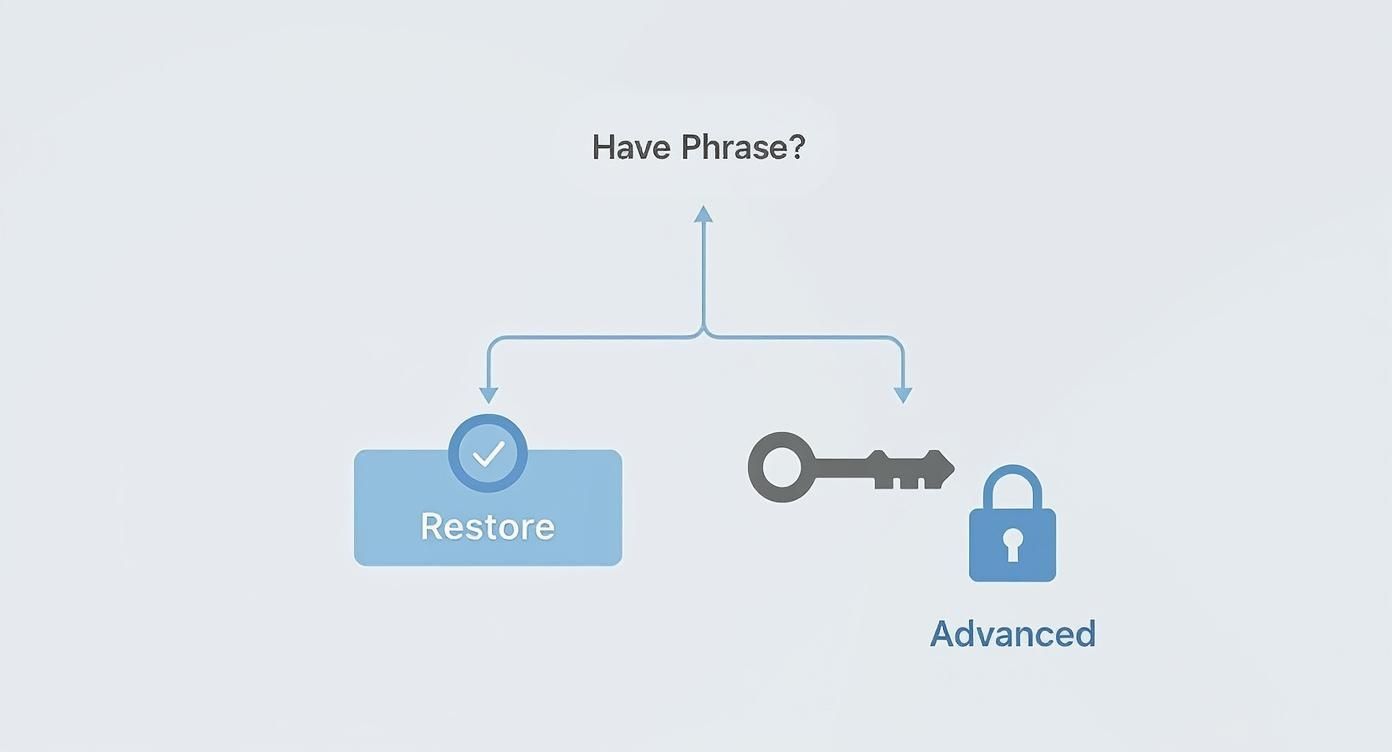
As you can see, without that seed phrase, your only way forward is to break the password encryption on the wallet file itself.
Building Your Personalized Password Attack
The most successful password-cracking attempts are deeply personal. Brute-force tools like Hashcat or John the Ripper are absolute beasts, but they need guidance. You have to feed them a personalized wordlist—basically, a text file packed with every password guess you can possibly think of.
Start by digging into your memory. What was going on in your life when you set up that wallet?
- Old Passwords: Jot down every password you've ever used. Even fragments or variations are useful.
- Personal Info: Think names of pets, family members, street addresses, and important dates like birthdays or anniversaries.
- Hobbies and Interests: What were you into back then? Favorite bands, movie characters, books, or even technical jargon from your job can be the key.
- Common Patterns: Did you have a go-to formula? Maybe a base word followed by numbers and a symbol, like
Password!23.
This kind of targeted approach is light-years more effective than just throwing a generic dictionary at it. You’re giving the software a highly concentrated, relevant list to work with, which massively boosts your odds of getting a hit.
I see this all the time. Someone finds an old Ethereum presale JSON file from 2014 and knows there are thousands of dollars worth of ETH locked inside. They can't for the life of them remember the password. By building a wordlist with old email passwords, the name of the dog they had back then, and their usual number patterns, they provide the raw fuel for a tool to test millions of combinations in a short time.
The Growing Need for Secure Recovery
As crypto has grown, so have the risks. Forgetting a password is one thing, but theft is another beast entirely. The constant news of wallet compromises shows why a solid recovery plan is no longer optional.
In just the first half of one recent year, over $2.17 billion was stolen from crypto services. Personal wallet compromises made up 23.35% of all those stolen funds. You can read more about these cryptocurrency crime trends to get the full picture.
This reality makes mastering wallet recovery essential—not just for getting back what you've lost, but for protecting what you have. When these self-recovery methods don't pan out, bringing in a professional is the next logical step.
Troubleshooting a Failed Hardware Wallet
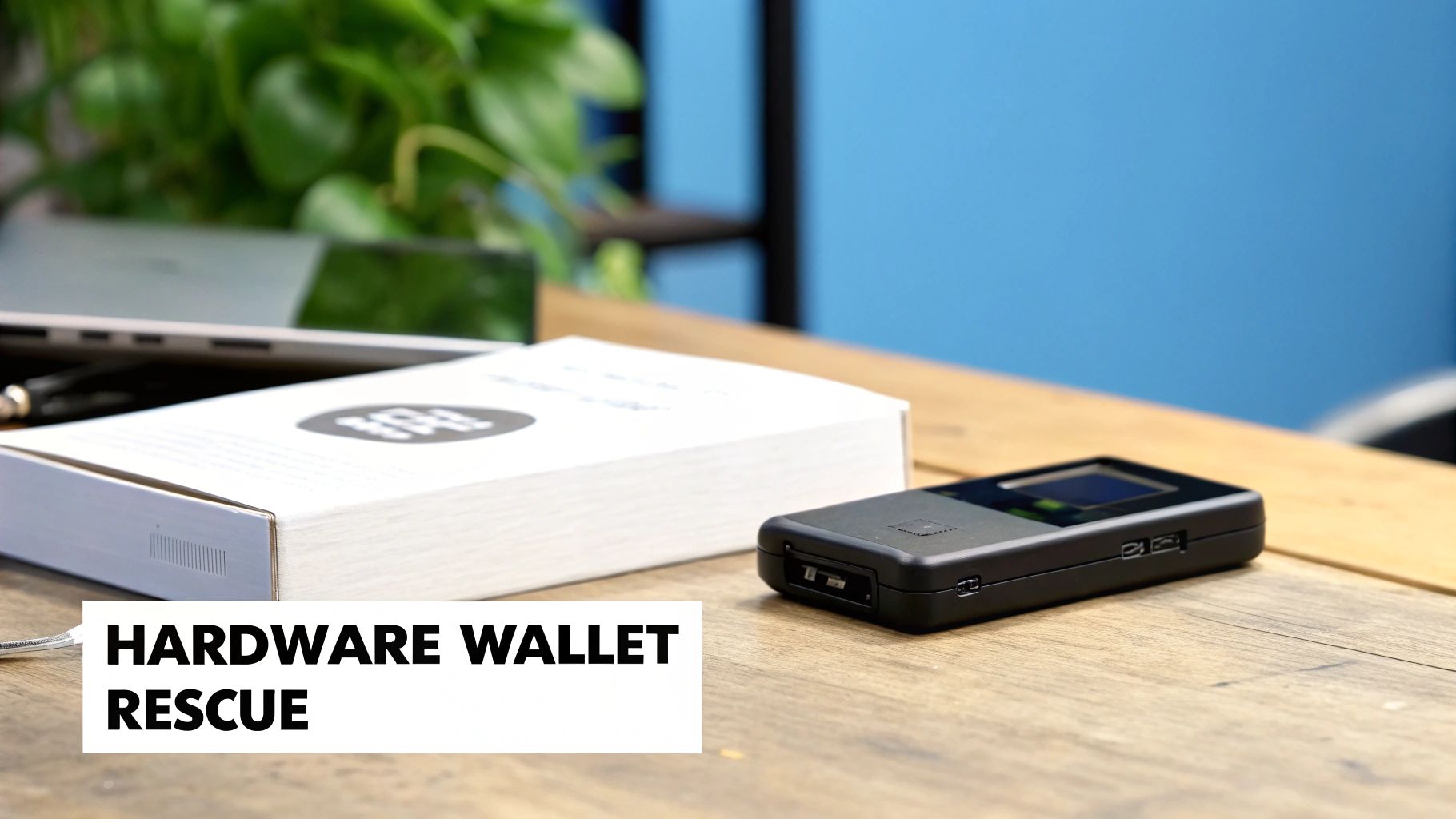
There’s a special kind of dread that hits when your hardware wallet just… dies. Maybe the screen is cracked, a firmware update went sideways, or it simply won't power on. Your first thought is probably that your crypto has vanished.
But here’s the most important thing to burn into your memory: your assets are not in the wallet.
They live on the blockchain. That little device is just the key. This single fact is the difference between a minor headache and a major catastrophe. As long as you have your seed phrase, that broken piece of plastic is just an inconvenience.
Your game plan is simple: grab that seed phrase and use it to restore access on a new wallet. This could be a fresh hardware device from the same company or even a compatible software wallet in a pinch.
Your Recovery Blueprint with a Seed Phrase
When you get your new Ledger or Trezor, you’ll see an option during the initial setup that says something like "Restore from recovery phrase." That’s your golden ticket. You're not creating a new wallet; you're importing your existing one.
You’ll carefully type in your 12, 18, or 24 words in the exact right order. The new device uses this phrase to regenerate your private keys. Once it syncs up, your balance will reappear, safe and sound. Think of it like using a master key to open a new door to the very same vault.
The official Ledger website has guides for this exact process, and they all stress the same point: your recovery phrase is the only backup that truly matters. The device itself is completely replaceable.
Common Failure Points to Watch For
Hardware wallets are tough, but they aren't immortal. Most failures I've seen fall into a few predictable buckets. Knowing what they are can help you figure out if it's time to just move on.
- Firmware Glitches: A botched or interrupted firmware update is a classic way to "brick" a device, leaving it totally unresponsive.
- Physical Damage: This is the obvious one. Cracked screens, a trip through the washing machine, or a bent USB port will put a wallet out of commission fast.
- Battery Failure: For wireless models, a battery that no longer holds a charge is a death sentence for the device.
The bottom line is this: if the device won't turn on or let you enter your PIN, stop. Don't keep trying to fix it. You could do more harm than good. Your energy is much better spent getting a new wallet and having your seed phrase ready to go.
The Sobering Reality of a Double Loss
Now, let's talk about the nightmare scenario. What if you’ve lost the hardware wallet and the seed phrase?
I'll be blunt: your options are almost zero. The secure chips in these devices are designed specifically to prevent the kind of forensic data recovery you’d need. It’s incredibly complex, astronomically expensive, and has a near-zero success rate.
If you find yourself in this situation, your funds are likely gone for good. It's a harsh lesson, but it highlights why protecting your seed phrase is the absolute number one rule in crypto security. It is your ultimate failsafe.
When you've exhausted every option and your funds are still frustratingly out of reach, a professional crypto wallet recovery service can feel like a lifeline. But this space is also a minefield, littered with scammers preying on people's desperation. Knowing how to spot a genuine expert versus a fraud is absolutely critical.
The most obvious red flag? A demand for an upfront fee. Legitimate services work on a success-only basis. They'll take a cut of the recovered funds—usually between 10% and 25% depending on the complexity—but only after they get your crypto back. If anyone asks for money before the work is done, run.
Another dead giveaway is a cast-iron guarantee. No honest specialist can promise a 100% success rate. It’s just not realistic. The entire process hinges on the quality of information you provide. A real professional will be upfront about the odds and manage your expectations from the start.
What a Trustworthy Service Looks Like
Beyond just avoiding scams, you need to know what to look for. A credible service will have a clear, verifiable track record. I’m talking about real customer reviews, detailed case studies, and a professional presence online.
They should also be completely transparent about their methods without ever asking you to compromise your security.
A legitimate service will NEVER ask for your seed phrase. Ever. They might need your encrypted wallet file and a list of password hints, but your master key stays with you. Sharing it is like handing over the PIN to your bank account.
The crypto world is also swimming with illicit funds. Bad actors hold nearly $15 billion in crypto, and they’re always inventing new ways to launder stolen assets, which makes legitimate recovery harder. You can get a sense of the challenges involved by reading up on the landscape of seizable crypto assets from Chainalysis. Professionals have the tools to navigate this mess.
Key Questions to Ask Any Potential Service
Before you hand anything over, you need to grill any potential service. Their answers (or lack thereof) will tell you everything you need to know.
- What's your fee structure? The only right answer is a no-win, no-fee commission.
- What information do you need from me? They should only ask for the encrypted file and password clues. Never, ever your seed phrase.
- Can you show me verifiable testimonials or case studies? A real company has a history of successful recoveries they can point to.
- How do you keep my data secure? They should have a clear, confident answer about their security protocols.
Asking these simple questions puts you back in control. For a deeper dive, our guide on cryptocurrency recovery services offers more insights. Choosing the right partner is the single most important decision you'll make at this stage.
Answering Your Top Crypto Recovery Questions
When you're trying to get back into a locked crypto wallet, a million questions probably run through your mind. It's a stressful situation, and you need clear, straightforward answers. Let's tackle some of the most common questions I hear from people dealing with everything from lost passwords to jumbled seed phrases.
First things first, a lot of people ask if they can get back into their wallet using just the public address. I wish I had better news, but the answer is a hard no. Think of your wallet address like your home address—anyone can send you mail (or crypto), but it doesn't give them the key to your front door. The real power is in your private key, which is derived from your seed phrase. Without that key, the funds are locked tight.
What About Costs? And What If I Only Have Part of My Seed Phrase?
The cost of getting professional help is another big concern. Here’s a critical rule of thumb: any legitimate crypto recovery service will operate on a success-based fee. They should never ask you for money upfront. The standard practice is to take a percentage of the recovered funds, usually somewhere between 10% to 25%, but only after they've successfully gotten your assets back. This keeps everyone honest and motivated.
Now, for a more hopeful question: can you recover a wallet with just a partial seed phrase?
Absolutely. This is actually a very common and often successful recovery scenario. If you've got most of the words but aren't sure about the order, or you think you misspelled one or two, you're in a good spot. We can use powerful software to brute-force the remaining possibilities, testing millions of combinations by filling in missing words from the official BIP39 wordlist and shuffling the order until we hit the right one.
It takes a ton of computing power, but the success rate is surprisingly high as long as the information you have is mostly correct. Every single word you remember drastically cuts down the search field, turning a seemingly impossible problem into a solvable puzzle. Knowing this can give you a lot more confidence as you start the recovery process.
If you've tried everything and are still stuck, we're here to step in. Wallet Recovery AI uses a secure, AI-powered approach to crack even the toughest cases, from forgotten passwords to corrupted wallet files. Request a confidential assessment of your situation today at Wallet Recovery AI.
Leave a Reply