
A crypto wallet recovery service is pretty much what it sounds like: a team of digital sleuths who use some seriously advanced tools to get you back into a locked cryptocurrency wallet. Think of them as locksmiths for the digital age. They’re the experts you call when you’ve forgotten a password, misplaced your recovery phrase, or worse, been a victim of theft. They offer a real fighting chance to get your digital assets back.
The Unique Misery of Being Locked Out of Your Crypto
Losing access to your crypto wallet is a special kind of hell. It’s like having a safe full of cash right in front of you, but the key just vanished into thin air. You're completely locked out of your own money, and it feels like there’s nothing you can do.
The very thing that makes crypto secure—its decentralized nature—is what makes this scenario so terrifying. You, and only you, are responsible for the keys to your kingdom. For a long time, if you lost that password or seed phrase, that was it. Game over. We’ve all heard the horror stories of people losing fortunes locked away on old hard drives, becoming grim reminders of what was at stake. It left a lot of people feeling totally helpless, forced to accept that their crypto was gone for good.
A Glimmer of Hope for Locked-Out Owners
Thankfully, things are starting to change. The emergence of the specialized crypto wallet recovery service has opened up a new avenue for people who thought all was lost. These aren't miracle workers, but teams of forensic experts and ethical hackers who use methodical, high-powered approaches to crack open digital vaults.
It's a fascinating mix of art and science. They combine a deep understanding of cryptography with massive computing power. Each case is a unique puzzle, and they start by piecing together any fragments of information you can give them.
This could be things like:
- Parts of the password you remember, or common patterns you tend to use.
- Fuzzy memories about words in your recovery phrase.
- Details about the wallet software and roughly when you set it up.
The big idea here is that even tiny scraps of information can dramatically cut down the number of possibilities. It turns what feels like an impossible search into a complex but solvable problem. A professional service uses technology to blitz through millions of combinations faster than any human ever could.
It’s Not Just About Forgetting Your Password
While getting people back into their locked wallets is the main event, these services often handle more serious situations, too. Many have the expertise to track and trace stolen funds across the blockchain.
By following the digital trail left by thieves, they can work with crypto exchanges and even law enforcement to help freeze and recover assets that were stolen.
The first step is just understanding what a recovery service can actually do for you. For most people, the most precious item is their wallet recovery phrase—the ultimate master key to all their funds. If you've lost or damaged that phrase, your first move should be learning about potential recovery methods for a wallet recovery phrase. This guide will break down exactly how these services work, the techniques they use, and how to find a team you can trust with something this important.
How Crypto Wallet Recovery Services Really Work
Think of a crypto wallet recovery service as a specialized digital forensics team for your lost crypto. It’s not magic—it's a methodical investigation that combines deep cryptographic knowledge with an enormous amount of computing power. And the whole thing hinges on the clues you can provide.
The process always starts with a detailed consultation. This is much more than a simple chat; it's an evidence-gathering mission. The specialists will ask for every scrap of information you can remember, no matter how small or irrelevant it seems. This might include public wallet addresses, transaction IDs, or even just fragments of a password or seed phrase you once used.
This initial data is the foundation for their entire strategy. It helps them map out the problem and pick the right tools for the job.
This flow chart gives you a clear picture of the journey, from that initial feeling of panic to hopefully getting your funds back with expert help.
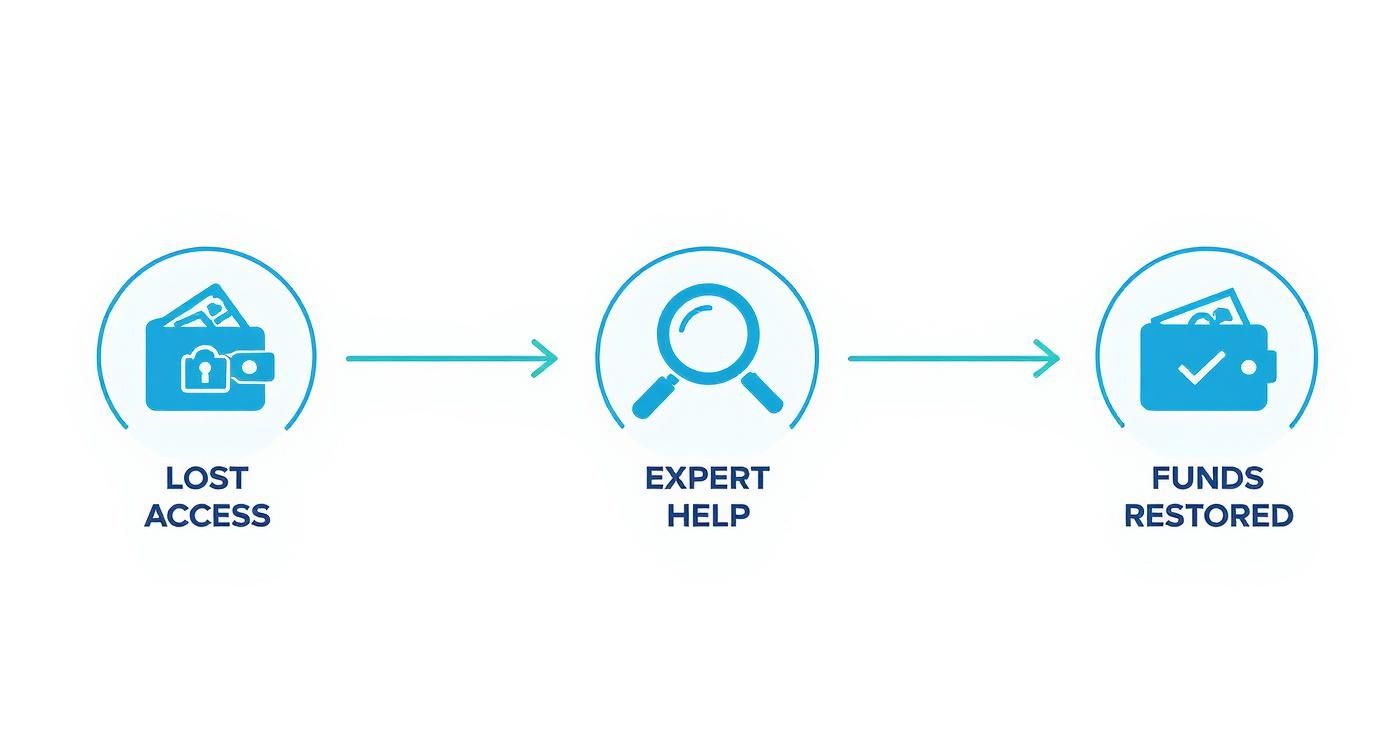
As you can see, the path to recovery is a structured, multi-step process. It's definitely not an instant fix.
The Technical Investigation Phase
Once they have your information, the real work begins. The approach they take depends entirely on what’s gone wrong. Generally, cases fall into two camps: regaining lost access or tracing stolen funds. Each requires a completely different set of skills and tech.
If you've forgotten the password to an encrypted wallet file, the main tool is a brute-force attack. It sounds aggressive, but it’s actually a highly calculated process. Instead of just guessing randomly, the service uses powerful, specialized hardware and software to systematically churn through billions of potential password combinations.
A more targeted version of this is called a "dictionary attack," where the software focuses on lists of common words, phrases, and password patterns. This is where your clues become so important. They allow the service to build custom dictionaries tailored to you, which dramatically boosts the odds of hitting the right one.
When a seed phrase is lost, the job shifts to reconstruction. Experts can use software to piece together a damaged or incomplete phrase, testing valid word combinations based on what you remember.
Tracing and Analysis on the Blockchain
When funds are stolen, the mission changes from cracking codes to following the money. This is where blockchain analysis takes center stage. Every crypto transaction is carved into a public, unchangeable ledger. And while transactions are pseudonymous, they're not completely anonymous.
Experts use powerful analytical tools to trace the movement of stolen crypto from one wallet to the next. They can follow this digital trail across countless transactions and even across different blockchains. It's a lot like following footprints in the snow—every step is visible if you know exactly where to look.
To get a better handle on how this transparent ledger works, you can check out our detailed guide on what a blockchain explorer is and see how it visualizes transaction data.
This deep analysis involves a few key steps:
- Transaction Mapping: Creating a visual chart of where the funds have moved.
- Wallet Clustering: Identifying groups of wallets that are likely controlled by the same person or entity.
- Exchange Identification: Pinpointing if the stolen funds have been sent to a centralized exchange to be cashed out.
That last step is often the most critical. If the funds land on a regulated exchange, the recovery service can work with that exchange and law enforcement to try and freeze the assets. It’s a complex dance between technical skill and procedural know-how. A successful crypto wallet recovery service has to be great at both—the deep technical dive and the administrative legwork needed to see a case through to the end.
Recovering Stolen Funds vs. Regaining Lost Access
Not all crypto recovery missions are the same. When you reach out to a professional crypto wallet recovery service, the first thing they’ll figure out is which of two very different battles you’re facing. Are we trying to track down assets stolen by a scammer, or are we simply trying to get you back into a wallet you’ve been locked out of?
Knowing the difference is critical. The strategies, expertise, success rates, and even the emotional stress of each scenario are worlds apart. One path is a high-tech digital chase, while the other is a careful, methodical act of digital locksmithing.
The Digital Chase: Recovering Stolen Funds
Recovering stolen crypto is an active, often combative process. Think of it as a digital manhunt where forensic experts follow a trail of electronic breadcrumbs left on the blockchain. The moment your funds are stolen, the clock starts ticking.
The main strategy here is blockchain analysis. Experts use advanced software to trace the stolen crypto as it moves from one wallet to another. Their goal is to follow the money until it lands somewhere identifiable—usually, a major crypto exchange.
Key steps in this "chase" include:
- Rapid Investigation: Immediately tracing transaction IDs to map the thief's escape route.
- Collaboration: Working with exchanges and, in many cases, law enforcement agencies.
- Freezing Assets: If the funds land on a regulated exchange, the service can petition to have the account frozen, stopping the thief from cashing out.
This is a genuine race against time. Thieves often use "mixers" or "tumblers" to jumble their stolen crypto with other funds, making the trail much harder to follow. Success hinges on speed and the cooperation of third parties.
The Digital Locksmith: Regaining Lost Access
In complete contrast, regaining access to a wallet you own is a more self-contained, technical puzzle. The enemy isn't a hacker; it's a forgotten password, a corrupted file, or a seed phrase with a missing word. This situation isn't a chase at all—it’s more like trying to crack a fiendishly complex digital safe.
The methods used are entirely different, focusing on cryptography and raw computational power.
This is where the true "locksmithing" comes in. Instead of chasing a person, the service is attacking a digital lock with a massive set of keys, hoping one eventually turns.
Techniques include:
- Brute-Force Attacks: Systematically trying billions or trillions of password combinations against an encrypted wallet file.
- Mnemonic Reconstruction: Using partial information you remember to piece together a valid seed phrase from millions of possibilities.
- Targeted Dictionary Attacks: Creating custom word lists based on your personal habits, old passwords, and other clues you provide to narrow the search.
The scale of this challenge is huge. It's estimated that somewhere between 2.3 million and 3.7 million Bitcoins are gone for good, mostly due to forgotten keys. You can learn more about the scope of lost Bitcoin on Ledger's official site. However, specialized recovery services can apply massive computational resources and cryptographic expertise to turn a hopeless situation into a successful recovery.
To make this crystal clear, this table breaks down the core differences between the two scenarios.
Comparing Recovery Scenarios Stolen Funds vs Lost Access
This table highlights the key differences in approach, success factors, and typical challenges between recovering stolen cryptocurrencies and regaining access to a lost wallet.
| Aspect | Stolen Funds Recovery (The Chase) | Lost Access Recovery (The Locksmith) |
|---|---|---|
| Primary Goal | Trace and intercept stolen assets. | Crack a password or reconstruct a key. |
| Main Challenge | Outpacing the thief and their attempts to obscure the trail. | Overcoming strong encryption with computational power. |
| Key Tools | Blockchain analytics software, exchange cooperation. | High-performance hardware, custom cracking software. |
| Success Factor | Speed of reporting and law enforcement collaboration. | Quality of clues provided (partial passwords, etc.). |
| Typical Timeline | Months to years, depending on legal proceedings. | Days to months, depending on complexity. |
Ultimately, whether you need a detective or a locksmith, a professional crypto wallet recovery service is equipped for both. The key is to accurately diagnose the problem right away so the right tools and strategies can be put into action.
Here's the rewritten section, crafted to sound completely human-written and natural, based on the provided guidelines and examples.
Setting Realistic Expectations for Recovery Success
When you're staring at a locked wallet, desperate to get your crypto back, it's easy to cling to any glimmer of hope. But the single most important tool you have right now isn't hope—it's realism. A professional crypto wallet recovery service can work wonders, but success is never a sure thing.
Let's be clear: recovery is a puzzle, and the final picture depends entirely on the pieces you bring to the table. Some cases have a clear path forward. Others are like trying to find a needle in a haystack, blindfolded.
What Actually Determines Success?
The odds of a successful recovery boil down to a few key variables. Think of it like giving a rescue team a map—the more details you can provide, the faster they'll find what they're looking for.
Here are the factors that really move the needle:
- How fast you act: In theft cases, the clock is your biggest enemy. The quicker you report it, the less time thieves have to wash the funds through mixers or complicated transaction chains that muddy the trail.
- The quality of your info: This is the big one. Can you remember fragments of a password? A list of words you might have used in a seed phrase? The exact wallet software? Every little clue narrows the search field and dramatically boosts your chances.
- The coin itself: Trying to recover funds on a transparent blockchain like Bitcoin or Ethereum is one thing. It's a whole different ballgame with privacy coins like Monero, which are specifically designed to hide transaction details.
A recovery service doesn’t have a magic wand. Their work is built on logic, data, and a ton of computing power. The better the information you give them, the better your chances of getting your crypto back.
The Numbers Behind the Recovery Game
The crypto world is no stranger to eye-watering losses, which is why recovery services are more critical than ever. In 2025 alone, hackers and scammers made off with over $3.1 billion by the middle of the year.
Despite those staggering numbers, there's good news. Across the industry, about 70% of stolen crypto is successfully returned, and top-tier firms often boast success rates in the 94-98% range. You can dig deeper into these numbers with these crypto recovery statistics on CoinLaw.io.
That gap in success rates isn't just marketing fluff. It reflects the types of cases these firms handle. A company that focuses on straightforward password cracks will naturally have a higher rate than one that goes after sophisticated international theft rings.
Ultimately, getting your funds back is a very real possibility, but it’s never guaranteed. Any reputable service will be upfront about your odds from the get-go, giving you an honest assessment based on your specific situation. That transparency is what helps you make the right call, with a clear and realistic view of what’s ahead.
How to Choose a Trustworthy Recovery Service
When you’re staring down the barrel of losing your crypto, stress can mess with your judgment. That’s exactly what scammers are counting on. Picking a legitimate crypto wallet recovery service isn't just about finding someone who knows what they're doing—it's about protecting yourself from getting burned a second time.
Think of it like hiring a specialized surgeon for a critical operation. You wouldn't just pick the first name you see on Google. You’d dig into their background, check their success rate, and make sure you understand every part of the process. The same level of diligence is absolutely essential here. A real pro will be transparent, professional, and upfront about how they operate.
Your Vetting Checklist
It's time to put on your detective hat. The right service won't just tolerate your questions; they'll welcome them and give you clear, straight answers. Your job is to sift the proven experts from the opportunists who feed on panic.
Here are the steps you need to take:
- Dig Into Their Reputation: Go way beyond the glowing testimonials on their own site. Hunt for independent reviews on places like Reddit, Trustpilot, and other crypto forums. What are actual clients—with no skin in the game—saying?
- Verify Their Track Record: Any firm worth its salt will have success stories to share. Ask them about the types of cases they’ve cracked. They can't spill confidential client details, of course, but they should be able to walk you through the technical hurdles they've overcome.
- Put Their Fee Structure Under a Microscope: This is a big one. The best services operate on a "no win, no fee" model. You only pay a percentage of the recovered funds after you’re back in control. It’s that simple.
A well-known company like Puran Crypto Recovery (PCR), for instance, built its entire business on this success-based model, and has even helped some victims pro bono. In 2024 alone, their forensic skills helped recover $4.2 million in Bitcoin, proving what's possible with the right team. You can see more analysis of the top crypto recovery experts for 2025 on I-RIC.org.
Critical Red Flags to Avoid
Knowing what to look for is only half the battle. You also have to know what to run from. Scammers are slick, often using high-pressure tactics to push you into a bad decision when you're most vulnerable. Spotting their tricks is your best defense.
Never forget: The crypto recovery space is the Wild West—it's unregulated. It's on you to be skeptical and do your homework. Your financial future might just depend on it.
Keep your guard up for any service that does the following:
- Guarantees Success: No one can promise a 100% guaranteed recovery. It’s an incredibly complex process. Anyone offering a sure thing is lying to you.
- Demands Upfront Fees: This is the oldest trick in the book. If they ask for a big, non-refundable payment before starting, it's a huge red flag. The "fee" is the scam; they’ll take your money and disappear.
- Asks for Your Full Seed Phrase: A legitimate crypto wallet recovery service will never need your complete seed phrase or private keys. They are experts at working with the fragments and clues you provide—they don't need the keys to the kingdom.
- Gives Vague or Evasive Answers: Can't they explain their process, security measures, or fee structure in plain English? Walk away. Transparency isn't a bonus; it's a non-negotiable requirement.
By sticking to this game plan, you can make a clear-headed, safe decision. The goal is to find a real partner who’s in your corner, not another predator waiting to strike.
Here's the rewritten section, crafted to sound like it was written by an experienced human expert.
Common Questions We Hear About Crypto Wallet Recovery
It’s completely normal to have a lot of questions when you're thinking about crypto recovery. Let's be honest, the whole situation is stressful enough without confusing jargon.
We get it. You need clear, straightforward answers before you can feel comfortable moving forward. So, let’s tackle some of the most common concerns we hear from people every day.
How Much Is This Going to Cost?
Legit recovery services almost always work on a success-fee basis. Simple as that. You only pay if we successfully get your funds back. This "no win, no fee" approach is the industry standard for a reason—it means our goals are perfectly aligned with yours.
The fee itself is a percentage of whatever we recover, usually landing somewhere between 10% and 30%. The final number really depends on how complicated your case is.
Quick tip: If a service demands a big, non-refundable payment upfront, that's a massive red flag. Real experts get paid for results, not just for trying.
Can You Get Back Crypto Sent to the Wrong Address?
This is a tough one, and the honest answer is almost always no. Blockchain transactions are designed to be irreversible. Once a transaction is confirmed on the network, it’s final. There’s no "undo" button.
A recovery service can't reverse a transaction like this. The only slim chance of recovery is if you happen to know the person who owns the receiving address and can convince them to send it back.
How Long Does Recovery Usually Take?
The timeline can be all over the map. There’s just no one-size-fits-all answer, so be very skeptical of anyone who promises a specific, super-fast turnaround.
- Simpler Cases: If it's a straightforward password crack and you've given us some good clues to work with, we might be looking at a few weeks of number-crunching.
- Complex Cases: For something like a theft investigation, where we have to trace funds across multiple blockchains and work with exchanges, it could easily take many months—sometimes even over a year.
A trustworthy service will always give you a realistic (though often broad) timeframe after they’ve had a chance to assess your situation.
Is It Safe to Give a Recovery Service My Info?
This is probably the most important question you can ask. Here’s the bottom line: you should never, ever hand over your full private key or your complete seed phrase. A legitimate service simply doesn’t need total control of your wallet to do its job.
Here’s what we typically work with:
- Your public wallet address.
- Transaction IDs (often called hashes).
- Any bits and pieces of a password or seed phrase you can remember.
Being asked for your complete private keys is the number one sign of a scam. A professional crypto wallet recovery service has the right tools to work with partial information without ever putting your other assets at risk.
Feeling locked out of your crypto is a horrible feeling, but you don't have to go through it alone. The team at Wallet Recovery AI uses specialized, AI-driven techniques to help you regain access securely and discreetly. Request a confidential assessment today.
Leave a Reply