Think of a wallet recovery service as a team of digital locksmiths for your crypto. They’re specialists who help you get back into your digital vault when you’ve lost the key—whether that’s a forgotten password, a misplaced seed phrase, or a busted hardware wallet.
The Digital Locksmith: Your Last Lifeline
Picture this: you have a digital safe filled with valuable crypto, but the combination is gone. It's a terrifyingly common scenario. Unlike your bank account, where you can just show your ID to reset a password, crypto puts all the security responsibility squarely on your shoulders. Lose that "key," and your access is gone. Period.
That's where a professional wallet recovery service becomes your last hope. These experts use a mix of powerful software, deep cryptographic knowledge, and digital forensics to try and crack open your wallet. They don't have some magic master key; they work methodically with the clues and hints you provide to piece the puzzle back together.
When Do You Call in the Cavalry?
Losing access to your crypto can happen in a ton of ways, each with its own unique technical headache. Most of the time, the call for help comes down to a few common, gut-wrenching situations.
Here's a quick look at the most frequent reasons people get locked out of their crypto and might need professional help.
Common Scenarios Requiring Crypto Recovery
| Problem | Typical Cause | Recovery Approach |
|---|---|---|
| Forgotten Passwords | Created a complex password for a wallet like MetaMask or Electrum, then lost the note or forgot it. | Brute-force attacks using partial password hints and sophisticated algorithms. |
| Corrupted Wallet Files | The core wallet file (like a wallet.dat file) gets damaged from a hard drive crash or software glitch. |
File repair techniques and data extraction to salvage private keys from the damaged file. |
| Damaged Hardware Wallets | A physical Ledger or Trezor device is destroyed by fire, water, or an electrical short. | Advanced hardware forensics to extract data directly from the device's memory chip (only possible if the seed phrase is also lost). |
| Lost or Misplaced Seed Phrases | The 12 or 24-word recovery phrase is lost, and the original device is also broken or inaccessible. | This is the toughest case, often relying on finding fragments of the phrase or attempting password recovery on any existing wallet backups. |
As you can see, the path to recovery is different for every problem. The more information you can provide, the better the chances of success.
The Staggering Scale of Lost Crypto
This isn't just a small problem affecting a few unlucky people. We're talking about a mind-boggling amount of wealth that's completely locked away. Because crypto is decentralized, there's no "customer service" to call for a password reset. This has created a massive global issue.
A study from Chainalysis revealed that an estimated 20% of all existing Bitcoin is likely lost or stuck in wallets people can't get into. That's around 3.7 million BTC, worth well over $140 billion.
That number is a stark reminder of how critical these recovery services are. Those locked funds aren't just numbers on a screen; they represent people's life savings, inheritances, and business capital. You can read more about the impact of lost crypto passwords from TokenPost. For countless owners, these services offer the only realistic shot at getting back what they thought was gone forever.
How Crypto Recovery Experts Get Your Funds Back
So, how does this all actually work? Recovering crypto that seems lost forever isn't some kind of dark magic. It's a highly technical process, a bit like a digital forensics lab, that combines raw computing power with years of specialized experience. The exact tools and strategies we use depend entirely on what kind of "lock" is keeping you from your funds.
The most common scenario we see is a forgotten password. Here, our primary tool is a brute-force attack, but it's much smarter than just guessing random letters and numbers. It's all about the clues you can provide. Think back—any old password fragments, common phrases you lean on, even the types of characters you usually use are incredibly valuable. We feed all of that into our systems.
This software then generates and tests millions, or even billions, of potential passwords, but only based on the patterns and hints you gave us. It’s like a locksmith who knows you always use a four-digit PIN starting with "19." Instead of trying every number from 0000 to 9999, they can just focus on 1900-1999. It cuts down the search time massively. The more you remember, the better our odds.
Unlocking Passwords with Precision
A proper brute-force attempt is never a blind guess; it's a calculated assault. We use sophisticated algorithms that can test all sorts of variations based on your hints—adding numbers, swapping special characters, or trying common substitutions you might have made (like "e" for "3"). This targeted approach is what turns a seemingly impossible task into a solvable puzzle.
If you want to get into the nitty-gritty of these techniques, our guide on professional password recovery services explains the whole process in more detail.
Digital Forensics for Damaged Files
Sometimes the password isn't the problem at all. The issue might be a corrupted wallet file, like a wallet.dat file. This can happen from a hard drive failure, a power outage, or just a random software glitch. When this happens, we switch gears from password cracking to what I'd call digital archaeology.
Our experts use forensics tools to go through the raw data of the corrupted file, piece by piece. The goal is simple: find and pull out the undamaged private key, which is the only thing that really matters.
- File Structure Repair: We'll first try to rebuild the damaged parts of the file, correcting the errors that are stopping the wallet software from reading it.
- Data Carving: If the file is too far gone, we can "carve" out the specific string of data that is your private key, even if the rest of the file is a total mess.
It's delicate work, a lot like a data recovery specialist piecing together a shattered hard drive to get back priceless family photos. It requires a deep understanding of how different wallet types store their information.
The key takeaway is this: even in a corrupted file, the private key is often still there, perfectly intact. The real challenge is finding and extracting it from all the digital noise, and that’s where specialized knowledge is non-negotiable.
When Hardware Fails
Hardware wallets from brands like Ledger and Trezor are incredibly secure, but they aren't immortal. They can get fried, soaked, or crushed. If your device is broken and you've also lost your 24-word seed phrase, you're in a tough spot.
In these extreme cases, we may have to resort to advanced hardware intervention. This can mean physically de-soldering the memory chip from the circuit board and using a special reader to extract the raw data directly. It’s a high-stakes, last-ditch effort that could destroy the device, so it’s only something we consider when all other options are off the table.
Recovery Methods at a Glance
| Recovery Method | Best For | Technical Approach |
|---|---|---|
| Brute-Force Attack | Forgotten passwords for software wallets (MetaMask, Electrum). | Uses client-provided hints to generate and test millions of password variations. |
| Digital Forensics | Corrupted or damaged wallet.dat files and other wallet software files. |
Analyzes raw file data to repair structure or extract the private key directly. |
| Hardware Extraction | Physically damaged hardware wallets where the seed phrase is also lost. | Involves physically removing and reading the device's memory chip to recover keys. |
Ultimately, a good wallet recovery service combines all these techniques, creating a custom strategy for your specific problem. It's not about luck or guesswork—it's a disciplined application of computer science, cryptography, and meticulous data analysis to get back what you thought was gone for good.
Your Step-By-Step Client Recovery Journey
Thinking about trying to recover a lost wallet can feel overwhelming, but a professional service turns a stressful situation into a clear, methodical process. Knowing what to expect demystifies everything and gives you the confidence to take the first step. This isn't about just handing over sensitive info and hoping for the best; it’s a collaborative effort with well-defined checkpoints every step of the way.
The entire journey is built on a foundation of trust and meticulous investigation, starting from the very first conversation.
The Initial Consultation And Assessment
Your journey kicks off with a free, no-obligation consultation. Think of this as the diagnostic phase, where we figure out if your case has a fighting chance. We'll go over the specifics of what happened: the wallet you used, the crypto involved, and exactly how you got locked out (forgotten password, corrupted file, you name it).
This first chat is all about determining if recovery is realistically possible. If we think the odds are close to zero, we’ll tell you straight up. Honesty is everything at this stage—it saves you from false hope and wasted time. Any reputable wallet recovery service will only move forward if they see a legitimate path to success.
The infographic below shows the core technical stages that typically follow a positive assessment, from brute-force attacks to deep forensic data extraction.
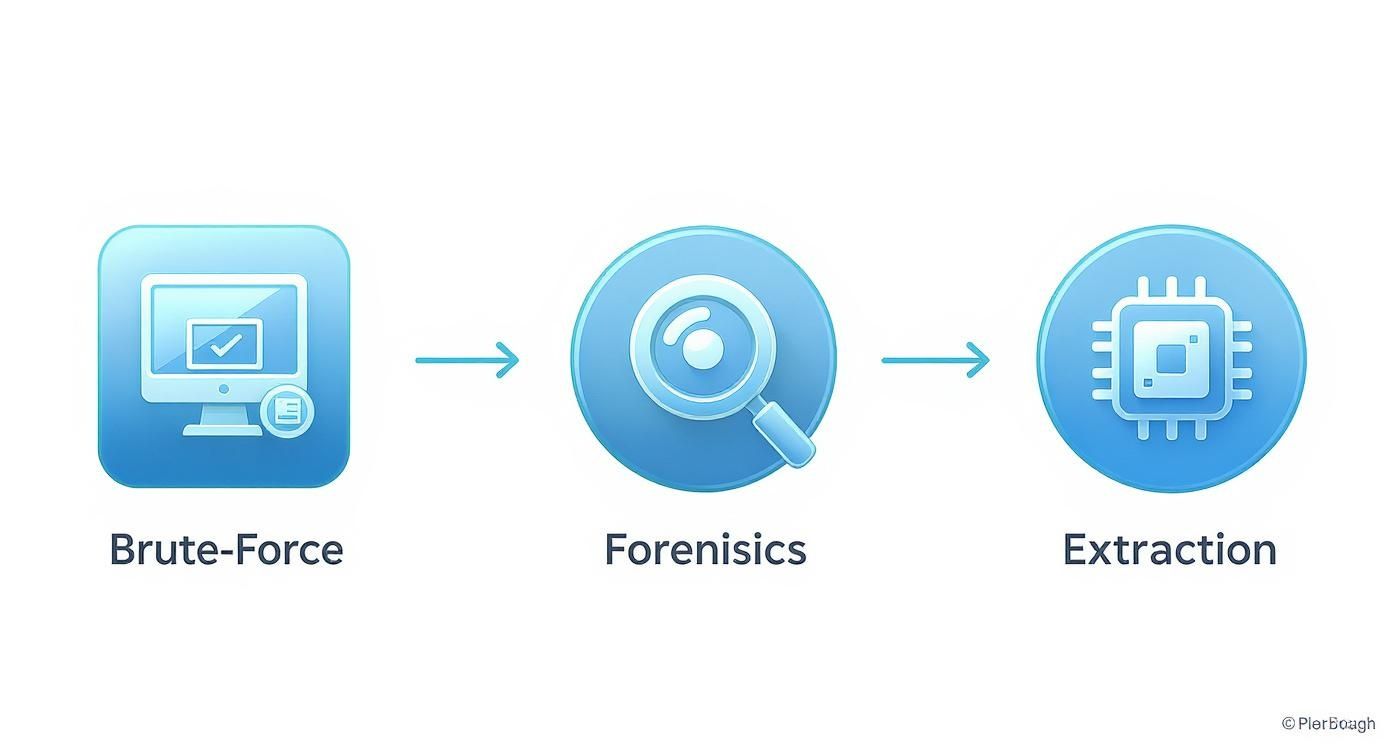
This workflow really highlights how different problems demand different tools, which is why getting that initial assessment right is so critical for choosing the best approach.
Gathering Your Clues And Information
Once we’ve established that your case is recoverable, we move into the information-gathering phase. This is where you become the lead detective. The more detailed and accurate your clues are, the better our chances of cracking the case.
We’ll guide you through preparing a comprehensive list of every little detail you can remember. It's not just about the password itself, but all the context surrounding it.
Checklist Before Contacting a Recovery Service
Gathering this information beforehand can significantly increase the chances of a successful and efficient recovery process.
| Information Type | Examples of What to Provide | Why It Helps |
|---|---|---|
| Wallet Details | Wallet name (e.g., MetaMask, Electrum), version number, OS. | Narrows down the specific encryption algorithm and attack vectors. |
| Password Fragments | Any words, phrases, character patterns, or possible lengths. | These are the "knowns" that drastically reduce the search space. |
| Password Habits | Typical capitalization, numbers, or special symbols you use. | Creates a "profile" to build more intelligent password guesses. |
| Related Files | The encrypted wallet.dat or JSON keystore file. Never your seed phrase. |
This is the encrypted data we need to actually work on. |
Every piece of information, no matter how tiny it seems, acts like a filter. It helps our systems cut down billions of possibilities to a much smaller, manageable set, which massively speeds up the recovery and boosts the probability of success.
Legal Safeguards And Agreements
Before a single line of code is run, we lock everything down in a secure and legally protected framework. This part is non-negotiable. It’s how we ensure your assets and personal data are protected from start to finish. Two key documents make this happen.
First, you'll sign a Non-Disclosure Agreement (NDA). This is a legally binding contract that holds us to strict confidentiality. It guarantees that any information you share is kept completely private and is only used for your recovery attempt.
Second, we'll draw up a crystal-clear service contract. This document lays out the scope of work, the success-based fee structure (usually a percentage of what's recovered), and the plan for returning your assets. It formalizes our "no win, no fee" promise—if we can't get your funds back, you don't owe us a dime. This keeps our interests perfectly aligned, which is the hallmark of a legitimate wallet recovery service.
Once we've successfully recovered your crypto, we work directly with you to transfer the funds to a brand-new, secure wallet that only you control. And just like that, the recovery journey is complete.
How to Spot Scams and Choose a Service You Can Trust
Navigating the world of crypto recovery can feel like walking through a minefield. You’re in a vulnerable spot, desperate to get your funds back, and scammers see a golden opportunity. The key to protecting yourself is knowing exactly what a legitimate wallet recovery service looks like—and what red flags mean you should run for the hills.
Let's be blunt: the crypto space is filled with con artists. Billions have been stolen through hacks and scams over the years, making it a high-risk environment for anyone. While some reports show average recovery rates for certain thefts can hit 70%, those numbers plummet for large-scale hacks. You can dig into more crypto scam recovery statistics from CoinLaw.io.
This dangerous landscape makes choosing a trustworthy partner absolutely critical. The last thing you want is to become a victim twice.
Major Red Flags of a Recovery Scam
Scammers aren't usually very creative. They rely on the same old tricks that prey on your urgency and technical uncertainty. Once you know what to look for, they become glaringly obvious.
Keep an eye out for these common warning signs:
- Demands for Upfront Payment: This is the biggest giveaway. Any legitimate service operates on a "no win, no fee" basis. If someone asks you to pay before they've even touched your wallet file, walk away. It's almost certainly a scam.
- Unrealistic Guarantees: Nobody can guarantee a 100% successful recovery. It's a complex process that depends entirely on the information you can provide. Anyone promising absolute success isn't being honest—they're just selling false hope.
- Requests for Your Seed Phrase: You should NEVER, under any circumstances, share your seed phrase. It's the master key to your entire wallet. A real recovery expert works with encrypted wallet files and password hints, not your private keys. To learn more, check out our guide on the critical role of a wallet seed phrase.
- Vague or Secretive Methods: A true professional will be happy to explain their process. If they hit you with confusing jargon or refuse to detail their approach, it’s a huge red flag. They probably have something to hide.
The golden rule is simple: If it sounds too good to be true, it absolutely is. A trustworthy service will manage your expectations, put your security first, and be completely transparent from day one.
Your Vetting Checklist for a Trusted Provider
Once you've weeded out the obvious scams, it's time to do some homework on the legitimate contenders. A little due diligence now can save you from a world of hurt later. Think of it like hiring a financial advisor—you wouldn't hand over your money without checking their credentials first.
Use this checklist to properly vet any service you’re considering:
- Verify Business Credentials: Look for a registered business with a physical address and a professional website. Real companies aren't anonymous; they have a reputation to protect and are accountable for their work.
- Seek Out Credible Testimonials: Don't just take their word for it based on reviews on their own site. Hunt down independent reviews on platforms like Trustpilot, Reddit, or crypto forums to get an unbiased picture of their track record.
- Demand a Professional Service Agreement: Before any work starts, you should get a clear, legally binding contract. This document must spell out the scope of work, the success-based fee structure, and include a Non-Disclosure Agreement (NDA) to protect your privacy.
- Assess Their Communication Style: Are they professional? Patient? Do they explain things clearly? A trustworthy expert will take the time to answer all your questions without ever pressuring you to make a decision.
Choosing the right service is about more than just technical skill. It's about finding a partner who is transparent, ethical, and has your back. By staying vigilant and following these steps, you can confidently find a service that genuinely wants to help you safely reclaim your assets.
What Success Looks Like: Real Stories and Timelines
The technical details of wallet recovery are one thing, but what really hits home are the results. Seeing real-world success stories makes it clear that even when things seem hopeless, there's often a way back. These aren't just technical victories for us; they're moments of incredible relief for people who were sure their crypto was gone for good.
Many of these stories start with a simple, all-too-human mistake. We recently worked with an early Bitcoin adopter who found an old, forgotten laptop with a wallet.dat file from over ten years ago. Not only was the file corrupted, but the password was a complete blur. We started with some digital forensics to piece the file back together, then ran a targeted brute-force attack based on the fuzzy memories he had of the password. It worked. He recovered a significant amount of Bitcoin he had long since written off.
Turning Faint Memories into a Full Recovery
It's amazing how often a partial memory is all we need. A client came to us with an Ethereum wallet that had been locked up for years. She couldn't remember the full password, but she remembered parts of it—a specific phrase she liked, a string of numbers she used for other things, and that it definitely included her pet's name.
This is where the real craft of recovery comes into play. We used those fragments as a blueprint, building a custom dictionary for our software to chew on. Instead of just guessing randomly from A to Z, it was methodically testing every possible combination based on her clues. A few days of heavy computation later, we hit the jackpot. She had her entire portfolio back.
These cases really drive home a key point: even a tiny shred of a memory can be the key that unlocks the whole thing. The more clues you can give us, no matter how small they seem, the better our chances are.
How Long Does This Actually Take?
While the success stories are exciting, we need to be real about timelines. This isn't an instant process. Wallet recovery is a marathon, not a sprint, and how long it takes really depends on the puzzle we're trying to solve.
Here’s a rough guide to what you can expect:
- Simple Password Cases (Days to Weeks): If you have a pretty good idea of the password structure and it's a standard software wallet, we could be looking at a few days to a couple of weeks.
- Complex Password Cases (Weeks to Months): For those wallets with super long, random passwords and very few clues, the sheer computational power needed can push the timeline into several weeks or even a few months.
- Corrupted File Recovery (Variable): Fixing a damaged wallet file can be quick if the corruption is minor. But if it needs a deep forensic dive, that could take a week or more before we can even start trying to crack the password.
- Hardware Wallet Failures (Months): Cases involving physically broken hardware are in a league of their own. These are the most complex and delicate jobs, often taking months of meticulous work.
The potential here is genuinely life-changing. Top firms in this field are showing just how powerful specialized tech and key legal partnerships can be. Some have reported recovering hundreds of millions of dollars for thousands of clients, even taking on complex cases involving sophisticated phishing schemes. You can find more details on how experts are tackling crypto recovery challenges on dgcine.gob.do to see what's possible.
At the end of the day, any trustworthy service will give you a completely transparent assessment of your odds and an estimated timeline before you commit to anything. Patience and a clear picture of the road ahead are your best allies in getting your funds back.
Common Questions About Wallet Recovery Services
Stepping into the world of crypto recovery can feel daunting, and you probably have a lot of questions. We get it. Let's walk through some of the most common ones we hear, giving you clear, no-nonsense answers so you know exactly what to expect.
Can You Recover a Lost Seed Phrase?
This is the big one, and the answer isn't a simple yes or no. A seed phrase that is completely gone—never written down, device wiped clean—can't be pulled out of thin air or from the blockchain. For your own security, it was never stored there in the first place.
But that doesn't always mean it's game over. If you still have the device where the wallet was first set up, there's a fighting chance. Specialists can perform deep forensic scans on the device's memory to find digital breadcrumbs or fragments of the seed phrase, as long as that data hasn't been completely overwritten. It's a complex, delicate process, but it's a real path to recovery.
What Are the Typical Fees?
Any legitimate recovery service worth its salt operates on a contingency basis. In plain English, that means "no-win, no-fee". You should never, ever pay anything upfront.
The fee is simply a percentage of the funds we successfully recover for you, usually somewhere between 10% and 25%. The final rate depends entirely on how tough the job is. A straightforward password recovery will be at the lower end, while untangling a complex hardware failure will naturally be higher. This model keeps everyone honest—we only get paid when you do.
The "no-win, no-fee" structure is the gold standard in this industry. It aligns our interests with yours, removing any risk of you paying for an attempt that doesn't succeed. Be extremely skeptical of any service that asks for money before they've recovered your funds.
How Do I Know My Funds Are Safe?
Trust is everything, and we take it seriously. Reputable firms will always start with a legally binding contract and a Non-Disclosure Agreement (NDA) to protect your privacy and your information. All the recovery work happens in a secure, isolated environment, completely cut off from any outside access.
And when we succeed? The funds are immediately transferred to a brand-new, secure wallet that only you control. We never take custody of your assets for any longer than absolutely necessary. It's a transparent, clean handover.
What Are the Real Success Rates?
Anyone promising a 100% success rate isn't being straight with you. The odds vary wildly depending on the problem. If you’ve forgotten a password but can provide some solid hints or remember parts of it, the chances are pretty good. But for a badly corrupted file or physically damaged hardware, it really depends on the extent of the damage.
Industry insiders report that specialized companies might handle 50 to 70 cases a day, with a long-term historical success rate of about 35%. That number really shows how challenging this work is—nearly two-thirds of cases, despite our best efforts, are unrecoverable. You can learn more about the challenges in wallet recovery from TokenPost. An honest service will always give you a realistic assessment of your chances before you commit to anything.
If you're locked out of your wallet, you don't have to go it alone. The experts at Wallet Recovery AI are here to guide you through the process with complete security and transparency. Contact us today for a free, no-obligation consultation.
Leave a Reply