Think of a wallet recovery service as a team of digital locksmiths for your crypto. When you've lost the password or misplaced the seed phrase to your wallet, they use highly specialized techniques to try and get you back in. Without them, those funds could be locked away forever.
Why You Might Actually Need a Wallet Recovery Service
Ever had that heart-stopping moment when you realize you can't find your keys? Now imagine those keys unlock your entire digital fortune. A forgotten password, a misplaced slip of paper with your recovery phrase, or a fried hard drive—any of these simple mistakes can permanently lock you out of your crypto.
This is a bigger problem than most people realize, especially as more of us move our assets into self-custody wallets.
When you control your own keys, you are your own bank. That's incredibly empowering, but it also means there’s no "forgot password" link to click if something goes wrong. This is where wallet recovery services come in. They are the emergency response team for your digital assets, offering a last-ditch effort to reclaim what you thought was gone for good.
The Double-Edged Sword of Self-Custody
The shift toward self-managed wallets is fantastic for giving users full control, but it also means the security buck stops with you. This reality has created a very real—and growing—need for professional help.
It’s easy to get into a situation where you need an expert. Here are some of the most common reasons people find themselves locked out of their funds.
Common Scenarios Requiring Wallet Recovery
This table breaks down the most frequent situations that lead cryptocurrency owners to seek professional help for regaining access to their digital assets.
| Scenario | What It Means | Typical Causes |
|---|---|---|
| Forgotten Passwords | You can't remember the password for an encrypted wallet file. | Forgetting a complex password for a wallet.dat file or a desktop wallet like Exodus. |
| Lost Seed Phrases | The master key to your wallet is gone or incomplete. | Misplacing the paper backup, losing a few words, or having a damaged backup. |
| Damaged Hardware | The physical device holding your keys is broken or inaccessible. | A hardware wallet that won't turn on or a computer with a failed hard drive. |
| Corrupted Wallet Files | The software file containing your keys is unreadable. | Software bugs, improper computer shutdowns, or malware infection. |
Each of these scenarios presents a unique technical puzzle, often requiring sophisticated software and hardware tools to solve.
The rise of self-custody has put millions of people in charge of their own banks. While empowering, it also means that human error can have permanent financial consequences without a proper safety net.
A Critical Safety Net for the Crypto World
As the crypto space grows up, the role of these recovery services is becoming more and more important. We're seeing a huge trend toward cold storage wallets, which are kept offline for better security. In fact, cold wallet transaction volumes are expected to grow by 12–14% year-over-year in 2025.
That sounds great, but here's the catch: a recent study found that a staggering 20–30% of users admit they don't have a reliable backup of their seed phrase. You can check out more stats like this over at CoinLaw.io. This creates a high-stakes problem just waiting to happen.
Ultimately, wallet recovery services aren't just a niche convenience. They are a vital part of the crypto ecosystem, acting as a lifeline for people who stand to lose life-changing amounts of money to a simple mistake. They’re the last line of defense against funds being lost to the digital void forever.
Inside the Crypto Recovery Process
So, what actually happens when you hire an expert to crack open a digital vault? It's less like a magic trick and more like a high-stakes digital forensic investigation. Wallet recovery services follow a methodical workflow that blends deep technical skill with some seriously creative problem-solving to piece together the clues you provide.
The whole thing kicks off with a simple, no-obligation consultation—not a demand for payment. Think of it as a debriefing. You hand over the "case file," which is everything and anything you can remember about your locked wallet. This could be a half-remembered password, a jumbled list of seed phrase words, or even just the name of an old computer where the wallet file might be hiding.
This infographic gives you a bird's-eye view of the typical journey, from that initial moment of panic to getting your funds back.
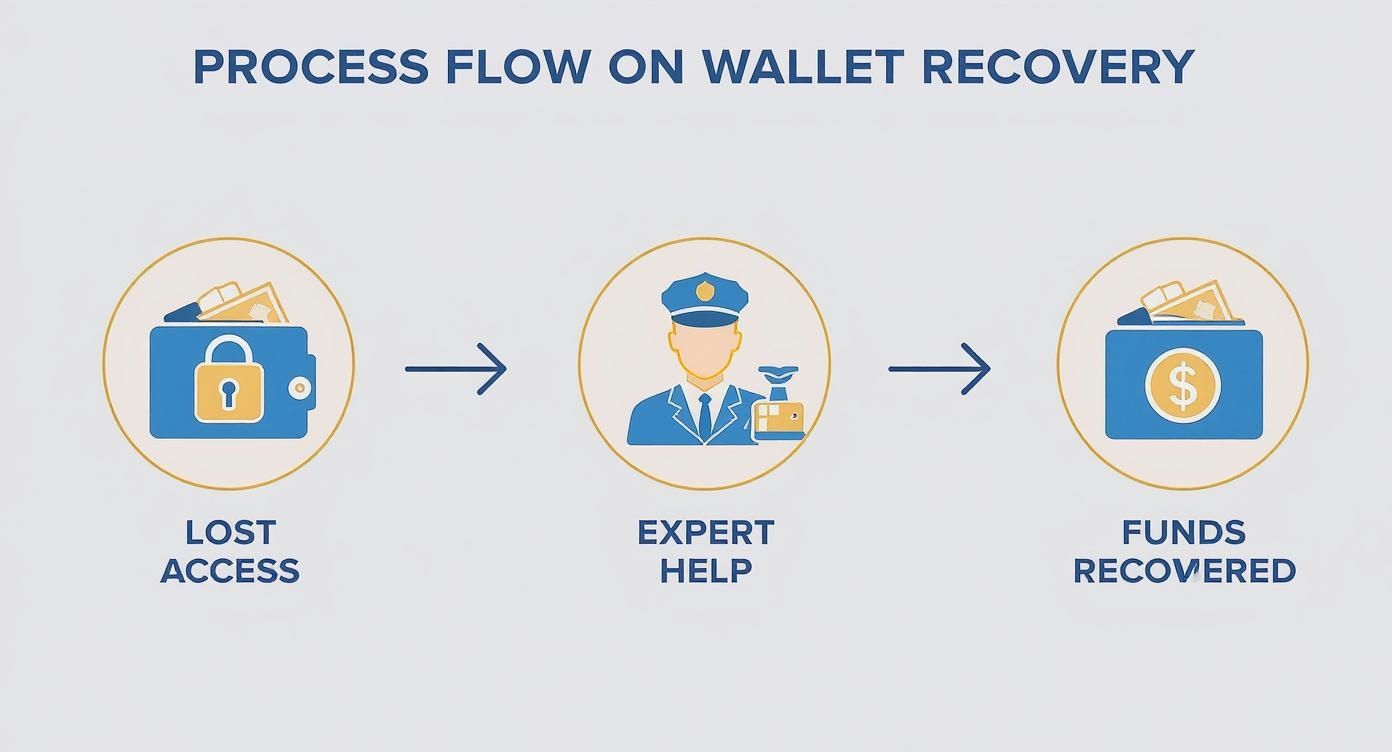
As you can see, a professional service turns chaos into a structured, expert-led process designed to get you back in control.
The Technical Toolkit Unpacked
Once the recovery specialists have all your clues, they get to work on the technical side. This is where the real magic happens, and it's definitely not a one-size-fits-all deal. The approach is tailored specifically to your situation.
- Advanced Brute-Forcing: This isn't just random guessing. Experts use custom-built rigs with powerful hardware that can churn through billions of password combinations a second. The real secret sauce, though, is how they use your personal clues—like family names, important dates, or common ways you substitute characters—to intelligently filter the search and find the right password exponentially faster.
- Forensic Data Recovery: If your hard drive is corrupted or your USB stick is fried, the process shifts into a data rescue mission. Specialists work in cleanroom environments with specialized tools to physically pull raw data from failing hardware, whether it's a hard drive, a broken phone, or a dead hardware wallet.
- Seed Phrase Reconstruction: Got an incomplete seed phrase or a scrambled word order? This is where algorithmic analysis comes in. Specialized software can test millions of possible word orders and combinations, checking each one against the blockchain until it finds the one that unlocks a valid wallet.
These methods require immense computational power and a level of expertise that's simply out of reach for most people. For anyone curious about tackling simpler cases themselves, various types of crypto recovery software are available that can be a good starting point.
Hardware Wallets and Recovery
A huge chunk of recovery work revolves around hardware wallets. While they're incredibly secure, they're also a single point of failure. If you lose or damage your Ledger or Trezor, that seed phrase is your only lifeline. The skyrocketing popularity of these devices just goes to show how vital professional recovery options are.
The hardware wallet market is booming for a reason. Valued at around USD 348.4 million in 2025, it's projected to grow at a compound annual rate of about 23.5% through 2032. This explosive growth is driven by people wanting to keep their keys offline and safe from hackers, which ironically makes recovery services even more critical when that physical device is lost. You can dig into more market data over at coherentmarketinsights.com.
A legitimate wallet recovery service operates with a clear, ethical framework. They are not hackers; they are digital archaeologists, carefully unearthing lost information using methodical, legal, and secure techniques.
The Final Step: Secure Asset Transfer
When the recovery attempt is successful, the final step is handled with extreme care. The service will guide you in setting up a brand-new, completely secure wallet. Only after you confirm you have sole control over this new wallet will they transfer the recovered funds directly to you.
This secure handover is non-negotiable. A reputable firm will never ask to hold your funds for you or request the private keys to your new wallet. Their job is to unlock the old door, nothing more. Then you move your assets to a new, safer home.
When you're staring at a locked wallet, stress and panic can set in fast. It’s a vulnerable moment, and unfortunately, it's exactly the kind of situation scammers love to exploit. They make big promises, preying on your desperation, only to leave you with even bigger losses.
Your single most important job right now is to distinguish a legitimate expert from a predator. This isn't just about getting your crypto back; it's about not making a terrible situation infinitely worse. You need a trusted partner, not another disaster.
Choosing a Trustworthy Recovery Service
The key is to take a deep breath and approach this methodically. Before you even think about sharing any information, you need to vet every potential wallet recovery service with a healthy dose of skepticism. A real professional will be completely transparent and will welcome your questions. A scammer, on the other hand, will try to rush you.
The Vetting Checklist: What to Look For
Think of this like hiring a specialist for a high-stakes financial operation—because that's precisely what it is. A genuine expert has a proven track record, clear business practices, and security protocols they’re proud to talk about.
Here’s a practical checklist to help you separate the pros from the cons:
- Public Reputation and Reviews: Go hunting for real, independent reviews. Check platforms like Trustpilot, dig through crypto forums, and see what people are saying on Reddit. A long history of detailed, positive feedback is a huge green flag.
- Transparent Fee Structure: The industry standard is a "no-win, no-fee" model. Simple as that. You should only pay a percentage of the recovered funds after the work is successfully completed. Anyone demanding a large payment upfront is not your friend.
- Professional Consultation: A legitimate service will always offer a free, no-pressure consultation to hear you out. They'll ask smart, detailed questions to figure out if they can actually help before making any promises.
- Security and Confidentiality: Ask them directly about their security. How will they protect your sensitive information? They should be using encrypted communication channels and be perfectly willing to sign a Non-Disclosure Agreement (NDA) to protect your privacy.
Don't skip this research phase. A few hours of due diligence now can literally save you from losing everything.
Red Flags That Scream "Scam!"
Scammers tend to sing the same tune. They play on your anxiety with guarantees that are just too good to be true. Learning to spot their tactics is your best defense.
The most dangerous word in the crypto recovery world is "guaranteed." No ethical service can guarantee a successful recovery because of all the technical variables. Anyone promising a 100% success rate is almost certainly lying to you.
Keep an eye out for these classic scam moves:
- Upfront Fees: This is the oldest trick in the book. They'll ask for a "service fee," "tax," or "tool cost" before they've done a thing. Once you send the money, they vanish.
- Unrealistic Promises: As we just covered, a 100% success guarantee is pure fiction. Real recovery work is complex, and success is never a sure thing.
- Vague Processes: If you ask a scammer how they work, you'll get a lot of buzzwords and hot air. They can't explain their technical methods because they don't have any.
- Requests for Full Control: They might ask for your other seed phrase words or the private keys to a different wallet, claiming they need it for the transfer. Never, ever share information that gives someone direct access to your other funds.
Knowing the difference between a real pro and a fake one is everything.
Reputable Service vs. Potential Scam: A Comparison
To make it crystal clear, use this side-by-side comparison to spot the differences between a trustworthy wallet recovery partner and the warning signs of a fraudulent operator.
| Characteristic | Reputable Service | Potential Scam |
|---|---|---|
| Payment Model | No-win, no-fee (paid from recovered funds) | Large upfront fees required |
| Success Claims | Realistic, case-by-case assessment | Guaranteed 100% success rate |
| Communication | Professional, secure, and transparent | High-pressure tactics, vague answers |
| Reputation | Verifiable reviews and public history | Anonymous or fake testimonials |
| Security | Clear protocols, NDAs offered | No mention of data security |
Ultimately, it comes down to professionalism. A real company has a reputation to uphold; a scammer is just looking for a quick payday and will disappear tomorrow.
The Impact of Choosing the Right Partner
Picking a competent and ethical service can genuinely be life-changing. This industry has come a long way, and today's specialists are achieving some incredible results. For instance, top wallet recovery service providers have reported remarkable outcomes heading into 2025.
Companies like Xpress Hacker Recovery (XHR) are at the forefront, claiming a 97% success rate in recovering lost cryptocurrency wallets. To put that in perspective, XHR alone reportedly recovered about $715 million for its clients, a massive number that shows just how effective—and in-demand—these services are. You can read more about these industry achievements on an article from Vocal.media.
These figures prove that with the right team on your side, recovering funds you thought were gone forever is absolutely possible. Your job is to find the skilled professionals who can get it done safely and ethically. Stick with this guide, and you can navigate your options with confidence and find a partner who truly has your back.
It's one thing to talk about the theory, but what do these recovery situations actually look like? It’s easy to feel like your specific problem is a lost cause, that you’re the only one who messed up this badly.
But the truth is, most wallet recovery cases fall into a few common buckets. It’s not about waving a magic wand; it’s a methodical process of using the right tools and deep expertise to fix very human mistakes or predictable hardware failures. Let's walk through some of the most common scenarios we see every day.
The Forgotten Password for an Old Wallet File
This is a classic. You were an early adopter, maybe mined some Bitcoin back in the day, and saved it in a wallet.dat file. You encrypted it with a password you haven't thought about in ten years, and now… nothing. The file is there, but the password is a total blank.
This is where a targeted brute-force attack comes in, but it’s far from random guessing. The process starts with a deep dive into your memory, gathering every possible clue, no matter how insignificant it seems.
- Personal Clues: Did you use pet names, important dates, or family members' names?
- Common Habits: Do you have a go-to pattern, like swapping letters for numbers (like 'e' for '3') or always adding a '!' at the end?
- Fuzzy Memories: Can you remember anything at all? Even the password's rough length or a small piece of it is a huge help.
Armed with this information, a specialist builds a custom "dictionary" file filled with potential passwords. Then, high-powered computer rigs start testing millions—or even billions—of variations based only on your clues. This radically boosts the chances of success compared to just guessing in the dark.
Your own memory is the single most valuable asset in these cases. A tiny detail you think is useless could be the very thing that cuts the search down from impossible to solvable.
The Incomplete or Damaged Seed Phrase
Here's another gut-wrenching moment: you find your seed phrase backup, but it's damaged. Maybe a coffee stain or water damage has made a few words impossible to read. Or worse, you realize you only wrote down 18 words of a 24-word phrase.
This isn't a dead end; it's a math problem. A standard seed phrase uses words from a specific list of 2,048 words, known as the BIP39 wordlist. If a few words are missing, we don't have to guess—we can calculate.
Specialized software can systematically plug every word from that list into the blank spots. For each new combination it creates, it checks the blockchain to see if that seed phrase corresponds to a wallet that actually exists and has a history. If you're only missing one or two words, this can be a surprisingly fast process. The more words missing or out of order, the harder it gets, but it's often still very much possible.
The Physically Damaged Hardware Wallet
Hardware wallets are tough, but they’re not invincible. We’ve seen them all—dropped, run over, water-damaged, or just dead from electronic failure. When the device won't even power on, it feels final. But the data inside is often perfectly fine.
This job calls for a completely different skillset, more like a forensic data recovery expert working in a sterile cleanroom.
- Device Teardown: First, the wallet is carefully taken apart in a static-free environment to avoid causing more damage.
- Chip-Off Recovery: The key component—the flash memory chip holding your encrypted private keys—is physically de-soldered and removed from the circuit board.
- Data Extraction: That tiny chip is then placed into a special reader that pulls the raw, encrypted data directly off it.
Once the data is successfully extracted, the problem usually shifts back to a password-cracking challenge to get past the device's PIN or passphrase. It’s a multi-stage attack, combining delicate physical work with heavy-duty software power, but it proves that even a physically dead wallet isn't necessarily a lost cause.
How to Avoid Needing Recovery Services
The best recovery is the one you never have to do. While a professional wallet recovery service is an incredible safety net, the real goal is to build a security system so tight you never have to make that call. Think of it as your first and most important line of defense—the one that keeps you in the driver's seat of your own assets.
Calling a recovery expert is like calling the fire department after your house is already burning. It's a critical service when you need it, but you'd have been far better off installing smoke detectors and fire extinguishers beforehand. Taking the time to bulletproof your crypto security now can save you a world of stress and potential financial loss later.
This isn't just about jotting down a seed phrase and hoping for the best. It's about creating a tough, multi-layered strategy that can handle anything from a simple mistake to a physical disaster.
Bulletproof Your Seed Phrase Management
Your seed phrase, sometimes called a wallet recovery phrase, is the master key to your entire crypto kingdom. Protecting it isn’t just a good idea—it’s everything. A flimsy piece of paper shoved in a desk drawer is just asking for trouble. It's an easy victim of fire, water, or even just being accidentally thrown out.
To really lock it down, you need to think about permanence and redundancy. For a deeper dive into the basics, our guide on the wallet recovery phrase is a great place to start.
Here are a few far more durable and strategic methods to consider:
- Metal Plate Backups: Get your seed phrase engraved or stamped onto a steel or titanium plate. These things are built to survive fires, floods, and just about anything else you can throw at them, far outlasting paper.
- Geographical Separation: This is a big one. Never keep all your backups in one location. Store a durable backup somewhere else entirely—like in a safe deposit box or at a trusted family member's home. This protects you if something like a fire or theft happens at your primary location.
- Digital Redundancy Done Right: Storing your seed phrase on a computer or in the cloud is a huge risk. If you absolutely feel you need a digital copy, make sure it is heavily encrypted and stored on a device that is never connected to the internet (an "air-gapped" device).
Explore Advanced Security Protocols
If you're holding a significant amount of crypto, basic backups might not cut it. This is where more advanced cryptographic schemes come into play, designed to distribute trust and get rid of single points of failure. These make it almost impossible for one mistake to wipe you out.
Shamir's Secret Sharing is a brilliant cryptographic method that splits a secret—like your seed phrase—into multiple unique parts, called 'shares.' You get to decide how many shares are needed to put the original secret back together.
For example, you could split your seed phrase into five shares but set it up so that you only need any three of those five to restore your wallet. You could then give one to your lawyer, one to a sibling, put one in a safe deposit box, and so on. That way, no single person or disaster can ever compromise your assets.
Test Your Recovery Plan Regularly
A backup plan you've never tested isn't a plan at all—it's just a wish. You absolutely have to check on your backups from time to time to make sure they're still good and that you actually know how to use them.
Schedule a "recovery drill" at least once a year. This is simple: you take your seed phrase backup and use it to restore your wallet on a fresh, clean device. This little test does two crucial things:
- It proves your backup is accurate and readable. You might find that a word has faded or that you made a mistake when you first wrote it down. Better to find that out now.
- It gets you comfortable with the restoration process. When you aren't in a panic, you can calmly walk through the steps, making sure you'll know exactly what to do if a real emergency ever strikes.
By putting these robust practices into place, you stop being a passive crypto holder and become an active guardian of your own wealth. That proactive mindset is the ultimate key to making sure you never need to call a wallet recovery service in the first place.
Your Wallet Recovery Questions, Answered
Losing access to your crypto is incredibly stressful, so it's only natural to have a lot of questions about how recovery services work. You're probably wondering about the cost, the security, and whether it's even possible to get your funds back.
Let's clear the air. This section will walk you through the most common questions people have when they're in your shoes. We'll give you the straightforward, practical answers you need to make a safe and informed decision.
How Much Do Wallet Recovery Services Typically Cost?
This is usually the first question on everyone's mind, and for good reason. The industry standard, and the only model you should trust, is a "no-win, no-fee" arrangement.
What this means is you only pay if they get your crypto back. Simple as that. The fee is almost always a percentage of the recovered funds, typically ranging from 10% to 20%. The exact rate will depend on how complex your case is and the value of the assets recovered.
Here's the big red flag to watch for: anyone demanding a large, non-refundable payment upfront. A legitimate company ties its success directly to yours and will always put the fee structure in writing before starting any work.
Is It Safe to Share My Partial Seed Phrase or Wallet File?
Handing over sensitive data feels risky, and you're right to be cautious. This is the single most important reason to choose a service with a rock-solid reputation for security and professionalism.
A trustworthy provider will take every precaution to protect your information. Here’s what that looks like in practice:
- Encrypted Communication: All your conversations and file transfers must be handled through secure, encrypted channels.
- Non-Disclosure Agreements (NDAs): A reputable service won't hesitate to sign an NDA, which legally binds them to confidentiality.
- Minimal Information Request: They will only ever ask for the absolute minimum data needed for the recovery attempt—like an encrypted wallet file or the seed phrase words you recall. They will never ask for information that gives them independent access to your other funds.
Always do your homework. Check out a company's security policies and public reputation before you send them a single piece of information.
What Is the Success Rate for Recovering Lost Crypto?
Success rates aren't a simple number; they vary wildly depending on the specifics of your case. For example, cracking a forgotten password has a much higher chance of success if you can offer clues or partial memories to narrow down the possibilities.
Likewise, recovering from a partial seed phrase is often feasible if you're just missing a few words or have them in the wrong order. On the other hand, a completely lost seed phrase that was never backed up is virtually impossible for anyone to recover.
A legitimate service might quote success rates between 30-50% for tough cases. Be extremely skeptical of anyone promising a 100% success rate. That’s not realistic—it's a marketing gimmick.
How Long Does the Crypto Recovery Process Take?
This is another area where patience is a virtue. The timeline can be anything from a few hours to several weeks, or sometimes even longer. It all comes down to the technical difficulty of the job.
A simple password recovery with good hints could be cracked fairly quickly using a targeted brute-force attack. But a complex case involving a long, totally forgotten password or data recovery from a damaged hard drive requires a massive amount of time and computing power.
Any reliable service will give you a realistic time estimate after they've assessed your situation. Everyone wants their crypto back yesterday, but the heavy-duty technical work involved just can't be rushed.
At Wallet Recovery AI, we provide secure, confidential, and expert assistance to help you regain access to your valuable digital assets. Our AI-enhanced approach is designed to tackle even the most complex recovery scenarios with professionalism and care. If you're locked out of your wallet, let our team help you find the way back in. Learn more and start your confidential assessment at https://walletrecovery.ai.
Leave a Reply