

Think of crypto recovery software as a digital locksmith for your crypto assets. When you’ve lost the key—whether it's a forgotten password, a corrupted wallet file, or a damaged hard drive—this kind of software is built to systematically pick the lock and get you back in.
How Does Crypto Recovery Software Actually Work?
At its heart, crypto recovery software is a highly specialized tool designed to brute-force its way through whatever is blocking you from your funds. It isn't a magic wand that can conjure lost keys out of thin air. Instead, it's a powerful suite of algorithms that gets to work on the data you do have, like a wallet file sitting on your computer, to find a way back inside.
Imagine your crypto is locked in a digital safe. You know the safe is yours and it's sitting right there on your hard drive, but the combination is gone from your memory. The software acts like a master locksmith, methodically trying thousands, or even millions, of potential combinations per second until it finds the one that clicks. It automates a process that would be literally impossible for a human to do manually.
These tools give you a structured way to tackle these problems head-on, offering a real lifeline when your digital assets seem gone for good.
When Is This Software the Right Tool for the Job?
The need for a tool like this usually pops up in a few common, and always stressful, situations. Many people turn to crypto recovery software when they're facing problems like:
- Forgotten Passwords: You have the wallet file, but the password needed to open it and sign transactions is completely blank in your mind.
- Corrupted Wallet Files: Your
wallet.dator JSON keystore file got scrambled and is now unreadable, maybe from a software crash, a virus, or just shutting down your computer the wrong way. - Damaged Storage Devices: The hard drive or SSD holding your wallet has suffered either physical or logical damage, making the files impossible to access normally.
Let's take a quick look at the kinds of problems this software is built to solve.
When Crypto Recovery Software Can Help
| The Problem | How The Software Helps |
|---|---|
| You forgot your wallet password. | It runs through millions of password variations based on hints you provide. |
Your wallet file (wallet.dat) is corrupted. |
It attempts to repair the file structure and extract the private keys. |
| Your hard drive is failing or damaged. | It can scan the drive sector-by-sector to find and piece together wallet data. |
| You accidentally deleted your wallet file. | It performs a deep scan of your storage device to recover the deleted files. |
Basically, if the core data still exists on a device you own, there's a good chance this software can help you get it back.
The sheer scale of lost and stolen crypto is staggering, which really drives home why reliable recovery options are so critical. To date, cybercriminals have siphoned over $28.2 billion from crypto platforms around the globe. In response, top-tier services like Puran Crypto Recovery (PCR) have reported recovering approximately $782 million for their clients, proving just how effective these dedicated efforts can be. You can dig deeper into these crypto recovery statistics and what they mean.
It's important to be clear: the main job here is to restore access, not to chase stolen funds across the blockchain. Think of it as a tool for self-custody problems—situations where you still control the device with the underlying data but have simply lost the key. It empowers you to tackle the problem yourself, on your own hardware, putting you back in control of your digital property.
How These Recovery Tools Actually Work
So, how do these recovery tools pull off what seems like a digital miracle? It's not magic—it's just a whole lot of methodical, high-speed guesswork. Think of these programs as digital forensic kits, specifically designed to hammer away at whatever is locking you out of your crypto.
Imagine your lost password is a massive, complex combination lock. A brute-force attack is the most straightforward approach. The software literally tries every single possible combination, one after another, until it hears that satisfying click. Of course, if your password is even moderately complex, the number of combinations can be astronomical, making this a painfully slow process.
That’s where you come in. The single most important factor is providing the software with hints. Any little scrap you can remember—a piece of the password, common words you use, its approximate length, or even a pattern—slashes the number of possibilities from trillions down to something manageable. You’re essentially telling the software where to focus its firepower.
The Power of Targeted Attacks
This is why the best recovery tools don't just guess randomly. They use smarter, more strategic methods to find the right combination.
A dictionary attack, for example, is a much sharper approach than a pure brute-force. Instead of trying nonsensical combinations like "a$7b&!z," it works through a massive list (a "dictionary") of common words, phrases, and passwords that people use all the time. It then gets clever, adding common variations like numbers and symbols to those words.
Then you have rule-based attacks. This is where you can give the software your personal password quirks. Maybe you always end your passwords with "123!" or capitalize the second word. You feed it these rules, and the software applies them to its wordlists, creating highly targeted guesses that are far more likely to be correct.
"The core principle is simple: leverage computational power to automate what a human could never do. A modern GPU can test billions of password variations per second, transforming a theoretical possibility into a practical solution for wallet recovery."
If you want to get a better sense of how these algorithms work under the hood, this guide on how to find lost passwords using targeted techniques is a great place to start. Understanding the process helps you give better hints, which can shave days or even weeks off the recovery time.
This infographic lays out the common situations where this kind of software becomes a lifesaver.
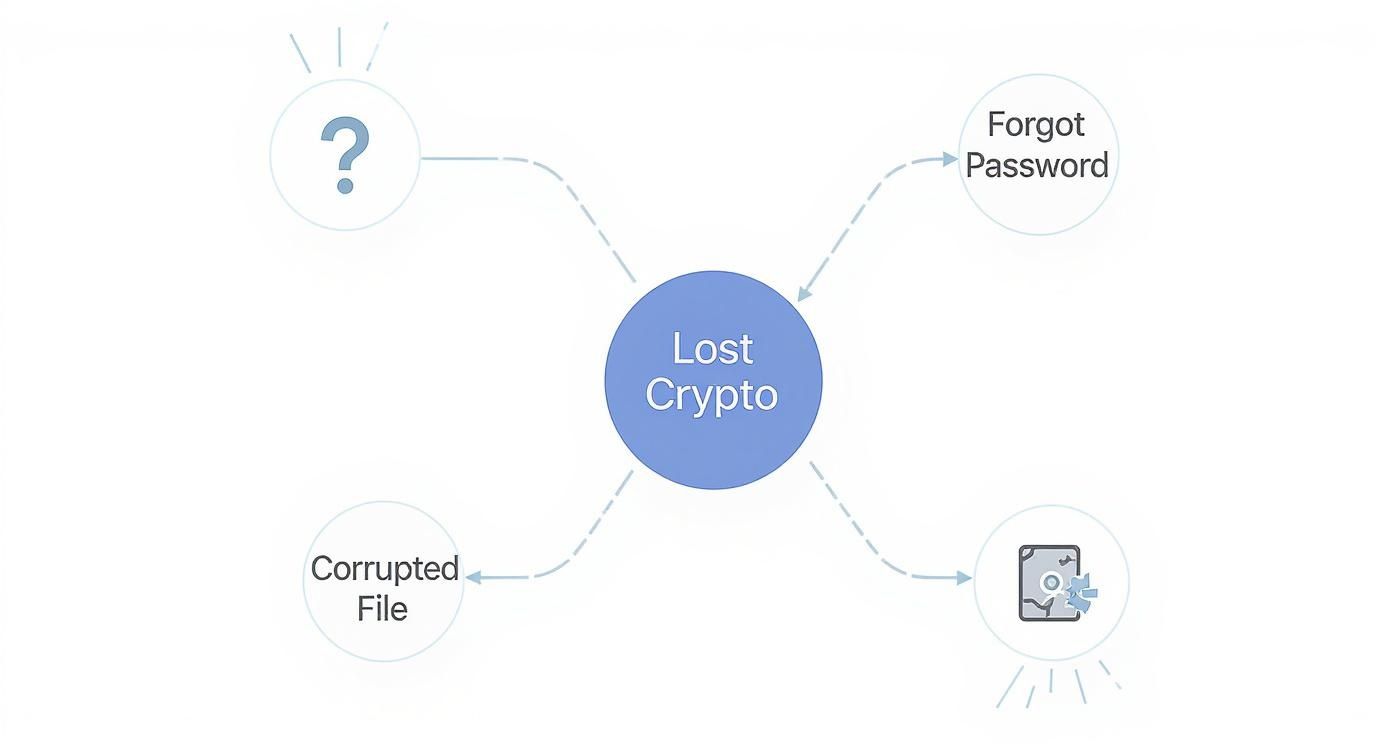
As you can see, whether it’s a simple forgotten password or a much bigger problem like a fried hard drive, a methodical recovery process is your best bet to get your funds back.
Recovering Corrupted and Damaged Wallet Files
But what if the problem isn't a password? What if the wallet file itself is a garbled mess? A wallet.dat file, for instance, holds your private keys inside a very specific data structure. If that structure gets corrupted—say, from a sudden power outage or a system crash—your wallet becomes unreadable.
In these cases, the recovery software switches hats and becomes a digital archaeologist. It doesn't care about a password. Instead, it meticulously sifts through the corrupted file, scanning for the digital fingerprints and data signatures that scream "private key here!" From there, it can either rebuild the file's original structure or just pull the keys straight out of the digital wreckage.
This is a multi-step process that usually involves:
- File Signature Analysis: The tool first looks for the file's "magic bytes"—a unique header identifying it as a specific wallet type.
- Key-Pair Scanning: It then dives into the raw binary data, hunting for the distinct cryptographic patterns of private and public key pairs.
- Data Reconstruction: If bits of the file are missing or scrambled, the software will try to piece the fragments back together into a working wallet.
- Extraction: Once valid keys are found, the tool yanks them out so you can import them into a fresh, uncorrupted wallet.
This same logic applies when you’re dealing with a physically damaged or dying hard drive. The software can perform a deep, sector-by-sector scan, finding and piecing together wallet data that your operating system gave up on long ago. It's a painstaking job, but it’s often the only way to rescue keys from a device that looks like a total goner.
Software Wallets vs. Hardware Wallets: A Different Ballgame for Recovery

Getting your crypto back isn't a one-size-fits-all process. The strategy shifts entirely depending on whether you're dealing with a software wallet or a hardware wallet. Think of it like this: recovering a file from your laptop is a completely different challenge than cracking open a physical safe.
Understanding this difference is the absolute first step. It dictates the kind of crypto recovery software or professional service you'll need, because the tools and techniques couldn't be more distinct.
Unlocking Software Wallets
Software wallets, also known as "hot wallets," keep your private keys in an encrypted file right on your computer or phone. Super convenient for quick transactions, but it also ties their fate to your device. When something goes wrong here, it's almost always a software problem.
The usual suspects for software wallet issues are:
- Corrupted Wallet Files: The classic
wallet.dator JSON file gets garbled from a system crash or because you shut down your PC too fast. - Forgotten Passwords: You have the file, but the password to unlock it is a complete blank.
- Accidental Deletion: Whoops. The wallet file just got sent to the recycling bin, which you then emptied.
In these situations, recovery software acts like a digital detective. It can scan your hard drive to undelete files, patch up corrupted data, or run a brute-force attack to methodically guess your password. The whole operation is contained on your computer, focused on the data stored right there.
Navigating Hardware Wallet Recovery
Hardware wallets, or "cold wallets," do the exact opposite. They lock your private keys away on a special, offline device. This creates a powerful air gap between your crypto and online threats like malware, but it also introduces a whole new set of recovery puzzles.
You can't just point a program at a hardware wallet and tell it to get to work. The recovery process revolves around the physical device itself and its credentials.
"A hardware wallet is designed to be a black box; its primary security feature is making private keys difficult to extract. This means recovery efforts must respect that architecture, focusing on the device's firmware and security chip without compromising the keys."
The biggest headaches with hardware wallets are usually a forgotten PIN, a physically broken device, or a firmware update that goes sideways and bricks it. In these cases, you almost never try to "crack" the device. The ultimate escape hatch is your seed phrase (also called a recovery phrase). That list of 12 to 24 words is the master key to everything.
If you have your seed phrase, you don't even need the old device. Just get a new hardware wallet, punch in those words during setup, and you'll restore full access to your funds. Easy.
When Recovery Gets More Complicated
The real trouble starts when you've lost both the PIN and the seed phrase, or if the device is so busted it won't even turn on. This is where you move beyond simple software and into the realm of specialized professional services. These experts use incredibly advanced techniques like chip-off forensics or glitching attacks to physically extract keys from the device’s memory chip—a high-stakes, delicate procedure.
As hardware wallets become more popular—representing nearly 22% of the crypto wallet market with over 5.8 million devices shipped—the need for these niche recovery skills is growing. With more than 71% of crypto users preferring them for security, the demand for solid hardware recovery options is only going up. You can read more about these growing hardware wallet market trends.
At the end of the day, your recovery plan boils down to one question: where are your keys? For software wallets, the fight is on your computer's turf. For hardware wallets, the battle is with a physical device, and that seed phrase is your trump card.
Choosing Trustworthy Crypto Recovery Software
Alright, let's turn theory into practice. Dipping your toes into the world of crypto recovery software can feel like walking through a minefield. One wrong step, and you could end up in a worse spot than when you started. Choosing the right tool isn't just a technical decision—it’s an act of trust.
Think of it like hiring a locksmith for a high-security safe. You wouldn't just pick the first name you find online. You'd want someone with a proven track record, the right tools for your specific lock, and a reputation for handling your property with care. The exact same logic applies here.
Evaluate Core Technical Capabilities
First things first: does the software actually fit your situation? A tool that’s brilliant at cracking Bitcoin wallet.dat files is completely useless if you're trying to save an Ethereum keystore from a dying hard drive.
Start by checking off these non-negotiables:
- Wallet and Coin Support: Does it explicitly list your wallet (like Exodus or MetaMask) and the specific crypto you need to access? If not, it's a no-go.
- Operating System Compatibility: Make sure the tool runs on your computer, whether it's Windows, macOS, or Linux. This sounds basic, but it’s a hard wall if there's a mismatch.
- Recovery Method Alignment: Does the software do what you need it to do? If you’ve forgotten a password, you need something with powerful brute-force or dictionary attack features. If your file is corrupted, it has to be a specialist in data reconstruction.
A good tool will be crystal clear about what it can and can't do. Vague promises are a huge red flag.
Prioritize Security Above All Else
This is the big one. Security isn't just a feature; it's the absolute foundation of any legitimate recovery tool. A proper piece of software is designed to work in a completely sealed-off environment, with zero connection to the internet.
The gold standard is simple: the software must operate 100% offline. If a tool needs an internet connection to run its recovery algorithms, it's a deal-breaker. That connection creates an unacceptable risk of your wallet data, private keys, or password attempts being exposed.
This offline principle ensures that nothing sensitive ever leaves your machine. Any software that asks you to connect to the web during the recovery process should be disqualified immediately. No exceptions.
Look for Signs of Legitimacy and Transparency
In an industry where scams are unfortunately common, reputation is everything. Real developers and services earn trust by being transparent, showing verifiable results, and getting positive feedback from the community. Scammers, on the other hand, just want to create a sense of urgency with wild promises.
Here’s a practical way to tell the good from the bad. Legitimate recovery software almost always has a few key things in common, so it's a good idea to build a small checklist when you're comparing your options.
Crypto Recovery Software Evaluation Checklist
| Feature | Why It Matters | What to Look For |
|---|---|---|
| Verifiable Success Rates | This shows a history of actually helping people. It proves competence. | Look for detailed case studies, independent reviews on sites like Reddit, and testimonials that feel genuine, not generic. |
| Offline Operation | This is your guarantee that sensitive data never leaves your computer. | The software's documentation or website should explicitly state that it runs without any internet connection. |
| Clear Pricing Model | Honest tools are upfront about their costs. Many even work on a "no win, no fee" basis. | A clear fee structure (e.g., you only pay after recovery is confirmed) with absolutely no hidden charges. |
On the flip side, be on high alert for these classic scam tactics:
- Asks for Your Seed Phrase Upfront: This is the reddest of red flags. You should never type your seed phrase into third-party software or give it to another person. Ever.
- Guarantees 100% Success: Recovery is never a sure thing. Password complexity or severe data corruption can make some wallets impossible to open. Anyone promising a guaranteed result is lying.
- Requires Remote Access to Your Computer: Letting a stranger control your machine is like handing them the keys to your digital life. Don't do it.
- Lacks Independent Reviews: If you can't find mentions of the tool on forums like Reddit, Bitcointalk, or reputable crypto news sites, it’s a bad sign. It’s either brand new and unproven or a well-disguised trap.
By sticking to this framework, you can cut through the noise, avoid the dangerous pitfalls, and pick a trustworthy crypto recovery software that puts the security of your funds first.
Of course, here's the rewritten section following your specific style and requirements.
How To Prevent The Need For Recovery

While crypto recovery software is an incredible safety net, the absolute best strategy is to never need it in the first place. It's all about building a fortress around your assets from day one, giving you a peace of mind that no software can truly match. This means shifting your mindset from reactive to proactive—taking control of your own security.
At the heart of it all is your seed phrase. Think of it as the master key to your entire crypto life. It's the one thing that can restore your funds on any compatible device, anywhere in the world.
Master Your Seed Phrase Security
Let's be clear: your seed phrase is everything. The most common reason people lose their crypto for good is because they lost this phrase. Just jotting it down on a piece of paper and shoving it in a drawer is a classic recipe for disaster. Paper burns, it gets soaked, and it gets thrown out by mistake.
Instead, you need to think about durability and redundancy. The goal is simple: make your backup tough enough to survive common household accidents.
- Go Beyond Paper: Don't just write it down; etch or stamp your seed phrase onto a metal plate. These things are built to withstand serious heat and water, ensuring your master key survives a fire or flood.
- Create Multiple Backups: Never, ever rely on a single copy. Keep at least two backups stored in different, secure, and geographically separate locations. This protects you from a localized disaster like a house fire or a break-in.
- Never Store It Digitally: This is non-negotiable. Don't save your seed phrase in a text file, snap a photo of it, or plug it into a password manager. Any device connected to the internet is a potential target for hackers. Keep it offline, always.
Believe it or not, a shocking 20–30% of cold wallet users admit to having no reliable backup of their seed phrase. This one statistic explains why recovery tools are so crucial. The data shows a clear pattern: users who take proactive steps, like stamping their phrases on metal plates, have a much higher success rate when things go wrong.
Implement Multi-Signature Wallets
If you want to take your security to the next level, look into a multi-signature (multisig) wallet. Imagine a bank vault that needs two or three different keys turned at the same time to open. That's a multisig wallet. It requires multiple private keys to sign off on a single transaction.
For example, with a "2-of-3" setup, you could keep one key on your laptop, another on your phone, and the third in a safe deposit box. To send any funds, you'd need to approve the transaction with at least two of those keys. This makes it incredibly difficult for a thief to get your crypto, since they’d have to compromise multiple devices or locations simultaneously. You can dive deeper into the importance of the wallet recovery phrase in our full guide.
In the end, bulletproof security isn’t about being a tech genius; it’s about disciplined habits. By prioritizing the physical safety of your seed phrase and adding layers like multisig, you dramatically reduce the odds of ever needing to make that panicked call for recovery software.
Of course. Here is the rewritten section, crafted to sound like an experienced human expert, following the specific style and tone requirements.
Common Questions About Crypto Recovery
Even after getting the basics down, it’s completely normal to still have a few questions. Let's be honest, the process can feel a bit technical, and with your crypto on the line, the stakes are incredibly high.
So, let's jump right into the questions we hear all the time. We'll tackle everything from "is this even possible?" to the critical differences between your options, clearing up the confusion so you can move forward with confidence.
Is It Really Possible To Recover Lost Cryptocurrency?
Yes, absolutely—in many situations. But success hinges entirely on the specifics of your case. The most important thing to understand is that the underlying wallet data must still exist, even if you can't get to it right now.
Think of it like this: your crypto is inside a locked digital safe (your wallet file). Recovery software acts as a highly skilled locksmith that can systematically figure out the combination (your forgotten password). If the safe itself is damaged (a corrupted file), the right tool can often repair the locking mechanism enough to get it open.
But these tools aren't magic. They can't just create private keys out of thin air. If the private keys are truly gone for good—say, the hard drive was physically destroyed with no seed phrase backup anywhere—then the crypto is likely lost forever. The software is designed to unlock the container, not to rematerialize what was inside.
Are Crypto Recovery Tools Safe To Use?
This is probably the most critical question you can ask, and the answer is: it depends entirely on the tool. The safety of any recovery software comes down to its design and the reputation of the people who built it. Any reputable crypto recovery software is built to run completely offline on your computer.
This offline operation is a non-negotiable security feature. It creates an "air gap" between your sensitive data and the internet, ensuring your private keys, seed phrase, or password guesses are never exposed to prying eyes.
A legitimate tool will never need an internet connection to do its job. It works locally on your machine, which means you're in full control of your sensitive data from start to finish.
Unfortunately, the crypto space is also rife with scams. Malicious programs often disguise themselves as helpful recovery tools, tricking you into entering your information only to drain your wallet. Always do your homework—research the tool, look for independent reviews, and give preference to open-source software that has been audited by security pros. And most importantly: never, ever type your seed phrase into an online website or tool.
How Much Does Crypto Recovery Usually Cost?
The cost can be anything from zero to a substantial percentage of the assets you're trying to get back. It really just depends on the route you take.
- Free Open-Source Tools: Some fantastic tools are built by the community and are free for anyone to use. The trade-off is that they often demand more technical know-how and usually lack a friendly user interface or customer support.
- Commercial Software: Paid software solutions frequently use a "success-based" fee. You might pay a flat fee or a price tiered to the wallet's value, but here's the key part: you often only pay after you've confirmed the wallet is unlocked. This is a great way to verify the tool actually works before you spend any money.
- Professional Services: For the really tough cases, bringing in a professional recovery service is the most expensive route. These experts typically charge a percentage of the recovered funds—often between 5% and 20%—depending on how complex the job is.
Software vs. Service: What Is The Difference?
Figuring out whether you need a piece of software or a full-blown service is key to getting the right help.
A recovery software is your do-it-yourself (DIY) option. You download the program, install it on your computer, and you're the one running the recovery process. This gives you the highest level of security and privacy because your wallet files and keys never leave your machine. It's the perfect choice for more common problems like a forgotten password or a corrupted wallet file.
A recovery service, on the other hand, means you're hiring a team of specialists to handle everything for you. This approach makes more sense for highly complex situations that require specialized hardware or deep forensic expertise, such as:
- Serious hardware failure on a cold storage device.
- Complex multi-signature wallet recovery.
- Blockchain forensics to trace stolen funds.
While services bring a ton of expertise to the table, they also require a huge amount of trust, as you'll likely need to hand over sensitive information. The bottom line: software helps you regain access to your own files, while a service is for outsourcing a much bigger, more complicated challenge.
At Wallet Recovery AI, we provide a secure, confidential service to help you regain access to your digital assets. If you're facing a locked wallet, our AI-enhanced process and expert team are here to guide you through every step. Start your confidential wallet recovery assessment with Wallet Recovery AI today.
Leave a Reply