When you're locked out of your digital assets, a cryptocurrency recovery service can feel like a last resort. These are specialized outfits, staffed by experts who use some pretty advanced tech to get you back into a wallet you thought was lost forever. They tackle everything from forgotten passwords and busted hardware to the messy aftermath of a scam.
The Reality of Losing Your Crypto Assets

Losing access to your crypto wallet is a uniquely gut-wrenching feeling. One minute, you're part of the financial future; the next, a simple mistake or a clever scam has slammed the door shut on your funds. The stakes are incredibly high, both financially and emotionally, and it happens more often than you'd think.
This isn't just about forgetting a password, either. The reasons people find themselves needing professional help are often complex and deeply personal.
Common Crypto Loss Scenarios
Think about the classic story: an early Bitcoin enthusiast mines a bunch of coins back in 2011, storing them on a laptop that's now gathering dust in the attic. Years go by, the password is long forgotten, but that old wallet now holds a small fortune. This is a prime example of a case for cryptocurrency recovery services.
Of course, there are plenty of other ways to get locked out:
- Forgotten Passwords: This is the big one. We're told to create complex, unique passwords, but sometimes they're a little too unique and get lost to time.
- Lost Seed Phrases: That 12 or 24-word phrase is the master key to your crypto. Misplace it, and you've got a serious problem.
- Hardware Failure: Hard drives crash. Hardware wallets like a Ledger or Trezor can break or become corrupted. When the physical device fails, your access can fail with it.
- Sophisticated Scams: Phishing schemes and elaborate social engineering cons are getting more convincing every day, tricking people into handing over their credentials or sending crypto to a thief's address.
The sheer scale of crypto theft and scams is mind-boggling. In 2024 alone, losses from these incidents have already hit $36.6 billion, a staggering 45% jump from the previous year. It’s a clear sign that the need for trustworthy recovery experts is only growing.
How Professional Recovery Services Operate
So, what happens when you call in the pros? A legitimate recovery service brings the kind of technical skill and raw computing power that's simply out of reach for most people.
Firms like Puran Crypto Recovery (PCR) have made a name for themselves in this space, claiming success rates as high as 94% across different types of loss situations. These specialists take the clues you can provide—password fragments, corrupted wallet files, old notes—and use them to systematically try and crack the code.
They are essentially digital locksmiths, blending forensic analysis with powerful, custom-built algorithms to give you a fighting chance to get back what's rightfully yours. You can discover more insights on how these services are changing the game for people who thought all hope was lost.
What to Do Before You Contact a Recovery Service

Before you fire off an email to a recovery professional, hitting pause and doing a bit of prep work can make all the difference. Think of it as gathering evidence for your own case. The more information you can pull together now, the better the odds are that a legitimate cryptocurrency recovery service can piece together the puzzle.
This initial legwork is absolutely crucial. Not only does it make the expert's job easier, but the process of digging through old notes and memories often shakes loose the one tiny detail that cracks the whole thing open.
Gather Every Scrap of Information You Can Find
Your first move is to open up a secure, offline document and start a "brain dump" of everything you know about the lost wallet. No detail is too small or insignificant. You’re trying to build a complete profile of the wallet and the circumstances around its loss.
Knowing the specific wallet you used, for instance, is a game-changer. A recovery attempt on a MetaMask wallet is a completely different beast than cracking an old Electrum file.
Here's what you should be hunting for:
- Wallet Type and Version: Was it a hardware wallet like a Ledger or Trezor? A desktop app like Exodus or Atomic Wallet? Pinpointing the exact software and even a rough version number is a huge head start.
- Password Clues and Fragments: Jot down every password variation you can possibly think of. This includes old passwords, common patterns you always use, names of pets or family, and significant dates. Even a partial password is an incredibly valuable piece of the puzzle.
- Linked Email Addresses or Usernames: Did you tie an email to the wallet or the exchange where you created it? List every single one you might have used.
- Date of Last Access: Try to remember the last time you successfully opened the wallet. This simple date can help a technician narrow the search and find the right files, especially if you have multiple old backups floating around.
- Location of Wallet Files: Do you still have the computer or hard drive where you first set up the wallet? If you know the file path to something like a
wallet.datfile for Bitcoin Core, write it down.
A Critical Warning: Whatever you do, do not download and run random brute-force recovery tools you find online. You could easily corrupt the wallet file permanently or add another layer of encryption, making professional recovery impossible. Leave the heavy lifting to the pros.
Securely Document and Organize Your Findings
As you collect this information, it's vital to keep it safe. Avoid typing it into a Google Doc or sending it to yourself in an unencrypted email. Your best bet is to write it down on physical paper and store it securely, or use an encrypted offline text editor.
This preparation does two things. First, it protects your already vulnerable information from any further risk. Second, it lets you present a clear, organized case to a service like Wallet Recovery AI. This allows us to assess your situation and give you a realistic success probability right away.
The following checklist is a great way to structure your notes before reaching out.
Your Wallet Recovery Information Checklist
Use this checklist to organize all necessary information before you contact a cryptocurrency recovery service.
| Information Category | Details to Collect | Why It's Important |
|---|---|---|
| Wallet Details | Name of the wallet software/hardware (e.g., MetaMask, Ledger Nano S), approximate version number, and the cryptocurrency it holds. | Different wallets have unique file structures and encryption methods; this directs the entire technical strategy. |
| Password Information | Any full passwords, partial passwords, common patterns, hints, or clues you can remember. List everything, no matter how unlikely. | This is the most crucial data. Even a small fragment drastically reduces the time and complexity of a brute-force attack. |
| Associated Accounts | Any email addresses, usernames, or phone numbers linked to the wallet or the platform where it was created. | These can be used to recover account data or provide clues to password patterns. |
| Key Dates | The approximate date the wallet was created and the date you last successfully accessed it. | Helps locate the correct backup files and can provide context for password creation (e.g., related to life events). |
| File Information | The location of any wallet files (e.g., wallet.dat, Keystore JSON files) on your computer, hard drive, or cloud backup. |
Having the actual encrypted file is often a prerequisite for any recovery attempt. |
| Seed Phrase/Private Key | Any words from a seed phrase you might have written down, even if the list is incomplete or the order is wrong. | An incomplete seed phrase is still incredibly powerful and can often be reconstructed with specialized tools. |
Taking the time to fill this out transforms a moment of panic into a structured, proactive recovery mission. When you provide a detailed summary like this, you're not just asking for help—you're giving the recovery team the ammunition they need to win back your funds.
So, you’ve hit a wall and need help getting back into your crypto wallet. This is a tough spot to be in, and unfortunately, it's a magnet for scammers. They prey on the panic and desperation that comes with losing access to your funds.
Choosing the right recovery partner is probably the most important decision you'll make in this entire process. Your diligence here is the difference between getting your crypto back and getting scammed a second time.
The good news? Scammers are often sloppy. They leave clues, make impossible promises, and use predictable tactics to rush you. A real expert, on the other hand, is methodical, transparent, and absolutely obsessed with security.
What a Trustworthy Service Looks Like
A legitimate crypto recovery service operates with a level of professionalism that's easy to spot once you know what to look for. These aren't just nice-to-haves; they're non-negotiable requirements that separate the pros from the predators.
First, check their public reputation. A company with a real history of success will have a digital footprint. Look them up on crypto forums like Reddit or Bitcointalk. Search for independent reviews, articles, or testimonials from actual clients.
Next, zoom in on their security practices. A reputable service will always:
- Never, ever ask for your seed phrase or private keys. This is the golden rule. A true professional only needs a secure, encrypted copy of your wallet file and your password hints to get to work.
- Insist on a Non-Disclosure Agreement (NDA). This is standard procedure. An NDA is a legal document that protects your confidentiality, and any serious service will require one.
- Use secure, encrypted channels for all communication. From the very first email, they should be protecting your information.
Red Flags That Should Send You Running
Spotting a scam gets a lot easier when you know their playbook. Fraudsters rely on a few classic tricks designed to exploit your anxiety and cloud your judgment.
The biggest, brightest red flag of them all is a 100% guarantee of success. No one can promise this. Crypto recovery is complex, and success is never a sure thing. Anyone offering a guarantee is selling you a fantasy.
Watch out for these other major warning signs:
- They demand upfront fees. The industry standard is a success-based fee. You should only pay a percentage after you have your funds back. A scammer will ask for a "processing fee" or "tax payment" before they've done anything.
- They use high-pressure sales tactics. If they're trying to rush you with "limited-time offers" or warnings that your funds will vanish if you don't act now, walk away. A real professional gives you time to think.
- Their company information is vague or missing. Can you find a business registration? A physical address? If they’re hiding behind an anonymous social media account or a generic website with no real details, be extremely suspicious. For a deeper dive, our guide on what to look for in a crypto recovery expert has more specifics.
How to Properly Vet a Potential Partner
Once you've narrowed down your list, it's time to put them to the test. Your goal is to verify their claims and get a gut check on their professionalism. Reach out and start asking pointed questions.
Ask them to walk you through their technical process. They won't give away their secret sauce, of course, but they should be able to explain their general approach—like using brute-force attacks with custom dictionaries—in a way that makes sense. A legitimate service is an open book about how they work and how they protect you.
The rise of successful, ethical recovery firms is precisely why so many scammers have flooded the market. Investors lost a staggering $3.1 billion to crypto scams and hacks in the first half of 2025 alone. In stark contrast, top-tier recovery firms reported success rates between 94% and 98% in 2024, proving that getting your assets back is very possible with the right team. Choosing a thoroughly vetted partner ensures you end up on the right side of those statistics.
A Look Inside the Technical Recovery Process
Let's pull back the curtain on how professional cryptocurrency recovery actually works. It's not magic; it’s a meticulous, high-tech process blending forensic analysis with a staggering amount of computing power. When you bring in a legitimate service, you’re hiring experts who live and breathe wallet encryption. They know how to systematically test every possible lock until one finally gives.
This is where brute force meets a sophisticated, intelligent strategy.
The whole thing often kicks off with what’s known as a brute-force attack, but this is miles beyond the basic tools you might find floating around online. Professionals use massive, custom-built computing clusters—we're talking networks of powerful GPUs—to hammer away at your wallet file, testing millions, sometimes billions, of password combinations every second.
But this isn't just a random shot in the dark. The brute force is guided by you.
Crafting Custom Dictionaries
This is where those little hints and fragments of memory you have become the blueprint for getting your crypto back. A professional service will take every single clue you can remember—old passwords, your dog's name, important dates, the weird way you always swap an 'e' for a '3'—and use it to build a custom dictionary attack.
This isn't some generic wordlist downloaded from the internet. It’s a personalized set of password candidates, algorithmically generated from your own data.
For instance, if you mentioned your dog was named "Buddy" and you were born in "1985," the system doesn't just try those two things. It starts building variations:
- Buddy1985
- buddy!85
- B#ddy1985!
- 19Buddy85
Now, imagine that logic scaled up across hundreds of permutations and combined with common password patterns. This intelligent approach dramatically boosts the odds of hitting the right combination compared to a blind, random assault.
Repairing Corrupted Wallet Files
Sometimes, the enemy isn't a forgotten password but a damaged wallet file. It happens. A hard drive fails, a power surge messes things up during a shutdown, or malware gets its hooks in. Suddenly, your wallet.dat or Keystore JSON file is corrupted and unreadable, even if you have the right password.
In these situations, technicians perform a kind of digital surgery. They dive into the file's binary code to find and patch up the corrupted sections, rebuild missing data structures, or even extract the private keys directly from the damaged file. It's an incredibly delicate operation that requires an expert-level understanding of specific wallet architectures.
Here's the bottom line: The entire recovery process lives or dies on secure collaboration. Reputable services will always operate under strict Non-Disclosure Agreements (NDAs) and use encrypted communication from the very first email. They will never ask for your seed phrase—only a secure copy of the encrypted wallet file.
The infographic below gives you a clear, simple process for vetting an expert before you hand over anything sensitive.
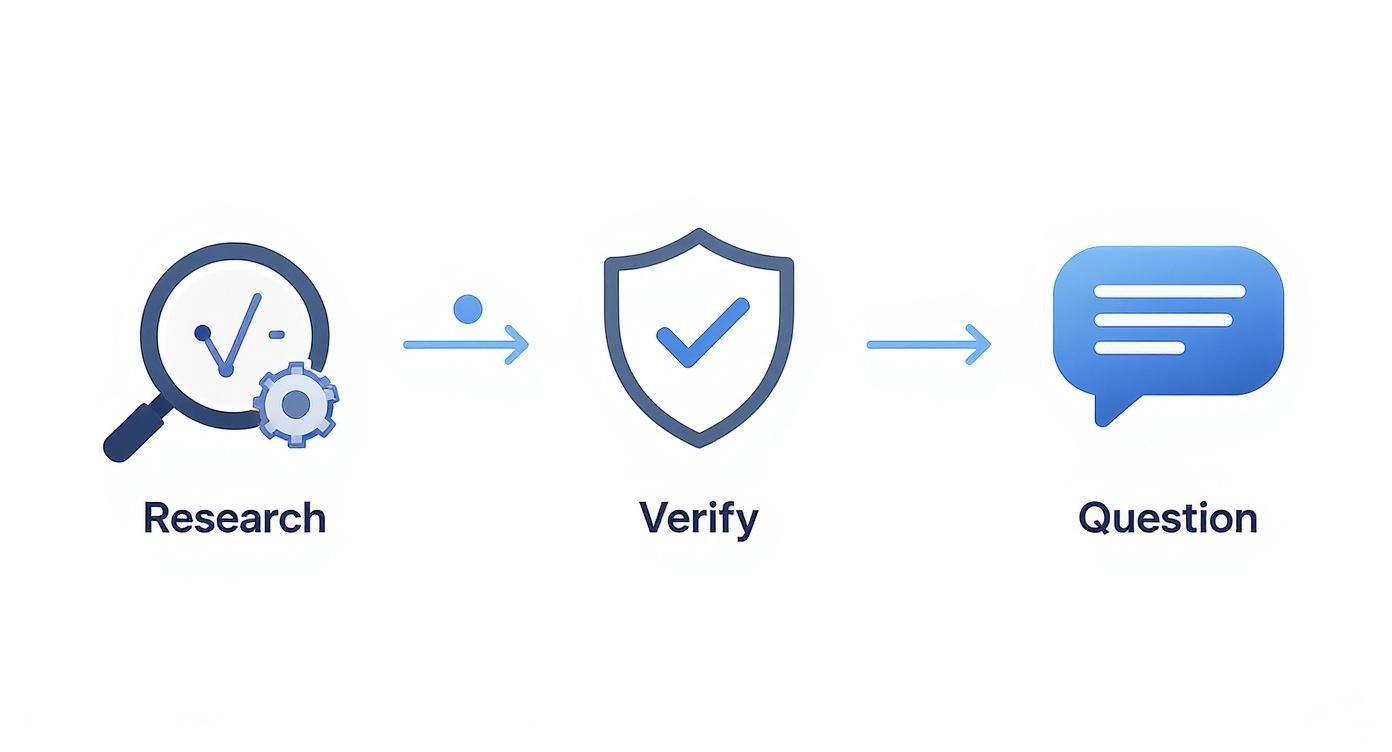
This flow really drives home the critical steps: research a firm's reputation, double-check their security protocols, and ask tough, direct questions before you commit. While the technical methods are impressive, they’re nothing without a foundation of trust.
You can also dig into the different types of crypto recovery software out there to get a better feel for the tools professionals have at their disposal. In the end, understanding both the tech and the security measures is what empowers you to choose the right partner and walk into the recovery process with your eyes wide open.
Why Security and Custody Are Everything in Asset Recovery
Let's get one thing straight: the world of cryptocurrency recovery services isn't some back-alley operation run by lone-wolf hackers. At least, the legitimate side isn't. The best firms operate as a highly specialized arm of the much larger, more established crypto asset management industry.
This connection is huge. It means they bring institutional-grade security and a serious level of professionalism to what is, for you, a very stressful and sensitive situation.
When you hand over your wallet data, you're not just hoping the person on the other end is a tech wizard. You're placing an immense amount of trust in their integrity and their security setup. The top firms get this. They build their entire operation around the same security models used by custodian services that protect billions in digital assets for massive institutions.
Thinking Like an Institutional Custodian
To handle your data and potential assets with the extreme care they deserve, top-tier recovery experts have lifted security measures straight from the institutional playbook. This isn't just a marketing line; it's a core part of how they have to operate to stay in business.
Here’s what that looks like in practice:
- Cold Storage First: Any recovered funds are immediately swept to offline, air-gapped hardware wallets. This isolates them completely from hackers and online threats.
- Multi-Signature (Multi-Sig) Controls: They use wallets that require multiple private keys to authorize a transaction. This simple but powerful step ensures no single person—not even a company executive—can move funds on their own.
- Airtight Data Handling: Your wallet file and password hints are kept in encrypted, isolated environments. Access is on a strict need-to-know basis, limited only to the technicians actively working on your case.
This isn't just about recovering your crypto. It's about turning a risky gamble into a secure, controlled, and professional procedure.
The Industry is Growing Up, and That's Good for You
The entire crypto asset management sector is maturing at an incredible pace, and that progress directly benefits anyone who needs recovery services. The global market, valued at around USD 1.73 billion in 2025, is expected to explode to USD 7.71 billion by 2032.
Custodian services—the ones focused on asset protection—hold the dominant market share at roughly 62.3%, using advanced security to keep funds safe. If you want to dive deeper, you can explore the full research on this growing market and see just how seriously professionalism is taking hold.
This isn't just about money pouring in. This growth reflects a major shift toward regulation and compliance. As regulators step in with clearer rules, they push out the shady operators, making the whole ecosystem safer for everyone.
What does this professionalization mean for you? It means you can have genuine confidence in the process. The legitimate players aren't just tech-savvy; they are compliant, often insured, and built on a foundation of trust and security.
Choosing a service that lives and breathes these principles isn't just a good idea—it's the only way to ensure your assets are in safe hands.
Your Top Crypto Recovery Questions, Answered
I get it. The world of crypto is complicated enough, and when you're locked out of your own funds, you need straight answers, not jargon. You've read through the process, but a few questions are probably still nagging at you. Let’s tackle the big ones I hear most often from people in your exact situation.
What’s This Going to Cost Me?
This is usually the first question, and for good reason. Any legitimate, professional recovery service operates on a success-based fee. It's that simple. You should never, ever pay a dime upfront.
The fee is just a percentage of whatever funds we successfully recover for you, and you only pay it after you’ve confirmed you have access to your crypto.
Think of it this way: our goals are perfectly aligned. We only get paid if you get your money back.
The standard rate in the industry hovers between 10% and 20%, and this range depends entirely on how complex your specific case is. If anyone asks you for an upfront "processing fee," a "tax," or a "software license," run. That’s the classic playbook for scammers looking to take advantage of people who are already in a tough spot.
How Do I Know My Wallet Info Is Safe?
Handing over sensitive information feels risky, and you're right to be cautious. The key is working with a vetted, reputable company that puts your security above all else. A true professional will never ask for your seed phrase. Let me repeat that: your seed phrase is for your eyes only.
The actual process is built around security and transparency. We work with an encrypted copy of your wallet file, not your master key.
Here’s what a secure engagement looks like:
- A Non-Disclosure Agreement (NDA): Before we even start, we both sign a legal contract that guarantees your privacy.
- Encrypted Channels: All our communication and file transfers happen over secure, protected connections. No exceptions.
- Offline Operations: We handle your encrypted wallet file on a secure, air-gapped system, completely isolated from any online threats.
What Are the Real-World Chances of Success?
Anyone promising a 100% success rate is not being honest with you. That's a massive red flag. The truth is, your odds depend entirely on your situation.
For cases where you've forgotten a password but can remember bits and pieces—old passwords, names, dates, common patterns you use—the chances are actually very high. Top-tier specialists, myself included, often see success in over 90% of these scenarios.
On the other hand, recovering funds from a sophisticated scam or a catastrophic hardware failure is a much tougher challenge with lower odds. A good service will be upfront about this. We'll give you a realistic, no-nonsense assessment of your chances based on the details you provide, so you can decide what’s best for you.
If you're staring at a locked wallet and need a professional partner you can trust, the team at Wallet Recovery AI is ready to help. We combine sophisticated recovery techniques with a security-first approach to give you the best possible shot at getting your funds back.
Start Your Confidential Recovery Assessment with Wallet Recovery AI
Leave a Reply