
A cryptocurrency recovery firm is essentially a team of digital detectives for the blockchain. When all other options are exhausted, these specialists step in with advanced technical and investigative skills to help people and businesses get back lost, stolen, or otherwise inaccessible crypto assets. Their work can be anything from cracking a long-forgotten password to tracing stolen funds through a maze of fraudulent transactions.
Understanding the Role of a Cryptocurrency Recovery Firm

Think of these firms as a forensic accounting unit, but for the digital world. A forensic accountant meticulously follows a paper trail to find where money went; a crypto recovery expert does the same thing, but across the unchangeable public ledger of the blockchain. They’re the last call for high-stakes situations where crypto seems gone for good.
The need for these services comes from the very design of cryptocurrency. Unlike your bank account, where you can just reset a password or call customer service to dispute a charge, crypto transactions are final. With self-custody, the responsibility is 100% on you. One simple mistake—a forgotten password, a fried hard drive, or falling for a phishing scam—can mean your funds are lost forever.
Common Crypto Loss Disasters
People and businesses usually turn to a recovery firm after a catastrophe. The skills needed to fix these problems are far beyond what the average crypto owner has. These scenarios are all too common:
- Forgotten Credentials: You’ve lost or can’t remember the password to an encrypted wallet file.
- Hardware Failure: Your hard drive dies, or a hardware wallet (like a Ledger or Trezor) gets corrupted, damaged, or just stops working.
- Theft and Scams: Your funds get swiped through a clever hack, a phishing attack, or a shady investment scheme you thought was legitimate.
- Inaccessible Exchanges: An exchange gets hacked or goes belly-up, locking you out of your account and your assets.
A legitimate cryptocurrency recovery firm will never contact you first or promise guaranteed results. Unsolicited outreach and bold claims are major red flags, often used by secondary scammers preying on victims who have already suffered a loss.
These firms bring a potent mix of deep technical know-how and sharp investigative instincts to the table. They might use powerful computer arrays to brute-force a password, perform delicate data extraction from a broken device in a clean room, or use on-chain analysis to follow stolen funds until they can be legally frozen and reclaimed. Their unique skill set is often the last line of defense in the decentralized world.
To give you a clearer picture, the table below breaks down some frequent loss scenarios and the strategies a professional firm might use to tackle them.
Common Crypto Loss Scenarios and Professional Recovery Methods
| Loss Scenario | Common Cause | Recovery Firm's Approach |
|---|---|---|
| Locked Wallet | User forgets a complex password or loses a seed phrase. | Utilizes advanced brute-force and algorithmic attacks to test millions of password variations. |
| Damaged Device | A hard drive containing wallet files fails or a hardware wallet is broken. | Performs physical data recovery in a specialized lab to extract critical wallet files or keys. |
| Exchange Hack | A centralized exchange is compromised, and user funds are stolen. | Traces stolen assets on the blockchain and collaborates with law enforcement to freeze funds at other exchanges. |
| Investment Scam | Victim sends crypto to a fraudulent platform or individual. | Conducts blockchain forensic analysis to follow the transaction trail and identify the scammer's wallets. |
As you can see, each problem requires a highly specialized approach that combines different fields of expertise, from data science to digital forensics.
How Experts Technically Recover Your Crypto
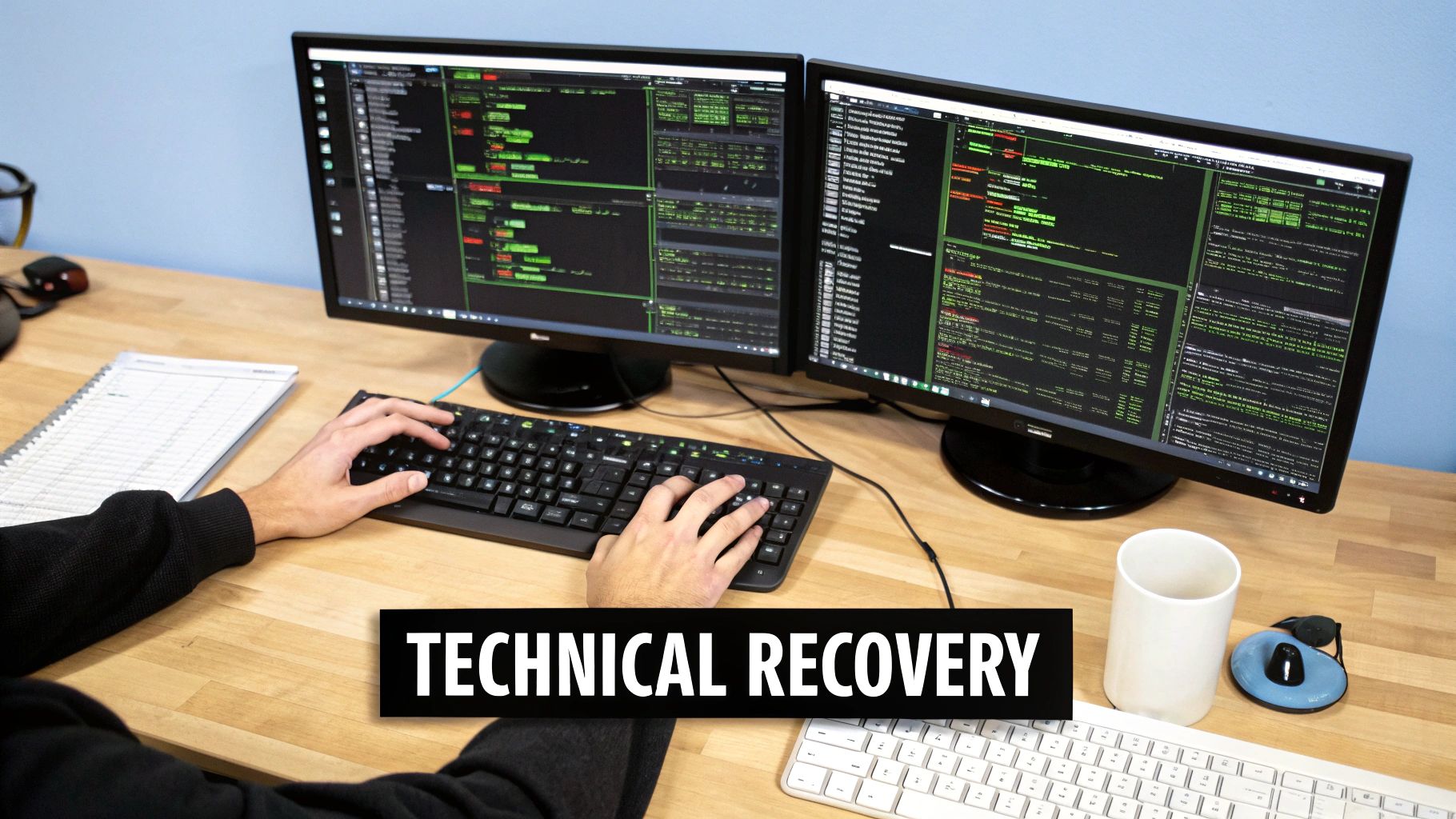
Recovering crypto isn't a magic trick. It's a methodical hunt that blends deep technical skill with old-school investigative work. A real recovery firm has a whole toolkit of strategies they can deploy depending on how you lost your funds, and it goes way beyond anything you could pull off on your own. We're talking specialized software, massive computing power, and sometimes, a little help from the legal system.
Think of it like a digital crime scene. When your crypto is stolen, the first move is blockchain forensics. This is the digital equivalent of dusting for fingerprints. Experts use sophisticated analytical tools to trace the path of your stolen coins across the public ledger. They follow the money through a maze of transactions and wallets, searching for patterns, clues, or a final destination—like an account at a major crypto exchange.
Unlocking Wallets and Rescuing Damaged Drives
But what if it's not theft? What if you just can't remember your password? That's when the approach shifts from investigation to raw computational power. A brute-force attack sounds aggressive, but it's a systematic process where high-performance computers try millions (or even billions) of password combinations against your encrypted wallet file.
This isn't just random guessing. A pro will use every scrap of information you can give them—fragments of old passwords, important dates, pet names—to build intelligent, targeted wordlists. This smart approach massively cuts down the time and dramatically boosts the odds of hitting the right combination.
Sometimes the problem is physical. A fried hard drive or a smashed hardware wallet can feel like a total loss. In these scenarios, specialists perform physical data recovery in a sterile, lab-like environment called a clean room. They carefully take the device apart to get at its internal memory chips, hoping to extract the raw data that holds your precious private keys or seed phrase.
The secret to crypto recovery is finding the weakest link in the chain of loss. Whether it’s a forgotten password, a busted device, or a scammer's sloppy transaction trail, experts know how to apply the right tool to that specific weakness.
The Crossover Into Legal and Investigative Action
Technical skill alone isn't always enough, especially with theft. If blockchain forensics tracks your stolen funds to a regulated exchange, the recovery firm's job changes. They’ll bundle up all their findings into a detailed forensic report that you can take straight to law enforcement.
This hard evidence is what you need to back up legal actions, like getting a court order or subpoena to force the exchange to freeze the thief's account. This dance between technical tracing and legal strategy is often the only way to get money back from sophisticated scammers. It shows the well-rounded expertise a top-tier firm brings to the fight. To see what powers these efforts, you can learn more about the specialized crypto recovery software that experts have in their arsenal.
Choosing a Recovery Firm Without Getting Scammed
Trying to find help after a crypto loss can feel like walking through a minefield. Scammers love to target people who are already in a desperate situation, making it incredibly risky if you don't know what to look for. Your job is to find a legitimate cryptocurrency recovery firm, not get tangled up in a second scam.
The very first thing to check is if the company is even real. A legitimate firm will have a physical address you can verify and an official business registration. If a company is operating from the shadows with no concrete details, that's a huge red flag. Just walk away.
Vetting a Firm’s Credibility
Beyond the basics, you need to dig into their actual expertise. A trustworthy firm isn't shy about its team's background. Look for professionals with real-world experience in cybersecurity, blockchain forensics, or even former law enforcement. These are the people who actually know how to get things done.
The biggest warning sign of a scam is a demand for a large upfront payment. Real recovery firms almost always work on a success-fee model. They take a cut after they get your funds back, which means their goals are perfectly aligned with yours.
To make sure their claims are solid, ask for proof of their past work. This could be things like:
- Verifiable Case Studies: Detailed stories of past recovery jobs that show you their methods and results.
- On-Chain Evidence: While they need to protect client privacy, a firm can sometimes point to public blockchain transactions that back up their recovery claims.
- Third-Party Reviews: Don't just read the glowing testimonials on their website. Look for reviews on independent platforms to get the full picture.
Top-tier cryptocurrency recovery firms have an impressive track record, with some achieving a high success rate and retrieving hundreds of millions of dollars for thousands of clients. It just goes to show how effective a specialized team can be when they combine blockchain forensics, legal know-how, and connections with law enforcement. You can see more on this by checking out the crypto scam recovery success statistics at CoinLaw.io.
Understanding the Fee Structure
How a company charges you says everything about their integrity. The industry gold standard is a "no-win, no-fee" model, also known as a success-based fee. You only pay if they actually get your crypto back. Simple as that.
Here’s a quick breakdown of what to look for:
| Fee Structure | Legitimacy Signal | Why It Matters |
|---|---|---|
| Large Upfront Payment | High Risk (Scam) | The firm gets paid whether they succeed or fail, so they have zero incentive to actually help you. |
| Small Assessment Fee | Moderate Risk | Some legit firms charge a small fee to see if your case is even possible. This should be minimal. |
| Success-Based Fee | Low Risk (Legit) | The firm is motivated to recover your funds because that's the only way they get paid. |
A typical success fee will run you anywhere from 10% to 30% of the recovered value, and it usually depends on how complex the case is. Always, always demand a clear, written contract that spells out all the costs, what they promise to do, and the timeline before you agree to anything.
Choosing the right asset recovery company is your single best defense against losing even more money. If you prioritize transparency and stick to firms with a success-based fee, you can find a partner who is genuinely invested in getting your funds back.
What to Expect During the Recovery Process
Knowing what’s around the corner can make a tense situation feel a lot more manageable. When you work with a real, professional crypto recovery firm, you’re not just handing over your problem—you’re stepping into a structured, methodical process. It’s not magic, and it’s definitely not instant. It’s a careful, step-by-step effort to give you the best possible shot at getting your funds back.
The whole thing kicks off with an initial consultation. Think of this as a no-strings-attached conversation where you lay out what happened. The firm’s experts will listen and ask targeted questions to see if they can genuinely help. Are you dealing with a forgotten password, a dead hard drive, or a complex scam? Their first job is to figure out if recovery is even on the table.
The Formal Engagement and Recovery Phases
If they're confident they can tackle your case, you'll move on to a formal agreement. This is a non-negotiable step and a huge green flag. This contract should spell everything out in plain English: what they plan to do, the strategy they'll use, how they get paid (it should always be success-based), and a realistic timeline. Don't move an inch without a signed contract that protects you.
With the paperwork out of the way, the active recovery phase begins. This is where the real heavy lifting happens. Depending on your situation, this could mean unleashing powerful computers to brute-force a password, performing forensic data extraction on a broken device, or diving deep into blockchain forensics to trace stolen crypto. This part takes patience. Complex cases can take weeks, sometimes even months.
A legitimate firm will keep you in the loop. You won't get a play-by-play every single day, but you should expect regular progress updates and have a direct line to someone who can answer your questions.
Timelines and Getting Your Assets Back Safely
Let’s be clear about one thing: real crypto recovery takes time. Anyone promising to get your funds back in a few hours is almost certainly a scammer. A simple password recovery might take a few weeks, while a tangled theft investigation could stretch on for months. A trustworthy company will be upfront about this from the start.
The final, and best, part of the process is the secure return of your assets. Once your crypto is recovered, the firm will work with you to transfer it to a brand-new, secure wallet that only you control. They'll walk you through every step to make sure your assets are safe for good.
Before you even get to that point, though, you need to choose the right partner. This simple flowchart breaks down the critical due diligence you need to do upfront.
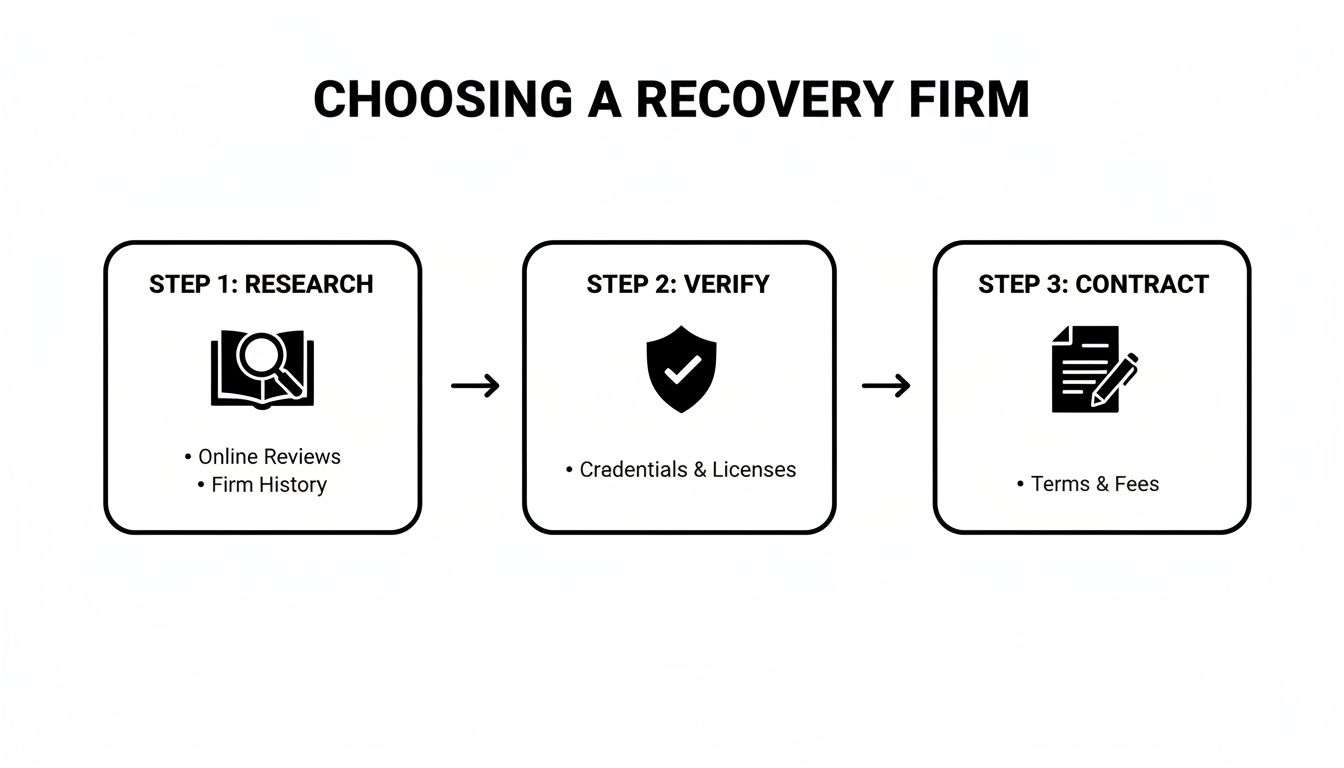
The takeaway here is simple: do your homework. Researching, verifying, and checking the contract terms isn't just a good idea—it's essential for keeping your assets safe.
Navigating the Security and Privacy Minefield
Let's be blunt: when you hire a crypto recovery firm, you’re handing someone the keys to your digital safe. It’s an act that requires an enormous amount of trust. Facing the security and privacy risks head-on isn’t just a good idea—it’s the only way to protect yourself from making a bad situation even worse.
The kind of information you might need to share is incredibly sensitive. We're talking about wallet files, scraps of old passwords, clues to a seed phrase, or even detailed transaction logs from a theft. A true professional understands the weight of this responsibility and will never ask for more information than is absolutely essential to get the job done.
How to Protect Your Private Data
From the very first email, a legitimate expert puts your privacy first. They’ll have a secure system for communication and handling your data, making sure nothing leaks.
Here are the non-negotiables:
- Non-Disclosure Agreements (NDAs): This is ground zero. An NDA is a legally binding contract that makes it illegal for the firm to share your information. It’s a standard first step and a clear sign you’re dealing with professionals.
- Encrypted Communication: All your conversations and file transfers must happen over secure, end-to-end encrypted channels. This scrambling of data is what stops snoops from intercepting your private details.
- A Clear Data Destruction Policy: You need to ask what happens to your sensitive files after the job is over, whether they succeed or not. A good firm will have a strict policy for wiping your data from their systems.
A trustworthy firm’s only goal is to get your crypto back, not to collect your data. If a company seems casual about security or immediately pressures you for full passwords or your entire seed phrase, that's a massive red flag. Walk away.
Why a Legal Agreement Is Your Best Friend
Beyond secure channels, a solid legal contract is your most powerful form of protection. Insist on a comprehensive service agreement before any work begins. This document lays out all the rules of the engagement, so there’s no confusion later on.
Before you sign anything, make sure the contract clearly spells out:
- Scope of Work: What, exactly, will the firm be doing to try and recover your funds?
- Fee Structure: How much will it cost? It should detail the success-based fee and any other possible charges.
- Liabilities and Guarantees: What happens if they can't recover the funds? What are the limits of their responsibility?
This contract isn't just for you; it protects the firm, too. It turns a handshake deal into a formal, accountable partnership where everyone knows where they stand.
Securing Your Funds After Recovery
Okay, let's say they did it—the funds are back. The job isn't over. The final step is arguably the most important for your long-term peace of mind.
Any professional firm will insist that you immediately move the recovered assets to a brand-new, completely clean wallet. This means a wallet with a fresh seed phrase that has never been typed into a computer, photographed, or stored digitally.
This one action ensures that whatever security hole caused the initial loss—whether it was malware on your computer or a weak password—can't be used against you again. It’s the final, critical step to locking down your assets for good.
Frequently Asked Questions About Crypto Recovery
When you're staring down the barrel of a potential crypto loss, the questions and uncertainty can be overwhelming. Let's cut through the noise and get you some straight, clear answers to the most common things people ask when considering a cryptocurrency recovery firm.
Every situation is different, of course, but this should help you set some realistic expectations for what's ahead.
How Much Does a Cryptocurrency Recovery Service Cost?
This varies a lot, but any firm worth its salt will work on a success-fee model. What this means is they take a percentage of the funds they get back for you—usually somewhere between 10% and 30%—and they only get paid after your assets are safely back in your control. Some might ask for a small, upfront fee to cover the initial deep-dive analysis of your case.
Be incredibly cautious of anyone demanding a huge payment before they even start. That's the biggest red flag of a recovery scam out there. It gives them zero incentive to actually succeed. Always, always get the full fee structure in writing.
A clear, performance-based fee lines up their goals with yours. Simply put: they only win if you win.
Can You Recover Crypto Sent to a Scammer?
Getting crypto back from a scammer is tough, no doubt about it, but it's not always impossible. Success really comes down to how fast you act and what the scammer does next. If the thief moves your funds to a big, regulated exchange, a recovery expert can use blockchain forensics to trace the money trail.
With that solid proof in hand, law enforcement can be brought in to potentially freeze the scammer's account. The things that really matter are:
- Speed: The quicker you get started, the less time the scammer has to tumble the funds through mixers or swap them for privacy coins.
- Destination: Money sent to well-known, regulated exchanges is much, much easier to intercept and recover.
- Evidence: A professional forensic report is what convinces exchanges and police to take action. Without it, you're just another voice in the crowd.
How Long Does the Crypto Recovery Process Take?
The timeline is completely tied to how complex your case is. A simple password recovery for a single wallet might take just a few days or weeks of heavy-duty computing. On the flip side, chasing stolen funds across multiple blockchains and dealing with all the legal hoops can easily stretch out for several months.
No legitimate firm is going to promise you an instant, guaranteed result. A true professional will look at the specifics of your situation and give you a realistic estimate during your first chat.
What Is the Typical Success Rate for Crypto Recovery?
Success rates are all over the map depending on what happened. Cases involving lost passwords or seed phrases have a much higher chance of success than theft investigations. While the top-tier firms often have great track records on the cases they take on, nobody can guarantee recovery.
If you see a cryptocurrency recovery firm advertising a 100% success rate, run the other way. It's a classic, misleading tactic that fraudulent outfits use to prey on people who are desperate. A firm you can trust will be upfront about your odds and the challenges they see in your specific case.
If you've lost access to your wallet because of a forgotten password or a corrupted file, Wallet Recovery AI offers a discreet and secure way to reclaim your assets. Our AI-enhanced approach is built to maximize your chances of success while keeping your data completely private. Start your confidential recovery process today.
Leave a Reply