

A seed phrase wallet is a crypto wallet that gives you a list of 12 to 24 simple words to back up and restore your funds. Think of it as the one and only master key to everything you own in the crypto world. It's how you get back in if your phone gets stolen, your computer dies, or you just forget your password.
What Is a Seed Phrase? Your Digital Lifeline
Imagine you have a physical vault full of your most valuable things. Instead of a clunky metal key, you have a secret sentence. With that sentence, you can instantly rebuild that exact vault, contents and all, anywhere on the planet. That's what a seed phrase does for your crypto. It's your ultimate backup, the very foundation of taking control of your own money.
This string of words—often called a recovery phrase or mnemonic seed—is the heart of any non-custodial wallet. The moment you set up a new wallet, it generates this unique phrase just for you. From that point forward, you're the only one in charge.
The Power and Peril of True Ownership
Unlike a bank account, a seed phrase wallet puts you in absolute control. There's no one to call for help, no customer service line, and definitely no "forgot my password" button. This kind of direct ownership is liberating, but it also comes with serious responsibility. If you lose that seed phrase, your crypto is gone. Forever.
This idea can be a tough pill to swallow if you're used to traditional banking. The crypto space is littered with tragic stories of permanent loss, not from sophisticated hacks, but from a simple slip-up like a misplaced piece of paper. In the high-stakes world of cryptocurrency, that seed phrase is your lifeline, yet it's also a massive point of failure. Just look at the stats: after $3.4 billion was swiped in crypto hacks in 2025 alone, an even quieter crisis was unfolding—countless people losing everything due to poor seed phrase management. These losses don't make the news because there's no bank to call.
Key Takeaway: With a seed phrase, you are your own bank. You get total freedom, but you also carry the full weight of securing your assets. Lose the master key, and there's no safety net.
Before we go further, it's helpful to see where a seed phrase fits in the bigger picture. Here’s a quick breakdown of the core ideas.
Seed Phrase Wallet at a Glance
| Concept | Description |
|---|---|
| Seed Phrase | A list of 12-24 words that acts as the master backup for your entire wallet. |
| Private Keys | The actual cryptographic keys that sign transactions and prove ownership of your assets. |
| Derivation | Your wallet uses the seed phrase to mathematically generate every single private key you'll ever need. |
| Self-Custody | You, and only you, hold the seed phrase, giving you 100% control over your funds. |
This table shows how everything connects: the seed phrase is the source of all your power and control within a non-custodial wallet.
Custodial vs. Non-Custodial: A Critical Distinction
To really get why a seed phrase is so important, you need to understand the two main types of wallets out there:
- Custodial Wallets: These are run by a third party, like a crypto exchange. They hold your keys for you. It's convenient, sure, but you're trusting them with your money, just like a bank. You don't get a seed phrase because you don't actually own the keys.
- Non-Custodial Wallets: You hold the private keys, which are all derived from your seed phrase. This gives you complete, undeniable control over your funds. A seed phrase wallet is, by its very nature, non-custodial.
Choosing a non-custodial wallet is a big step toward financial freedom. It means no one can freeze your account, block a transaction, or lose your money because they got hacked. It all comes down to those 12 or 24 words. For a closer look at this, check out our guide on the fundamental differences between a wallet and a seed phrase.
How a Seed Phrase Magically Generates Your Wallet
It might seem like black magic that 12 simple words can hold the keys to an entire crypto portfolio. But it's not magic at all—it's just incredibly clever math. This process isn't random; it's a rock-solid, standardized system that makes a seed phrase wallet so powerful and reliable.
The whole thing is built on a set of agreed-upon industry standards, starting with Bitcoin Improvement Proposal 39 (BIP39). Think of BIP39 as the universal recipe book that turns your list of words into one master secret, known as a "seed." This standard is why the phrase "apple pear banana…" will generate the exact same master seed whether you type it into MetaMask, a Ledger, or a Trezor. It creates a common language for all wallets to speak.
The Seed as the Root of Your Financial Tree
Once BIP39 turns your words into that master seed, another standard called BIP32 steps in. This is where a tree analogy really helps. Picture your master seed as the single, vital root of a massive tree. Everything—every single key, address, and transaction—grows from this one starting point.
From this root, BIP32 derives a "master private key" and a "master chain code." Together, they form the trunk of your financial tree. This is the main pathway from which all your accounts will branch out. This entire structure is what defines a Hierarchical Deterministic (HD) wallet, one of the most important innovations in crypto security.
The diagram below shows this top-down relationship, from the seed phrase all the way down to the individual keys.
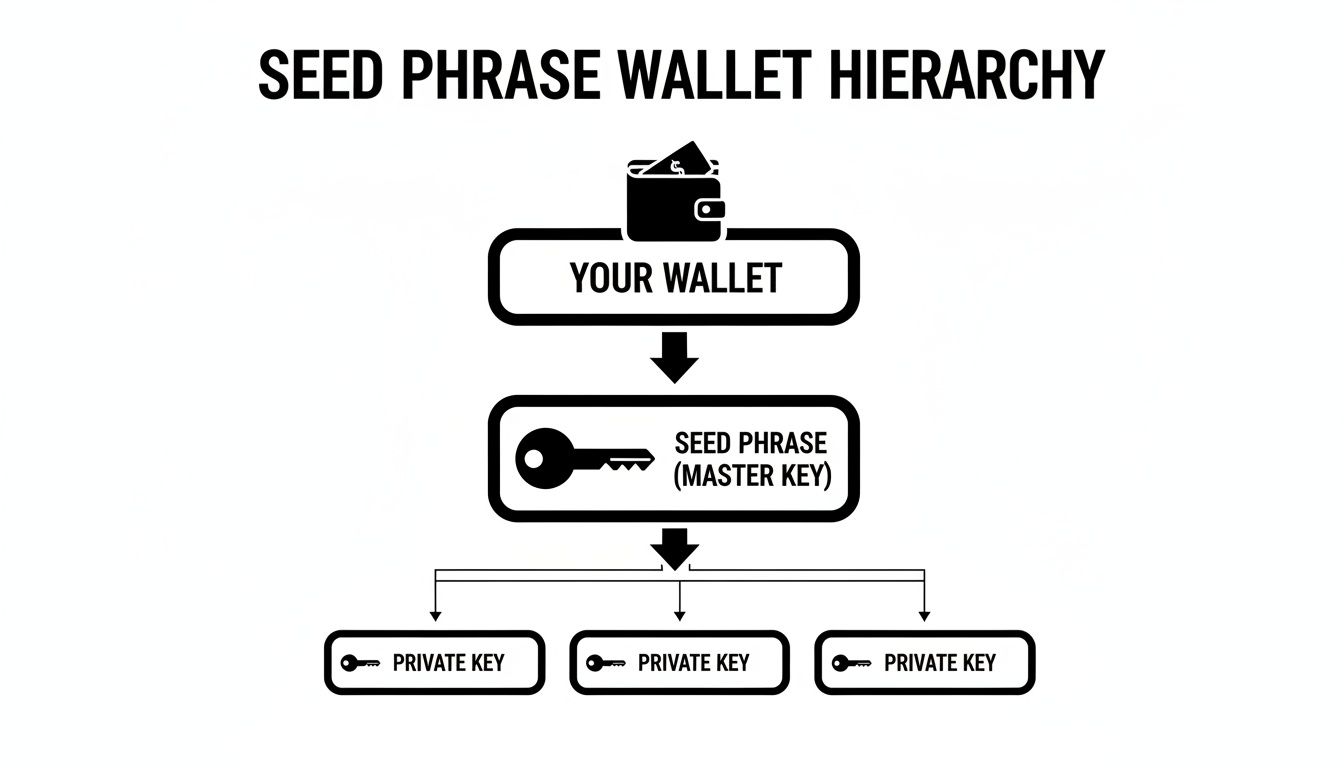
As you can see, the seed phrase is the single point of origin for everything that secures your assets.
From Trunk to Branches and Leaves
With the trunk in place, your wallet can now sprout a virtually endless number of branches and leaves without ever needing to look at the original seed phrase again. This is the "Hierarchical" aspect of an HD wallet in action. Your wallet can create different branches for different crypto assets or purposes.
- Branch 1: Could be your Bitcoin account.
- Branch 2: Could be your Ethereum account.
- Branch 3: Could be a separate savings account you rarely use.
Each of these branches can then grow countless "leaves," which are your individual public addresses—the ones you share to receive crypto. And for every public address, there's a corresponding private key that's also mathematically derived from its branch.
Why This Matters: This tree structure means you only have to back up one thing: your original 12 or 24-word seed phrase. That single phrase can recreate the entire tree from scratch—every branch (account) and every leaf (address and private key).
This deterministic process is the secret sauce. It ensures that no matter what happens to your device, as long as you have those words, your wallet can always find its way back home.
Choosing the Right Type of Seed Phrase Wallet
Not all crypto wallets are built the same, and the one you choose has massive implications for the security of your funds. When you set up a seed phrase wallet, you're picking a home for your master key. The first big decision you'll face is whether to store that key online in a "hot" wallet or completely offline in a "cold" wallet.
This isn't some minor technical detail—it's probably the single most important security decision you'll make in crypto. The difference boils down to one simple thing: internet connectivity.
Software Wallets: The Convenience of Hot Storage
Software wallets, which most people call hot wallets, are just apps that run on your computer or phone. You've probably heard of the big ones: MetaMask, Trust Wallet, and Exodus. They're called "hot" because they're always connected to the internet, which makes them incredibly convenient for day-to-day use.
With a hot wallet, you can send, receive, and mess around with decentralized apps (dApps) in seconds, with no extra fuss. But that constant connectivity is also their biggest weakness. Anything that's always online is a bigger target for hackers, malware, and sophisticated phishing attacks.
Think of a hot wallet like the cash in your physical wallet—it's great for quick, easy access, but you wouldn't carry your life savings around in it.
Hardware Wallets: The Fortress of Cold Storage
Hardware wallets, or cold wallets, are small, physical devices built to do one thing and one thing only: keep your private keys completely offline. Brands like Ledger and Trezor are the titans of this space. These little gadgets sign transactions internally, which means your seed phrase and private keys never, ever touch your internet-connected computer.
To approve a transaction, you have to physically press buttons on the device itself. This creates a secure "air gap" between your keys and online threats. Sure, they're less convenient for frequent trading—you have to plug the device in every time you want to do something—but they offer a fortress-like level of security. This is the equivalent of keeping your gold bars locked away in a bank vault.
A hardware wallet's main job is to ensure your seed phrase is generated and stored in a completely offline environment, protecting it from the moment it's created. This makes it the gold standard for long-term storage and securing significant amounts of crypto.
The contrast between these two approaches became painfully clear in recent years. This issue peaked in 2025 when high-profile cases, including the Trust Wallet $7M exploit, showed just how vulnerable even popular apps can be. That scare prompted a 34% surge in the retail adoption of cold wallets—which now hold 22% of the market, up from 15%—precisely because they rely on robust, offline seed phrase backups. You can learn more about the evolving wallet landscape from industry analyses.
Comparing Your Wallet Options
To really get a feel for this, it helps to see the trade-offs side-by-side. Your choice will come down to your personal risk tolerance, how often you transact, and of course, how much crypto you're trying to protect.
Here's a quick breakdown to help you decide.
Software Wallets vs Hardware Wallets
| Feature | Software Wallet (Hot) | Hardware Wallet (Cold) |
|---|---|---|
| Security Level | Good, but vulnerable to online threats | Excellent, keys remain offline |
| Convenience | High; ideal for frequent transactions | Lower; requires physical device access |
| Cost | Usually free to download and use | One-time purchase ($60 – $200+) |
| Common Use Case | Daily spending, DeFi, NFTs | Long-term holding, securing large sums |
| Primary Risk | Malware, phishing, remote hacks | Physical loss, damage, or theft of device |
This table lays out the core differences, but the right answer often isn't one or the other—it's about using the right tool for the right job.
Non-Custodial Power Is Non-Negotiable
Here’s the bottom line: whether you choose a hot or cold wallet, the most crucial part is that it must be non-custodial. This simply means you—and only you—are in control of the seed phrase. That's the entire point of having a seed phrase wallet in the first place: to give you absolute sovereignty over your digital assets.
When you use a custodial service (like keeping your crypto on an exchange), you are trusting a third party with your money. They hold the keys, not you. A true seed phrase wallet ensures no one else can freeze, seize, or lose your funds. For a deeper dive into this critical concept, check out our guide on custodial vs. non-custodial wallets.
In the end, many seasoned crypto users take a hybrid approach. They keep a small amount of "spending money" in a hot wallet for convenience, while the vast majority of their holdings are locked down and secured in a hardware wallet for total peace of mind.
Best Practices for Securing Your Seed Phrase
In the crypto world, your seed phrase isn't just important—it's everything. It's the one and only master key to your entire portfolio. Protecting it isn't just a recommendation; it's the only thing standing between you and losing your assets for good. How you choose to store these words will ultimately define the long-term safety of your seed phrase wallet.
The stakes are unbelievably high. It's estimated that a huge chunk of the roughly 20% of all bitcoins—worth over $400 billion—are lost forever, and a primary culprit is misplaced seed phrases. Even experienced users struggle. Shockingly, surveys show that 46% of hardware wallet owners admit they have trouble storing their phrases securely, often falling back on dangerous habits like taking a quick photo on their phone. You can dig deeper into these wallet security trends to see just how common these mistakes are.
Physical Storage Is the Only Way
Let’s get one thing straight: the absolute, non-negotiable rule of seed phrase security is to keep it offline. Period. This means physically writing it down on something tangible and stashing it somewhere no one else can access it. Your seed phrase should never, ever touch a device that's connected to the internet.
Here are the most common ways people do this:
- The Classic Paper Backup: Simply writing your phrase on a high-quality, acid-free piece of paper. It’s the original method, and it costs nothing. The downside? Paper is flimsy. It’s easily destroyed by fire, water, or just plain old wear and tear.
- Indestructible Metal Plates: For those who want true peace of mind, you can stamp or etch your seed phrase into a metal plate, usually made of stainless steel or titanium. These things are fireproof, waterproof, and basically crush-proof, giving you the ultimate defense against physical disasters.
Key Insight: Don't just think about hackers; think about life. A house fire or a burst pipe can happen to anyone. Spending a little on a robust metal storage plate is a tiny price to pay to ensure your master key survives a catastrophe.
The 3-2-1 Rule for Bulletproof Backups
In the world of professional data security, experts rely on a time-tested strategy called the 3-2-1 rule. It’s a beautifully simple concept that provides incredible redundancy against almost any disaster you can imagine.
Here’s how it works:
- Three Copies: Make at least three separate copies of your seed phrase.
- Two Formats: Store your copies on at least two different types of media. For instance, one on paper and two on separate metal plates.
- One Offsite Location: Keep at least one copy in a completely different physical location. Think a bank's safe deposit box or a trusted family member's home.
Following this rule means that even if your house burns down, you still have a secure way to get your funds back.
The Mistakes That Will Cost You Everything
Knowing what not to do is just as critical as knowing the right steps. One slip-up is all it takes to hand a thief the keys to your entire crypto wallet.
Burn these into your brain—never do the following:
- Never take a screenshot or photo: Your phone’s camera roll is almost always synced to the cloud. The moment you snap that picture, a digital copy of your master key is online for hackers to hunt down.
- Never save it in a password manager: These tools are built for online logins and are a huge target for cybercriminals. A breach of your password manager could expose your seed phrase along with everything else.
- Never type it into a website or app: This is a classic phishing scam. A fake website will ask you to "verify" your wallet by entering your seed phrase. No legitimate service will ever ask for it.
- Never say it out loud: Your smart speakers and other devices are always listening. Don’t discuss your seed phrase where an Amazon Echo or Google Home might pick it up.
Each of these actions creates a digital record of your phrase, totally defeating the purpose of keeping it offline in the first place.
Adding a Passphrase for Next-Level Security
If you want an even stronger layer of defense, most modern wallets support an optional passphrase, sometimes called the "25th word." This is a custom word or sentence that you add on top of your 12 or 24-word seed.
Here’s the genius part: using a passphrase creates an entirely new, separate wallet. It’s as if you have a secret, hidden vault. If a thief finds your physical seed phrase, it's useless to them without the passphrase you created. They wouldn’t even know the second wallet exists.
But this power comes with a serious warning: if you forget the passphrase, your crypto is gone forever. There is no recovery process. Only use this feature if you are absolutely certain you can remember the passphrase or can store it just as securely as your main seed phrase.
That sinking feeling in your stomach when you realize your seed phrase is gone, damaged, or worse, in someone else’s hands—it's the crypto owner's ultimate nightmare. This is the one key that unlocks everything, and when it’s compromised, it feels like the walls are closing in.
Before you let the panic take over, stop. Take a breath. You need to think clearly, because what you do in the next few minutes could mean the difference between a close call and a total loss.
First things first: what kind of problem are you facing? Is the phrase physically compromised, meaning a thief or a hacker might have a copy? Or is it simply lost or unreadable? Your next steps depend entirely on the answer.
Immediate Steps for a Compromised Seed Phrase
If you have even the slightest suspicion that someone else has your seed phrase—maybe you found your backup where it shouldn't be, or you're seeing weird activity on your accounts—you have to act like your house is on fire. Because digitally, it is. Your funds are in immediate danger.
There's only one move here: create a brand new seed phrase wallet right now. Once you have a new, secure wallet set up, you need to transfer every single asset out of the old, compromised wallet and into the new one. Don't wait. A thief with your seed phrase won't.
Potential DIY Recovery for a Lost or Damaged Phrase
Now, if your phrase is lost or damaged instead of stolen, you can breathe a little easier. The situation isn't as time-sensitive, but it's a lot more complicated. If you've completely lost the phrase with no other backup, I'm sorry to say it's game over. But if the loss is only partial, you might have a shot at recovery.
Here are a few scenarios where a little DIY work could pay off:
- A single missing word: If you know exactly which word is missing (say, word #5), you could try to guess it. The official BIP39 wordlist only has 2048 words, so you could patiently work your way through them.
- Two or three jumbled words: Got a few words wrong or wrote them down in the wrong order? There's specialized software that can churn through the different combinations to find the right one.
- A damaged backup: If your paper backup got scorched in a fire or soaked in a flood, some words might be unreadable. But since all BIP39 words are unique within their first four letters, you can sometimes piece together enough clues to figure out the rest.
Important: Tread very, very carefully here. Attempting this on your own requires some technical know-how. If you use untrusted online tools or sketchy software, you could accidentally hand your partial phrase over to a scammer, turning a recoverable problem into a complete disaster.
When to Call in Professional Help
DIY recovery has its limits. Guessing one missing word is a pain, but it's doable. Guessing two? The number of combinations explodes into the millions, making it practically impossible for a person to solve. This is where a professional recovery service stops being a last resort and becomes your best strategic move.
The amount of crypto that's simply "gone" is staggering. It's estimated that over 3.7 million bitcoins—worth a mind-boggling $370 billion at January 2026 prices—are lost forever. A stunning 75% of that is due to lost seed phrases or broken hardware. It’s no surprise that UK data recovery firms have seen a 40% jump in seed-related cases since 2024. You can read more about the digital wallet outlook on kubra.com.
A service like Wallet Recovery AI brings serious firepower to the problem. We use powerful, AI-driven algorithms to blast through millions of potential word combinations faster than any human ever could. If you have a partial seed phrase, a list of possible words, or the right words in the wrong order, this is your best chance of getting your funds back. We can process huge amounts of data securely and offline, maximizing the odds of recovery without ever putting your information at risk. When real money is on the line, getting an expert is a smart investment.
Here's the rewritten section, crafted to sound like a human expert:
Is This the End of the Seed Phrase?
For years, the 12-word seed phrase has been the gold standard for self-custody. It’s powerful, but it's also a huge single point of failure. Let's be honest: putting the entire responsibility for your life savings on a tiny scrap of paper is a lot to ask of anyone.
The good news is that the industry gets it. Innovators are working hard to build a future where you can have true ownership of your assets without the constant fear of losing a password. The goal is to deliver the security of self-custody without the high-stakes pressure. Two main technologies are leading the charge.
The Next Wave of Wallet Tech
- Multi-Party Computation (MPC) Wallets: Imagine instead of one master key, your key is split into several pieces, or "shares." You might hold one share on your phone, another on your laptop, and a third with a secure service. To sign a transaction, you need a certain number of these shares to agree. This means a hacker who steals your phone still can't access your funds. It completely gets rid of the need for a single, vulnerable seed phrase.
- Smart Contract Wallets: These are less like traditional accounts and more like programmable vaults that live directly on the blockchain. This opens up a world of possibilities, like setting daily spending limits or requiring multiple people to approve a large transfer (multisig). But the real game-changer here is social recovery.
With social recovery, you can appoint trusted people or devices—think your spouse, a sibling, or your hardware wallet—as "guardians." If you ever lose access to your primary device, a majority of your guardians can vote to restore your access. No seed phrase needed.
As we look toward 2026, the vulnerabilities of seed phrases are becoming a bigger and bigger hurdle to mass adoption. These keyless models are starting to catch on precisely because they solve the problems that scare newcomers away. While die-hards will point out that seed phrases have secured billions for over 15 years, many experts are betting that 2026 is the year MPC and smart contract wallets finally break into the mainstream. They aim to get rid of the confusion and what some call the "unnecessary risk" that seed phrases create for everyday users. You can find more data on these evolving consumer trends at Security.org.
A Few Common Questions About Seed Phrase Wallets
To wrap things up, let's go through some of the most common questions people have when they're first getting the hang of seed phrase wallets. Getting these concepts down will help you manage your crypto with a lot more confidence.
Does the Order of the Words Really Matter?
Yes, absolutely. The order isn't just important—it's everything.
Your 12 or 24 words aren't just a jumble of words to be checked off a list; they form a precise, numbered sequence. If you swap even two words, you're not pointing to your wallet anymore. You're pointing to a completely different, and almost certainly empty, wallet.
Think of it like a bank safe's combination. The code 10-20-30 will open it, but 30-20-10 will get you nowhere. Your seed phrase is the exact same. The sequence has to be perfect.
Can I Trust a Seed Phrase from a Software Wallet?
This is a great question. Reputable, open-source software wallets like MetaMask or Trust Wallet use the same rock-solid, industry-standard process (BIP39) to generate seed phrases that hardware wallets do. So, the phrase itself is cryptographically secure.
The real difference isn't the phrase, but the environment where it's generated and stored. A software wallet lives on your computer or phone—a device that's connected to the internet. That inherently opens it up to risks like malware, keyloggers, or phishing attacks.
For any significant amount of crypto, generating your phrase on a hardware wallet is always the gold standard for security.
Expert Tip: For true peace of mind, generate your seed phrase using a hardware wallet. This process happens entirely offline, meaning the words are created and stored in a "cold" environment from the very beginning. It completely eliminates any risk of online exposure.
What Should I Do if I Think My Phrase Was Exposed?
If you have even the slightest suspicion that someone else saw your seed phrase—maybe you typed it into a weird website or took a picture of it—you need to act immediately. Treat it as a full-blown emergency, because your funds are at immediate risk.
Don't wait around to see what happens. Here's the drill:
- Create a New Wallet: Grab a secure, clean device and generate a brand new seed phrase. Set up a fresh wallet with it.
- Move Everything. Now. Send all your crypto and NFTs from the old, compromised wallet to the new, secure one. You're in a race against whoever might have your phrase, so speed is critical.
Once the transfer is done, abandon the old wallet forever. That's the only way to be sure you've regained control and secured your assets.
If you're stuck with a more complicated problem, like a lost word or a jumbled-up phrase, trying to fix it yourself is a long shot. That’s where a service like Wallet Recovery AI comes in. We use specialized, AI-powered tools to run through millions of possibilities and recover access to your funds safely. If you need a hand, contact Wallet Recovery AI for a confidential consultation.
Leave a Reply