

So, you're locked out of your crypto wallet. It's a gut-wrenching feeling, like realizing the key to a safe holding your life savings is gone. This is exactly where a crypto investment recovery service comes into play.
Think of them as digital locksmiths for your crypto. But it's crucial to understand their role: they are specialists in regaining access to wallets you own, not a task force for chasing down funds you lost in a scam. Their job is to crack the code, not to track down thieves.
What Is A Crypto Investment Recovery Service?
When you lose the password or seed phrase to your crypto wallet, it feels like the money has just vanished. It hasn't. The assets are still on the blockchain, protected by a cryptographic lock—and you've simply lost the key.
This is where a crypto-focused recovery service steps in. They're not like traditional asset recovery firms that might sell off old factory equipment. These are highly technical experts who use brute-force computing power and sophisticated software to solve the cryptographic puzzles locking you out of your funds. They essentially try every possible key until one fits the lock.
The Scope of Wallet Recovery
Let's be crystal clear about what these services can and can't do. Their expertise is laser-focused on restoring access when user error or technical failure is the problem. They are not a solution for fraud or theft.
A legitimate investment recovery service can almost certainly help if you find yourself in one of these common predicaments.
| Access Issue | Example Scenario | Recovery Feasibility |
|---|---|---|
| Forgotten Password | You have a general idea of the password but can't remember the exact combination of letters, numbers, or symbols. | High, especially if you can provide partial clues or a list of potential passwords. |
| Lost Seed Phrase | Your 12 or 24-word seed phrase is partially lost, the words are out of order, or one or two words are missing. | Moderate to High, depending on how many words are missing or incorrect. |
| Malfunctioning Hardware | Your Ledger or Trezor hardware wallet is physically damaged, but the encrypted data is potentially intact. | Moderate, often requires specialized hardware skills alongside cryptographic knowledge. |
| Corrupted Wallet File | The wallet.dat file or keystore file on your computer has become unreadable due to a software glitch or hard drive failure. |
High, as long as the corrupted file can be retrieved from the storage device. |
As you can see, the common thread is that you still possess a crucial piece of the puzzle. Whether it’s the hardware device itself or the encrypted wallet file, the recovery experts have a tangible starting point.
The core principle is simple: If you still possess the encrypted wallet file or the hardware device, a recovery service has a tangible starting point. They work with the clues you provide to systematically unlock the cryptographic barrier.
This isn't a niche problem, either. It’s massive. Some estimates suggest up to 20% of all Bitcoin in existence is locked away in inaccessible wallets. By 2024, an estimated 1,510.02 BTC had accumulated as unspendable "dust," a stark reminder of the billions in digital wealth that are just sitting there, out of reach. If you want to dive deeper, Ledger's research offers some fascinating insights into the scale of lost crypto.
Ultimately, these services provide a lifeline. They offer a real chance to turn what feels like a permanent loss into a successful recovery. A forgotten password doesn't have to be the end of the story.
Why Wallet Recovery Demand Is Surging
The need for a professional investment recovery service didn’t just pop up out of nowhere. It’s a direct result of the absolute explosion we’ve seen in the crypto world. Not long ago, digital wallets were a curiosity for tech junkies. Now, they’re becoming as common as a checking account for millions of people.
This massive shift from a niche hobby to a mainstream financial tool means a flood of new users are suddenly in charge of their own digital money for the very first time. And with this influx comes a predictable outcome: the more people managing their own crypto wallets, the more slip-ups are bound to happen. Forgetting a gnarly password, misplacing a 24-word recovery phrase, or having a hardware wallet just give up the ghost are no longer rare occurrences. They're common problems for a huge and growing number of people.
The Sheer Scale of the Wallet Boom
The numbers behind this trend are genuinely staggering. They paint a crystal-clear picture of why this demand is only going up. The global crypto wallet market isn't just growing—it's multiplying at an unbelievable pace.
Valued at USD 12.59 billion in 2024, the market is on track to blast off to USD 100.77 billion by 2033. That’s fueled by a compound annual growth rate (CAGR) of a whopping 26.3% kicking off in 2025. Right now, North America is leading the pack, holding a 30.9% slice of the revenue pie. You can dive deeper into these numbers by checking out the full crypto wallet market analysis.
Think about it: every single new wallet is another chance for a password to be forgotten or a seed phrase to vanish. This isn’t about people being careless; it’s just a statistical reality. As the user base swells into the hundreds of millions, the number of folks needing a hand to get back into their own funds is growing right alongside it.
The boom in wallet recovery isn't a sign that crypto is failing. It's the opposite. It’s a sign of its success and maturity. As more people jump in, the ecosystem of support services needed to help them through the unique hurdles has to grow, too.
Human Error in a Be-Your-Own-Bank World
The whole idea behind cryptocurrency is self-sovereignty—you are your own bank. That freedom is incredible, but it also means the entire burden of security lands squarely on your shoulders. Unlike your bank, which can reset your password with a quick phone call, there’s no central help desk to call in the decentralized world of crypto.
This heavy responsibility is what leads to the common headaches that keep recovery services busy:
- Password Brain-Freeze: We’re all told to create long, complex, unique passwords that are impossible to guess. The problem? They’re also incredibly easy to forget.
- Seed Phrase Scares: That 12 or 24-word seed phrase is the master key to everything in your wallet. Keeping it safe—but not so safe you can't find it—is a real challenge for the average person.
- Hardware Heartbreak: Hardware wallets are tough, but they aren't bulletproof. They can get lost, stolen, or just die from electronic failure over time, locking you out of your assets if you don’t have that recovery phrase handy.
Put all these factors together, and you have the perfect storm. As millions more people get into crypto, the demand for reliable, professional, and secure investment recovery services will only keep climbing. It's becoming an essential piece of the entire digital asset economy.
How The Crypto Recovery Process Actually Works
Handing over the details of your locked wallet to a recovery service can feel like a huge leap of faith. I get it. But the real process is far from some back-alley digital wizardry; it's a structured, methodical, and surprisingly secure operation.
Think of it as hiring a digital forensics expert. You bring them the cold case file—your fragmented memories—and they use powerful tools to piece together the clues and crack the cryptographic code. It’s a true partnership, and your input is the single most important piece of the puzzle. Let's walk through exactly how a professional turns a hopeless situation into a successful recovery, all without ever touching your funds.
The Initial Secure Consultation
It all starts with a confidential, no-strings-attached conversation. This is where you lay it all out. Did you forget a password? Is your seed phrase a jumbled mess? Maybe a hardware wallet just decided to give up the ghost.
A reputable service will use this time to:
- Listen to your story: They need to understand the wallet type, the crypto involved, and exactly how you got locked out. The context is everything.
- Give you a reality check: Based on what you tell them, they'll give you an honest, preliminary take on the odds of success.
- Explain how they work: They’ll outline their methods, security protocols, and their success-based fee structure. No smoke and mirrors.
There should be zero pressure and absolutely no request for an upfront fee. This first step is all about gathering information and making sure you're comfortable. The only goal here is to figure out if they can actually help.
Gathering The Digital Breadcrumbs
This is where you become the star witness. The recovery team will need you to dig deep and provide every scrap of information you can remember about the lost password or seed phrase. This is the raw material their algorithms will work with.
Every tiny detail helps. We're talking about things like:
- Password fragments: Any pieces of the password you remember, even if they're out of order.
- Your usual patterns: The kinds of words, names, numbers, or special characters you always seem to use.
- Key dates: Birthdays, anniversaries, or any other significant dates that might have made their way in.
- Word lists: A brain dump of any words you think could be in the password or seed phrase.
It's critical to understand this: you are never asked for your complete seed phrase or any information that would give them direct access to your funds. You're only providing clues about the password itself, which they use to build a custom-tailored attack plan.
All the information you provide is encrypted and handled with extreme care. The more you can give them, the faster and more likely the recovery will be. This simple flowchart shows why these services are becoming so essential—as more people use crypto wallets, more people inevitably make mistakes.
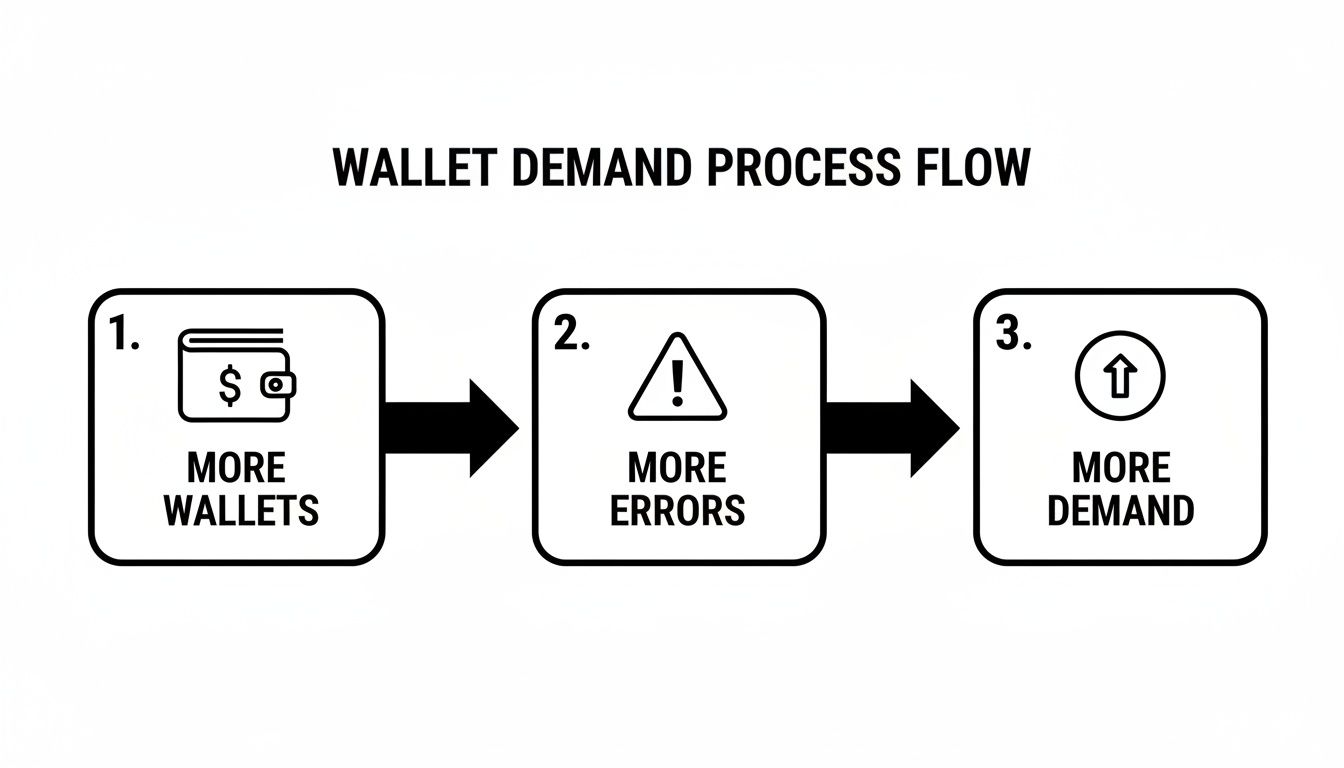
It’s a straightforward market dynamic: more wallets mean more user errors, which naturally fuels the demand for professional help.
Launching The Computational Attack
Once they have your clues, the real heavy lifting begins. The service will fire up clusters of high-performance computers running incredibly sophisticated software to start cracking the lock on your wallet. This isn't just random guessing; it's a precision-guided assault.
They'll use a mix of powerful techniques, including:
- Customized Brute-Forcing: The software runs through trillions of password variations, but only ones that follow the specific rules and patterns you provided.
- Dictionary Attacks: It methodically tests words and phrases from massive dictionaries, often modified with common substitutions you might make (like swapping "e" for "3").
- Algorithmic Analysis: For situations involving corrupted files or partial seed phrases, advanced algorithms work to repair the data and intelligently fill in the blanks.
This can take a few hours or, in tough cases, several weeks. It all boils down to the password's complexity and how good your clues were. A good service will keep you in the loop with regular progress updates. To see how these methods are put into practice, you can dig deeper into the specifics of digital asset recovery in our other guide.
Successful Recovery and Secure Handover
The second a correct password is found, everything stops. The team will get in touch right away to share the good news.
And here's the most important part: they will provide you with the discovered password through a secure, encrypted channel. They do not use it to access your wallet. That final, crucial step is all on you. You're the only one who will use that password to unlock your wallet and immediately move your funds to a new, secure location.
Once you confirm you're back in control and have secured your crypto, the job is done. Only then is the success fee due. This "no win, no fee" model is the ultimate guarantee that their interests are perfectly aligned with yours from the very beginning.
A Look at How Wallet Recovery Actually Works
When you bring in a professional recovery service, they don’t just start guessing passwords randomly. They come armed with a powerful toolkit of highly specialized methods, each built to crack a specific kind of digital lock. Think of it like a master locksmith who knows a vintage padlock requires a different touch than a modern electronic safe—the tool has to fit the job.
The entire success of a recovery attempt boils down to matching the right strategy to the right problem. It's a precise mix of raw computing power, smart algorithms, and, most importantly, the clues you can provide about your old habits. These aren't wild stabs in the dark; they are methodical, targeted searches.
Brute-Force and Dictionary Attacks: The Art of Smart Guessing
The most common tools in the shed are brute-force and dictionary attacks, but they're a lot smarter than they sound. A pure, old-school brute-force attack that tries every possible combination of letters and numbers would literally take centuries to crack a decent password. That’s not what we’re doing here. Instead, your memory is the secret weapon that makes it all work.
Services use what's called a customized brute-force attack. This approach takes the hints you provide—like your kids' names, old street addresses, or favorite bands—and builds a set of rules around them. The software then intelligently mixes these core elements with common number patterns (123, 2024) and special symbols (!, #, @) that you typically use. It’s a way to shrink an ocean of possibilities down to a manageable pond.
A dictionary attack works on a similar principle but with words. It runs through massive lists of words from dictionaries, slang terms, technical jargon, and even famous quotes, often tacking on numbers or symbols at the end. By blending these two approaches, the hunt becomes a highly focused mission instead of a blind shot in the dark.
Algorithms for Damaged and Partial Seed Phrases
But what if the password isn't the problem? What if you have a damaged or incomplete seed phrase? A seed phrase, usually 12 or 24 words, is the ultimate master key to your crypto. If just one word is misspelled, missing, or in the wrong order, you’re locked out for good.
This is where specialized algorithms become critical. A recovery service uses software that knows the exact technical structure of seed phrases (it’s a standard called BIP-39). For example, if you have 11 of your 12 words, the algorithm can instantly test all 2,048 possible words from the official list to find the missing one. If your words are just scrambled, it can methodically test every sequence until it finds the one that unlocks the wallet. Trying to do this by hand is impossible, but for a powerful computer, it's a straightforward task.
The real game-changer here is the use of AI and machine learning. These systems can analyze the clues you provide to learn your unique password habits, then intelligently test the most probable combinations first. This can slash the recovery time from months down to just days or even hours.
Tackling Different Wallet Types
The right recovery technique also depends entirely on the type of wallet you’re trying to access. Software wallets and hardware wallets are built differently, and a skilled service knows how to adapt its strategy for each one.
Here’s a quick breakdown of how the recovery methods are applied to different wallet types.
Recovery Techniques For Different Wallet Types
The approach for a software wallet like MetaMask is fundamentally different from that for a hardware wallet like a Ledger. Understanding these distinctions helps set the right expectations from the start.
| Wallet Type | Common Issues | Primary Recovery Technique |
|---|---|---|
| Software Wallets (e.g., MetaMask) | Forgotten password, corrupted wallet.dat file, lost keystore file. |
Customized brute-force and dictionary attacks on the encrypted wallet file. |
| Hardware Wallets (e.g., Ledger, Trezor) | Forgotten PIN, lost or damaged device with no seed phrase backup. | Focus on seed phrase reconstruction if any part is remembered; physical device recovery is rare and highly specialized. |
With software wallets, the main goal is to crack the password on the encrypted wallet file stored on your computer. That’s where the brute-force attacks are aimed. For hardware wallets, it's a different story. The PIN is usually protected by security that wipes the device clean after a few wrong guesses. Because of that, the recovery effort almost always shifts to rebuilding the 24-word seed phrase, which acts as the final backdoor to your funds.
How To Choose A Trustworthy Recovery Service

In a high-stakes field like crypto recovery, picking the right partner is everything. The line between a legitimate expert and a convincing scammer can feel incredibly blurry, especially when you're stressed and staring at a locked-up balance.
Making the wrong choice doesn't just mean a failed recovery attempt; it could lead to the permanent loss of your assets. That's why your vetting process is the single most important step you'll take. A real investment recovery service operates with total transparency, ironclad security, and a client-first mindset.
Let’s break down the non-negotiables you must look for and the bright red flags that should send you running.
The Green Flags of a Reputable Service
A legitimate recovery expert will be proud to show you how they work. They want to build your trust, not pressure you into a risky decision. Keep an eye out for these key positive signs.
- Strict Non-Custodial Policy: This is the golden rule. A trustworthy service will never ask for your seed phrase or private keys. Their job is to find the forgotten password, which they then give to you so you can unlock your wallet yourself. You, and only you, should ever move your funds.
- Success-Based Pricing: You want to see a "no win, no fee" model. Reputable services only get paid if they successfully recover your assets. They take a pre-agreed percentage of the recovered funds after you have regained full control. This model ensures their success is directly tied to yours.
- Verifiable Client Testimonials: Real stories from past clients are powerful. Look for detailed reviews or case studies, either on their website or on third-party platforms. While privacy is crucial, legitimate companies often showcase success stories that speak to their competence and reliability.
A professional service's entire business model is built on trust and results. Their communication will be clear, their process transparent, and their fee structure will reflect their confidence in their ability to succeed. Any deviation from this is a major cause for concern.
For a deeper look into how a professional firm operates, you might find our guide on what to expect from an assets recovery company helpful. These principles apply across the board, from individual wallets to complex corporate asset recovery scenarios.
Red Flags That Scream "Scam"
While you’re looking for those good signs, it’s just as important—if not more so—to recognize the warning signs of a fraudulent operation. Scammers prey on desperation, using convincing language to lure you into a trap. Walk away immediately if you encounter any of the following.
- Requests for Upfront Fees: This is the most common and dangerous red flag. A scammer will ask for a fee or a "tax" before they've done any real work, often claiming it's for software or processing. Once you pay, they vanish.
- Guarantees of Success: No honest recovery service can guarantee a 100% success rate. The outcome depends heavily on the clues you provide and the complexity of the wallet's encryption. Unrealistic promises are a classic high-pressure sales tactic used by scammers.
- Demands for Your Seed Phrase or Private Keys: Never, ever, ever share your seed phrase. Anyone asking for it is trying to steal your crypto, not recover it. It’s the digital equivalent of handing a stranger the signed deed to your house and the keys to your front door.
Verifying a Service’s Legitimacy
Once a service passes the initial sniff test, it's time to do a little more digging. Check for a physical business address and professional contact information. Legitimate companies aren't hiding who they are or where they operate.
Success stories from established firms also help validate the entire industry. For instance, in 2025, one leading firm successfully restored access to wallets holding over $2.5 million in inaccessible crypto, proving that complex recoveries are entirely possible with the right expertise and security protocols. You can read more about these successful recovery efforts.
By arming yourself with this checklist of green and red flags, you can navigate your options with confidence, sidestep costly mistakes, and find a partner who is truly capable of helping you.
Common Questions About Crypto Recovery Services
Jumping into the world of crypto recovery can feel like a high-wire act. When your own money is locked away, it’s completely natural to have questions about security, cost, and whether it’s even possible to get it back. It's a field loaded with technical jargon and big promises, so getting straight answers is critical.
To help you get your bearings, we’ve put together a list of the most common questions people ask before working with a professional investment recovery service. Here’s what you need to know to make the right call.
Is It Safe To Use An Investment Recovery Service?
The short answer is yes, but only if you pick a reputable, professional provider. The safety of this whole process really boils down to one simple, non-negotiable rule: the non-custodial rule.
A legitimate service will never, ever ask for your seed phrase or private keys. They operate on a purely non-custodial basis, meaning their only job is to help you figure out the password. You are the only one who should ever use that password to actually open the wallet.
Think of it like this: they’re a locksmith who figures out the combination to your safe but doesn't touch the dial. They just hand you the numbers, and you're the one who opens the door. Any company that wants your seed phrase or asks for direct control over your assets is a massive red flag. Run, don't walk.
The gold standard of safety in this industry is a strict, non-negotiable policy where the recovery expert helps you find the key, but you are the only one who ever touches the lock. This ensures your assets remain secure and under your control from start to finish.
Always look for providers who have clear privacy policies, use end-to-end encrypted communication, and walk you through a transparent process that puts your security first.
How Much Does Crypto Wallet Recovery Cost?
This is usually the first thing on everyone's mind. The good news is that the pricing model for any legitimate service is built to be completely risk-free for you.
Reputable crypto recovery experts work on a success-based fee model—you've probably heard it called a "no win, no fee" arrangement. You only pay a percentage of the recovered assets after they've successfully unlocked your wallet and you've moved the funds to a safe place.
This is a huge sign of a trustworthy service because it means their goals are perfectly aligned with yours. They don't get paid unless you do. There should be no upfront charges, no diagnostic fees, and no hidden costs whatsoever before your crypto is back in your hands.
The final commission percentage usually depends on a few things:
- Case complexity: A password where you remember a few clues is a simpler job than one with zero leads.
- Total wallet value: Higher-value wallets might have different fee tiers.
- Computational resources: A tough crack that needs weeks of server time will be priced differently than a quick one.
Before any work starts, you should receive a clear, written agreement that spells out the exact success fee. That way, there are no surprises when the job is done.
What Is The Success Rate For Recovering Lost Crypto?
While we'd all love a magic bullet, no honest service can promise a 100% success rate. The reality is, the chance of a successful recovery depends almost entirely on the quality and quantity of information you can provide.
Your own memory is the single most powerful tool in this process. The more clues you can give, the better the odds. Things like partial passwords, a list of words or names you often use, the password’s approximate length, or even the year you created the wallet can drastically narrow the search.
A professional service will give you an honest, realistic assessment of your chances during the initial consultation. They won’t overpromise or sell you false hope. Instead, they'll look at the specifics of your situation and tell you what’s realistically possible based on the clues you have.
It's also worth noting that services using advanced computational methods, like AI and machine learning, tend to have much higher success rates. These tools can intelligently guess passwords based on your personal patterns, making the search far more efficient than just brute force.
How Long Does The Recovery Process Usually Take?
The timeline here can be all over the map, ranging from a few hours to several weeks—or even months for the really tough cases. It all comes down to two main factors: the password's complexity and the quality of your hints.
For example, if you remember most of your password but are just fuzzy on a few characters or the word order, the algorithms can focus on a very small set of possibilities and often solve it quickly.
On the other hand, a long, completely random password with no clues requires a staggering amount of computer power to churn through trillions of combinations. Similarly, trying to recover a badly corrupted wallet file can also be a long haul, as it requires meticulous data reconstruction before the password search can even begin.
Any good service will manage your expectations by giving you a realistic time estimate after they've reviewed your case. They should also keep you in the loop with periodic updates so you’re not left wondering what’s going on.
If you're staring at a locked wallet and don't know where to turn, Wallet Recovery AI offers a secure, confidential, and effective path forward. Using advanced AI-driven techniques, we help you regain access to your assets without ever compromising your security.
Start your confidential and risk-free recovery assessment with us today.
Leave a Reply