

That sinking feeling in your stomach when you realize you've been scammed is awful. But what you do in the next 24 hours can make or break any chance of getting your crypto back. The goal right now is twofold: stop the bleeding and gather every shred of evidence. You have to act fast to lock down what's left and start documenting everything—from transaction IDs to a scammer’s empty promises.
Your First 24 Hours After a Crypto Scam
Panic, anger, confusion—it's a nasty cocktail of emotions. But this is the moment where a clear head and decisive action matter most. Instead of freezing up, you need to shift into damage control and evidence-gathering mode. Every second counts, and the steps you take now will be the foundation for everything that follows, whether it's contacting an exchange or filing a police report.
This isn't a small problem. In 2025 alone, cryptocurrency scams and fraud siphoned an estimated $17 billion from victims globally, thanks to a huge spike in sophisticated impersonation scams. The average payment a scammer received skyrocketed by 253%, jumping from $782 in 2024 to $2,764 in 2025, largely because AI-powered scams became so much more convincing and profitable. You can dig into the latest trends in this research on crypto scam tactics.
Secure Your Digital Environment Immediately
First things first: stop any further loss. If you even suspect a platform, wallet, or account has been compromised, you need to cut it off. This isn't just about the funds already gone; it's about protecting what you still have.
- Disconnect From Compromised Platforms: Immediately log out of any sketchy websites, apps, or exchanges. If a scammer had you install any software, uninstall it now and run a deep virus and malware scan on your computer.
- Move Remaining Assets: Transfer any crypto you still have in the compromised wallet to a brand new, secure wallet. Make sure you create this new wallet after the incident occurred. A hardware wallet is your best bet for security going forward.
- Revoke Wallet Permissions: Scammers love to trick you into granting token approvals or smart contract permissions they can use to drain your wallet later. Use a tool like Etherscan's Token Approval Checker to review and revoke anything that looks suspicious.
To help you stay focused, here's a quick checklist of the most urgent actions to take. Think of this as your emergency response plan.
Immediate Action Checklist for Scam Victims
This table summarizes the critical first steps to protect your remaining assets and preserve crucial evidence immediately after discovering a cryptocurrency scam.
| Action Item | Why It's Critical | Example/Tool |
|---|---|---|
| Disconnect & Scan | Scammers may have installed malware to monitor your activity or steal more assets. | Log out of all platforms, uninstall suspicious software, and run a scan with Malwarebytes or a similar tool. |
| Move Remaining Funds | The compromised wallet is no longer safe. Any assets left there are at risk of being stolen. | Create a new wallet with a fresh seed phrase and transfer your remaining crypto to it immediately. |
| Revoke Permissions | Malicious smart contracts or token approvals can drain your wallet without further action from you. | Use tools like Etherscan's Token Approval Checker or Revoke.cash to cancel suspicious permissions. |
| Screenshot Everything | Scammers often delete their accounts, messages, and websites to cover their tracks. | Capture all chats, profiles, and transaction details before they disappear. |
| Copy All Hashes | Transaction IDs (hashes) are the digital fingerprints needed to trace the stolen funds on the blockchain. | Go to your wallet history and copy the full transaction hash for every payment sent to the scammer. |
Following these steps methodically will put you in the best possible position for the next phase of the recovery process.
Become a Digital Detective and Document Everything
Once you've contained the immediate threat, your job is to become an evidence collector. Meticulous documentation is the absolute backbone of any successful recovery attempt. Don't delete a single thing, no matter how trivial it might seem.
Key Takeaway: Treat this situation like a crime scene. Every scrap of data—every message, every wallet address, every transaction hash—is a potential clue that could help investigators follow the money.
This simple diagram breaks down the core response process: Secure, Document, and Report.
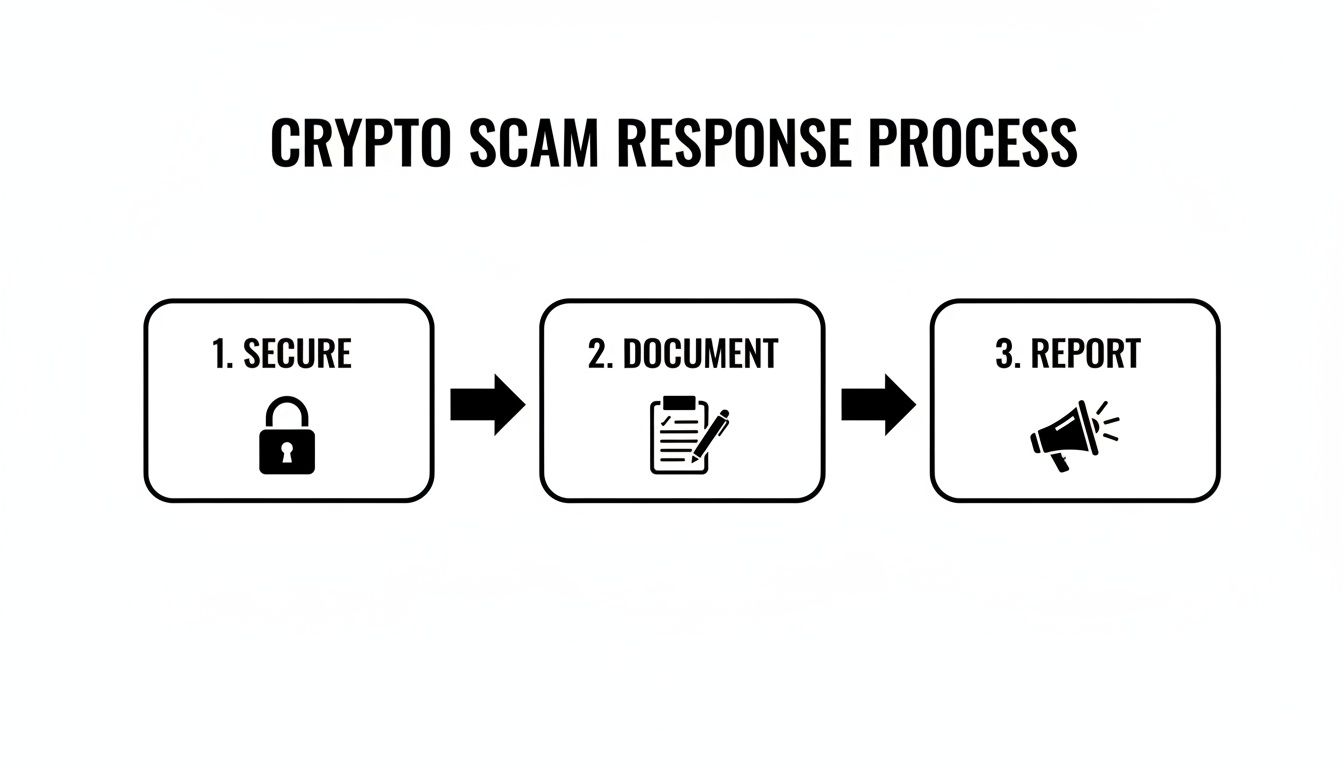
As the visual shows, you have to get your assets locked down and your evidence organized before you can effectively report the crime to the right people.
Start by creating a new folder on your computer and begin gathering this critical information:
- Transaction IDs (Hashes): This is the most important evidence you have. Copy the full transaction hash for every single transfer you sent to the scammer.
- Scammer Wallet Addresses: Make a list of every crypto address the scammer gave you or used to receive your funds.
- Communication Records: Screenshot all of your conversations. This includes emails, text messages, and chats on platforms like Telegram, WhatsApp, or even dating apps. Don't assume the platform will keep them—the scammer will likely delete their account.
- Scammer Profiles and Websites: Take screenshots of the scammer's social media profiles, the fake investment website, or any other online property they used to lure you in.
- Personal Timeline: Open a document and write down a detailed timeline of what happened. Include dates, times, the amounts you sent, and a summary of what was said. This narrative will be a massive help when you start filing official reports.
Following the Money on the Blockchain
Now that you've secured what's left, it's time to go on the offensive. The public nature of the blockchain, the very thing scammers rely on for anonymity, is about to become your best investigative tool. Every single transaction creates a permanent, public breadcrumb, and we’re going to follow that trail.
Think of the blockchain as a giant, unchangeable public record book. A block explorer is your search engine for this book, allowing you to watch the movement of your stolen crypto from one wallet to the next. This is ground zero for any serious recovery effort.
How to Start Tracing with a Block Explorer
You don't need to be a coding genius to take the first step. That transaction ID (or "hash") you saved earlier is your key. Pop that into the right block explorer, and you'll see the first "hop" your funds took right after they left your wallet.
Here are the go-to explorers for the big players:
- Ethereum (ETH) & ERC-20 Tokens: Etherscan.io is the gold standard.
- Bitcoin (BTC): You can use either Blockchain.com Explorer or Blockstream.info.
- Other Coins: A quick search for "[Coin Name] block explorer" will usually point you in the right direction.
Your mission is to follow the money. Start at the scammer’s wallet address—the direct recipient of your funds—and meticulously track every transaction moving out of it. This initial tracing will tell you if the crypto is just sitting there or if the scammer is already trying to hide it. To get a better handle on these tools, check out our guide on what a blockchain explorer is.
Common Tricks Scammers Use to Hide Stolen Funds
Scammers know their activity is public, so they've developed a playbook of techniques to muddy the waters. Understanding their tactics is key to knowing when you've hit a wall and might need professional help.
A classic move is the "peeling chain." The scammer sends the full amount to a new wallet, then immediately "peels off" a tiny fraction to another wallet, then another, and another. This creates a long, confusing series of micro-transactions designed to exhaust and frustrate anyone trying to follow along.
For more sophisticated jobs, they use "mixing services" or "tumblers." These are services that pool dirty crypto from countless sources, jumble it all up, and spit out "clean" funds to new addresses. It’s a deliberate attempt to break the on-chain link between the crime and the criminal.
Expert Insight: The moment stolen funds hit a mixing service, DIY tracing is effectively over. Professional chain analysis firms use powerful clustering software and off-chain intelligence to "de-mix" these transactions and pick up the trail on the other side.
Knowing the Limits of DIY Tracing
Following the first few wallet hops can feel empowering, but the path gets complicated fast. Scammers can split funds across hundreds of wallets, use bridges to jump between different blockchains, or swap tokens through decentralized exchanges.
This is where doing it yourself runs into a hard ceiling.
| DIY Tracing (Block Explorer) | Professional Chain Analysis |
|---|---|
| Good for tracking simple, direct transfers. | Uses software to map out complex webs of thousands of wallets at once. |
| Shows you wallet addresses, but not who owns them. | Cross-references addresses with databases of known entities (exchanges, illicit services). |
| Hits a dead end at mixers and tumblers. | Can often trace funds through mixers using proprietary tools and methods. |
| Gives you raw data for a police report. | Produces a comprehensive, court-ready report that can link the theft to a real person. |
Your initial tracing is incredibly valuable—it's the preliminary evidence that gets the ball rolling. But the ultimate goal is to find an "off-ramp." This is a point where the scammer tries to cash out their stolen crypto into fiat currency, usually through a centralized exchange.
These exchanges (think Coinbase, Binance, Kraken) are regulated businesses that require users to verify their identity (KYC). If you or a professional can trace the funds to an account on one of these platforms, law enforcement can issue a subpoena to unmask the scammer. This is the critical moment where a digital crime connects to the real world, and it's the single biggest breakthrough you can hope for in a cryptocurrency scams recovery.
You’ve traced the initial path of your stolen crypto. Now what? It’s time to bring in the big guns: the exchanges and law enforcement. The evidence file you’ve carefully put together is about to become your most powerful tool.
Your goal here is simple: present a clear, concise, and compelling case that forces them to act. A jumbled, emotional report is easy to ignore. But a well-organized file with transaction hashes, wallet addresses, and chat logs? That demands attention. You need to make it as easy as possible for a compliance officer or a detective to look at your case and know exactly what to do next.
Getting the Crypto Exchanges on Your Side
If you’ve tracked the stolen funds to a major centralized exchange (CEX) like Coinbase, Binance, or Kraken, you've found a critical pressure point. These aren't just rogue platforms; they are regulated financial businesses with teams dedicated to fighting this exact kind of crime. Acting fast is everything.
When you file a ticket with their support or compliance team, don't bury them in a long story. Give them exactly what they need:
- The Transaction Hash: This is the on-chain proof, showing the funds leaving your wallet.
- The Scammer’s Deposit Address: The specific address on their platform where your crypto landed.
- A Quick Summary: A brief, factual rundown of what happened. Stick to dates, amounts, and the type of scam (e.g., pig butchering, phishing link, etc.).
Keep it professional and to the point. The exchange’s first job is to confirm the funds are in an account they control and see if that user violated their rules. Clear, on-chain data is the fastest way to get them moving.
A dose of reality: The exchange won't just send your money back. That's not how it works. Their role is to investigate. If they confirm the crime, they can freeze the scammer's account, trapping the funds. This stops the thief from cashing out while the authorities get involved.
Bringing in Law Enforcement
At the same time you're contacting the exchange, you need to file an official police report. This isn't optional. It’s the formal documentation that exchanges often require to take action, and it’s your ticket to any potential legal or asset seizure down the road.
Where you report depends on where you live:
- United States: Start with the FBI's Internet Crime Complaint Center (IC3). This is the central hub for all cybercrime reports in the US.
- United Kingdom: Report the incident to Action Fraud, which is the UK’s national center for fraud and cybercrime reporting.
- Your Local Police: Always, always file a report locally. Even if they don't have a seasoned crypto detective on staff, that official report number is a crucial piece of your evidence package.
Attach your entire evidence file to every report you submit. That timeline, the screenshots, the transaction data—it all works together to make your claim credible and actionable. This isn't just a shot in the dark, either. We're seeing law enforcement get much better at this. They’ve managed some massive seizures, including a 61,000 Bitcoin haul in the UK and freezing assets tied to a $15 billion criminal ring. These wins show they can and do corner scammers on regulated platforms. You can read more about these improving recovery efforts on chainalysis.com.
Be prepared for a long haul. This process is slow and often frustrating, so set your expectations accordingly. You won't get your funds back tomorrow. Think of it as a two-pronged attack: engaging the exchanges is about getting a quick freeze, while filing with law enforcement builds the official case needed for a long-term seizure. Every step is a vital part of a complete cryptocurrency scams recovery strategy.
How to Find Legitimate Recovery Services
After the shock of a scam wears off, the desperation to get your funds back can make you a prime target for a second wave of fraud: the recovery scam. These predators hang around online forums and social media, waiting to pounce on victims with too-good-to-be-true promises. They aren’t here to help; they’re here to take whatever you have left.
Learning to spot the difference between a genuine expert and a con artist is probably the most critical skill you can develop at this stage. Legitimate services do exist, but they are vastly outnumbered by fraudulent operators who prey on hope.
Hallmarks of a Trustworthy Recovery Partner
A real recovery specialist operates with total transparency. Their work isn't based on vague promises of "hacking back" your funds. Instead, they focus on verifiable, professional methods like deep blockchain analysis, coordinating with exchanges, and working alongside legal channels.
They should have a clear, documented process and be able to walk you through it. This usually starts with an initial consultation to see if recovery is even feasible before you commit to anything. Their business will have a real-world footprint—like a registered address and a history of verifiable work—and their communication will be professional, not pushy.
Here’s what you should be looking for:
- Success-Based Fees: This is a big one. Reputable firms almost always work on a contingency basis, meaning they only charge a fee after successfully recovering your funds. Their success is tied directly to yours.
- A Clear Methodology: Ask them how they work. They should be able to explain their process, which involves chain analysis, legal filings, and exchange communication. If they start talking about "special software" or "blockchain exploits," walk away.
- A Focus on Privacy: A real service will never ask for your private keys, seed phrase, or any direct access to your remaining wallets. Your security should be their absolute priority.
These professionals can provide real value, particularly when funds have been moved to a centralized exchange or tumbler but not yet fully laundered. While massive exchange hacks often see victims get back pennies on the dollar (0.4-10%), expert intervention in individual scam cases can be much more effective.
In fact, some studies show recovery rates for individual cases can average around 70%. For specific scams like phishing, top-tier services have even hit 95-98% success—a crucial statistic considering over $3.4 billion was lost to crypto scams in a single recent year.
Red Flags That Scream "Recovery Scam"
Spotting a recovery scam usually comes down to what they promise and what they ask for. These fraudsters play on your emotions, using a sense of urgency and impossible claims to get you to lower your guard.
The biggest, most universal red flag is a demand for an upfront fee. They'll disguise it as a "tax," "processing charge," or "wallet synchronization fee." Once you pay it, they vanish.
Crucial Warning: Never, ever pay an upfront fee to recover stolen crypto. Legitimate services are compensated from the funds they successfully recover, not by taking more money from a victim who's already been hurt.
Another dead giveaway is a guarantee of success. The world of crypto recovery is incredibly complex. No honest professional can ever promise a 100% chance of getting your money back. Anyone who does is lying to you.
Finally, be extremely wary of anyone who contacts you first. Scammers actively monitor social media and forums for posts from victims. If you suddenly get an unsolicited DM on Telegram, Twitter, or Discord from a "recovery expert" who saw your post, it's almost certainly a scam. You can learn more by checking out our guide to crypto scam recovery services and the right way to engage them.
To help you tell the difference at a glance, we've put together a quick comparison table.
Legitimate Recovery Service vs. Recovery Scam
| Characteristic | Legitimate Service (e.g., Wallet Recovery AI) | Recovery Scam |
|---|---|---|
| Payment Structure | Success-based fee (a percentage of recovered funds) | Demands upfront fees, taxes, or charges. |
| Promises Made | Offers a realistic assessment of success chances. | Guarantees 100% recovery of your funds. |
| Methodology | Transparent process involving chain analysis and legal action. | Vague claims about "hacking" or "special software." |
| Privacy & Security | Emphasizes privacy; will NEVER ask for private keys. | Asks for your seed phrase or remote access to your computer. |
| Initial Contact | You initiate contact through their official website. | Contacts you first via unsolicited social media messages. |
Arming yourself with this knowledge is the best way to navigate your options safely and avoid getting burned a second time. A methodical, skeptical approach is your best defense from here on out.
Right, so you've been through the wringer. Getting your crypto back is one thing, but making sure this never, ever happens again? That’s the real win. It’s time to move from being a target to becoming a fortress. This isn't just about technical stuff; it’s a total mindset shift. You need to get inside the scammer's head to beat them at their own game.
Scammers are absolute pros at playing on human emotion. Take the classic pig butchering scam. They don't just pop up and ask for your life savings. No, they spend weeks, sometimes months, building what feels like a real connection. They become a friend, a confidant, a romantic interest. Only after that trust is cemented do they casually mention a "can't-miss" investment. Phishing scams work on the same principle but use fear and urgency instead of friendship, scaring you into clicking a link that looks official but is designed to empty your wallet in seconds.
Once you understand their playbook, you start seeing the red flags everywhere. That stranger who slides into your DMs and quickly becomes your closest advisor? That’s the pig butchering script. The frantic email warning you to "secure your account immediately"? Pure phishing bait. Recognizing these emotional hooks is your first line of defense, stopping a scam before it even gets close to your funds.
Building Your Digital Fortress
Okay, let's talk practicals. It’s time to put some serious barriers between the criminals and your crypto. This isn't about being a tech genius; it’s about building a few non-negotiable security habits. Think of these as the digital equivalent of deadbolts, alarm systems, and a very big dog.
First up, and I can't stress this enough: get a hardware wallet. Seriously. A device from Ledger or Trezor keeps your private keys completely offline. This makes you virtually immune to the kind of online hacks that target software wallets. A thief can't approve a transaction without physically having your device in their hands. It’s a simple, powerful roadblock.
From there, bake these habits into your routine:
- Use Multi-Factor Authentication (MFA) Everywhere: Go into every exchange you use and turn on MFA. This adds a second layer of approval, usually a code from your phone, before anyone can log in. Even if a scammer nabs your password, they're stopped cold without that code.
- Guard Your Seed Phrase Like Your Life Depends On It: Your seed phrase is the master key to everything. Never, ever share it. With anyone. For any reason. Write it down on a piece of paper—or better yet, steel—and lock it away somewhere safe and offline. Don't ever save it as a text file, a photo, or an email draft.
- Simulate Transactions Before Signing: Before you interact with a new smart contract, use a tool that shows you exactly what will happen if you sign. Wallet extensions like Pocket Universe or Fire can simulate the transaction, revealing if a malicious contract is about to drain your assets.
The Golden Rule of Crypto Security: If it feels too good to be true, it is. Full stop. If someone is pushing you to act right now, they're trying to bypass your critical thinking. Slow down and verify everything.
Recognizing and Avoiding Investment Traps
Some of the most brutal scams I've seen are dressed up as incredible investment opportunities. Scammers build slick-looking fake trading platforms that show fake profits climbing higher and higher, all to trick you into depositing more. Ponzi and pyramid schemes, in particular, have found a terrifyingly effective home in crypto.
These schemes sucked out around $6.1 billion from victims in 2025 alone, a mind-boggling 49% increase from the year before. The reason for the jump? A huge rise in mega-schemes. The number of scams that pulled in over $100 million each more than doubled, from just six in 2024 to 13 in 2025. You can dig into all the grim details in these findings in the 2026 Crypto Crime Report.
Always be deeply skeptical of any platform promising guaranteed high returns. Real investing always has risk. The final step in your recovery is turning this painful lesson into a powerful defense, so you can navigate the crypto world with the confidence and security you’ve earned.
Common Questions About Crypto Scam Recovery
After a crypto scam, your head is probably swimming with questions. It's a confusing and stressful time, and you need clear, honest answers. Let's tackle some of the biggest concerns victims have.
Is It Actually Possible to Recover Stolen Crypto?
The short answer is yes, it's possible. But it's crucial to understand this isn't a sure thing.
Unlike a fraudulent credit card charge you can just reverse, crypto transactions are final. There’s no "undo" button. Recovery isn't about reversing the transaction; it's about meticulously tracing the stolen funds until they land somewhere we can take action, which is almost always a centralized, regulated exchange.
A few key things heavily influence the outcome:
- How fast you move: The clock starts ticking the second the funds are gone. The quicker you report the theft to exchanges and law enforcement, the better your odds.
- The scammer's skill: If the thief is a pro, they might immediately run the crypto through a mixing service or complex decentralized finance (DeFi) protocols. This makes tracing a nightmare, but not always impossible.
- Where the money ends up: The end goal is to track the funds to an account on a major exchange that enforces identity checks (KYC). This is the critical chokepoint where authorities can step in and freeze the assets.
The road to recovery is almost always a long and winding one. It takes a blend of immediate action, careful evidence gathering, and professional help. Don't expect a quick fix.
But real-world successes do happen. We've seen cases where expert-led efforts brought back $756,000 from a fake Canadian investment scheme and another $256,000 from a sophisticated romance scam out of the UK. These aren't just stories; they're proof that with the right strategy, getting your assets back is achievable. For a deeper dive, you can see some of these findings from TRM Labs.
How Long Does a Crypto Recovery Process Take?
Be prepared for a marathon, not a sprint. This process is measured in months, and sometimes, even years. Every case is different, so there’s no fixed timeline.
To give you a rough idea, here's how things usually unfold:
- Initial Triage and Tracing (1-2 Weeks): The first sprint involves pulling together all your evidence, running the initial blockchain analysis to see where the funds went, and firing off reports to all relevant exchanges and law enforcement agencies.
- The Waiting Game with Exchanges (Weeks to Months): If your funds land at an exchange, their compliance team has to open an internal investigation. They have their own legal protocols to follow, and this part can take a while.
- Law Enforcement Engagement (Months to Years): This is often the longest stretch. Getting a law enforcement agency to issue subpoenas or warrants requires patience. The timeline here depends heavily on the complexity of your case and the agency's current caseload.
It's tough, but setting realistic expectations from the start will save you a lot of heartache. The key is to follow the process step-by-step and not get discouraged by the pace.
Can I Get My Money Back if I Paid Scammers with Bitcoin?
Absolutely. It doesn’t matter if the scammers took Bitcoin (BTC), Ethereum (ETH), or any other coin. The fundamental recovery process is the same.
The core strategy is always to trace the funds on the public blockchain and pinpoint an "off-ramp"—a moment where the scammer tries to cash out at a regulated exchange.
That said, different blockchains have their own quirks.
| Cryptocurrency | What Makes Tracing Unique | Common Scammer Moves |
|---|---|---|
| Bitcoin (BTC) | We trace transactions on the Bitcoin blockchain using tools like the Blockchain.com explorer. The way Bitcoin works (its UTXO model) can sometimes create messy, complex transaction trails. | Scammers often use "peeling chains" to split the stolen BTC into dozens of smaller amounts. They also have access to mixers built specifically for Bitcoin. |
| Ethereum (ETH) | Etherscan is the go-to for tracing. The challenge here is often untangling interactions with smart contracts and various DeFi apps. | Thieves might exploit token approvals you've granted or immediately swap your stolen ETH for other obscure tokens on a decentralized exchange (DEX) to muddy the waters. |
No matter the coin, the evidence you need to gather is always the same: transaction IDs (hashes), the scammer's wallet addresses, and a complete record of all your conversations. The strategy is consistent; only the specific analysis tools change. A solid trail of evidence is the bedrock of any crypto recovery attempt.
At Wallet Recovery AI, we specialize in helping people navigate this difficult process. Our team uses advanced tracing techniques and can guide you through the reporting and recovery steps, all while keeping your privacy and security front and center. If you need expert help, submit your case for a confidential assessment.
Leave a Reply