So you've been scammed. That gut-punch feeling—the shock, the anger, the violation—is all too real. One moment, your digital assets are safely in your wallet; the next, they’ve disappeared into the blockchain's labyrinth.
If you're reading this, you're likely in that exact spot, and it’s critical to know you aren’t alone.
This sense of helplessness is precisely what scammers thrive on. The scale of this problem is staggering and growing fast. In 2025 alone, crypto scams and fraud accounted for an estimated $17 billion in stolen funds globally. That’s a huge jump from $12 billion the year before, fueled by increasingly sophisticated impersonation schemes that grew by a mind-boggling 1400%, often using AI deepfakes and highly organized fraud rings. You can dig deeper into these crypto crime trends from Chainalysis.
Out of this bleak reality, an entire industry has emerged to fight back: crypto scam recovery services.
So, What’s the Real Path Forward?
Think of a legitimate recovery service not as a magician, but as a specialized digital forensics team. They can't just hit an "undo" button—blockchain transactions are, by design, irreversible. What they can do is meticulously build a case from the ground up.
Their process usually breaks down into a few key areas:
- Blockchain Forensics: This is the core of the operation. Using advanced tools, they trace the stolen funds from your wallet through the tangled web of transactions designed to obscure their final destination.
- Law Enforcement & Legal Liaison: They compile the on-chain evidence into a detailed package that can be handed over to agencies like the FBI or Secret Service, giving official investigations a critical head start.
- Exchange Collaboration: When stolen funds eventually land on a centralized exchange, these services work directly with the platform's compliance team to try and get the assets frozen.
A genuine recovery service won't sell you on impossible guarantees. Their job is to offer a clear, evidence-based strategy that turns your despair into a series of actionable steps.
But be warned: this space is also a hunting ground for predators. Countless fake recovery agents are out there, ready to scam victims a second time with promises of guaranteed returns if you just pay an upfront fee.
This guide will give you the tools to tell the real experts from the fakes, understand what's actually possible, and start taking back control.
Here is the rewritten section, designed to sound completely human-written and natural.
How Legitimate Crypto Recovery Services Operate
So, you've been scammed. The first thought is often a mix of panic and a faint hope: can I get my crypto back? It’s easy to picture some movie-style hacker magically reversing the transaction, but that’s not how real crypto scam recovery services work. The legitimate process is far more methodical, grounded in deep investigative work that feels more like a digital detective agency than a high-tech heist.
Forget about "hacking the hacker." A genuine recovery operation is a grind. It’s a multi-pronged attack combining digital forensics, legal know-how, and a deep understanding of how criminals operate online. They don't make wild promises; they build a case, piece by piece, by meticulously following the digital trail everyone leaves on the blockchain. This blend of skills is what separates the pros from the predators who are just waiting to scam you again.
To really get what you're paying for, you need to look behind the curtain. The whole process really boils down to three core pillars of operation.
The journey from getting scammed to actually starting a recovery process isn't instant. It’s a deliberate investigation that has to happen first.
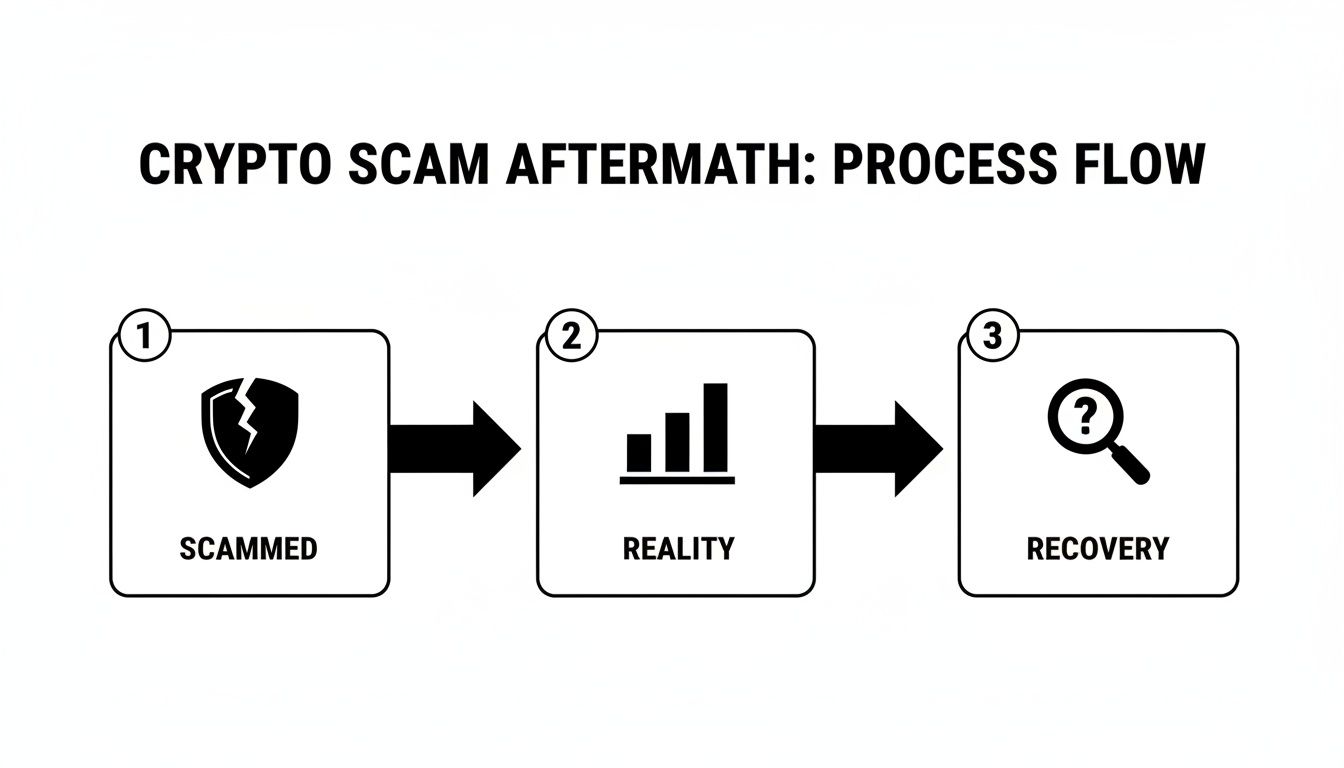
As you can see, recovery isn't a quick fix. It’s the investigative phase that kicks in after the loss, once you've had a realistic look at the damage.
The First Pillar: Blockchain Forensics
At the very heart of any real recovery attempt is blockchain forensics. The blockchain is basically a permanent, public record of every single transaction. While the transactions are pseudonymous—tied to wallet addresses, not your name—they create an unchangeable "breadcrumb trail."
Forensic experts use sophisticated analytics tools to follow that trail. Their job is to trace your stolen funds from your wallet to the scammers' first stop, and then through the tangled web of wallets they use to cover their tracks. Scammers aren’t dumb; they use tricks like chain hopping (swapping between different cryptocurrencies) and mixers (services that jumble stolen funds with legitimate ones) to muddy the waters.
But even with these tactics, specialized tracing software can often cut through the noise. It finds patterns and links scattered addresses back to a single criminal entity. The ultimate goal is to follow the money until it hits a known "off-ramp"—usually a major crypto exchange where the scammer will try to cash out into traditional currency.
The Second Pillar: Legal And Law Enforcement Collaboration
Finding where the funds went is a huge step, but it’s only half the battle. This is where legal and law enforcement partnerships are absolutely critical. A reputable recovery service doesn't just work in a bubble; they serve as a vital bridge between you, the victim, and the authorities who can actually do something.
Once the forensic team maps out the fund movements, all that evidence gets compiled into a detailed case file. This isn't just a simple printout. It’s a professional package built for agencies like the FBI’s Internet Crime Complaint Center (IC3) or their international counterparts. This file will typically include:
- Transaction Hashes (TXIDs): The unique ID for every single transaction involved.
- Wallet Addresses: A full list of every address the scammers used.
- On-Chain Analysis: A clear report showing the flow of funds and any known connections to other illicit activity.
- Victim Impact Statement: Your own documented story of what happened, including all communications with the scammer.
Handing this package to law enforcement gives them a massive head start. Instead of starting from scratch, they have actionable intelligence they can use to issue subpoenas to exchanges, freeze criminal accounts, and, hopefully, identify the people behind the screen. Honestly, without this professional legwork, a victim's report often just gets buried in a pile.
A legitimate service empowers law enforcement with clear, verifiable evidence. They build the case so that official agencies can take decisive action, such as freezing assets once they land on a regulated exchange.
A Note On Technical Wallet Recovery
It's really important to know the difference between scam recovery and another service called technical wallet recovery. They sound similar, but they are completely different things. Technical recovery isn't about chasing down stolen funds. It's for people who have lost access to their own wallets because they forgot a password, lost a seed phrase, or have a corrupted wallet file.
While some companies might do both, technical recovery is a separate skill set focused on things like decrypting files or running brute-force algorithms to unlock a wallet you still technically own. If a scammer has drained your funds, this is not the service you need. Understanding this distinction is key to finding the right expert for your situation.
Spotting And Dodging Predatory Recovery Scams
In a cruel but all-too-common twist, the most dangerous predators often show up right after you’ve been victimized. Scammers know that when you're reeling from a loss, you're vulnerable and desperate for any sliver of hope. They bank on this, posing as helpful crypto scam recovery services to exploit your pain for a second payday.
These fraudulent operations are masters of disguise. They build slick websites, use professional-sounding jargon, and even pepper their pages with fake testimonials to hook you. Their goal is painfully simple: squeeze more money out of you before vanishing, leaving you in an even deeper financial and emotional hole. Learning their playbook isn't just a good idea—it's your best defense against getting burned twice.
The Unmistakable Red Flags Of A Recovery Scam
Thankfully, these predatory "agents" tend to follow a predictable script. Once you know what to listen for, their act becomes glaringly obvious. If you spot any of these signs, it's time to cut off all communication immediately.
- Guarantees of Success: This is the big one. No legitimate service on earth can guarantee the recovery of stolen crypto. The entire process is riddled with complexity and depends on countless factors outside their control. If you hear phrases like "we have a 99% success rate" or "we guarantee we'll get your money back," you're dealing with a liar.
- Demands for Upfront Fees: Scammers love to ask for a hefty payment before lifting a finger. They'll disguise it as a "tax," a "processing fee," or a "wallet synchronization cost." Real firms typically structure their fees with a modest retainer for the initial legwork and a contingency fee that's only paid from the funds they successfully recover.
- Requests for Private Keys or Seed Phrases: This is a non-negotiable dealbreaker. Never, ever share your private keys or seed phrase with anyone. Doing so is like handing over the master key to your entire financial world. A real investigator simply doesn't need this information to trace transactions on a public blockchain.
A legitimate crypto recovery service will focus on gathering evidence like transaction IDs and wallet addresses. A scammer will focus on getting access to your remaining assets or demanding upfront payment for impossible promises.
These recovery scams have become dangerously sophisticated. Predators lurk on social media, actively scanning for posts from people who have just been scammed. They deploy bot accounts with names like @cyber_recovery43 or @FBI_recoveryteam to jump on these posts within minutes, offering false hope and promising "advanced algorithms." They'll often demand 20% of the lost assets upfront or thousands in bogus "verification" costs. The latest crypto scam tracker data shows just how widespread this problem is.
To help you tell the good guys from the bad, here's a quick checklist comparing the two.
Legitimate Service vs Recovery Scam Checklist
| Characteristic | Legitimate Recovery Service | Recovery Scam Artist |
|---|---|---|
| Guarantees | Offers no guarantees, explains the risks and complexities involved. | Promises a 100% success rate or guaranteed recovery of funds. |
| Fees | Charges a reasonable retainer and a contingency fee from recovered funds. | Demands a large upfront fee for "taxes," "software," or "processing." |
| Information Requested | Asks for transaction hashes, scammer's wallet addresses, and evidence. | Demands your private keys, seed phrase, or remote access to your device. |
| Communication Style | Professional, methodical, and patient. Avoids high-pressure tactics. | Urgent, aggressive, and pushy. Creates a false sense of emergency. |
| Transparency | Is clear about their process, team credentials, and pricing structure. | Is vague about their methods, using confusing jargon to build false authority. |
| Online Presence | Has a professional website, verifiable reviews, and a credible history. | Uses anonymous social media profiles and recently created websites. |
Keep this table handy. If the "expert" you're talking to ticks any of the boxes in the right-hand column, walk away.
How These Scammers Operate In The Wild
You'll find these predators swarming platforms where victims gather for support, like Telegram, X (formerly Twitter), and Reddit.
Picture this: you post on a crypto subreddit about losing funds to a phishing attack. Within an hour, your DMs are flooded. One profile, using a stolen photo of a financial analyst, claims to be a "certified blockchain recovery specialist." They speak with an air of authority, throwing around technical terms to earn your trust. They might even show you a doctored screenshot of a wallet full of "recovered funds" from another supposed client.
Their pitch always has a sense of urgency. They'll insist you must act now before the trail goes cold, pushing you to pay a fee in crypto to "initiate the tracing algorithm." This entire song and dance is a carefully crafted illusion, designed to play on your emotions and rush you into another terrible decision. True professionals are methodical, transparent, and will never use high-pressure sales tactics.
A Practical Guide to Vetting a Recovery Service
Navigating the aftermath of a crypto scam is overwhelming enough. Choosing an ally to help you fight back shouldn’t add to the stress. Now that you know how to spot the predatory fakes, you can focus on finding a genuine, professional partner.
This takes a methodical approach, a lot like hiring any other expert. It all comes down to asking the right questions, scrutinizing their methods, and understanding exactly what you’re paying for. You’re shifting from the role of a victim to that of an informed consumer hiring a specialized firm for a critical job. The goal is to find a team with a transparent process, verifiable credentials, and a realistic grasp of the immense challenge ahead. This diligence is your best defense against false hope and further financial loss.

Scrutinize Their Credentials and Online Footprint
First things first: investigate the company itself. A legitimate service will have a professional, transparent online presence that can stand up to a little digging. Don’t just take their website at face value; you need to verify their claims and establish real credibility.
Start by looking for tangible proof of expertise. Do they name their team members? Do those people have verifiable backgrounds in blockchain forensics, cybersecurity, or law enforcement? A company that hides behind anonymous profiles and vague bios is a massive red flag.
Next, do your own background check:
- Company Registration: See if the business is legally registered. While this doesn't guarantee quality, it shows a basic level of legitimacy.
- Case Studies: Ask for anonymized case studies or examples of their work. They can't share confidential client details, but they should be able to walk you through their process and outcomes in specific, non-identifiable terms.
- Third-Party Reviews: Hunt for reviews on independent platforms, not just the glowing testimonials cherry-picked for their website. Check out what past clients are saying on forums or professional networks.
Analyze Their Methodology and Process
Once you feel the company is legit, the next step is to understand how they actually work. A reputable firm will be more than willing to walk you through their entire process, from the initial analysis to potential legal action. They should be able to explain complex concepts in a way you can understand, without hiding behind a wall of confusing jargon.
Come to your initial consultation prepared with a list of critical questions. Their answers (or lack thereof) will tell you everything you need to know about their experience and transparency.
A professional recovery firm will manage your expectations with honesty. They will explain that success is never guaranteed and will base their assessment on the specific details of your case, not on empty promises.
Here are some essential questions to have ready:
- What specific tools and techniques do you use for blockchain tracing? Their answer should be more than generic buzzwords; maybe they'll mention specific analytics platforms they use.
- What is your protocol for working with law enforcement? Experienced firms have established procedures for packaging evidence for agencies like the FBI.
- How do you handle cases involving mixers or privacy coins? This question really tests their expertise with advanced obfuscation techniques.
- Can you explain your fee structure in detail? Get a crystal-clear breakdown of any retainers, contingency fees, and other potential costs.
Understand the Fee Structure
Finally, a clear and fair fee structure is the hallmark of a trustworthy service. Predatory scams thrive on demanding huge, non-refundable upfront payments for guaranteed results. Legitimate services, on the other hand, typically use a model that aligns their success with yours.
You’ll generally run into two main types of fees:
- Initial Retainer/Consultation Fee: This is a modest fee that covers the intensive initial investigation, blockchain analysis, and case-building. It compensates the team for the foundational work that every recovery attempt requires.
- Contingency Fee: This is a percentage of the funds that are successfully recovered. This performance-based model gives the company a powerful financial incentive to get a positive outcome for you.
Be wary if a service only asks for a contingency fee. The initial investigative work is resource-intensive, and a firm working entirely for free until a recovery happens might just be too good to be true. A balanced model with a reasonable retainer and a clear contingency agreement is usually the most professional and realistic approach. You can find more information on how to choose a reliable assets recovery company in our guide.
The Role Of Law Enforcement In Crypto Recovery
When you've been hit by a crypto scam, calling the cops might feel like a long shot. After all, what can they do about assets that only exist on a computer network? It’s a common hesitation, but the truth is, involving official law enforcement is one of the most powerful moves you can make.
Filing a report with an agency like the FBI’s Internet Crime Complaint Center (IC3) or your local law enforcement isn't just about paperwork. It creates an official record of the crime, which is the exact kind of evidence a private crypto scam recovery service needs to build a rock-solid case. Think of it as a force multiplier: your private investigation team supplies the detailed on-chain evidence, and the official report gives it the legal standing it needs to matter.
This relationship works both ways. While a private firm is zeroed in on the meticulous task of tracing your stolen funds, law enforcement agencies are built to see the bigger picture. They have the authority to issue subpoenas, freeze accounts on regulated exchanges, and work with international partners to bring down the entire criminal network.
Why Your Official Report Matters
Don't think of your report as just another number in a stack. It's a crucial piece of intelligence that helps investigators connect the dots between what might seem like thousands of unrelated crimes. For them, your loss could be the missing piece of a much larger puzzle.
Here’s what your report helps authorities do:
- Spot the Patterns: Law enforcement can link wallet addresses from your case to others, revealing the true scale of a scammer's operation.
- Build an Ironclad Case: The more victim reports they have, the stronger the case against the criminals. This makes it far more likely that prosecutors will take action.
- Seize and Return Stolen Funds: When investigators dismantle a major criminal ring, they often seize huge amounts of cryptocurrency. These funds are then earmarked for victim restitution.
Managing Expectations: The Pace Of Justice
It’s critical to have realistic expectations about the timeline. A private forensic team can often trace stolen funds in a matter of days, but the legal system moves at a much different speed. Law enforcement investigations are incredibly thorough and can take months, sometimes even years, to yield results. They aren't just tracing assets; they're building a criminal case that has to hold up in court.
This is exactly why the two approaches work so well together. A private service gives you the speed and laser focus needed to follow the money before the trail goes cold. At the same time, law enforcement provides the legal muscle required to actually seize the funds and prosecute the people behind the crime.
Law enforcement and private recovery firms aren't competitors; they're two sides of the same coin. A detailed forensic report gives authorities a massive head start, while an official police report gives the entire investigation the legal teeth it needs to bite.
We’re seeing more and more proof that this collaborative approach gets results. Law enforcement's ability to fight crypto fraud has come a long way, offering real hope to victims. In 2025, authorities celebrated major victories, including a $225.3 million cryptocurrency seizure by the U.S. Secret Service that helped over 400 victims around the world. These large-scale busts show that official channels can deliver.
You can dive deeper into the data in this crypto crime report from Chainalysis. The blockchain tracing that makes these operations possible relies on tools you can learn more about in our guide on what a blockchain explorer is.
Here's the rewritten section, designed to sound like it was written by an experienced human expert.
Your Crypto Recovery Questions, Answered
When you’ve been hit by a scam, your head is spinning with questions. The "what ifs" and the uncertainty can feel just as bad as the loss itself. Let's cut through the noise and get you some straight, honest answers to the things you're probably wondering right now.
We're going to tackle the tough stuff: success rates, how long this all takes, what it costs, and—most importantly—what you need to do right now.
What Are The Realistic Chances Of Getting My Crypto Back?
Let’s get one thing straight right out of the gate: recovering stolen crypto is never a sure thing. Anyone who promises you a 100% success rate isn't telling you the truth; they're likely running a recovery scam themselves. The reality is far more complicated.
Whether or not you can get your funds back depends on a handful of key factors, many of which are completely out of anyone's control.
- How fast you act: Time is your enemy here. Scammers start moving funds immediately, often washing them through a maze of wallets within hours to cover their tracks. The sooner you start, the better.
- The scammer's skill level: It’s one thing if a scammer simply sent your funds to their account on a major exchange. It’s a whole different ballgame if they used sophisticated tools like crypto mixers, hopped across different blockchains, or swapped into privacy coins designed to erase the trail.
- Where the money ends up: If your crypto lands on an unregulated exchange in a country that couldn’t care less about crypto crime, getting that money frozen is an uphill battle, to say the least.
A legitimate crypto scam recovery service will give you an honest, no-fluff assessment of your case after they’ve looked at the evidence. They'll tell you what the on-chain data says and what’s actually possible, not just what you want to hear.
The whole point of a real recovery effort is to maximize the probability of getting your money back. It's about meticulously tracing the funds and building a rock-solid case for law enforcement and exchanges. It’s a game of odds, not certainties.
How Long Does The Crypto Recovery Process Take?
Patience isn't just a virtue in crypto recovery; it's a requirement. The initial blockchain tracing can often be done in a matter of days or weeks, but the full journey is almost always a marathon, not a sprint. You should be thinking in terms of months, and for really complex cases, it can even stretch into years.
The process breaks down into a few key stages, each with its own timeline.
- The Initial Dig (Days to Weeks): This is where forensic experts get to work, mapping out exactly where your stolen funds went on the blockchain. It's the fastest part of the job, relying on specialized software and a ton of expertise.
- Building the Case File (Weeks): All the findings are then bundled into a detailed, professional report built for law enforcement and financial institutions. This isn't just a summary; it's a carefully documented evidence package.
- The Waiting Game (Months to Years): This is, by far, the longest stretch. It means submitting the report to agencies like the FBI, working with the compliance teams at exchanges, and waiting for subpoenas and court orders to grind their way through the system. And the legal system has its own, very slow, pace.
It's critical to understand that your recovery team has no control over these external timelines. They can provide the proof and push for action, but at the end of the day, they depend on the cooperation of exchanges and government agencies.
I Was Just Scammed. What Should I Do Right Now?
The first few hours after a scam are absolutely critical. What you do next can make or break the chances of ever seeing your crypto again. It's natural to panic, but a few clear-headed moves can make a world of difference.
Here’s your three-step emergency plan. Do it now.
- STOP All Contact and Payments: This is non-negotiable. Scammers will almost always come back for a second bite, inventing fake "taxes," "unlocking fees," or other nonsense to squeeze more money out of you. It's all part of the con. Block their number, their email, everything. Go completely dark.
- Document Everything: Turn into a detective. Screenshot every conversation, save every email, and copy every transaction ID (TXID) and wallet address involved. Gather every shred of evidence you can find—websites, social media profiles, anything. You can't have too much documentation.
- File an Official Report: Don't put this off. Go to the FBI’s Internet Crime Complaint Center (IC3) and file a report immediately. This creates an official paper trail that is vital for both law enforcement and any recovery firm you hire. It proves you're a victim and gets your case into the system.
Taking these steps helps lock down the evidence before the scammer can delete it and builds the foundation for everything that comes next.
How Much Do Crypto Scam Recovery Services Charge?
Pricing models can vary, but be extremely suspicious of any service that asks for a huge, non-refundable payment upfront. That’s a massive red flag and a classic tactic of recovery scammers. Reputable firms use a model that aligns their success with your success.
Most professional services use a hybrid model with two parts:
- Initial Retainer/Investigation Fee: This is a flat fee you pay at the start. It covers the immense amount of work that goes into the initial forensic deep-dive, blockchain tracing, and case preparation. It pays for the expert's time and their expensive, specialized tools.
- Contingency Fee: This is the main fee, and it’s calculated as a percentage of the funds that are actually recovered. It's a success fee. This performance-based model means the company only makes its real money if you get your money back.
This two-part structure is the industry standard because it's fair. The firm gets compensated for its initial labor, but the big payday only comes if they deliver results for you. Always, always get a clear, written agreement detailing every possible fee before you move forward.
If you've lost access to your crypto wallet due to a forgotten password or lost seed phrase, Wallet Recovery AI offers a different kind of recovery. We use a secure, AI-driven process to help you regain control of your own assets. Learn how we can help at https://walletrecovery.ai.
Leave a Reply