
In the world of cryptocurrency, security isn't just a feature; it's the foundation of ownership. While most investors understand the basic principle of 'not your keys, not your crypto,' mastering the art of cold storage is what separates the secure from the vulnerable. Cold storage, the practice of keeping your private keys completely offline, is the gold standard for protecting digital assets from the ever-present threats of hacking, malware, and online theft. Simply choosing a cold wallet is not enough; understanding the nuances between the different types of cold wallets is essential for true asset protection.
This guide moves beyond surface-level advice to provide a detailed roundup of the distinct cold storage methods available today. We will dissect each one, from popular hardware wallets to more complex setups like air-gapped computers and multi-signature schemes. You will learn not just what they are, but how they function, their specific recovery risks, and the real-world failure modes that could jeopardize your funds.
Key Takeaway: The goal is not just to store your crypto offline but to implement a robust system that balances security, usability, and disaster recovery. A misplaced seed phrase or a damaged device can be just as final as a hack.
This article serves as a definitive roadmap for your security strategy. We will explore the mechanics, weigh the unique pros and cons, and provide actionable recommendations for each method. By understanding the full spectrum of options, including hardware devices, paper wallets, and even advanced cryptographic schemes like Shamir's Secret Sharing, you can confidently choose, implement, and secure the right solution for your portfolio. We will also cover when and how to engage a wallet recovery service if the worst happens, giving you a complete plan for safeguarding your digital wealth.
1. Hardware Wallets (Ledger, Trezor, KeepKey)
Hardware wallets are specialized physical devices engineered to store your cryptocurrency private keys in an offline environment. They are widely considered one of the most secure types of cold wallets because the keys never touch an internet-connected computer or mobile device. This isolation creates a formidable barrier against online threats like malware, viruses, and phishing schemes. When you want to authorize a transaction, you connect the device to your computer, and the signing process happens entirely within the wallet's secure chip. The device sends only the signed transaction back to the network, never exposing your private key.
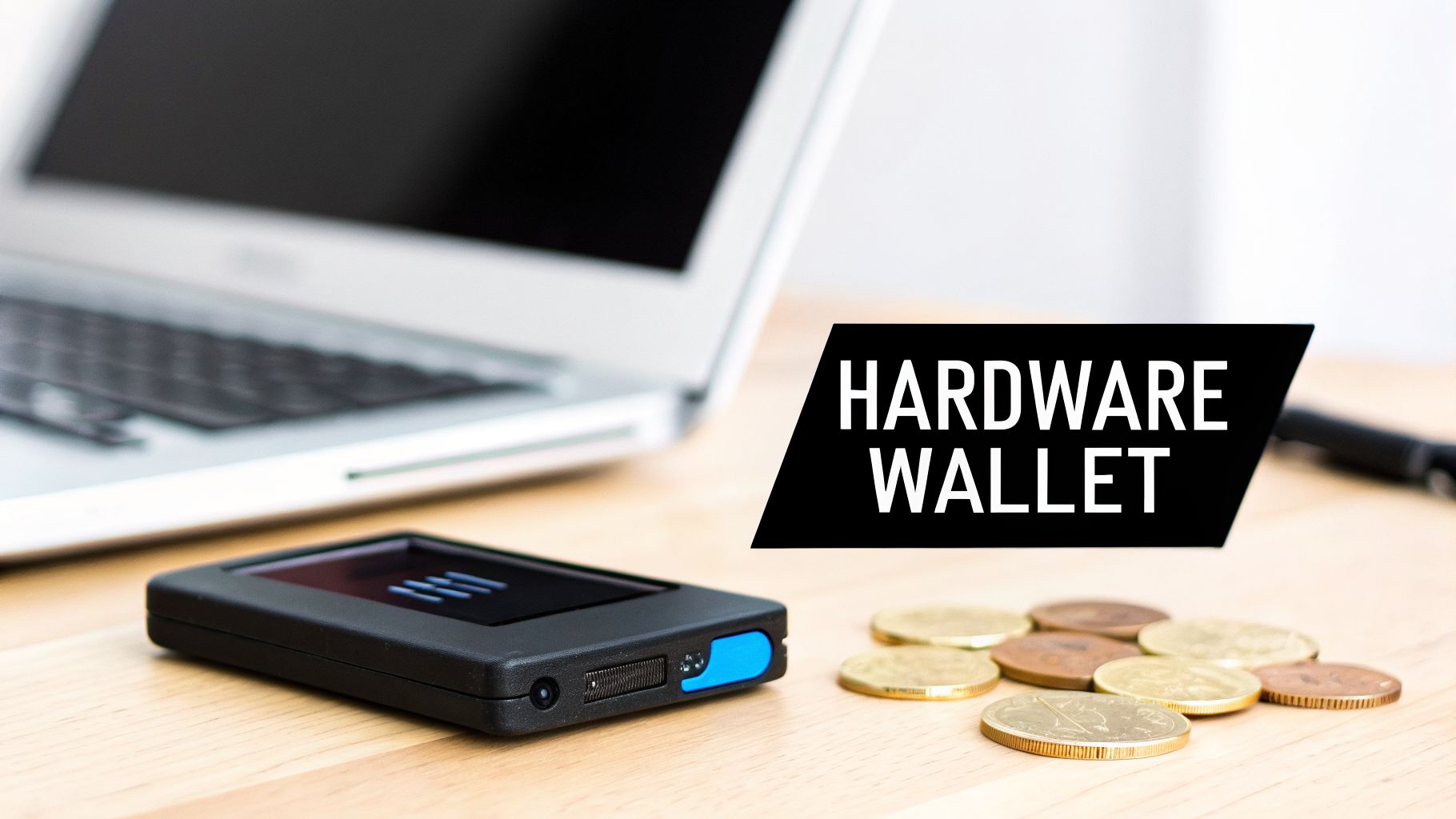
This method provides an excellent balance of security and accessibility, far surpassing the protections of software or "hot" wallets. To get a deeper understanding of the core principles behind this security model, you can learn more about cold storage crypto and its role in asset protection.
How They Work and Common Failure Points
When you set up a new hardware wallet, it generates a master private key. From this key, it derives a recovery seed phrase, typically 12 or 24 words long. This phrase is the only backup of your private keys. You must physically confirm transactions on the device itself, usually by pressing buttons, which prevents remote attackers from moving your funds even if your computer is compromised.
Despite their strong security, access can still be lost in several ways:
- Physical Loss or Damage: The device can be lost, stolen, or destroyed by fire or water.
- Forgotten PIN: All hardware wallets are protected by a PIN. Entering the wrong PIN too many times will wipe the device.
- Lost Recovery Seed: Without the seed phrase, a lost or wiped device means your crypto is gone forever.
- Forgotten BIP39 Passphrase: This optional "25th word" creates a separate, hidden wallet. Forgetting it makes the associated funds permanently inaccessible, even with the correct 12/24-word seed.
Key Insight: The security of a hardware wallet shifts from protecting against online hacks to ensuring the physical security and accessibility of your backup seed phrase. The most common point of failure is human error related to managing this backup.
Best Practices and Recovery Guidance
To protect your assets, purchase devices only from official manufacturers like Ledger or Trezor. Create at least two physical copies of your recovery seed and store them in different, secure locations (e.g., a home safe and a bank deposit box). Before transferring your main holdings, always test the recovery process with a small amount of crypto to ensure your backup works.
If you lose your PIN, damage the device, or forget your BIP39 passphrase, do not make repeated, frantic attempts to guess it. This can lead to the device wiping itself or locking you out permanently. In such scenarios, professional assistance from a service like Wallet Recovery AI can be critical. Engaging a specialist early in the process provides the best chance of recovering access without risking the permanent loss of your assets.
2. Paper Wallets (Cold Printed Keys)
Paper wallets are one of the original and purest forms of cold storage, representing a physical document that contains all the information needed to access your cryptocurrency. This method involves generating your private and public keys offline and printing them, often as both alphanumeric strings and QR codes, onto a piece of paper. Since the keys are created on a computer that is never connected to the internet (an "air-gapped" system) and are then stored physically, they are completely isolated from online threats like hacking, malware, and remote attacks.

This extreme offline approach was very popular among early Bitcoin adopters and remains a viable option for long-term "deep cold storage." The keys exist only on the physical medium you create, making them immune to digital theft. To learn more about the principles of offline security that make this method effective, you can explore the fundamentals of what cold storage crypto is and its advantages.
How They Work and Common Failure Points
To create a paper wallet, you use a wallet generator tool like the once-popular BitAddress.org on an offline computer. The tool generates a new key pair (public and private). You then print this information, and the digital file is permanently deleted. To spend the funds, you must "sweep" the private key into a software (hot) wallet, which broadcasts the transaction to the network. This act of exposing the private key online means a paper wallet should only be used once for spending; any remaining funds should be moved to a new, unused wallet.
Despite their immunity to online attacks, paper wallets are highly susceptible to real-world risks:
- Physical Damage: Paper is fragile. It can be easily destroyed by water, fire, tearing, or simply fading over time.
- Theft or Loss: A paper wallet is like cash. If it's lost or stolen, anyone who finds it has full control of the funds.
- Improper Creation: If the computer used for generation was secretly compromised with malware, the keys could be stolen from the start.
- Degradation of Ink: The ink used for printing can fade, especially if exposed to sunlight, rendering the keys unreadable.
- Accidental Disposal: Being just a piece of paper, it can be easily mistaken for trash and thrown away.
Key Insight: The security of a paper wallet is entirely dependent on its physical integrity and the security of its creation process. Unlike hardware wallets, there is no PIN or secondary protection; physical possession of the paper equals control of the crypto.
Best Practices and Recovery Guidance
When creating a paper wallet, use an air-gapped computer and a trusted, open-source key generator. Print on high-quality, acid-free paper and consider lamination for protection. For greater durability, you can stamp the keys onto metal plates. Store multiple copies in geographically separate, secure locations like a fireproof safe and a bank deposit box. Always test the wallet with a tiny transaction before committing your full balance.
If your paper wallet is partially damaged, faded, or torn, do not attempt to guess or manually reconstruct the key. A single incorrect character will make the entire key invalid. In these situations, the precise analysis offered by a professional service is invaluable. Experts at Wallet Recovery AI can use advanced forensic techniques to restore faded ink or piece together damaged keys, providing the best possible chance to recover funds that would otherwise be permanently lost.
3. Air-Gapped Computers (Offline Devices)
An air-gapped computer is a system that is physically and permanently isolated from any network, including the internet and local networks. This setup creates a completely offline environment used exclusively for generating private keys, storing them, and signing cryptocurrency transactions. By ensuring the machine never connects to an external network, it eliminates the possibility of remote attacks, making it one of the most secure types of cold wallets for managing significant crypto assets. The process involves preparing a transaction on an online "watch-only" computer and then transferring it to the air-gapped machine via a physical medium like a USB drive or QR code for signing.
This method is favored by Bitcoin Core developers, institutional custody providers, and advanced users who require a high degree of security and control. The signed transaction is then moved back to the online machine for broadcasting to the blockchain, all without the private key ever being exposed to a networked device. While more complex than using a hardware wallet, it offers an exceptional level of security for those with the technical skill to implement it correctly.
How They Work and Common Failure Points
Setting up an air-gapped system involves dedicating a new or wiped computer for offline use only. A minimal operating system, like a lightweight Linux distribution, is installed along with wallet software such as Electrum or Armory. The computer generates and stores private keys, and transactions are signed in this secure bubble. Data transfer for transaction signing is done using USB drives, which introduces its own risks if not handled carefully.
Despite its robust security against online threats, this approach is vulnerable to operational and physical failures:
- Hardware Failure: The computer's hard drive or other components can fail, making the stored keys inaccessible if not backed up.
- Physical Loss or Theft: The entire machine could be stolen, lost, or destroyed in a fire or flood.
- Data Transfer Contamination: A USB drive used to move transaction data can potentially carry malware from the online computer to the offline one, though this is a complex and rare attack vector.
- Forgotten Passwords: The wallet files and the operating system itself are typically encrypted with strong passwords. Forgetting these passwords will lock you out of your funds.
- Backup Loss or Corruption: Backups of the wallet files or seed phrases, often stored on encrypted USBs or paper, can be lost, damaged, or become unreadable.
Key Insight: The security of an air-gapped system depends entirely on rigorous operational procedures. The primary risks are not from hackers but from hardware failure, physical security breaches, and human error in managing backups and passwords.
Best Practices and Recovery Guidance
To maintain security, use a dedicated, single-purpose computer that will never be connected to a network. Install a minimal operating system to reduce the attack surface. Create multiple, encrypted backups of your wallet files and recovery seeds, storing them in geographically separate, secure locations. Always document your hardware specifications and operational procedures for future reference or recovery.
If you experience a hard drive failure, forget a wallet password, or lose your backups, avoid any impulsive recovery attempts. Trying to brute-force a password or running data recovery software without expertise can lead to permanent data corruption. For complex scenarios like a failed hard drive with an encrypted wallet or a forgotten password, engaging a professional service is the most prudent step. Specialists can perform forensic data recovery and apply advanced computational techniques, providing a methodical approach to regaining access while minimizing the risk of irreversible loss.
4. Multi-Signature Wallets (Multi-Sig/M-of-N)
Multi-signature wallets, often called "multi-sig," introduce a layer of shared control and security by requiring more than one private key to authorize a transaction. Instead of a single point of failure, this model distributes control across multiple devices or individuals. This setup is defined by an "M-of-N" scheme, where 'N' is the total number of associated keys and 'M' is the minimum number of signatures required. For example, a 2-of-3 wallet requires two signatures from a total of three keyholders to approve any outgoing funds.
This approach is one of the most robust types of cold wallets for securing substantial assets, as it eliminates the risk of a single lost key or a rogue individual compromising the entire fund. It’s a popular solution for corporate treasuries, family trusts, and decentralized autonomous organizations (DAOs) where collective asset management is essential. Platforms like Gnosis Safe and Electrum have been instrumental in making multi-sig setups more accessible for both institutional and individual use.
How They Work and Common Failure Points
A multi-sig wallet is created by generating multiple independent private keys, each stored separately. These keys can be held on different hardware wallets, paper wallets, or other cold storage methods. When a transaction is initiated, it is broadcast to the keyholders, who must each sign it with their individual private key until the required threshold (M) is met. Only then is the transaction considered valid and executed on the blockchain.
This distributed authority model is strong, but it introduces unique failure modes centered on coordination and logistics:
- Insufficient Signers: If one or more keyholders become unavailable, lose their keys, or refuse to cooperate, the fund can be permanently frozen if the remaining parties cannot meet the signature threshold.
- Key Distribution Risk: Storing all keys in one location defeats the purpose of multi-sig. However, distributing them too widely without proper documentation can lead to a key being lost.
- Loss of Multiple Keys: While losing one key in a 2-of-3 setup is recoverable, losing two keys means the funds are gone forever. The risk of total loss increases with the number of keys lost.
- Collusion: In a business or group setting, a malicious majority (e.g., three actors in a 3-of-5 scheme) could conspire to steal funds.
Key Insight: The security of a multi-sig wallet depends less on protecting a single secret and more on the operational security, trust, and coordination among the keyholders. The primary failure point shifts from technical compromise to human and logistical breakdowns.
Best Practices and Recovery Guidance
To properly secure a multi-sig wallet, establish clear governance protocols from the start. Distribute keys among trusted parties in geographically separate and secure locations. It’s also wise to combine different storage methods; for example, one key on a hardware wallet, one on a steel plate, and another with a trusted attorney. Document all procedures, keyholder contact information, and recovery steps in a secure, shared location.
If you face a scenario where you cannot gather enough signatures due to a lost key, an unavailable signer, or a forgotten passphrase for one of the key devices, the situation is delicate. Avoid uncoordinated attempts to guess passwords or access individual keys, as this can lead to permanent lockouts. Engaging a specialized service is often necessary to recover access to one of the locked key shares, which may be enough to reach the required signature threshold and regain control of the assets.
5. Metal Seed Phrase Storage (Stamped/Engraved Backups)
Metal seed phrase storage is not a wallet itself, but rather an essential security enhancement for other types of cold wallets, especially hardware and paper wallets. This method involves stamping, engraving, or etching your 12 or 24-word recovery seed phrase onto a highly durable material like stainless steel or titanium. By moving your backup from a fragile medium like paper to a robust metal plate, you create an offline backup designed to withstand extreme conditions such as fire, water damage, and corrosion, ensuring your seed phrase remains legible for decades.
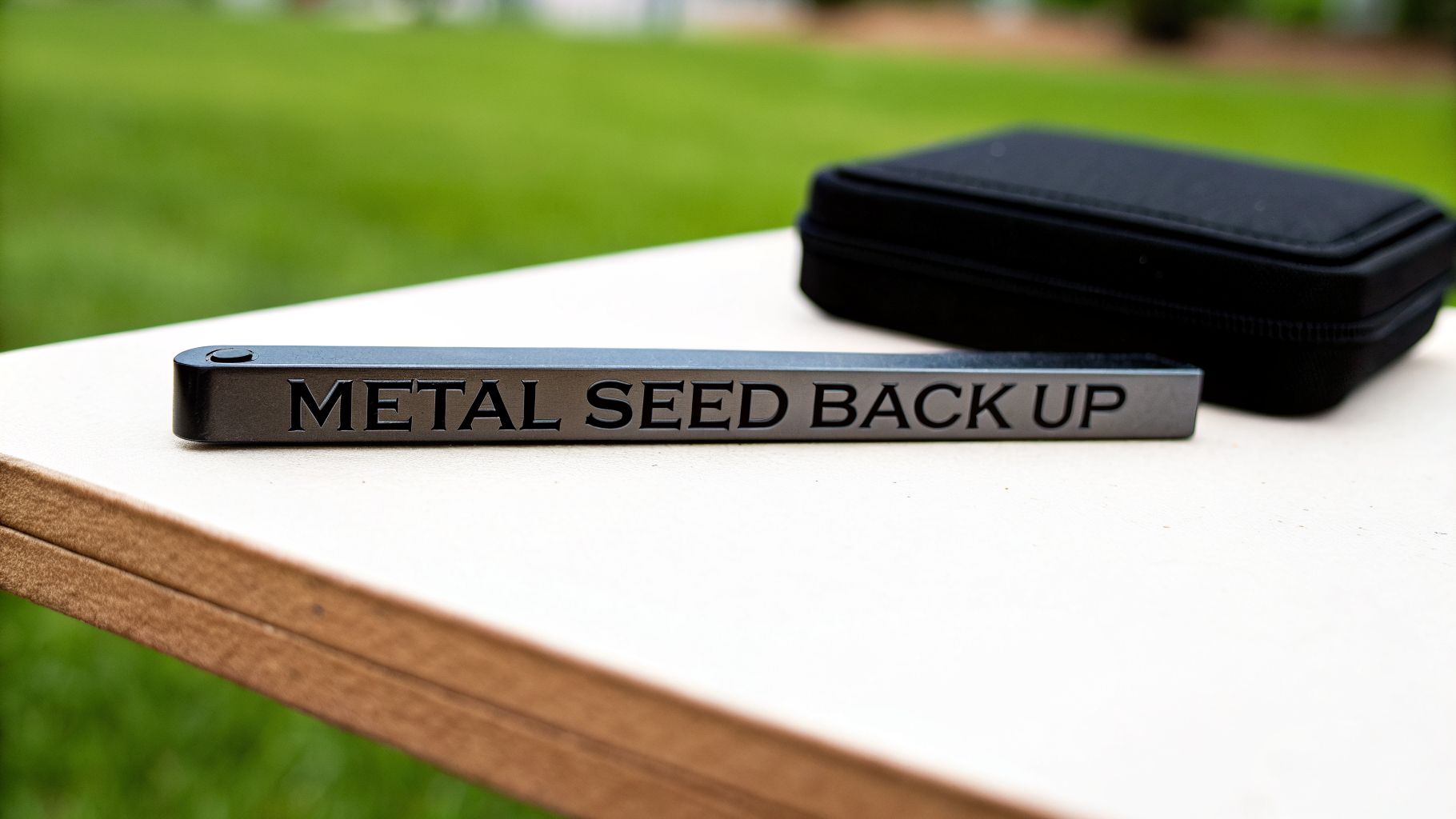
This approach directly addresses the primary weakness of paper backups: physical fragility. Leading hardware wallet manufacturers like Ledger and Trezor now recommend or sell their own metal backup kits, and specialized products like The Billfodl and ColdTi offer robust solutions. To explore the various options and determine which fits your security needs, you can find detailed reviews of the best metal seed phrase storage products available today.
How They Work and Common Failure Points
The process is straightforward: you receive a blank metal plate or set of tiles and a tool kit, typically with a letter stamping set. You then manually hammer each letter of your seed words into the metal, creating a permanent, physical imprint. Some solutions use pre-made letter tiles that you arrange in order and secure within a metal chassis. The final product is a fire-resistant, waterproof, and crush-proof record of the only key needed to restore your cryptocurrency wallet.
Despite their durability, user error remains the biggest risk:
- Incorrect Stamping: Misspelling a word, stamping letters illegibly, or putting words in the wrong order can make the backup useless.
- Physical Loss or Theft: Like any physical object, a metal backup can be lost or stolen. If not properly secured, it gives a thief direct access to all your funds.
- Single Point of Failure: Relying on just one metal backup stored in one location (e.g., your home) still exposes you to risk from theft or a localized disaster.
- Forgetting the Location: Simply forgetting where you stored the metal backup is a common and disastrous mistake, rendering it as good as lost.
Key Insight: Metal storage secures your seed phrase against environmental destruction, but it amplifies the need for meticulous operational security. The primary failure points shift from data corruption to physical security, transcription errors, and secure storage logistics.
Best Practices and Recovery Guidance
Always use a high-quality stamping or engraving kit on stainless steel or titanium for maximum durability and clarity. Create at least two metal backups and store them in geographically separate, secure locations, such as a fireproof home safe and a bank safety deposit box. Before storing it away, double-check every word and its order. Critically, perform a test recovery using a small, inconsequential amount of crypto to confirm your stamped backup works perfectly.
If you discover an error in your stamped backup or realize you’ve lost it, do not panic and create a new wallet without a plan. If you still have access to the original wallet (e.g., your hardware wallet is functional), you can safely move your assets. However, if you are locked out and your only backup is a faulty metal plate, professional assistance is vital. A recovery specialist can sometimes decipher poorly stamped words or explore other vectors if the metal backup is your last resort.
6. Cryptocurrency Exchange Cold Storage Vaults
Cryptocurrency exchange cold storage vaults refer to the custodial services offered by major trading platforms like Coinbase, Kraken, or Gemini. These services store a significant portion of customer funds in highly secure offline environments, completely disconnected from the internet. This institutional-grade approach mirrors the security practices of traditional banking systems, using multi-layered physical and digital protections to safeguard assets against online attacks, platform breaches, and unauthorized access. While this method introduces an element of trust in a third party, it is a common and often necessary component of the digital asset ecosystem.
Unlike personal cold wallets where you control the private keys, here the exchange acts as the custodian. This provides convenience but shifts the responsibility for security to the platform. Reputable exchanges like Coinbase Custody, Fidelity Digital Assets, and BitGo invest heavily in physical security, multi-signature protocols, and insurance policies to protect user deposits. You can learn more about cold storage crypto to understand the core principles that both individuals and institutions use for asset protection.
How They Work and Common Failure Points
When you deposit cryptocurrency into a major exchange, a large percentage (often 95% or more) is automatically transferred to their proprietary cold storage systems. These are typically air-gapped vaults with strict access controls, requiring actions from multiple authorized individuals to move funds. The small remaining portion stays in a "hot" wallet to facilitate daily customer withdrawals. The security of your assets relies entirely on the exchange's internal protocols, security audits, and operational integrity.
While this protects against external hacks, access can still be lost due to issues on the user's side:
- Lost Account Credentials: Forgetting the password to your exchange account is the most common point of failure.
- Loss of 2FA Device: If you lose the phone or hardware key used for two-factor authentication, you can be locked out of your account.
- Account Lockout: Suspicious activity or repeated failed login attempts can trigger an automatic security freeze on your account.
- Identity Verification Failure: If you cannot complete the exchange's KYC (Know Your Customer) process during a recovery attempt, you may be permanently denied access.
Key Insight: With exchange custody, the security focus shifts from managing private keys to managing your account credentials and identity. The primary risk of loss comes from being unable to prove to the exchange that you are the legitimate owner of the account.
Best Practices and Recovery Guidance
To protect your assets, choose exchanges with strong regulatory standing, proof-of-reserves audits, and comprehensive insurance coverage. Diversifying larger holdings across multiple reputable platforms like Kraken or Gemini can mitigate the risk of a single point of failure. Always enable the strongest two-factor authentication method available, such as a YubiKey, rather than relying on SMS.
If you are locked out of your exchange account, do not create a new account, as this can complicate the recovery process. Instead, immediately contact the exchange's official support or security department. Follow their identity verification procedures precisely and provide all requested documentation. If you encounter difficulties navigating the exchange’s specific recovery protocols or face an unresponsive support team, a professional service can help. Specialists can assist in preparing documentation and communicating effectively with the exchange to provide the best chance of successfully regaining control of your account.
7. Distributed Key Fragments (Shamir's Secret Sharing)
Distributed key fragments represent an advanced cold storage method that eliminates the single point of failure associated with a traditional 12 or 24-word recovery seed. This technique uses a cryptographic algorithm, most notably Shamir's Secret Sharing (SSS), to split a single private key or seed phrase into multiple unique "shards" or "fragments." Reconstructing the original key requires a specific number of these shards, known as a threshold. For example, in a "3-of-5" setup, the key is split into five fragments, and any three of them can be combined to restore the wallet.
This approach provides a powerful defense against theft, loss, or destruction. If one fragment is compromised, the funds remain secure because the thief lacks the required number of shards. Similarly, if you lose a fragment, you can still recover your wallet using the remaining ones. Major hardware wallet manufacturers like Ledger and Trezor have integrated this functionality into their devices, making it accessible to individual investors, not just institutions.
How They Work and Common Failure Points
When you enable Shamir backup on a device like a Trezor Model T, instead of one 24-word seed, the wallet generates multiple lists of words, each representing a unique fragment. The process is governed by a threshold scheme you define (e.g., 2-of-3, 3-of-5, 4-of-7). To recover your wallet, you must input the required number of these separate word lists. The algorithm then mathematically reconstructs the master key, granting you access to your crypto.
Despite its resilience, this method introduces unique failure points rooted in complexity and human error:
- Loss of Too Many Fragments: If you lose more fragments than your threshold allows (e.g., losing three shards in a 3-of-5 scheme), recovery becomes impossible.
- Incorrect Threshold Documentation: Forgetting your M-of-N scheme (e.g., thinking it was 2-of-5 when it was 3-of-5) can lead to failed recovery attempts and confusion.
- Fragment Management Overhead: The responsibility of securing multiple fragments in geographically separate locations can be complex and prone to mistakes.
- DIY Implementation Errors: Using unvetted online tools or writing your own SSS script can expose your key during creation or introduce flaws that make recovery impossible.
Key Insight: Shamir's Secret Sharing shifts the security burden from protecting a single seed phrase to managing a distributed system of fragments and their associated metadata. The most critical failure point becomes the loss of too many fragments or the documentation explaining how to combine them.
Best Practices and Recovery Guidance
To implement this method safely, use the built-in Shamir functionality on trusted hardware wallets like the Trezor Model T. Never use web-based tools for creating your fragments. Meticulously document your threshold scheme (e.g., "3-of-5"), the creation date, and which wallet it pertains to. Store this documentation separately from the fragments themselves.
Distribute your fragments in secure, geographically diverse locations, such as a home safe, a bank deposit box, and with a trusted family member or attorney. If you lose access due to misplaced fragments or forgotten threshold details, do not attempt to guess or brute-force combinations. The complexity makes manual success highly improbable and risks further confusion. Engaging a professional service with expertise in cryptographic recovery is the most prudent step. Specialists can analyze the remaining data and employ computational methods to assist in reconstructing the key, offering a structured path to recovery where manual attempts would fail.
7-Point Cold Wallet Comparison
| Method | 🔄 Implementation Complexity | ⚡ Resource Requirements | ⭐ Expected Outcomes (Security & Reliability) | 💡 Ideal Use Cases | 📊 Key Advantages |
|---|---|---|---|---|---|
| Hardware Wallets (Ledger, Trezor, KeepKey) | Low–Moderate: easy setup, firmware & backup steps | Moderate: device cost, secure storage for seed | ⭐⭐⭐⭐⭐ Strong offline key protection; resists malware/phishing | Everyday self-custody, portable cold storage for individuals & institutions | High security with usability, broad crypto support, insurance options |
| Paper Wallets (Cold Printed Keys) | Low: simple generation but strict handling required | Very Low: paper/printing; recommend air-gapped generation | ⭐⭐⭐ High offline security; high physical/environmental risk | Long-term hodling or cost-free backups when infrequent access needed | Zero tech cost, fully offline, easy redundancy |
| Air-Gapped Computers (Offline Devices) | High: technical setup, maintenance, secure procedures | High: dedicated hardware, encrypted backups, physical security | ⭐⭐⭐⭐⭐ Extremely secure vs. network attacks when configured correctly | Institutional custody, advanced users signing many transactions offline | Full control, customizable setups, scalable for many wallets |
| Multi-Signature Wallets (Multi-Sig/M-of-N) | Moderate–High: coordination and policy management | Moderate: multiple devices/holders, coordination tools | ⭐⭐⭐⭐⭐ Distributed control reduces single-point compromise risk | Organizations, family trusts, corporate treasuries requiring shared approval | No single key control, recovery tolerance, enforceable governance |
| Metal Seed Phrase Storage (Stamped/Engraved) | Low: simple stamping/engraving process but precision needed | Low–Moderate: purchase metal kit or professional engraving | ⭐⭐⭐⭐ Very durable against fire/water; protects long-term seed integrity | Long-term backups, estate planning, pairing with hardware wallets | Extreme durability, low maintenance, resists environmental damage |
| Exchange Cold Storage Vaults | Low (user): custodial process; High (provider): complex ops | Low (user): fees; provider requires infrastructure & insurance | ⭐⭐⭐⭐ Professional security and insurance but has counterparty risk | Users preferring custodial convenience, active traders, institutions | Convenience, insurance, regulatory compliance, professional recovery |
| Distributed Key Fragments (Shamir's Secret Sharing) | Moderate: requires crypto understanding and planning | Moderate: tools supporting SSS, secure fragment storage locations | ⭐⭐⭐⭐ Strong threshold security; tolerant of some fragment loss if planned | High-value personal holdings wanting distributed backups without multiple parties | Threshold reconstruction, flexible distribution, no central authority |
Your Next Move: Building a Resilient Recovery Plan
Navigating the world of cryptocurrency cold storage can feel like a complex undertaking, but understanding the various types of cold wallets is the first critical step toward securing your digital assets. We've explored everything from the tangible security of hardware wallets and stamped metal plates to the sophisticated, distributed trust of multi-signature and Shamir's Secret Sharing schemes. Each method offers a distinct balance of security, usability, and cost, with its own specific failure modes.
The core lesson is this: your choice of wallet is only the beginning. True asset sovereignty comes not just from taking your keys offline but from creating a robust, documented, and tested recovery strategy. A Trezor hardware wallet is strong, but not if its 24-word seed phrase is lost to a house fire. A paper wallet is simple, but not if the ink fades or the paper is destroyed by water damage. The security of any cold wallet system is only as strong as its weakest link, which is often the human element and the backup plan.
From Theory to Action: Solidifying Your Security
The most important action you can take after reading this article is to move from passive learning to active implementation. Your security is not a "set it and forget it" task; it's an ongoing process of diligence and preparation.
Your Immediate To-Do List:
- Document Everything: Create a secure, offline inventory of your assets. For each wallet, record its type (e.g., "Ledger Nano S," "Air-Gapped Laptop with Electrum," "3-of-5 Multi-Sig"), the date it was created, and a description of the assets it holds. Do not record private keys or seed phrases in this inventory.
- Audit Your Backups: Where is your seed phrase? Is it stored in a single, vulnerable location? Consider geographic distribution-storing backups in two or more physically separate, secure locations. If using metal storage, check for legibility and corrosion.
- Test Your Recovery Process: This is the step almost everyone skips. Can you confidently restore your wallet using only your backup? A test run with a small, non-critical amount of crypto can expose flaws in your plan before your entire stack is on the line.
Key Insight: A recovery plan that has never been tested is not a plan; it's a prayer. The stress and panic of a real access-loss event are the worst possible conditions under which to discover your backup is corrupted, incomplete, or inaccessible.
The Role of Professional Recovery Services
Even with the most meticulous planning, accidents happen. Hardware can fail unexpectedly, seed phrases can be damaged beyond recognition, and complex setups like multi-sig or SSS can become inaccessible if a key holder becomes unavailable. This is where you must have a plan B.
Forgetting a PIN or passphrase for a hardware wallet or losing a critical piece of a distributed key can feel like a final, irreversible loss. However, specialized recovery services have developed methods to address these exact scenarios. By establishing a relationship or at least knowing who to call before a crisis, you create a vital safety net. Waiting until disaster strikes adds unnecessary stress and can lead to hasty, poor decisions. In situations involving forgotten credentials, damaged backup media, or complex wallet configurations, a professional service can be the difference between asset recovery and total loss.
Should you ever face the stressful situation of being locked out of your wallet, remember that hope is not lost. Forgetting a password or PIN, or dealing with a corrupted backup for any of the types of cold wallets we've discussed, is a problem that Wallet Recovery AI is built to solve. Their secure, AI-powered approach provides a confidential and effective path to regaining access to your Bitcoin, Ethereum, and other crypto assets.
Leave a Reply