
That cold dread that sinks in when you realize you can't access your crypto is a feeling I know all too well. Your first instinct is probably to panic and start hammering away at your keyboard, trying every password you've ever used.
Don't.
Your very next moves are the most critical. Instead of making a bad situation worse, you need to shift your mindset from panic to a methodical process. This is often the first step before looking for professional crypto help near me, and it can make all the difference.
What To Do The Moment You Realize Your Crypto Is Inaccessible

The moment you’re locked out is a nightmare scenario for any crypto owner. But what you do in these first few minutes will dramatically influence your chances of getting your funds back.
Before you even think about hiring someone, it’s crucial to stabilize the situation and gather your facts. The table below outlines the most important things to do—and not do—right now.
Immediate Actions When You Cannot Access Your Crypto Wallet
Follow these steps to secure your situation before seeking professional help.
| Action Item | Why It Matters |
|---|---|
| Stop All Guessing | Many wallets have attempt limits that can lead to a permanently locked file or data corruption. |
| Document Wallet Details | Record the exact software (e.g., MetaMask, Electrum) or hardware name (e.g., Ledger, Trezor). |
| Brainstorm Password Clues | List any fragments, patterns, favorite words, or even the password's approximate length. |
| Gather Related Info | Note the approximate creation date and any associated email addresses or phone numbers. |
| Secure Your Device | Ensure the computer or device holding the wallet file is safe and not at risk of being wiped or formatted. |
Taking these steps shifts you from a state of panic into one of control, which is exactly where you need to be.
Resist The Urge To Guess Blindly
I can't stress this enough: your first impulse to rapidly guess passwords is a huge mistake. So many modern digital wallets have built-in security that limits your attempts.
Exceed that limit, and you could trigger a permanent lockout. Worse, I've seen cases where frantic guessing corrupts the wallet file itself, making recovery exponentially harder, even for a seasoned expert. Step away from the keyboard and take a breath.
Compile Every Detail You Can Remember
Now, it's time to become an information gatherer. Open a secure document and start a brain dump of everything—and I mean everything—you can recall about that wallet. This information is pure gold for a recovery specialist.
Your list should get as granular as possible:
- Wallet Information: The specific name of the software or hardware device.
- Creation Date: The approximate year, month, or even season you set it up.
- Password Clues: Any bits and pieces you remember. Think about favorite words, names of pets or family, important dates, special characters you always use (
!,@,#), or the password's general length. - Related Accounts: Any email addresses or phone numbers you might have linked to it.
Shifting from a panicked user to a meticulous archivist dramatically increases your recovery chances. Every small detail, no matter how insignificant it seems, can be the key that a specialist needs to unlock your funds.
This organized approach is your best preparation for finding crypto help near me. When you eventually contact a service like Wallet Recovery AI, you won’t be showing up empty-handed. You'll be providing them with a structured set of clues that turns a desperate plea into a solvable puzzle.
Navigating your way to local crypto help can feel like walking through a minefield. You're going to find a mix of legitimate professionals and outright predators, and knowing how to tell them apart is the single most important skill you need right now.
Doing your homework isn't just a good idea—it's your only real defense against losing even more money.
The first clues of a professional operation are often subtle. Start with their digital presence. A polished, well-written website that clearly explains their process is a great sign. On the flip side, a site riddled with spelling mistakes, broken links, or generic stock photos should set off alarm bells immediately.
Pay close attention to how they talk to you, too. A real expert will be patient and methodical. They’ll ask a lot of questions to understand your exact situation before they even think about making promises.
What a Real Service Looks and Feels Like
Trustworthy crypto recovery services are built on transparency. One of the biggest giveaways of a legitimate company is how they charge for their work. The industry standard is a success-based fee, often called a "no win, no fee" model. Put simply, they only get paid if they get your funds back.
This structure puts you both on the same team. They have every reason to succeed, and you're protected from paying for a failed attempt. The cryptocurrency recovery services industry has matured, and this commission model has become the hallmark of any reputable firm. A standard commission for a successful recovery is usually around 20%, though that can sometimes be negotiated for very high-value wallets.
A service demanding a large, non-refundable fee upfront is a massive red flag. Some might ask for a small, refundable deposit to cover the initial computing power, but the main payment should always be tied to success.
Beyond the fee structure, look for a professional and organized intake process. A real expert will have a formal, secure way of collecting information from you. It shows they've done this before and have a system that works.
The Absolute Deal-Breakers to Watch For
Knowing what to run from is just as critical as knowing what to look for. Scammers prey on desperation and panic, so being aware of their common tricks is your best defense.
If you see any of the following, stop all communication and walk away. Immediately.
- They Ask for Your Private Keys or Seed Phrase: This is the golden rule. A legitimate service will never need your full seed phrase or private keys. They work with password hints and other information you provide, running their recovery software on their own secure hardware. Giving someone your keys is like handing them the PIN to your bank card.
- They Guarantee Success: No one, and I mean no one, can guarantee a 100% recovery rate. The process is incredibly complex. A professional will give you a realistic, honest assessment of your chances—not an ironclad promise they can't possibly keep.
- They Use High-Pressure Tactics: Scammers create a false sense of urgency. They'll tell you to act "now or never." A genuine expert will encourage you to be careful and deliberate.
For a deeper look at what separates the good from the bad, you might find our guide on finding legitimate crypto recovery companies helpful. Understanding what established firms look like makes it much easier to spot the fakes.
Ultimately, finding the right partner comes down to patience and a critical eye. By carefully evaluating their online presence, fee model, and communication style, you can find the expert help you need with confidence.
When you start searching for "crypto help near me," you’ll find yourself at a fork in the road. Should you hire someone local you can meet in person, or trust a specialized online service? It's a common dilemma.
The idea of a face-to-face meeting is comforting, I get it. But you have to understand what each option is really built for. They're two very different beasts.
Local Help vs. Specialized Services
A local consultant can be a great resource for basic, educational tasks. Need someone to sit with you and explain how to set up a new hardware wallet? Or maybe you just want a walkthrough on crypto best practices. For that kind of hands-on guidance, someone local can be perfect.
But when things get serious—when you’re actually locked out of your funds—the game changes completely.
When A Specialist Is Your Only Real Option
If you're dealing with a forgotten password, a corrupted wallet file, or a damaged device, you’ve moved beyond basic support. These problems require serious firepower. We’re talking about massive computational resources for brute-force attacks and custom-built software designed to repair broken wallet files.
That’s just not something your average local IT guy or crypto enthusiast has in their garage.
This is where specialized online services like Wallet Recovery AI come in. Our entire operation is built around this one, specific task. We use powerful, AI-enhanced systems to churn through billions of password combinations faster than any standard computer ever could. The expertise is deep, and the tools are purpose-built for recovery.
Don't mistake physical proximity for security. True security in wallet recovery comes from proven expertise and audited, secure processes—not from being in the same room as the person helping you.
This flowchart maps out the vetting process, helping you distinguish legitimate services from the noise.
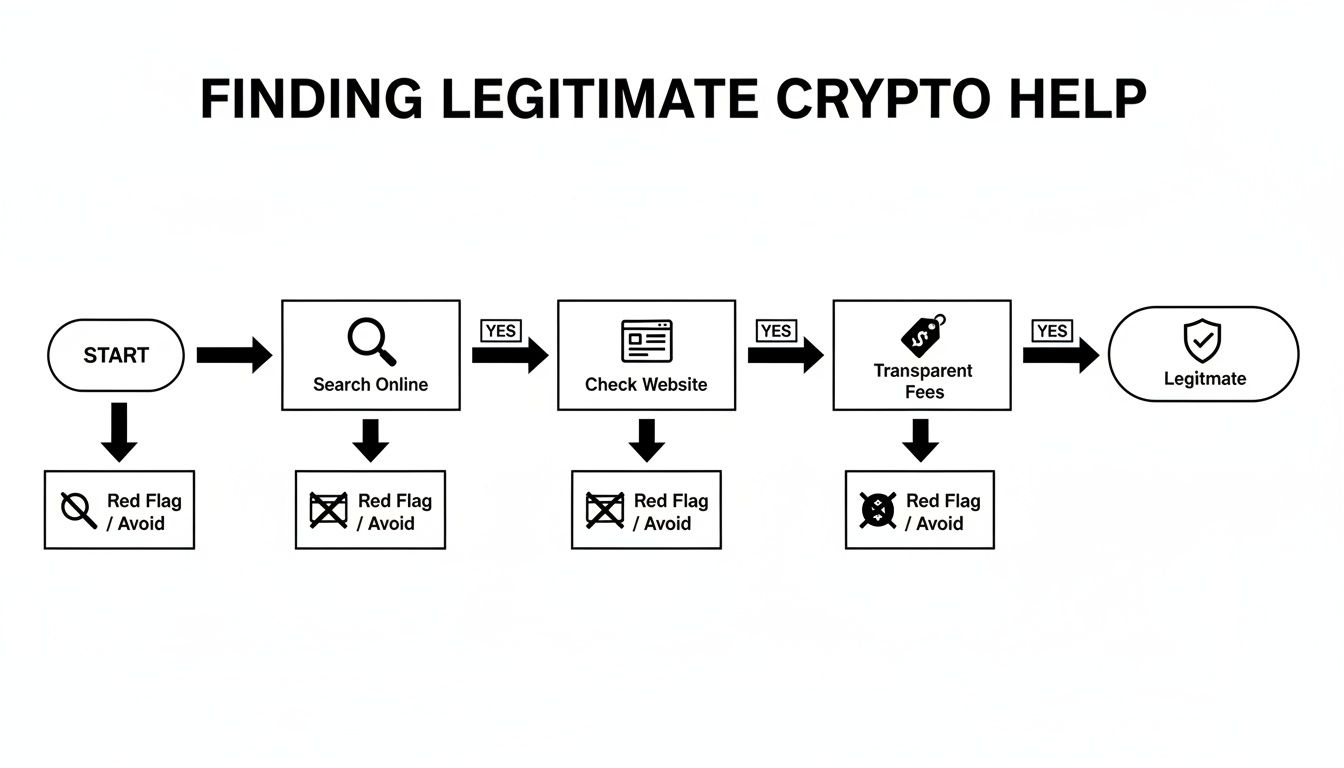
A legitimate service is defined by transparency—like having a clear, upfront fee structure—not by whether they have a physical office down the street. The success of any recovery attempt hinges on the details you can provide. Best-case scenarios can be resolved in just a few days, but more complex cases might need weeks of dedicated technical work.
Comparing Local vs. Online Crypto Recovery Services
To make the right call, you need to weigh the key differences. This table breaks down what you can realistically expect from each type of service.
| Factor | Local Consultant | Specialized Online Service (e.g., Wallet Recovery AI) |
|---|---|---|
| Technology | Usually limited to standard consumer hardware and off-the-shelf software. | Access to high-performance computing clusters and proprietary recovery tools. |
| Expertise | Often a generalist in IT with basic crypto knowledge. | Deeply specialized in cryptography, wallet architecture, and file corruption. |
| Security | Security protocols can vary wildly and are often unverified or ad-hoc. | Follows strict, audited procedures designed to protect client data at all costs. |
| Success Rate | Very low for complex cases due to a lack of specialized tools and power. | A significantly higher chance of success, especially for forgotten passwords or data corruption. |
The bottom line is that your choice should match the complexity of your problem. For anything beyond basic education, a specialized online service offers a clear advantage in technology, focused expertise, and robust security.
To help you vet potential services, our guide on identifying legitimate crypto recovery companies in the USA offers more tips for making a safe, informed decision.
How To Securely Prepare For The Recovery Process
Once you’ve done your homework and picked a service, it’s time to prepare your information. This is a critical step, and frankly, what you don’t share is just as important as what you do. Getting this right is often the difference between a successful recovery and a dead end.
Let me be blunt about the single most important rule: never, ever share your full seed phrase or private keys. No legitimate recovery service will ask for them. Anyone who does is trying to scam you, full stop. Think of those as the master keys to your kingdom; they never leave your sight.
Gather The Clues, Not The Keys
So, what should you give a recovery specialist? Instead of your credentials, you’ll be providing a set of clues. This helps them crack the code on their end without ever getting direct access to your funds. The goal is for you to be a helpful partner while staying in complete control of your crypto.
This information becomes the raw material for the recovery attempt. Get it all down in one secure document.
What a professional service actually needs:
- Wallet Type and Version: Be specific. Is it a MetaMask wallet? A Ledger Nano S? An old
wallet.datfile from Electrum on a dusty hard drive? The exact software or hardware name is vital. - Creation Date: Try to remember the approximate date you set up the wallet. Even just the year and season can be a massive help in narrowing down the search parameters.
- Password Hints: This is where you become the most valuable player. Jot down any fragments, character patterns, lengths, favorite words, important numbers, or special symbols (
!,#,*) you think you might have used.
This whole process is a bit like being a confidential informant for a detective. You're not handing over the master key to the vault; you're giving them the puzzle pieces they need to figure out the combination on their own.
How Your Information Is Used
This collection of clues is the fuel for highly specialized recovery tools. A professional service, including platforms like Wallet Recovery AI, will take your memory fragments and use them to build custom wordlists and attack patterns. These are then fed into powerful systems that run targeted, AI-driven attempts against an encrypted copy of your wallet.
For example, if you remember the password was "around 10 characters, had my kid's birth year in it, and ended with an exclamation point," the system can focus its immense power on combinations that fit that exact mold. This is infinitely more efficient than brute-forcing random guesses from A to Z.
The Information That Stays With You
To be crystal clear, here’s what you must protect no matter what. This information should never be shared with any service offering crypto help near you—or anywhere else, for that matter.
Critical Information To Never Share:
- Your Full 12 or 24-Word Seed Phrase: This grants immediate and irreversible control of your funds.
- Your Private Keys: Just like a seed phrase, this is the raw key to a specific crypto address.
- Your Full, Unchanged Wallet File: While a service might work with an encrypted copy, never send the original file without explicit, secure instructions from a professional you have thoroughly vetted.
Your job is to be an excellent source of intel, not to surrender control. By carefully preparing your clues while guarding your keys, you create the safest and most effective path toward a successful recovery.
Understanding The Real Costs And Timelines Of Wallet Recovery
When you're desperately searching for "crypto help near me," let's be honest—two questions are probably screaming in your head: "How much is this going to cost me?" and "How long will this take?"
Getting a realistic grip on the financial and time commitments is the first step to managing your expectations and not getting burned.
The truth is, there's no flat rate for crypto recovery. The price is tied directly to how complex your specific situation is. Cracking a forgotten password on a standard software wallet is one thing. Recovering funds from a physically fried hardware wallet or untangling assets lost in a maze of cross-chain swaps? That’s a completely different ballgame.
Breaking Down The Pricing Models
The gold standard in this industry—and a massive green flag you should look for—is the "no win, no fee" model. It’s simple: the recovery service only gets paid if they actually get your crypto back. This instantly aligns their interests with yours.
When they succeed, the fee is almost always a commission, taken as a percentage of the recovered funds.
For a successful recovery, you can typically expect a commission between 8% and 20%. This rate isn't set in stone; it's often negotiable and depends on the total value at stake and how tough the job is.
Straightforward password recovery jobs will land on the lower end of that scale because they're less intensive. On the other hand, complex cases like tracing funds through a DeFi exploit or peeling back layers of a dark web mixer require a ton of resources and highly specialized skills. Some top-tier firms might ask for a small, refundable upfront fee for initial analysis, but the main success-based charge only kicks in after your assets are safe. You can get a deeper look at how leading services price their work in this 2024 crypto recovery cost analysis.
How Case Complexity Affects The Timeline
Just like the cost, the timeline is all over the map. If anyone gives you a guaranteed turnaround time without digging into the details of your case, they're not being straight with you. The clock depends entirely on the problem.
Here’s a rough idea of what to expect for different scenarios:
- Simple Password Guessing: If you have some solid clues for a software wallet password, a specialist with powerful computers might crack it in a few days to a week.
- Corrupted Wallet File: Fixing a damaged
wallet.datfile is trickier. This could take anywhere from one to three weeks, depending on how bad the corruption is. - Damaged Hardware Wallet: This is the big one. Recovering data from a physically damaged device is a forensic-level task that can easily take several weeks or even months—if it's possible at all.
Patience is your best friend here. A true professional will keep you in the loop, but trying to rush the technical work will only lead to mistakes. The goal is a successful recovery, not a fast failure. Knowing this upfront helps you approach the process with a clear head and a realistic view of the investment required.
Frequently Asked Questions About Wallet Recovery Services
Handing over your wallet file for a recovery attempt brings up some tough, but fair, questions. You're right to be cautious. Let's walk through the big concerns we hear from clients all the time so you know exactly what to expect.
Is It Actually Safe To Use A Crypto Recovery Service?
Yes, but only if you're working with a legitimate, professional company. The entire process hinges on one simple, non-negotiable rule.
A trustworthy expert, including our team at Wallet Recovery AI, will never ask for your seed phrase or private keys. Full stop.
We don't need them. Our work is done by taking the clues and password hints you give us and running them through our own high-performance systems. The danger comes from scammers who insist they need your credentials to "access" the wallet—that's your signal to walk away immediately.
The safety of the recovery process comes down to this: A professional provides you with the password. You are the only one who uses it to access your funds. Your keys and crypto should never, ever pass through their hands.
What If I Remember Nothing About My Password?
Forgetting a password completely makes the job much harder, but not necessarily impossible. A professional service can still try more brute-force strategies, like running massive dictionary attacks or checking for known software bugs specific to your wallet type.
That said, your chances skyrocket with even the smallest hint. Think about anything—a pet's name, an old address, a favorite number, even a keyboard pattern you use. It's critical to be honest with the recovery service about having zero memory. It helps them build the right strategy from the very beginning.
Why Shouldn't I Just Try To Recover The Wallet Myself?
It’s tempting, we get it. But you run a very real risk of making things much, much worse.
Many wallets have a built-in limit on password attempts. Exceed it, and the wallet might lock permanently or the encrypted data file can become corrupted. Once that happens, even a professional might not be able to get it back.
Specialized services use computing clusters that can test billions of password combinations in a fraction of the time your home computer could—and they do it safely. For anything beyond a handful of simple guesses, going with a pro gives you a far better shot at success without the risk of accidentally destroying your data.
What Happens After My Wallet Is Successfully Recovered?
Once a reputable service gives you the correct password, their job is done. Your next step, and yours alone, is to immediately open the wallet and transfer all of your assets to a brand-new, secure wallet.
The recovery service should not and will not help with this part. This is a critical security boundary that ensures you, and only you, ever have control of your funds.
After your crypto is safe in its new home, the service will send an invoice for the agreed-upon success fee. That finalizes the process.
Feeling overwhelmed and not sure what to do next? The team at Wallet Recovery AI can help you figure out the safest path forward. Our AI-powered approach is built to maximize your chances of recovery without ever putting your privacy on the line.
Find out how we can help by submitting a confidential inquiry today.
Leave a Reply