
Let's get this straight: your crypto seed phrase is the single most important key to your entire digital kingdom. It's a simple list of 12 to 24 words that grants you absolute, unquestionable control over your crypto. Think of it as the ultimate escape hatch. If your laptop gets fried or your hardware wallet goes for a swim, this phrase is the only thing you need to get all your funds back, safe and sound, on a new device.
What Makes This String of Words So Powerful?
So, how can a handful of common words hold the keys to your financial future? At its heart, a seed phrase is just a user-friendly translation of a mind-numbingly complex string of cryptographic code. Instead of asking you to jot down a long jumble of random characters, wallets give you something you can actually write down and understand.
Here’s a simple way to think about it:
Imagine your crypto wallet is a massive, impenetrable bank vault. Each cryptocurrency you own—Bitcoin, Ethereum, Solana—is in its own separate safety deposit box inside. A private key opens just one of those boxes. Your seed phrase, on the other hand, is the master blueprint to the entire bank. It can recreate the key for every single box you own, now and in the future.
This whole system was standardized back in 2013 with something called Bitcoin Improvement Proposal 39 (BIP-39). It was a game-changer, setting the stage for the powerful "hierarchical deterministic" (HD) wallets we use today. The beauty of it is how it combines simplicity with rock-solid security:
- From Chaos Comes Order: It all starts with something called entropy, which is just a fancy word for pure, unpredictable randomness generated by your wallet. This ensures your phrase is one-of-a-kind.
- Words from Numbers: This random data is then cleverly converted into a mnemonic phrase—those 12 or 24 words you see. The wallet pulls them from a specific list of 2048 words.
- The Universal Key: Because virtually every modern wallet follows the BIP-39 standard, your seed phrase is portable. You can take a phrase generated on MetaMask and use it to restore your assets on a completely different wallet like Trust Wallet.
Let me be crystal clear: a seed phrase isn't just like a password; it is your money. If someone gets their hands on it, they can drain your wallet without asking permission. That’s why securing it is the first and most important rule of self-custody.
As crypto has gone mainstream, the reliance on this system has only deepened. With global crypto ETP inflows hitting an incredible $87 billion since 2024, an estimated 73% of individual holders still count on these simple word lists to protect their assets. It’s a powerful reminder of how fundamental seed phrases are to financial freedom in the digital age. You can discover more insights about the trends shaping crypto asset management and see for yourself why personal security remains paramount.
Understanding Your Seed Phrase at a Glance
To make this all a bit clearer, here's a quick breakdown of the core concepts that make your seed phrase work.
| Concept | Simple Explanation | Why It Matters |
|---|---|---|
| BIP-39 | The industry standard that allows wallets to create and interpret seed phrases. | Ensures you can move your assets between different compatible wallets without a hitch. |
| Entropy | A source of pure randomness your wallet uses to generate a unique phrase. | Prevents anyone from guessing or predicting your seed phrase. It's security from the start. |
| Mnemonic Phrase | The human-readable list of 12-24 words that represents your master key. | Makes it possible for you to write down, secure, and restore your crypto assets yourself. |
| HD Wallet | A "Hierarchical Deterministic" wallet that uses one seed phrase to manage all your keys. | Simplifies everything. You only need one backup for all your current and future accounts. |
Think of this table as your cheat sheet. These four pillars are what give you the power to truly own and control your digital assets, completely independent of any bank or third party.
How a Seed Phrase Creates Your Private Keys
Your crypto seed phrase isn't just a password. It's the master blueprint for your entire crypto life. Think of it as the single source of truth from which every private key you'll ever need is mathematically born. It’s a beautifully simple system that lets one phrase manage a virtually infinite number of accounts across countless blockchains.
The magic behind this is a standardized process called a derivation path. This is just a fancy term for a set of instructions your wallet follows to turn your seed phrase into a whole family tree of keys. Right at the top of that tree sits the master private key, generated directly from your seed. You'll probably never see it, but it's the ancestor of everything else.
From that one master key, your wallet can derive a massive number of individual private keys, each tied to a unique public address you can receive funds at. This is why you can hit "generate new address" in your wallet over and over without needing a new backup. They all trace their roots back to that original crypto seed phrase.
The Power of Deterministic Wallets
This whole hierarchical setup is what makes modern crypto wallets "deterministic." That just means a specific seed phrase will always generate the exact same set of private keys and addresses, in the exact same order. It doesn't matter if you're using a Ledger, a Trezor, or MetaMask—if they're compatible, the result is the same. This predictability is what makes wallet recovery possible.
It's a powerful idea because it opens the door to incredible flexibility. The derivation path doesn't just create new addresses for one coin; it can branch out to manage completely different cryptocurrencies, too.
- One Phrase for All Your Coins: A single seed phrase can spit out private keys for Bitcoin, Ethereum, Solana, and just about anything else. Your wallet uses a different derivation path for each coin, keeping everything neat, organized, and separate.
- Seamless Restoration: When you punch that seed phrase into a new wallet, it’s like giving it a map. The wallet follows all those derivation paths to regenerate every single private key for every crypto you owned, bringing your entire portfolio back to life in minutes.
The diagram below really clarifies this top-down relationship, showing how your seed phrase is the ultimate master key.
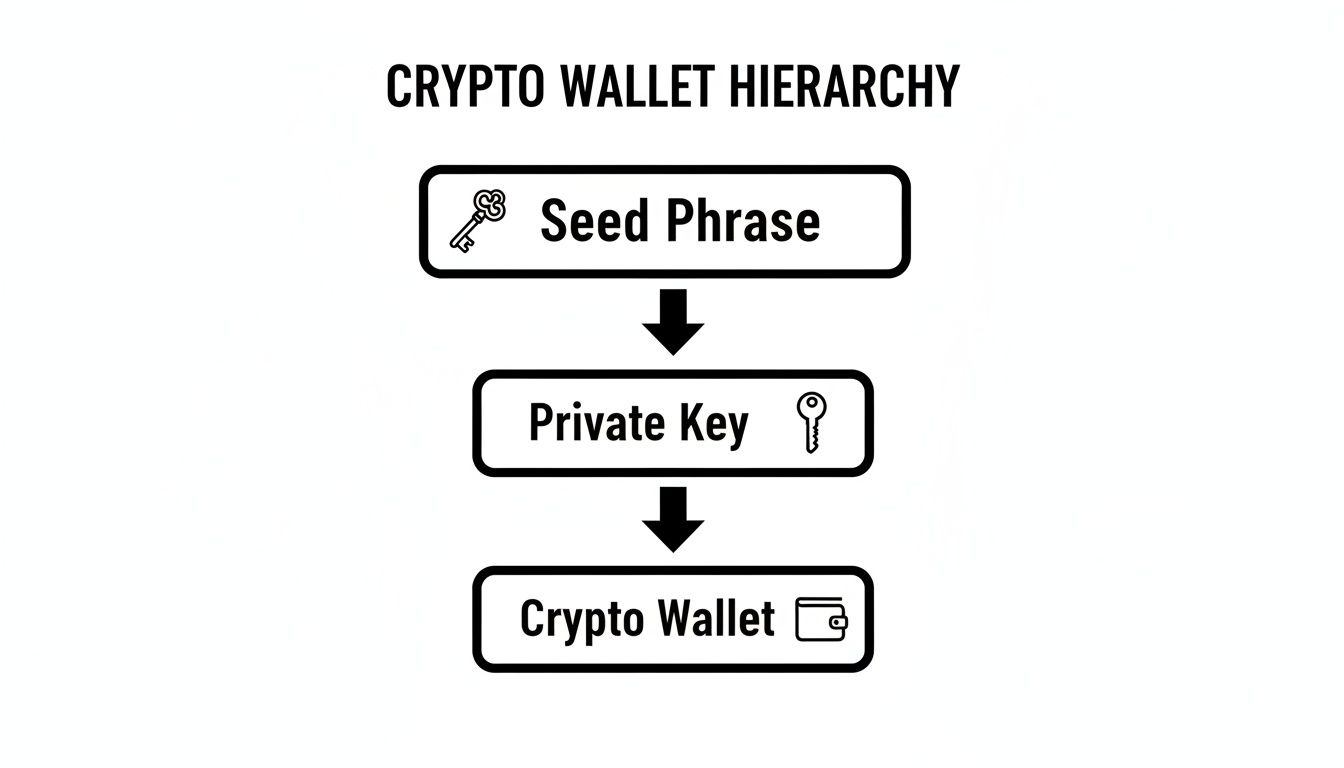
This makes it crystal clear: everything starts and ends with the seed phrase. If you lose it, the whole structure comes crashing down.
Understanding Derivation Paths
So how does a wallet know where to find your Bitcoin keys versus your Ethereum keys? It follows specific, industry-standard derivation paths. You can think of these paths like a digital filing cabinet for your crypto.
A common path might look something like m/44'/0'/0'/0/0. It looks like gibberish, but each number represents a different level in the key hierarchy. It tells the wallet the purpose, the coin type, the account number, and which specific address to generate.
The main takeaway: You don’t need to memorize these paths. Your wallet handles all the complex stuff behind the scenes. What you do need to understand is that this standardized system is what makes your seed phrase a universal key that different wallets can understand.
If you're curious and want to peek under the hood, tools exist that let you see this in action. You can play around with a mnemonic code converter to see the direct, mathematical link between the words you write down and the keys they produce. It’s a stark reminder of why protecting your crypto seed phrase is absolutely non-negotiable. If an attacker gets their hands on it, they can follow the exact same deterministic paths to your funds.
How to Securely Store Your Crypto Seed Phrase
Once it clicks that your seed phrase is the absolute master key to your crypto, the next thought should be how to protect it like it's a priceless artifact. Because it is. The way you generate and store this phrase is the single biggest factor in whether your self-custody journey is successful or a complete disaster waiting to happen.
The cardinal rule is simple, and it’s not up for negotiation: your seed phrase must never, ever touch the internet.
That means fighting every urge to store it digitally. Don't screenshot it. Don't save it in a notes app or a text file. And definitely don't upload it to Google Drive, Dropbox, or any other cloud service. Any device with an internet connection is a potential backdoor for a hacker to walk right in and drain your funds.
Generation and Initial Handling
So, how do you create it safely? The best practice is to generate your seed phrase completely offline, ideally when you first set up a reputable hardware wallet like a Ledger or Trezor. These devices are built specifically for this purpose—they create your phrase in a secure, isolated environment, far away from any malware that could be snooping on your computer or phone.
When your new wallet flashes those 12 or 24 words on its screen, what you do in the next few minutes is critical. Grab a pen and paper.
- Double-check every single word for correct spelling and order. One wrong letter can make the entire phrase useless.
- Number each word from 1 to 12 or 1 to 24. The sequence is just as important as the words themselves.
- Verify your backup immediately. Most hardware wallets have a confirmation step to make sure you wrote it down correctly. Don't skip it.
That piece of paper is now, financially speaking, one of the most valuable things you own. Treat it that way from the very first moment.
Physical Storage: The Only Secure Option
Since digital storage is a hard no, your only real choice is physical, offline storage. While this method makes you immune to remote hacks, it opens you up to physical world risks—fire, floods, theft, or even just the paper degrading over time. The solution is to create backups that are redundant, durable, and stored in different geographic locations.
Blockchain analytics tell a grim story: as of late 2025, an estimated 20% of all Bitcoin—around 4 million BTC—is sitting in wallets that haven't moved in over five years. A huge chunk of these "lost" coins, representing a mind-boggling 19% of Bitcoin's total supply, are likely gone forever because someone lost or destroyed their seed phrase. Even so, surveys show a shocking 68% of users still use dangerously insecure storage methods. You can read the full analysis on crypto trends to see how this impacts market predictions.
This data screams one thing: we have to do better. Let's look at the most common ways people store their phrases and see how they stack up.
Comparing Seed Phrase Storage Methods
Not all physical storage methods are built the same. That simple piece of paper is a necessary first step, but it's a terrible permanent solution. Here's a quick rundown of your options.
| Storage Method | Security Level | Pros | Cons |
|---|---|---|---|
| Paper | Low | Easy and free to create. Accessible to everyone. | Highly susceptible to fire, water damage, and physical decay. |
| Laminated Paper | Low-Medium | Offers some protection against moisture and wear. | Still vulnerable to fire, extreme heat, and physical destruction. |
| Steel Plate | High | Extremely durable. Resistant to fire, water, and corrosion. | Requires special tools for engraving/stamping. Higher initial cost. |
Etching your seed phrase into a steel or titanium plate is widely considered the gold standard for long-term, "act of God" proof storage. These metal plates can survive house fires, floods, and decades of neglect, ensuring your master key outlives almost anything you throw at it. Plenty of options exist, so it's smart to explore a full breakdown of the best metal seed phrase storage solutions to find one that fits your budget and security plan.
No matter what physical medium you choose, the strategy is always the same: create multiple copies and hide them in different, secure locations. This protects you from having a single point of failure. You could keep one in a fireproof safe at home, another in a bank's safe deposit box, and maybe a third with a trusted family member in another state. Redundancy is your best friend. If one location is ever compromised, you’ll still have a way back to your funds.
Common Mistakes and Security Threats to Avoid
Knowing how to properly store your crypto seed phrase is only half the battle. The other half is learning to spot and sidestep the countless traps laid by scammers and hackers. While the cryptography protecting your phrase is virtually unbreakable, human error is the weakest link in the security chain—and it’s a vulnerability that criminals exploit relentlessly.
To truly protect your assets, you have to adopt a zero-trust mindset. Treat every unsolicited message, strange pop-up, or unexpected request for your seed phrase with extreme suspicion. Scammers have become masters of manipulation, creating scenarios that feel urgent and legitimate to prey on your fear and trick you into handing over the master key to your entire crypto portfolio.

Digital Threats: Phishing, Malware, and Social Engineering
The most common way criminals try to steal your seed phrase is through digital attacks. They don't need to break into your house if they can just trick you into giving them the keys online. Often, these threats work together, creating a multi-pronged assault on your defenses.
A recent threat campaign, dubbed "PoisonSeed," is a perfect example of this danger in action. Attackers sent out phishing emails that looked like they were from major crypto companies like Coinbase or Ledger. These emails contained urgent warnings about "wallet migration" or "firmware upgrades," pushing users to a pixel-perfect clone of the official website. When users tried to "reconnect" their wallet on the fake site, their seed phrase was immediately stolen.
This shows just how sophisticated modern scams have become. Here are three of the most dangerous digital threats to watch out for:
- Phishing Attacks: These are deceptive emails, texts, or websites designed to fool you into entering your seed phrase. A classic tactic is an email claiming your wallet is compromised and you must click a link right now to secure your funds—but the link goes straight to a scammer’s data-harvesting site.
- Malware and Keyloggers: This is malicious software that can infect your computer and secretly record everything you type, including your seed phrase when you enter it into a legitimate wallet app. This is exactly why you should never type your seed phrase into any internet-connected device after the initial setup on a hardware wallet.
- Social Engineering: This is the art of psychological manipulation. A scammer might pose as a helpful support agent on Discord or Telegram, offering to fix a problem you mentioned. They build your trust before finally asking for your "recovery phrase" to "resync your wallet"—which is just a lie to get you to hand it over.
The Golden Rule of Crypto Security: Absolutely no one—not a wallet developer, support agent, or exchange employee—will ever need your crypto seed phrase for any reason. If someone asks for it, they are trying to rob you. Period.
Common but Costly Storage Mistakes
Beyond active threats from scammers, simple carelessness is a massive risk. The way you handle your physical backups can either secure your financial future or wipe it out in an instant.
Picture a UK investor who, after a close call with a scam, now looks at his seed phrase safely etched into a steel plate. That peace of mind comes from avoiding the common pitfalls that lead to staggering losses. An eye-opening report revealed that a shocking 92% of crypto losses in 2025 were linked to seed phrase vulnerabilities, totaling a mind-boggling $12.5 billion. You can explore detailed cryptocurrency security findings to learn more about this and other risks.
These huge losses often come from seemingly small mistakes. Storing your phrase on a cloud-synced device, laminating a paper copy that gets ruined in a flood, or just never making a backup at all are all recipes for disaster. The "lost forever" rate for Bitcoin, fueled by errors like these, is estimated to be around 18-20% of all coins ever mined. Don’t let your assets become another statistic.
That gut-wrenching moment when you realize your crypto seed phrase is gone—or worse, a jumbled mess—is something no one wants to experience. It feels like the digital equivalent of watching your house keys fall down a storm drain.
But don't panic just yet. Before you write off your assets as lost forever, you need to know there are often several paths you can take. The right move really depends on your exact situation. A simple typo on a paper backup is worlds away from a completely forgotten phrase. Let's walk through your options, starting with what you can tackle yourself before calling in the pros.
Starting with Self-Recovery Strategies
If you have most of your seed phrase or just suspect a small mistake, your first move should be a calm, methodical recovery attempt on your own. You'd be surprised how often simple human error is the culprit. A little patience here can go a long way.
First things first, gather every scrap of information you have. Don't dismiss anything. This means the words you do have, any notes about the order, the wallet you used, even when you created it. Once you have it all laid out, you can start troubleshooting the usual suspects.
Here’s what you can try:
-
Check for Spelling Errors: The BIP-39 wordlist is made up of 2,048 very specific words. It’s incredibly easy to misspell one, especially if you scribbled it down by hand. Go through your list and carefully check each word against the official list. Simple mistakes like writing "woman" instead of "women," or "legal" when you meant "leg" are common.
-
Verify Word Order: The order of the words is just as important as the words themselves. If you're pretty sure you have all 12 or 24 words but the sequence is wrong, you can try to reorder them. Now, trying every single combination by hand is impossible, but maybe you remember the first or last word? That alone can dramatically shrink the number of possibilities.
-
Look for Missing Words: Sometimes, you’re just missing a single word. If you have an idea where it might go (e.g., "I think it was the third word"), you can start plugging in words from the 2,048-word BIP-39 list one by one. It's tedious, for sure, but it can absolutely work.
A Quick Word on Security: This is critical. Any attempt to test a seed phrase needs to be done in a 100% secure, offline environment. Never, ever type potential seed phrases into a random online tool or web wallet. If the site is malicious, you’re just handing over the keys.
When to Consider Professional Recovery Services
While you can fix minor slip-ups on your own, some situations are just too complex for manual guesswork. If you're missing several words, have a corrupted wallet file, or are staring down a forgotten passphrase on top of everything else, the math gets out of hand. The number of potential combinations explodes into the billions, and that’s when it’s time to call in an expert.
This is where a professional service becomes a lifeline.
Services like Wallet Recovery AI are built for these heavy-duty jobs. They use powerful computers and smart algorithms to churn through millions or billions of combinations in a secure setting—something a person could never do.
Think about getting professional help if you're in one of these spots:
- You're missing more than one or two words from your phrase.
- You have a list of words but zero idea of the correct order.
- Your wallet is also locked with a password or passphrase you can't remember.
- You're dealing with a corrupted wallet file or an encrypted backup you can't open.
Working with a professional turns a desperate guessing game into a structured, methodical search. You provide all the clues you have—partial phrases, old password ideas, wallet files—and they use that to run powerful brute-force attacks safely. It’s the smartest path forward when you've hit a wall and gives you the best possible shot at getting your funds back.
Your Final Checklist for Seed Phrase Security
True self-custody in crypto boils down to one simple, non-negotiable rule: your seed phrase is your responsibility. Period. Keeping your assets safe isn't a "set it and forget it" task—it's an ongoing discipline.
Use this checklist to run a quick audit on your own security habits. It’s a simple way to make sure your crypto stays yours.
The most important thing to remember? Never share your seed phrase with anyone. A legitimate support agent, developer, or exchange will never ask you for it. Anyone who does is trying to scam you.
Auditing Your Security Practices
Take a second and be brutally honest with yourself about these questions. The answers determine whether you truly control your funds.
- Offline Generation: Did you create your seed phrase on a completely air-gapped device, like a new hardware wallet, that was never connected to the internet?
- Digital Purity: Is your seed phrase only stored physically? Are you 100% sure there are no digital copies floating around—no photos on your phone, no notes in a text file, no cloud backups?
- Physical Durability: Is your backup etched into something that can survive a fire or a flood? Think engraved steel plates, not just a piece of paper.
- Geographic Redundancy: Do you have backups in at least two different, secure physical locations? This protects you if one location is compromised by a disaster like a fire, flood, or theft.
Remember, the security of your seed phrase isn't about its length. It's about your discipline. A well-protected 12-word phrase is infinitely safer than a 24-word phrase left on a sticky note.
Run through this checklist every so often. Building these habits is what keeps your assets secure for the long haul and ensures you're always in complete control.
Got Questions About Seed Phrases? We've Got Answers.
Even after you get the hang of the basics, seed phrases can feel a bit mysterious. It's totally normal to have a few lingering questions. Let's tackle some of the most common ones head-on to clear things up and get you feeling confident about handling your crypto.
What's the Real Difference Between a Seed Phrase and a Private Key?
Think of it this way: your seed phrase is the master key to an entire hotel, while a private key just opens one specific room.
Your 12 or 24-word seed phrase is the one and only thing needed to generate all the individual private keys your wallet ever creates. Each of those private keys, in turn, controls a single crypto address. When you punch your seed phrase into a new wallet, it's not just pulling up a backup—it's mathematically recreating every single private key from scratch, giving you access to all your funds.
In day-to-day use, you'll never even see these individual keys. The seed phrase is the ultimate backup, the root of it all.
Here's a helpful way to picture it: The seed phrase is the root of a tree. From that one root, an entire system of branches (private keys) and leaves (public addresses) can grow. But it all comes back to that single, original source.
Can I Just Change My Seed Phrase?
Nope, you can't. A seed phrase is permanently locked to the wallet it creates. It’s a mathematical one-and-done deal.
If you ever think your seed phrase might be compromised—maybe you took a picture of it, or someone saw where you stashed it—the only safe move is to create a brand new wallet. This will give you a fresh, unique seed phrase. From there, you need to immediately transfer all your crypto from the old, compromised wallet to your new, secure one. Then, ditch the old wallet for good.
Is a 12-Word Phrase Way Less Secure Than a 24-Word One?
Honestly, both 12-word and 24-word phrases are ridiculously secure against brute-force attacks. A 12-word phrase has 2^128 possible combinations. That's a number so massive it’s essentially impossible for any computer on earth to guess.
While a 24-word phrase is exponentially stronger (2^256 combinations), the biggest risk you face isn't a hacker trying to guess your phrase. It's human error. How you store your phrase is infinitely more important than how long it is.
Let's break down the practical side of it:
- 12-Word Phrase: Provides more than enough security for almost everyone. By today's standards, it's mathematically unbreakable.
- 24-Word Phrase: Offers an even greater level of cryptographic security, making it more "future-proof," but the real threats are still things like a house fire, theft, or just forgetting where you put it.
At the end of the day, a 12-word phrase stored securely offline is a thousand times safer than a 24-word phrase jotted down on a sticky note. Your energy is better spent on creating a rock-solid storage plan, not worrying about the word count.
If you've lost access to your wallet because of a forgotten password, a corrupted wallet file, or even just a partially remembered seed phrase, don't assume it's gone forever. Wallet Recovery AI uses advanced techniques to help people get back into their accounts. Submit a request for a confidential recovery assessment today.
Leave a Reply