Losing access to your crypto is a uniquely brutal feeling. One minute your assets are there, and the next, they've vanished into the digital ether. It might be a forgotten password, a hardware wallet that’s given up the ghost, or the devastating work of a scammer. Whatever the cause, the result is the same: a sinking feeling of powerlessness.
Unlike a traditional bank where you can just call a support line and reset a password, the decentralized world of crypto offers no such safety net. Transactions are irreversible. Once your assets leave your wallet, they’re gone—at least, that’s how it can feel.
This is exactly where a cryptocurrency recovery service steps in. Think of them less as a support desk and more as a digital forensics team. These specialists combine deep technical knowledge with investigative prowess to track down and reclaim what was lost.
What Does a Crypto Recovery Service Actually Do?
You're not just hiring someone to guess passwords. A legitimate recovery firm brings a team of blockchain analysts, cybersecurity experts, and sometimes even legal strategists to the table. Their entire mission is to follow the digital breadcrumbs your assets left behind.
This isn't a simple process. It often involves:
- Deep Blockchain Forensics: Painstakingly tracing transactions across countless wallets and exchanges to find out where your funds actually ended up.
- Technical Key Recovery: Deploying advanced computational methods to crack forgotten passwords or piece together corrupted wallet files.
- Collaboration with Law Enforcement: Working with global authorities and legal channels to freeze and seize assets from known criminals.
The demand for these specialized services has exploded for a reason. In 2024 alone, crypto-related crime soared to $36.6 billion globally—a staggering 45% jump from the year before. And that trend is only continuing. You can dig deeper into the data on the rise of crypto crime in this comprehensive 2025 guide.
In an economy where billions of dollars are just lines of code, a crypto recovery service offers something more valuable than just technical skill—it provides a clear strategy and a genuine shot at getting your assets back.
They provide the expertise and tools most individuals simply don't have, turning a desperate situation into a structured, professional recovery operation. For many, they represent the only real path forward.
But how do people lose their crypto in the first place? It happens more easily than you might think. The scenarios range from simple human error to sophisticated criminal attacks.
How Crypto Is Commonly Lost
This table breaks down some of the most common ways people lose access to their digital assets and whether recovery is a possibility.
| Scenario | Description | Is Recovery Possible? |
|---|---|---|
| Forgotten Passwords/Seed Phrases | The most common issue. You lose the password to your software wallet or misplace your 12/24-word seed phrase. | Often Yes. Experts use brute-force techniques to recover passwords if a partial password or hints are available. |
| Hacked Wallets & Exchanges | A malicious actor gains unauthorized access to your wallet or exchange account and transfers your funds out. | Sometimes. Success depends on tracing the funds to a centralized exchange where they can be frozen with legal help. |
| Phishing & Investment Scams | You're tricked into sending crypto to a scammer or connecting your wallet to a malicious smart contract. | Difficult, but Possible. Involves tracing the funds and coordinating with law enforcement and exchanges. |
| Damaged or Lost Hardware | The physical hardware wallet or computer holding your crypto is lost, stolen, or damaged beyond repair. | Yes. If you still have your seed phrase backup, you can restore your wallet on a new device. |
| Corrupted Wallet Files | The wallet.dat or keystore file becomes corrupted, preventing the software from reading your private keys. |
Often Yes. Specialists can often repair the corrupted file to regain access. |
| Sending to the Wrong Address | You accidentally send your crypto to an incorrect or non-existent address. | Almost Never. Blockchain transactions are irreversible. If sent to an unowned address, the funds are likely lost forever. |
As you can see, while some situations are truly hopeless, many others have a potential solution. The key is acting quickly and engaging the right expertise before the trail goes cold.
Inside the Digital Detective Agency
Imagine a high-tech detective agency, but instead of chasing down clues in the physical world, its jurisdiction is the blockchain. That's essentially what a cryptocurrency recovery service is. When your digital assets vanish, you can't just file a standard police report and wait. Instead, these specialists launch a deep, meticulous investigation, combining serious technical chops with strategic action to hunt down your missing crypto.
It all kicks off with a detailed consultation, not unlike a detective taking a witness statement. You'll hand over every scrap of information you have—wallet addresses, transaction IDs, any communication you had with scammers, or even details about a locked-out device. This initial evidence-gathering step is absolutely crucial; it lays the entire groundwork for what comes next.
The Investigation Phase
Once they have your information, the real detective work begins. Analysts fire up powerful blockchain analysis tools to trace the digital breadcrumbs your transaction left behind. They start mapping the complex journey your funds took as they bounced across various wallets and exchanges, looking for patterns and, hopefully, a final destination.
This is rarely a straight line from A to B. Scammers are clever, often using sophisticated tricks like crypto mixers or "chain-hopping" to muddy the waters and throw trackers off their scent. Untangling this web requires a deep, practical understanding of how different blockchains work. The visual below gives you a high-level look at how they turn the chaos of a loss into a structured recovery plan.
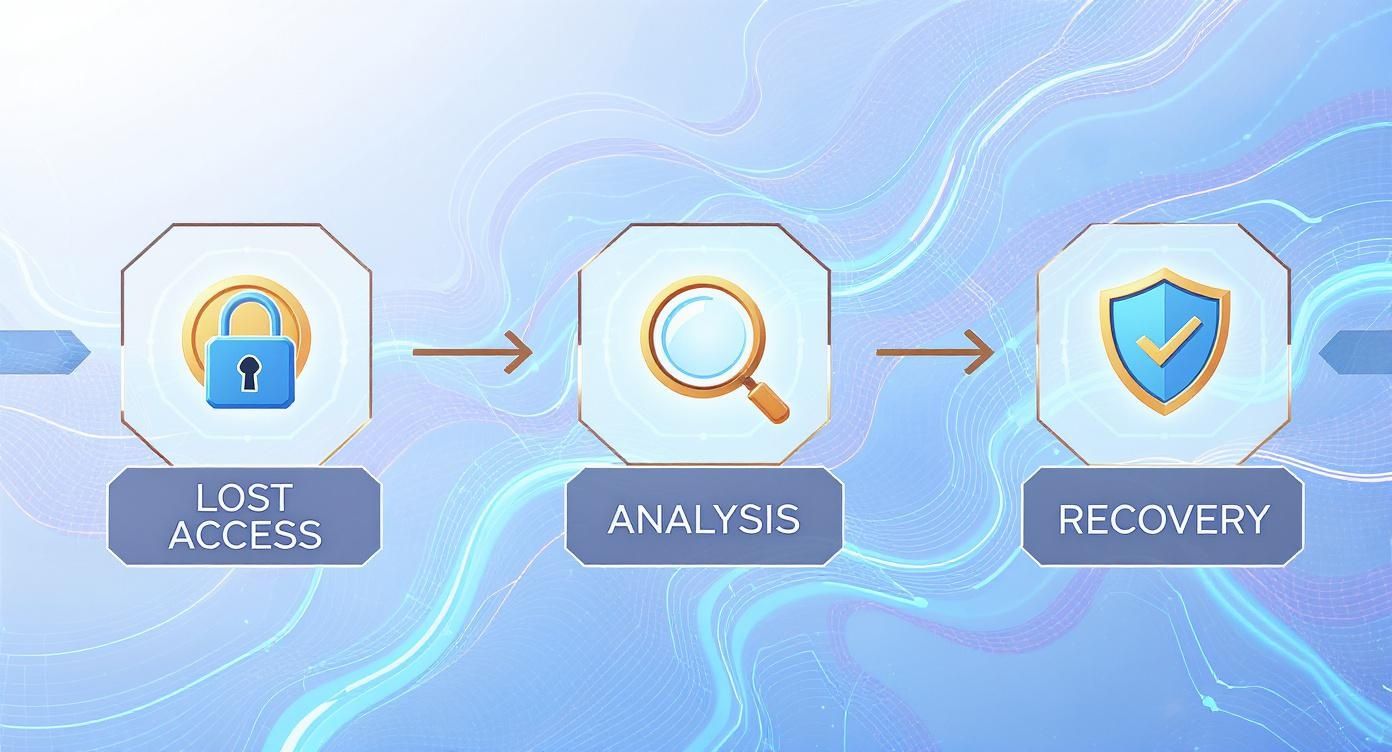
This process shows how a frantic situation gets organized into a methodical investigation, moving from that first analysis to a targeted strategy. While anyone can use a basic blockchain explorer to see public transactions, these analysts use far more advanced tools that can perform cross-chain analysis and help deanonymize wallets. If you're new to the concept, you can learn more by understanding what is a blockchain explorer.
The Path to Asset Recovery
The final stage is the actual recovery attempt. This isn’t one single move but a series of strategies carefully chosen for your specific case. The right approach depends entirely on where the funds ended up and how they were lost in the first place.
A successful recovery hinges on transforming digital clues into real-world action. It's the bridge between blockchain data and tangible results, often involving collaboration across multiple jurisdictions and platforms.
The methods a crypto recovery service might use can vary quite a bit:
- Legal Action and Law Enforcement: If the funds are traced to a centralized exchange, the service will coordinate with legal teams and law enforcement agencies to get court orders and freeze the assets.
- Direct Exchange Cooperation: Good recovery services have built relationships with the compliance departments at major exchanges. These connections can seriously speed up the process of identifying and locking down illicit funds.
- Technical Maneuvers: For cases involving forgotten passwords or corrupted wallets, experts deploy computational techniques (sometimes called brute-force attacks) to systematically test millions of password combinations to get you back in.
Ultimately, the goal is to turn those digital leads into a real, successful outcome. It takes a unique blend of sophisticated technology, legal savvy, and just plain stubborn investigation—the true marks of a digital detective agency.
Scenarios for Crypto Loss and Your Chances of Success
Losing your crypto isn't a single, straightforward problem. How you lost it completely changes the game when it comes to getting it back. Think of a crypto recovery service like a specialized medical team—the treatment they recommend depends entirely on the diagnosis.
Each scenario brings its own unique set of challenges and demands a completely different strategy. For instance, trying to get back funds lost in a sophisticated investment scam is a world away from cracking a forgotten wallet password. One is an intense investigative and legal fight; the other is a pure, brute-force technical puzzle. Understanding this from the get-go helps set realistic expectations.
Technical Recovery Scenarios
These are situations where you're locked out of a wallet you still technically control. The good news is that success rates here are often much higher because the funds haven't actually been stolen or moved by someone else.
- Forgotten Passwords or Seed Phrases: This is, by far, the most common reason people come to us. If you can remember even bits and pieces of a password or have some hints, experts can use powerful computers to run through millions of combinations and "brute force" the correct one.
- Corrupted Wallet Files: Sometimes, a software glitch can scramble a wallet file, making it totally unreadable. Specialists can often dive into the code, repair the damaged data structure, and restore access to your private keys.
- Damaged Hardware: A fried hardware wallet or a dead computer can feel like the end of the line. If you have your seed phrase backed up, recovery is a piece of cake. If not, forensic experts can sometimes work magic and pull the data directly from the damaged device itself.
Third-Party Loss Scenarios
This is where things get complicated. When your crypto is stolen or you accidentally send it to the wrong address, the challenge shifts from access to tracing. It becomes a race against the clock to track the funds before they vanish into the crypto ether.
Your odds of success are not a simple coin toss. The path to recovery is paved with specific details—how the crypto was lost, where it went, and how quickly you act are the most critical factors.
A huge hurdle here is that blockchain transactions are irreversible. If you send funds to a mistyped address that no one owns, that crypto is likely gone for good, locked away in a digital black hole.
But it's not all doom and gloom. While the overall statistics for crypto theft can look pretty grim, specialized recovery firms have reported surprisingly high success rates for certain types of cases—sometimes as high as 94% to 98% for recoverable scenarios. This optimism, however, needs a reality check; these high rates usually apply to more straightforward cases like password recovery. You can dig into more of the numbers by checking out these crypto scam recovery success statistics on coinlaw.io.
Ultimately, a successful recovery all comes down to a precise diagnosis. Investment scams, hacked exchanges, and simple transaction errors each need a unique plan of attack. A legitimate cryptocurrency recovery service will always start by analyzing your specific situation to see if there's a viable path forward, giving you a clear-eyed view of the complexity and the real chances of getting your funds back.
How to Find a Legitimate Recovery Partner
When your crypto is on the line, desperation can cloud your judgment. It’s a feeling scammers count on. The crypto recovery space, unfortunately, is littered with bad actors who prey on this vulnerability, promising the world while planning to take what little you have left.
Choosing the right recovery service isn't just about getting help; it's about protecting yourself from being victimized a second time.
Think of it like hiring a specialist lawyer for a high-stakes legal battle. You wouldn't hire an attorney who guarantees a win before seeing any evidence or demands a massive, non-refundable payment just to hear your story. The same exact logic applies here. A true professional operates with transparency, a clear process, and a verifiable track record.

Your first move should always be to scrutinize their reputation and how they operate. A legitimate firm will never use high-pressure sales tactics or stoke your fears. They'll offer a calm, methodical assessment of your situation.
Vetting Your Potential Recovery Service
Before you hand over any information or money, you need to do your homework. A credible company will welcome your questions and give you straight answers.
Here’s what to look for:
- Transparent Fee Structure: They need to be upfront about their costs. While a small fee for an initial assessment can be normal, run from anyone demanding a huge upfront payment. The best firms often work on a contingency or "no-win, no-fee" basis. They only get paid if they actually recover your funds.
- Verifiable Success Stories: Ask for case studies or anonymized examples of their previous work. Client confidentiality is key, of course, but they should still be able to show you a history of successful recoveries that are similar to your own situation.
- Proven Technical Expertise: You're looking for real-deal knowledge in blockchain forensics, cybersecurity, and advanced data recovery. Their team should be able to explain their methods in a way you can actually understand, not hide behind a wall of confusing jargon.
- Collaboration with Authorities: A top-tier service often works with law enforcement and legal teams, especially when theft or fraud is involved. This is a massive green flag—it signals they are legitimate and operate ethically.
Telling a professional firm apart from a scam can be tricky when you're stressed. This table breaks down the key differences to watch out for.
| Characteristic | Legitimate Recovery Service | Recovery Scam |
|---|---|---|
| Payment Model | No-win, no-fee or small assessment fee. | Demands large upfront payment. |
| Guarantees | Offers a realistic assessment of success. | Promises 100% guaranteed recovery. |
| Communication | Professional, patient, and transparent. | Uses high-pressure tactics and creates urgency. |
| Verification | Has a public track record, reviews, and case studies. | Lacks verifiable proof or uses fake testimonials. |
| Process | Explains their technical methods clearly. | Is vague or secretive about their process. |
| Collaboration | Works with law enforcement and legal counsel. | Operates in isolation and discourages reporting. |
Remember, no two cases are the same, but the patterns of legitimate and fraudulent operations are often very consistent. For an even deeper dive, our guide on selecting the best crypto recovery service provides a full checklist to help you vet potential partners.
A legitimate recovery partner sells expertise and a clear process, not a guaranteed outcome. They manage your expectations from the start and treat your case with the seriousness it deserves.
Your goal is to find a partner who is both technically skilled and ethically sound. Take your time, ask the tough questions, and never, ever ignore the red flags. The right service will arm you with a realistic strategy, not leave you with empty promises.
Why Crypto Recovery Is a Race Against Time
When your crypto vanishes, it's easy to feel paralyzed. But the hard truth is that every single second counts. The digital asset world moves at lightning speed, and criminals are masters at using that velocity to their advantage. The moment your funds are gone, the clock starts ticking, and they're already working to cover their tracks.
This isn't just a gut feeling; the numbers tell a grim story. In the first half of 2025 alone, a staggering $3 billion was lost to crypto-related crime. Of that, only about 5% was ever successfully recovered. That tiny percentage isn't a fluke—it's a direct reflection of how quickly a trail can go cold. You can dig deeper into these security challenges and recovery statistics in this 2025 investment analysis from ainvest.com.
The first few hours after a theft are everything. Scammers don't wait around. They immediately kick off a frantic laundering process, bouncing your assets through a tangled web of different wallets and exchanges to make them impossible to trace.
The Hurdles That Make Speed Essential
Several common tactics make a quick response absolutely critical:
- Crypto Mixers: Think of these as digital blenders. Scammers dump your stolen funds into these "mixer" services, where they get jumbled up with millions of other transactions. This effectively washes away the digital fingerprints a cryptocurrency recovery service needs to follow the money.
- Privacy Coins: It's common for thieves to quickly swap stolen funds for privacy-focused coins like Monero or Zcash. Once that happens, the transactions are designed to be anonymous, making them nearly impossible to track on a public blockchain.
- The Jurisdictional Maze: Cybercrime knows no borders. Your funds could be shot through exchanges in a dozen different countries in a matter of minutes, creating a legal and logistical nightmare that can bog down any recovery attempt.
The longer you wait, the colder the trail becomes. A swift response isn't just a good idea—for many, it's the only chance they have.
This is exactly why bringing in a professional service right away is your best bet. They already have the tools, expertise, and relationships with exchanges and law enforcement to jump into action within that critical initial window. While the best defense is always prevention, a rapid, expert-led response is the next best thing when the worst happens.
Fortify Your Defenses to Prevent Crypto Loss
While a cryptocurrency recovery service can be a lifeline when things go wrong, the best strategy is always prevention. It's about moving past generic advice and building a truly solid security setup for your digital assets. This isn't about being paranoid; it's about being a smart, prepared investor and making yourself a much tougher target for scammers and simple mistakes.
Your first line of defense is simple: separate your long-term holds from your daily trading funds. Think of a hardware wallet as a physical vault for your most important crypto. It keeps your private keys completely offline, far away from online hackers.
Essential Security Layers
A strong defense isn't about one magic tool; it's about layering your security. No single strategy is perfect, but when you combine a few, you create a powerful barrier against would-be thieves. You can start by putting these non-negotiable measures in place today:
- Enable Multi-Factor Authentication (MFA): Go turn on MFA for every single exchange and crypto service you use. Right now. A simple password just doesn't cut it anymore against modern cyberattacks.
- Secure Your Seed Phrase Offline: Never, ever store your seed phrase digitally. That means no text files, no cloud storage, and definitely not a photo on your phone. Write it down on paper and keep it in a few separate, secure physical locations.
- Use Multi-Signature Wallets: If you have significant holdings, a multi-signature (multisig) wallet is a game-changer. It requires approval from more than one device or person to send a transaction, making it incredibly difficult for a single attacker to steal your funds.
Adopting a security-first mindset transforms you from a potential victim into a prepared investor. Every layer you add significantly reduces your risk profile and the likelihood you'll ever need a recovery service.
Finally, stay constantly vigilant against phishing scams. These are getting more and more sophisticated. Always verify links, double-check sender email addresses, and be deeply suspicious of any "urgent" message asking you to connect your wallet or share sensitive info.
Common Questions About Crypto Recovery Services
When you're looking into a crypto recovery service, it's totally normal to have a ton of questions about how it all works. Figuring out the costs, timelines, and what's even possible is crucial for setting realistic expectations, especially when you're already stressed out. Let's tackle some of the most common things people ask.
How Much Is This Going to Cost?
One of the very first questions on anyone's mind is, "What's the price tag?" The honest answer is: it varies. But here's a key detail to look for: legitimate firms almost always work on a contingency fee basis. Think of it as a "no-win, no-fee" deal—they only get paid if they actually get your money back. This is a huge sign you're dealing with a trustworthy partner.
This fee is typically a slice of the recovered funds, usually somewhere between 10% to 30%, depending on how messy the case is. You need to be extremely wary of any service that asks for a big payment upfront. That's a massive red flag and a classic scammer tactic. A small, reasonable fee for an initial look at your case can be normal, but the main payment should always be tied to success.
How Long Does Recovery Take?
Another big one is, "How long until I see my funds?" There's no simple answer here because every situation is different. A straightforward password recovery might only take a few days or weeks. But a complex investigation into an international scam? That could easily stretch out for months, or sometimes even longer.
The process usually breaks down like this:
- Initial Analysis: This takes a few days to a week. The team digs into your case to see if a recovery is even possible and maps out a plan.
- Active Investigation: This is where the real work happens and it's the longest part of the journey. It can take weeks or months as analysts trace the funds across the blockchain and work with exchanges or law enforcement.
- Asset Seizure and Return: Once the funds are found and frozen, getting them back involves legal and administrative hoops that can add several more weeks to the clock.
A real pro will give you a realistic (if broad) timeline after they've done their initial homework. They’ll manage your expectations and won't promise you the moon with impossibly fast results—that’s a classic trick used by shady operators.
I Sent Crypto to the Wrong Address, Can I Get It Back?
Finally, the heartbreaking question: "Can crypto sent to the wrong address be recovered?" I wish I had better news, but the answer is almost always no. Blockchain transactions are irreversible by design. If you accidentally send your funds to an address that doesn't exist or that no one controls, those assets are gone for good, lost in a digital black hole.
There's a very slim chance if you sent the funds to an address controlled by a cooperative, centralized company, like a major exchange. In those rare cases, they might be able to help. But for most simple "fat finger" mistakes, the funds are permanently lost. Any reputable recovery service will be straight with you about this harsh reality from the get-go.
If you've lost access to your wallet because of a forgotten password or a technical glitch, Wallet Recovery AI offers a secure and discreet way to get your assets back. Our AI-driven methods are built to maximize success while keeping your information private. Start your confidential recovery process at https://walletrecovery.ai.
Leave a Reply