The entire debate between custodial vs non custodial wallets boils down to a single, critical question: who holds the keys to your crypto? With a custodial wallet, you're trusting a third party—like an exchange—to manage your private keys for you. It's convenient, much like a traditional bank. On the other hand, non-custodial wallets put you in the driver's seat, giving you exclusive control over your keys and making you the sole guardian of your digital assets.
Custodial Vs Non Custodial Wallets The Core Difference
Choosing your wallet is one of the first, and most important, decisions you'll make in crypto. It's a fundamental trade-off between the ease of a managed service and the absolute control of self-sovereignty. This decision will define everything from how you access your funds to the level of personal responsibility you carry for keeping them safe.
Think of a custodial wallet as your bank account. You rely on the bank to secure your money, and you access it with a familiar username and password. If you lose that password, you can call customer support and get it reset. This setup is perfect for newcomers or anyone who values a safety net.
A non-custodial wallet is more like a physical safe in your home where only you know the combination. You have complete and uncensorable control over what's inside. But if you forget that combination, there’s no one to call. This model is the heart of the crypto ethos: "not your keys, not your coins."
At-A-Glance Comparison Custodial Vs Non Custodial Wallets
This choice isn't purely technical; it's a philosophical one. Do you want the simplicity offered by a third-party service, or do you demand the total ownership that comes with holding your own keys? Getting a clear, high-level view of the differences is the first step to making a smart decision that fits your comfort level.
This table cuts right to the chase, laying out the essential distinctions between the two wallet types.
| Feature | Custodial Wallet | Non Custodial Wallet |
|---|---|---|
| Private Key Control | Managed by a third-party service (e.g., an exchange). | Fully controlled by you, the user. |
| Security Responsibility | The provider handles security measures and protocols. | You are solely responsible for securing your keys. |
| Account Recovery | Typically offers password reset and customer support. | Relies entirely on your securely stored seed phrase. |
| Ease of Use | Generally more beginner-friendly with a familiar login process. | Requires more technical understanding and personal diligence. |
| Control Over Funds | The provider can freeze or limit access to your assets. | You have complete, censorship-resistant control. |
While this table gives you a solid foundation, the real-world implications of these differences run deep. They influence your security, your privacy, and your freedom to engage with the wider world of decentralized finance. Now, let’s dig into the nuances of each wallet to figure out which approach is right for your crypto strategy.
Here’s the rewritten section, designed to sound completely human-written and natural, following the provided style guide.
Custodial Wallets: Trading Control for Convenience
Think of a custodial wallet like your bank account. When you use a major exchange like Coinbase or Binance, you're essentially handing over your crypto to a third party to look after. They manage the private keys for you, which makes the whole experience feel surprisingly familiar, especially if you're just getting started.
This approach is all about removing the scary, technical parts of crypto. Instead of safeguarding a long string of random characters (your private key), you just log in with a simple username and password. It's a design that intentionally lowers the barrier to entry, making it dead simple for anyone to get involved without needing a degree in computer science.
Why the Simple Experience is So Appealing
Let's be honest, the biggest draw of a custodial wallet is how easy it is. The entire setup is designed to be intuitive and to take the pressure off. If you forget your password, it’s not game over. You can usually reset it through your email or by talking to a support agent—a far cry from the irreversible loss you face if you misplace a seed phrase.
This built-in safety net is a huge relief for many. It completely removes the stress of being the sole guardian of your private keys, where one mistake could mean your funds are gone forever. The experience is all about ease and peace of mind.
- Easy Setup: Getting started is often as quick as signing up for a new social media account.
- Built-in Trading: These wallets are almost always part of an exchange, so buying and selling is seamless.
- Real Human Support: If something goes wrong, you can actually contact a customer service team for help—something you simply don't get with self-custody.
And it’s clear this model is catching on. The global market for custodial wallets hit $3.5 billion in 2023 and is expected to jump to $11.5 billion by 2032. That kind of growth tells you there's a massive demand for solutions that just work without forcing users to become their own security experts. You can dig into the numbers yourself over at Dataintelo.com's market report.
The Fundamental Trade-Off: A custodial wallet means you’re swapping ultimate control for convenience. You're trusting the platform to secure your assets, much like you trust your bank to hold your money.
Understanding the Risks You're Taking On
Of course, that convenience comes with a major catch: you're not really in control. The old crypto saying, "not your keys, not your coins," perfectly sums up the risk here. Because a third party holds the keys, you don't have absolute ownership of your funds.
This opens the door to a few serious problems. First, there's counterparty risk. If the exchange gets hacked, goes bankrupt, or gets shut down by regulators, your funds could be frozen or lost completely. We've seen this happen time and time again with major exchange failures.
On top of that, your access isn't guaranteed. The custodian can freeze your account or block a transaction if they suspect something fishy or if law enforcement comes knocking. This introduces a level of control that goes against the whole point of decentralized money. Finally, your privacy is limited. Most custodial services require extensive ID verification (KYC), linking your real-world identity to every transaction you make. This reality is at the heart of the custodial vs non custodial wallets debate—you have to choose between simplicity and true financial autonomy.
Why Non-Custodial Wallets Offer True Ownership
If custodial wallets are like a bank account, non-custodial wallets are like holding cash in your own private vault. This approach gets right to the heart of what cryptocurrency is all about: true ownership and financial self-sovereignty. When you use a non-custodial wallet, you are the only one who holds the private key, making you the sole controller of your assets.
This model flips the traditional financial structure on its head. Instead of trusting a company to hold your funds, you become your own bank. It all boils down to two critical pieces of data: your private key and your seed phrase.
The private key is the cryptographic secret that proves you own your crypto and gives you the authority to sign transactions. Meanwhile, your seed phrase—usually a list of 12 or 24 words—is the master key that can regenerate all your private keys if your device ever gets lost, stolen, or just stops working.
The Power of Absolute Control
Holding your own keys grants a level of freedom that custodial services simply can't replicate. It's the digital equivalent of cash in your pocket. No one can freeze your funds, block a transaction, or seize your assets without your explicit approval.
This complete control comes with some powerful advantages:
- Censorship Resistance: Your ability to send and receive crypto isn't at the mercy of a corporation or government. This is a game-changer for people in countries with unstable financial systems or strict capital controls.
- Enhanced Privacy: Most non-custodial wallets don't require you to complete Know Your Customer (KYC) verification, so your identity isn't directly tied to your assets on a company server.
- Direct DeFi Access: To really dive into Decentralized Finance (DeFi)—lending, borrowing, staking, and more—you need a wallet like MetaMask that you control yourself. Custodial wallets just can't plug into this ecosystem in the same way.
The demand for this kind of autonomy is surging. The non-custodial wallet market, valued at $1.5 billion in 2023, is expected to balloon to $8.4 billion by 2032. It’s no surprise when you consider that roughly 66.5% of crypto holders already prefer non-custodial options, a trend fueled by the constant headlines of security breaches at centralized exchanges. You can see a full analysis of this growing market trend on Appinventiv.
The Responsibility of Self-Custody
This incredible freedom comes with an equally immense amount of personal responsibility. The old crypto adage "not your keys, not your coins" cuts both ways. If you lose your keys, they really aren't your coins anymore.
With a non-custodial wallet, you are the entire security team. There is no customer support hotline to call if you forget your password or misplace your seed phrase.
This is the primary trade-off. Your seed phrase is a single point of failure. If it's lost, damaged, or stolen, your funds are gone for good through any normal means. This is why meticulous security is non-negotiable. It’s also why hardware wallets from companies like Ledger and Trezor are so popular; they keep your private keys completely offline, safe from online threats like malware. To get a better sense of how they work, check out our guide on what a hardware wallet is.
Ultimately, your choice in the custodial vs non custodial wallets debate comes down to how comfortable you are with this responsibility. Forgetting a password to an old wallet file or finding only a partial seed phrase can feel like hitting a brick wall. It's in these exact moments, after you've tried everything you can think of, that a specialized recovery service becomes the only realistic option for getting your assets back.
Comparing Security, Control, and User Experience
Choosing between a custodial and non-custodial wallet goes much deeper than just a simple list of pros and cons. It's a decision that fundamentally defines your relationship with your crypto, shaping everything from your security measures to how you use your assets day-to-day. A careful comparison across three key pillars—security, control, and user experience—reveals the critical trade-offs at play.
This isn't about which wallet type is objectively "better." It's about finding the right fit for your personal risk tolerance, technical know-how, and overall crypto strategy. Looking at it this way helps you move beyond flashy features and make a choice that truly serves your needs.
The Security Dilemma: Platform Risk vs. Personal Risk
Security is paramount for any crypto holder, but the threat models for custodial and non-custodial wallets are worlds apart. With a custodial wallet, you're essentially outsourcing your security to a third party. You're putting your trust in their infrastructure, their cybersecurity team, and their internal procedures.
The biggest risk here is platform-level failure. Think large-scale exchange hacks, internal fraud, or even the company going bankrupt. While major exchanges pour millions into institutional-grade security, they are massive targets for sophisticated attackers. You’re betting that their defenses are stronger than a hacker’s determination.
A non-custodial wallet, on the other hand, puts the entire security burden squarely on your shoulders. The risks become intensely personal. You stop worrying about an exchange getting hacked and start worrying about your own computer being hit with malware or falling for a phishing scam that tricks you into giving up your seed phrase.
With a custodial wallet, you trust the platform's security team. With a non-custodial wallet, you are the security team. This is the single most important distinction to grasp when deciding how to protect your assets.
The Spectrum of Control: True Asset Sovereignty
The idea of "control" gets to the philosophical heart of the crypto movement. Non-custodial wallets give you absolute asset sovereignty. Since you hold the private keys, nobody can freeze your funds, block a transaction, or seize your assets without your direct approval. This censorship resistance is a cornerstone of decentralization.
Custodial wallets, by their very design, compromise this sovereignty. You're granted access to your funds, but the provider holds the ultimate control. They can—and often do—impose withdrawal limits, flag transactions for review, or freeze accounts based on regulatory orders or their own risk models. While this is often done for security, it introduces a layer of permission you just don't have with self-custody.
This difference becomes crystal clear when you venture into the world of Web3. To really interact with decentralized applications (dApps)—from DeFi lending protocols to NFT marketplaces—you almost always need a non-custodial wallet that allows you to sign transactions and interact directly with smart contracts.
The following infographic breaks down the core principles that define the non-custodial experience.
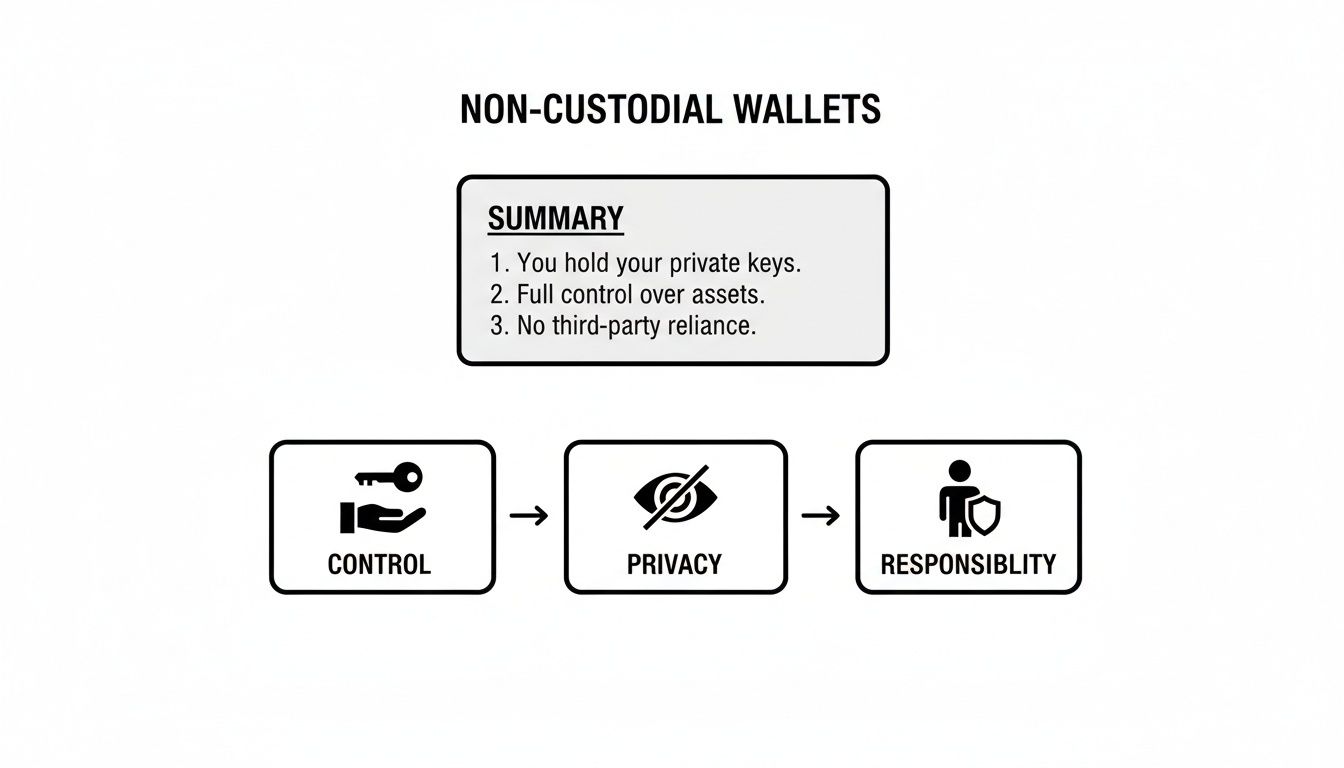
As you can see, full control and greater privacy go hand-in-hand with the immense personal responsibility that comes with managing your own keys.
The User Experience Trade-Off: Simplicity vs. Responsibility
Finally, the user experience (UX) is where the day-to-day differences really hit home. Custodial wallets have mastered creating a familiar, easy-to-use environment that feels a lot like your online bank account.
- Onboarding: Setting up an account is as simple as providing an email and creating a password.
- Transactions: Sending crypto is a breeze, with the platform handling all the technical heavy lifting behind the scenes.
- Recovery: If you forget your password, it’s not a disaster. You can get back into your account through standard identity verification.
Non-custodial wallets have a much steeper learning curve. The setup process involves carefully securing a seed phrase—a concept totally new to most people. Every transaction requires you to double-check wallet addresses, because one slip-up is permanent. And recovery? It all comes down to whether you safely stored that seed phrase. If you lose it, your funds are very likely gone for good.
This explosion in wallet options reflects a maturing industry. The global cryptocurrency wallet market hit $12.59 billion in 2024 and is projected to skyrocket to $100.77 billion by 2033. This growth is fueled by both beginner-friendly custodial platforms and powerful new non-custodial tools, serving a diverse user base that now includes over 659 million people globally. You can dive deeper into these trends in the full analysis from Grand View Research. This expansion means that whether you value a simple experience or total control, there's a wallet out there built for you.
Matching Your Wallet to Your Crypto Strategy
The whole "custodial vs. non-custodial" debate isn't about finding one wallet to rule them all. It's about matching the tool to the job. The wallet an active day trader needs is fundamentally different from what a long-term investor should be using.
Once you figure out your own crypto "persona," you can stop thinking in abstract pros and cons and start building a practical, effective strategy. Let's break down three common crypto user types to see how this plays out in the real world.
The Active Trader
If you're an active trader, speed is the name of the game. You're constantly buying, selling, and moving assets to catch market swings. Your main goal is to cut down on friction—delays and fees—to execute trades as fast as humanly possible.
For this person, a custodial wallet on a major exchange is the only logical choice. Keeping your funds on a platform like Coinbase or Binance means you get instant, often zero-fee internal transfers and direct access to the trading engine. Trying to move crypto from an external non-custodial wallet for every single trade would rack up network fees and introduce agonizing delays, turning winning trades into missed opportunities.
- Recommendation: Custodial exchange wallet.
- Why it works: You need raw speed, low friction, and deep liquidity. The trade-off is accepting a little counterparty risk for a massive performance gain.
The Long-Term Investor (The "HODLer")
The long-term investor, or "HODLer," plays a completely different game. Their strategy is simple: buy and hold for months or, more likely, years. They aren't trading frequently, so their number one priority is bulletproof security. They need to protect their assets from every threat imaginable, from exchange collapses to sophisticated hacks.
For this profile, a non-custodial hardware wallet is absolutely non-negotiable. A device from Ledger or Trezor keeps your private keys entirely offline, making them invulnerable to online attacks like malware or phishing. Yes, there's a small learning curve, but it's a tiny price to pay for the peace of mind that comes with true self-sovereignty and ironclad long-term security.
- Recommendation: Non-custodial hardware wallet.
- Why it works: When you're safeguarding wealth for the long haul, maximum security against online threats and zero counterparty risk are the only things that matter.
The DeFi Participant
The DeFi user is an explorer, an adventurer on the decentralized frontier. They're interacting directly with decentralized applications (dApps) to do things like lend, stake, yield farm, or swap tokens on decentralized exchanges (DEXs). This requires a wallet that can plug directly into Web3 platforms and sign smart contract transactions.
Here, a flexible non-custodial software wallet like MetaMask or Trust Wallet is the essential tool. These wallets are your passport to the decentralized web, giving you total control to connect with any protocol you want. Custodial wallets simply can't do this; they are walled gardens by design and can't provide the direct, permissionless access the DeFi ecosystem demands.
- Recommendation: Non-custodial software wallet (e.g., MetaMask).
- Why it works: You can't interact with dApps and smart contracts without a self-custody wallet that puts you in direct control of your keys.
The Hybrid Approach: Get the Best of Both Worlds
For most people, the smartest move isn't picking one side. It's using both. Keep a smaller amount of "active" funds on a trusted custodial exchange for trading and easy access. Meanwhile, lock down your core, long-term holdings in a non-custodial hardware wallet.
This two-wallet system balances the convenience you need for daily activity with the uncompromising security required for preserving your wealth. By separating your funds based on their purpose, you build a resilient and practical strategy that lets you participate fully in crypto while minimizing your risk. This is the hallmark of a mature approach to the custodial vs non custodial wallets landscape.
Navigating Wallet Recovery Scenarios
When things go wrong, the recovery process is where the differences between custodial vs non custodial wallets become painfully obvious. Your ability to get your funds back depends entirely on the choice you made when you first set up the wallet. The path forward is completely different for each.
With a custodial wallet, the process feels familiar. If you lose your password, you just contact their support team. It’s a lot like resetting a password for your online bank account—you’ll have to verify your identity with your email, phone, or personal documents to prove you’re the owner. Once they're satisfied, they’ll restore your access.
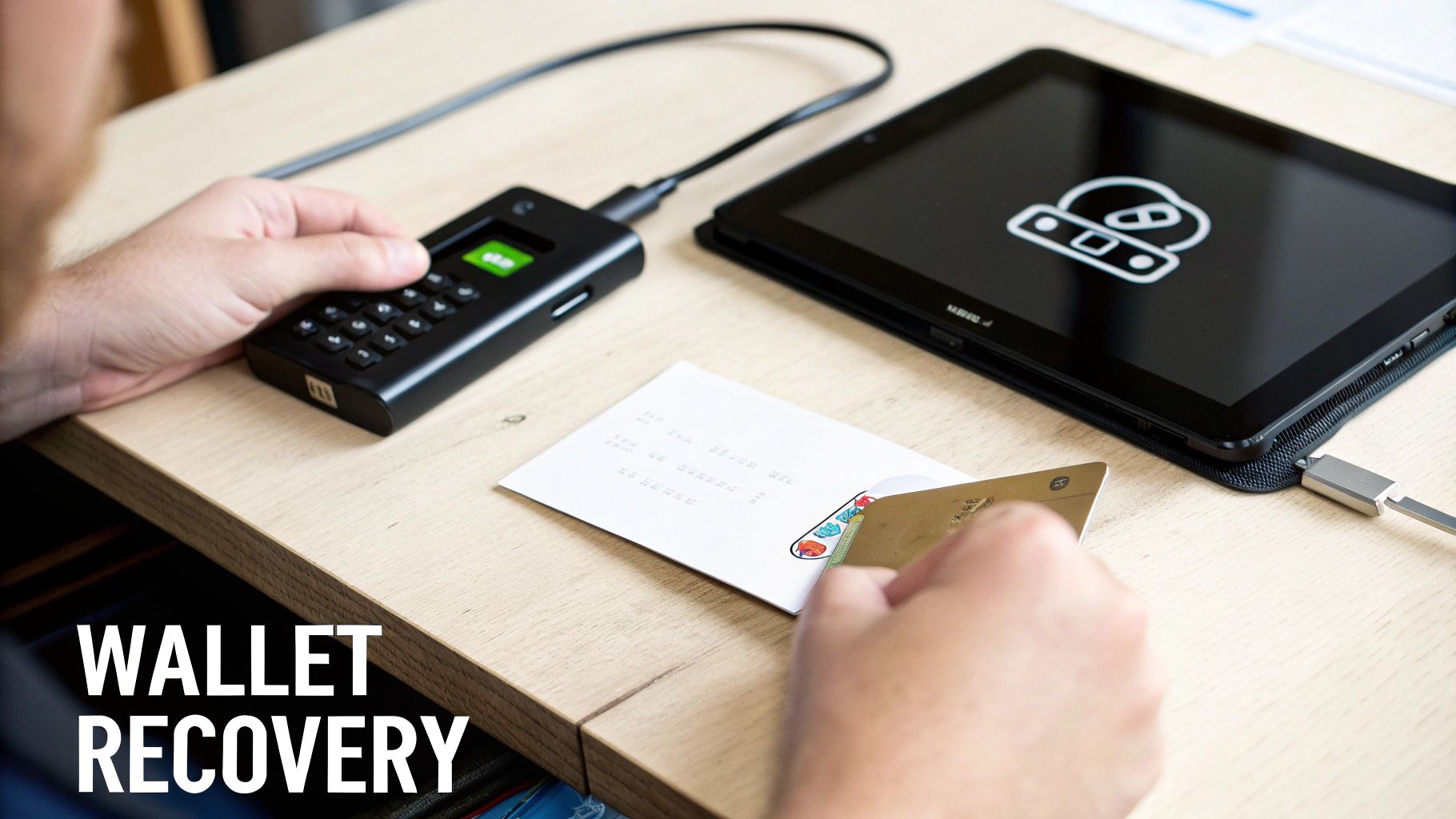
This built-in safety net is a huge draw for custodial services. The trade-off, of course, is that your access is always subject to their approval and their schedule.
The Self-Custody Point of No Return
For a non-custodial wallet, there's no customer support number to call. You are the bank. That means recovery is 100% your responsibility. The single, solitary key to getting back in is your seed phrase—that 12 or 24-word backup you were prompted to write down during setup. If your phone breaks or your laptop gets stolen, you can just import that phrase into a new wallet and your funds are right there.
But what happens when that seed phrase is gone or compromised? That's where the real trouble starts. The most common points of failure we see are:
- Misplaced Seed Phrase: The piece of paper is lost, or the digital file was accidentally deleted.
- Forgotten Password: You still have the encrypted wallet file but can't remember the password to decrypt it.
- Partial Data: You find only half of your seed phrase or have a wallet file that’s been corrupted.
For most people, any of these situations is a brick wall. Without the complete, correct seed phrase, there are no standard recovery options. Your funds are still on the blockchain, but the keys that prove you own them are gone forever. If you want to dive deeper, you can learn more about how a seed phrase works in our detailed guide.
This is the critical moment where professional help is no longer a luxury—it's a necessity. Once you've exhausted all the obvious fixes, like trying old passwords or tearing the house apart looking for that backup, your next move shouldn't be to give up. It should be to seek specialized help.
When to Contact a Recovery Service
A professional recovery service is often the only realistic path forward when you’re locked out of a non-custodial wallet. Scenarios like these are precisely why services like Wallet Recovery AI exist. We use advanced techniques to piece together partial data, brute-force forgotten passwords from encrypted files, or pull information from damaged hardware.
If you have an incomplete seed phrase, a corrupted wallet file, or a forgotten password for a local wallet, you've hit the limit of what you can safely do yourself. Trying to guess your way through it from here can easily lead to permanent data loss. That's the signal that it’s time to talk to experts who have the right tools and experience for these very specific, high-stakes recovery jobs.
Your Crypto Wallet Questions, Answered
Getting into the weeds of custodial vs non-custodial wallets always brings up a few common questions. Let's tackle some of the most frequent ones I hear, so you can get a clearer picture of how this all works in practice.
Can I Move My Crypto From an Exchange to My Own Wallet?
Absolutely. In fact, it’s a standard move for anyone serious about taking control of their assets. The process is pretty simple: get your new non-custodial wallet set up and—most importantly—back up that seed phrase somewhere safe. After that, you just initiate a withdrawal from the exchange and plug in the public address of your new wallet.
My Two Cents: Always, and I mean always, send a tiny test amount first. Wait for it to show up in your new wallet before you even think about sending the rest. It's a simple step that can save you from a very expensive typo.
Are Hardware Wallets Considered Non-Custodial?
Yes, they are the pinnacle of non-custodial security. Think of devices from Ledger or Trezor as specialized vaults for your private keys. By keeping your keys totally offline, they create an air gap between your crypto and online threats like malware or phishing scams that plague software wallets.
What Happens if My Non-Custodial Wallet App Just Vanishes?
Believe it or not, your funds are completely safe. This is one of the most powerful features of self-custody. Your crypto doesn't live in the app; it lives on the blockchain. If the software you use gets discontinued, you just take your seed phrase and import it into another compatible wallet. Boom—full access restored.
Is There Any Hope if I Only Lose My Wallet Password?
This is where things get tricky, and the answer is "it depends." If you've lost the password to an encrypted wallet file (like a keystore file) but you still have the file itself, you might be in luck. Specialized recovery services can sometimes brute-force these. But if you've lost your seed phrase, that's a different story. In most cases, those funds are gone for good.
If you're staring at a locked non-custodial wallet and have the encrypted file but not the password, don't throw in the towel just yet. Wallet Recovery AI focuses on these exact kinds of complex recovery situations. Explore our secure recovery options today.
Leave a Reply