
That gut-wrenching moment you realize your crypto is out of reach is something no one wants to experience. But before you panic, take a deep breath. The first step in figuring out how to recover your crypto wallet isn't to frantically try every password you've ever used. It's to figure out exactly what went wrong.
Usually, the problem boils down to one of three things: a lost seed phrase, a forgotten password, or a damaged device. Your path forward depends entirely on which of these you're dealing with.
Your Immediate Crypto Wallet Recovery Plan
Whatever you do, don't act on impulse. Rushing is the fastest way to turn a recoverable situation into a permanent loss. For example, hammering away with incorrect password guesses can trigger a wallet's security features and lock you out for good. Similarly, a factory reset on a device without a proper backup will almost certainly wipe your wallet data permanently.
The journey starts with a simple diagnosis. What's the barrier between you and your funds? Is it a mental block, like a password you can't quite remember? Or is it a physical problem, like a hardware wallet that’s just a paperweight now? Each scenario demands a completely different strategy.
Assess Your Situation Methodically
Think of yourself as a detective at a crime scene. Your job is to gather every clue you can find about your wallet and its history. This initial assessment is the single most important part of your recovery strategy—it dictates every step that follows.
Start by making a list of everything you have:
- Wallet Addresses: Do you have a record of your public addresses? You can pop them into a block explorer like Etherscan or Blockchain.com to confirm the balance is still there.
- Transaction History: Any old emails, screenshots, or records of transactions can provide useful context.
- Wallet Files: Did you ever save a
.datfile or a JSON keystore file somewhere? Check old computers, USB drives, and cloud storage. - Partial Information: Don't dismiss fragments! A partial seed phrase or a password hint is a huge head start.
This diagnostic flowchart helps visualize the different roads you might take depending on whether you're facing a lost phrase, forgotten password, or broken hardware.
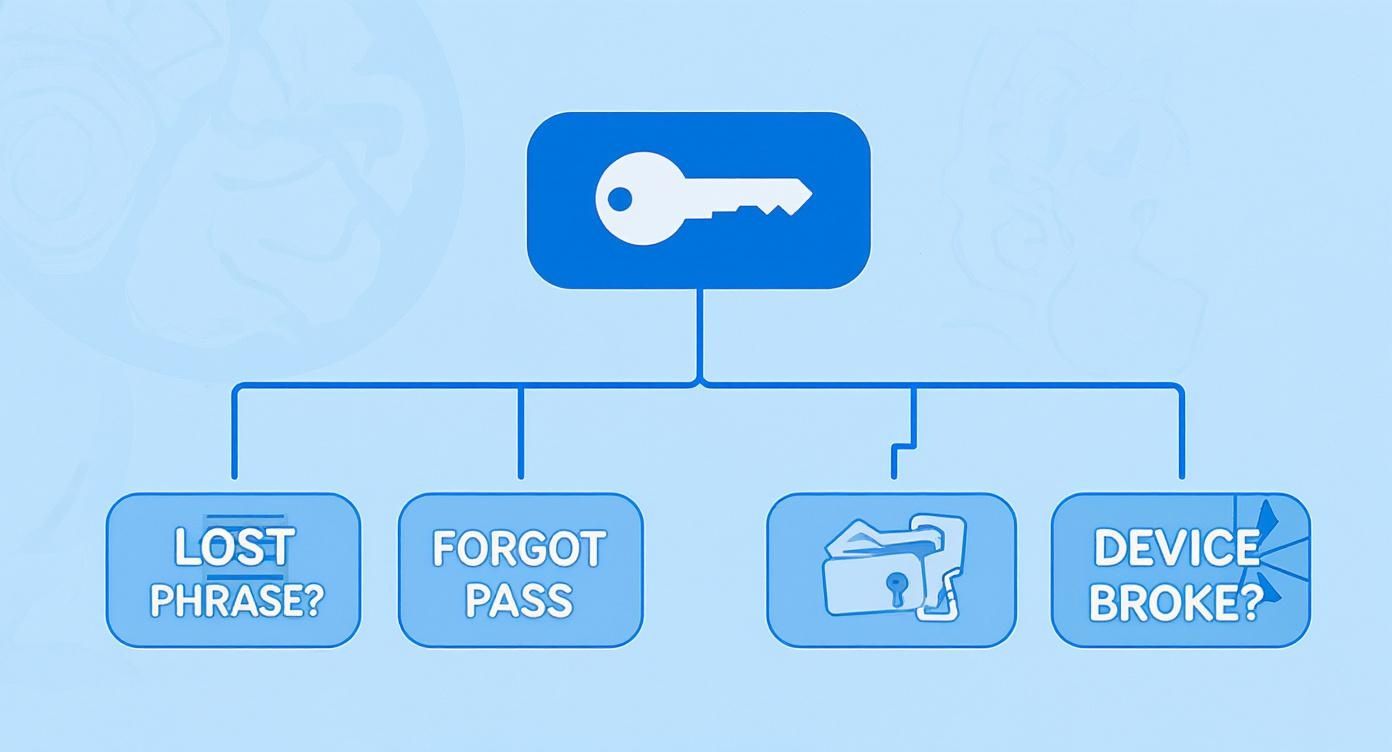
The takeaway here is simple: your recovery plan is defined by the problem. There's no one-size-fits-all fix.
To help guide your first moves, here’s a quick-reference table.
Immediate Actions for Wallet Recovery
| Problem Scenario | First Action | Critical Thing to Avoid |
|---|---|---|
| Lost Seed/Recovery Phrase | Search for any written copies, digital notes, or backups. Check old notebooks, safe deposit boxes, and encrypted files. | DO NOT restore the wallet on a new device. This will create a new, empty wallet, not recover your old one. |
| Forgotten Password | List every possible password variation, hint, or pattern you might have used. | DO NOT enter passwords repeatedly. Many wallets have a limit on failed attempts before locking or wiping the data. |
| Damaged/Broken Device | Safely power down the device. Do not attempt to repair it yourself unless you are an expert in data recovery. | DO NOT perform a factory reset or system restore. This will erase all local data, including your wallet files. |
This table should help you avoid common pitfalls right at the start of your recovery attempt.
Secure Your Environment First
The stress of being locked out can make you a prime target for scammers. Before you go any further, make sure you're working in a secure digital environment. Scammers love to hang out in forums and social media, offering fake "help" to desperate users.
They're getting more sophisticated, too. Research shows that personal wallet compromises accounted for 23.35% of all stolen fund activity in 2025, a significant jump from prior years. You can read the full research about these crypto hacking trends to see just how careful you need to be.
Critical Takeaway: Never, ever share your seed phrase or private keys with anyone online claiming to be "support." Legitimate recovery services will never ask for them directly. That phrase is the master key to your funds—guard it with your life.
By taking these calm, deliberate steps, you're shifting from a state of panic to one of control. You aren't just trying things at random; you're building a solid foundation for a targeted recovery attempt. Right now, patience and precision are your two most powerful allies.
Using Your Seed Phrase for a Clean Recovery
Think of your seed phrase as the ultimate "get out of jail free" card. This list of 12, 18, or 24 words—often called a recovery phrase—is the master key to every single private key your wallet holds. If you have it written down correctly, getting your funds back is almost a sure thing. It doesn't matter if your phone took a swim or your laptop's hard drive finally bit the dust.
This phrase isn't just a fancy password. It's the direct source code for your wallet's master seed, which is how all your addresses are created. That’s why you can take it to a brand-new phone or computer, pop it into a compatible wallet app, and see your balance reappear. It even works with different wallet software, as long as it follows the same industry-standard BIP39 protocol.
The Restoration Process Explained
The concept is simple. You grab a new, secure device and download a fresh copy of your wallet software. During setup, you’ll see two main choices: "Create a new wallet" or "Import/Restore an existing wallet." You always want to choose the second option.
The software will then ask you to enter your recovery phrase. This is where you need to be meticulous.
Key Insight: A seed phrase is an ordered sequence, not just a random jumble of words. Word #5 has to be word #5, and word #11 has to be word #11. Mix up the order, and you'll generate a completely different—and completely empty—wallet.
Once you type the phrase in correctly, the software does the math. It regenerates all your private keys from that phrase, restoring your access to the funds on the blockchain.
Common Mistakes to Avoid During Recovery
It sounds easy, but tiny mistakes can cause massive headaches. I've seen it time and time again. Here are the most common slip-ups people make when trying to recover a wallet:
- Wrong Order: This is the absolute number one error. The words must be entered in the exact sequence they were given to you.
- Typos and Misspellings: Every word is from a specific list of 2,048 words (the BIP39 wordlist). One misspelled word renders the whole phrase invalid.
- Extra Spaces: Be careful not to add a space before the first word or after the last one. Some interfaces are picky about this.
- Wrong Words: Sometimes "woman" gets written down as "women," or "search" as "seal." Double-check any words that look similar.
Imagine you’re trying to restore a MetaMask wallet. You download the extension on a new browser, hit "Import an existing wallet," and carefully type in your 12 words. If it fails, the first thing you should do is check your written copy against the official BIP39 wordlist. This simple step confirms every word is spelled correctly and actually exists on the list, which can save you hours of stress.
Choosing the Right Wallet and Derivation Path
Sometimes, a successful recovery comes down to the fine print. Most modern wallets are compatible, but older or more niche ones might use a different derivation path. Think of this as a road map that tells the wallet how to find your specific accounts using the master seed.
If you restore your phrase on a different wallet app and see a zero balance, don't panic just yet. The new wallet might just be looking down the wrong "path." Some wallets, especially more advanced ones like Electrum for Bitcoin, let you specify the derivation path manually in their settings.
It’s a more technical step, but it’s often the missing piece of the puzzle when an initial restore attempt shows nothing. For a much more detailed breakdown of how these phrases work, check out our guide to understanding a wallet seed phrase.
Your seed phrase is the most powerful tool in your crypto arsenal. Treat it like the digital gold it is, handle it with care, and it will always be your ticket back to your funds.
Solving Specific Wallet Recovery Scenarios
Not all wallet problems are the same, and the recovery playbook changes completely depending on what you’re up against. A glitchy software wallet demands a different approach than a dead hardware wallet or a long-lost file from crypto's early days.
Trying to apply one-size-fits-all advice here is a recipe for disaster. The details matter, so let's walk through the most common situations you're likely to encounter.
Navigating Corrupted Software Wallet Files
Software wallets like Exodus, Atomic, or Trust Wallet are fantastic for their convenience, but they live as simple files on your computer or phone. Those files can get corrupted—a sudden power outage, a nasty bit of malware, or a software update gone wrong can all do the trick. The next thing you know, the app crashes every time you open it or shows a zero balance.
If you have your 12 or 24-word seed phrase, this is just a minor headache. You can uninstall the wallet, reinstall it (preferably on a fresh device), and restore everything in minutes.
But what if you don't? Then your only hope is a backup file.
- Hunt for Backups: Many desktop wallets create automatic backups, often with file extensions like
.dator.bak. Dig through your computer's application data folders to see if you can find one. - Try a Restore: First, make a copy of the entire wallet data folder and put it somewhere safe. Only then should you try replacing the corrupted file with an older backup version you found.
- Use Data Recovery Tools: If you think the file was deleted by accident, data recovery software can sometimes bring it back from the dead. Success rates are all over the place, though.
Tinkering with these files can feel like performing digital surgery. One wrong move could wipe the files for good, which is why getting an expert involved is often the smartest play for complex file corruption.
When Hardware Wallets Fail
Hardware wallets from brands like Ledger and Trezor are rightfully seen as the gold standard for security, but they’re not immortal. They get lost, stolen, or damaged. I once worked with a client whose dog had literally chewed their hardware wallet into a plastic mess.
Thankfully, the whole point of a hardware wallet is that the device itself is replaceable. Your crypto isn't on the device; it's on the blockchain. The wallet is just the key.
Key Insight: Your seed phrase is the ultimate master key for your hardware wallet. With that phrase, you can buy a brand new device—even from a different brand—and restore full access to your funds like nothing ever happened.
The process is refreshingly simple:
- Buy a new, compatible hardware wallet from an official source.
- During setup, look for the "Restore from recovery phrase" or similar option.
- Carefully type your 24-word phrase directly into the new device.
And just like that, your entire wallet is revived on the new hardware, putting you back in control.
The Challenge of Old Keystore Files
Were you around for the early days of Ethereum, around 2015-2017? If so, you might have a keystore file stashed away somewhere. This is a JSON file holding your encrypted private key, and unlocking it requires two things: the file itself and the exact password you created with it.
Losing either piece of that puzzle is a massive roadblock.
- File but No Password: If you have the JSON file but the password is a total blank, your only real shot is a brute-force attack. This means running powerful software that cycles through millions of potential password combinations.
- Password but No File: If you remember the password but the file is gone, recovery is next to impossible. The only hope is to find a copy on an old hard drive, a dusty USB stick, or a forgotten cloud storage account.
The amount of money locked away due to problems like these is staggering. In 2024 alone, an estimated $1.5 billion in cryptocurrency was lost to wallet access issues. It's a huge problem, and it underscores just how critical these recovery methods are. You can get a deeper look into how wallet issues contribute to these losses by reading about the state of digital asset recovery in 2025.
As you can see, the path forward is completely different for each wallet type. Here's a quick cheat sheet to break it down.
Wallet Type Recovery Cheat Sheet
| Wallet Type | Primary Recovery Method | Common Failure Point |
|---|---|---|
| Software Wallet | Seed Phrase or Backup File | File Corruption / Deletion |
| Hardware Wallet | Seed Phrase | Device Damage / Loss |
| Keystore File | File and Password Combination | Forgotten Password |
By correctly identifying your wallet and the problem you're facing, you can stop guessing and start focusing on the specific steps that will actually get you back into your account.
How to Avoid Scams During Recovery
That sinking feeling when you realize you're locked out of your wallet? It's a mix of panic and desperation. And that's exactly what scammers are counting on. They hang out in crypto forums, social media comment sections, and slide into your DMs, just waiting for someone like you to post about being stuck.
Knowing the technical steps to recover your wallet is one thing, but sidestepping the predators who see your problem as their next payday is a whole different ball game.
These people are scarily good at faking it. They'll use official-looking logos, create convincing "support" profiles, and talk a big game about their technical prowess. But it always comes down to one thing: tricking you into giving up your seed phrase or private keys. The moment you do, it's game over.
Recognizing Common Recovery Scams
The most common scams are often the simplest. You post a question on Reddit or X about your wallet issue, and within minutes, a DM pops up. It's someone claiming to be from "official wallet support," and they have just the solution for you.
They'll send you a link to a website that looks exactly like the real one, but the URL is just slightly off. This is a classic phishing attack, a tactic designed to steal your most sensitive info. Their fake site will have a form or a "wallet synchronization tool" that asks for your seed phrase to "re-link" your account. The second you enter it and hit submit, your funds are drained.
The Golden Rule of Crypto Security: No legitimate company, support agent, or recovery expert will ever ask for your seed phrase or private keys. Ever. Giving that information away is the digital equivalent of handing a stranger the keys to your house, your car, and your safe deposit box.
Your Essential Security Checklist
Staying safe comes down to vigilance and a healthy dose of skepticism. If an offer of help seems too good to be true, it is. Run through this checklist to keep yourself secure while trying to get back into your wallet.
- Verify URLs Religiously. Before you even think about entering information, double- and triple-check the website address. Scammers love to use subtle misspellings like "metarnask.io" instead of "metamask.io". The best practice? Bookmark the official sites you use so you never have to rely on a search engine or a random link.
- Reject Unsolicited Help. If someone DMs you out of the blue offering help, it's a 99.9% chance it's a scam. Legitimate support teams will never contact you first. You have to initiate the conversation through their official, verified channels.
- Use Only Official Support Channels. Don't air your problems in a public forum or social media group chat. Go straight to the wallet provider's official website and find their support page. Use their ticket system or the email address listed there, and nowhere else.
- Know Your Public vs. Private Info. It's perfectly safe to share your public wallet address. Think of it like your bank account number—people can send you money, but that's it. Your private key or seed phrase, on the other hand, is like your banking password and PIN rolled into one. It must stay private, always.
By sticking to these rules, you're building a digital fortress around your assets, even when you're in a vulnerable position. This careful approach is what prevents a temporary lockout from becoming a permanent, devastating loss.
Trying to recover a crypto wallet yourself can be incredibly rewarding, but it’s not always the best path forward. Let's be honest, there are times when the complexity of the problem or the sheer value of the assets locked away means a DIY approach just adds more risk to an already stressful situation.
Knowing when to pump the brakes and call in an expert is a skill in itself. It can be the one thing that separates a successful recovery from a permanent, gut-wrenching loss.
Deciding to hire a professional isn't admitting defeat; it's making a smart, strategic move. If you've already tried the obvious stuff—like digging through old notebooks for a seed phrase or running through your usual password variations—it might be time to bring in the heavy hitters. The trick is to recognize you're out of your depth before you accidentally make things worse.
Red Flags That Signal You Need an Expert
Some situations are just built for professionals. These are the scenarios where specialized tools and years of experience really matter. Trying to muscle through these on your own can easily lead to irreversible data loss.
If any of these sound familiar, it's a huge sign you should seek professional help:
- Physically Damaged Hardware: Is your hardware wallet water-damaged, crushed, or showing a fried circuit board? Whatever you do, don't plug it in. Professionals work in cleanroom environments with specialized hardware to safely extract data from compromised devices without causing more harm.
- Forgotten High-Security Passwords: If your wallet is locked down with a strong, long password you simply can't remember, a brute-force attack is likely the only way in. A pro has dedicated, high-performance hardware that can churn through billions of combinations exponentially faster than your home computer, massively boosting the odds of a breakthrough.
- Corrupted Wallet Files: Sometimes, a software wallet’s
.datfile or another critical piece of data just gets scrambled. When that happens, the simple recovery tricks won't work. Experts use advanced data forensic techniques to piece together fragmented or damaged files—a task that’s next to impossible without the right software and know-how.
Vetting a Reputable Recovery Company
Unfortunately, the crypto recovery world has its share of scammers. That makes choosing the right partner absolutely critical. A trustworthy service will be completely transparent and will always put your security first. As you research, look for a proven track record, clear pricing, and success stories you can actually verify.
Key Takeaway: A legitimate recovery service will never ask you for your seed phrase or private keys. Their job is to recover the password or repair the file that lets you regain access, not to take control of your crypto themselves.
The process with a reputable firm should feel professional and secure right from the start. It usually begins with a confidential consultation where you can explain the problem without revealing any sensitive data. From there, they'll lay out a potential recovery strategy, give you a clear quote (often on a "no-win, no-fee" basis), and walk you through the technical steps. This professional approach is a hallmark of a legitimate wallet recovery service and is essential for building the trust needed to move forward.
The Power of Professional Intervention
The success rates of established recovery services speak for themselves. They prove just how valuable professional intervention can be when individual efforts hit a wall.
Top-tier services have reported incredibly high success rates, with some of the best firms hitting between 94% and 98% in 2024 and early 2025. These specialists have recovered billions in assets, handling everything from tracing stolen funds through complex mixers to unlocking high-value hardware wallets in just a few days. Their success comes from a combination of proprietary tech, deep forensic expertise, and sometimes even collaboration with law enforcement like the FBI and Interpol. You can discover more insights about the success of these recovery services to see how they tackle these complex cases.
In the end, the decision to hire a professional is a simple cost-benefit analysis. If the value locked in your wallet is significantly more than the cost of the service—and the technical challenge is beyond your skill set—making that call is the smartest investment you can make.
Common Questions About Wallet Recovery
When you're staring down the barrel of a locked crypto wallet, your mind can start racing. In a high-stress situation like this, you need clear, direct answers, not more confusion.
We get asked the same handful of questions all the time. Let's cut through the noise and tackle them head-on so you can figure out what to do next.
What Is the Difference Between a Password and a Seed Phrase?
This is easily the most common point of confusion, and the distinction is absolutely critical.
Think of your password as the key to your front door. It unlocks your wallet app on your computer or phone, encrypting the local file so no one else can open it on that specific device. It's a layer of local security.
Your seed phrase (that 12 or 24-word list) is the actual deed to your house. It is your crypto. With it, you can rebuild your entire wallet and access all your funds from any compatible device in the world. Losing a password is an obstacle; losing your seed phrase can be a complete disaster.
Can I Recover My Wallet Without the Seed Phrase?
This is the tough one. The honest answer is almost always "no," but there are a few exceptions. If your seed phrase is gone, you can't just download a new wallet and restore your funds. That's what the phrase is for.
Your only real hope is if you still have the original device where the wallet was created or used. If you can unlock that device and open the wallet app with your password, you might be able to find the seed phrase in the settings or export the private keys directly.
Important Reality Check: If the device is lost, stolen, or wiped, and you don't have the seed phrase written down, your chances of recovery are practically zero. The seed phrase is the ultimate backup for exactly this scenario.
How Long Does the Crypto Recovery Process Take?
There's no single answer here—the timeline depends entirely on what’s broken.
- You Have the Seed Phrase: This is the best-case scenario. You can be back up and running in under 10 minutes. Just download a fresh wallet, import the phrase, and your funds will reappear.
- You Forgot the Password: This is where it gets complicated. A brute-force recovery attempt could take hours for a simple password, but it could also take months or even years for a long, complex one. It all comes down to the password's strength and the computing power thrown at it.
- Your Hardware is Damaged: Getting data off a physically broken device is a job for specialists. The process involves careful work in a clean-room lab and can easily take several weeks.
Patience is crucial. Rushing, especially with password recovery, rarely ends well and often leads to mistakes. Understanding the potential timeline from the start helps manage expectations during a stressful time.
If you've hit a wall with a forgotten password or a damaged device, professional help might be your next best step. At Wallet Recovery AI, we combine deep expertise with advanced computational resources to give you the best possible chance of getting your funds back. Learn more about our recovery process and get a free consultation.
Leave a Reply