The physical Ledger device in your hand is replaceable. For about $100, you can get a new one. But the 24-word seed phrase it generates? That's priceless.
This string of words is the one and only master key to your entire crypto portfolio. Getting your head around this distinction is the first, most critical step toward genuine self-custody.
Why Your Seed Phrase Is More Valuable Than Your Ledger
It’s easy to think of your Ledger hardware wallet as the vault holding your cryptocurrency, but that’s not quite right. A better way to think about it is as a specialized key you use to securely sign transactions. Your actual crypto exists on the blockchain, and your seed phrase is the ultimate proof that you own it.
If your Ledger gets lost, stolen, or smashed, it's an annoyance, but it’s not the end of the world. As long as you have your 24-word seed phrase, you can just buy a new Ledger (or any other compatible wallet), restore your accounts, and get back in business. The device is just a tool.
The Real Point of Failure
The single biggest vulnerability in your entire setup is your ledger seed phrase storage method. This is where people get wiped out, not from a broken piece of hardware.
A thief doesn't need your Ledger device if they can find the piece of paper you wrote your phrase on. A house fire doesn't care about your PIN; it will turn a flimsy paper backup to ash without a second thought.
This isn't just a hypothetical risk. Recent surveys show that a staggering 24–30% of crypto users have lost access to their funds at least once, with losing their seed phrase being the main culprit. What’s truly wild is that around 20–30% of self-custody users admit to having no reliable backup at all, putting everything on the line. You can explore more crypto cold wallet statistics to see just how big this problem is.
Your Ledger device protects you from online threats like malware and phishing. Your seed phrase backup strategy protects you from real-world threats like theft, fire, and plain old human error. You absolutely need both.
Think of it this way: your Ledger is the gatekeeper, but your seed phrase is the deed to the entire kingdom. The gatekeeper can be replaced. If you lose the deed, you lose everything. This mental shift is crucial before you even start looking at storage solutions.
To really drive this point home, here’s a quick breakdown of the difference between the device and the phrase.
Ledger Device vs Seed Phrase At a Glance
The table below highlights the distinct roles of your hardware wallet and your recovery phrase. It’s a simple but powerful way to remember what truly matters.
| Attribute | Ledger Hardware Wallet | 24-Word Seed Phrase |
|---|---|---|
| Role | A secure key to sign transactions | The master key to restore all accounts |
| Replaceable? | Yes, easily replaceable | No, it is unique and irreplaceable |
| Value | The cost of the hardware (~$100) | The total value of your crypto assets |
| Threats | Physical theft, damage, loss | Fire, water damage, theft, accidental loss |
Understanding this difference isn't just trivia—it's the foundation of a solid security plan that protects your assets for the long haul.
Right, let's talk about the physical reality of keeping your seed phrase safe. When you first unbox a Ledger, you get a few paper cards to write your 24 words on. It's simple, straightforward, and gets the job done for the first five minutes.
But let's be honest. Relying only on that piece of paper is like writing the combination to a vault on a Post-it note. It's just not built to last.
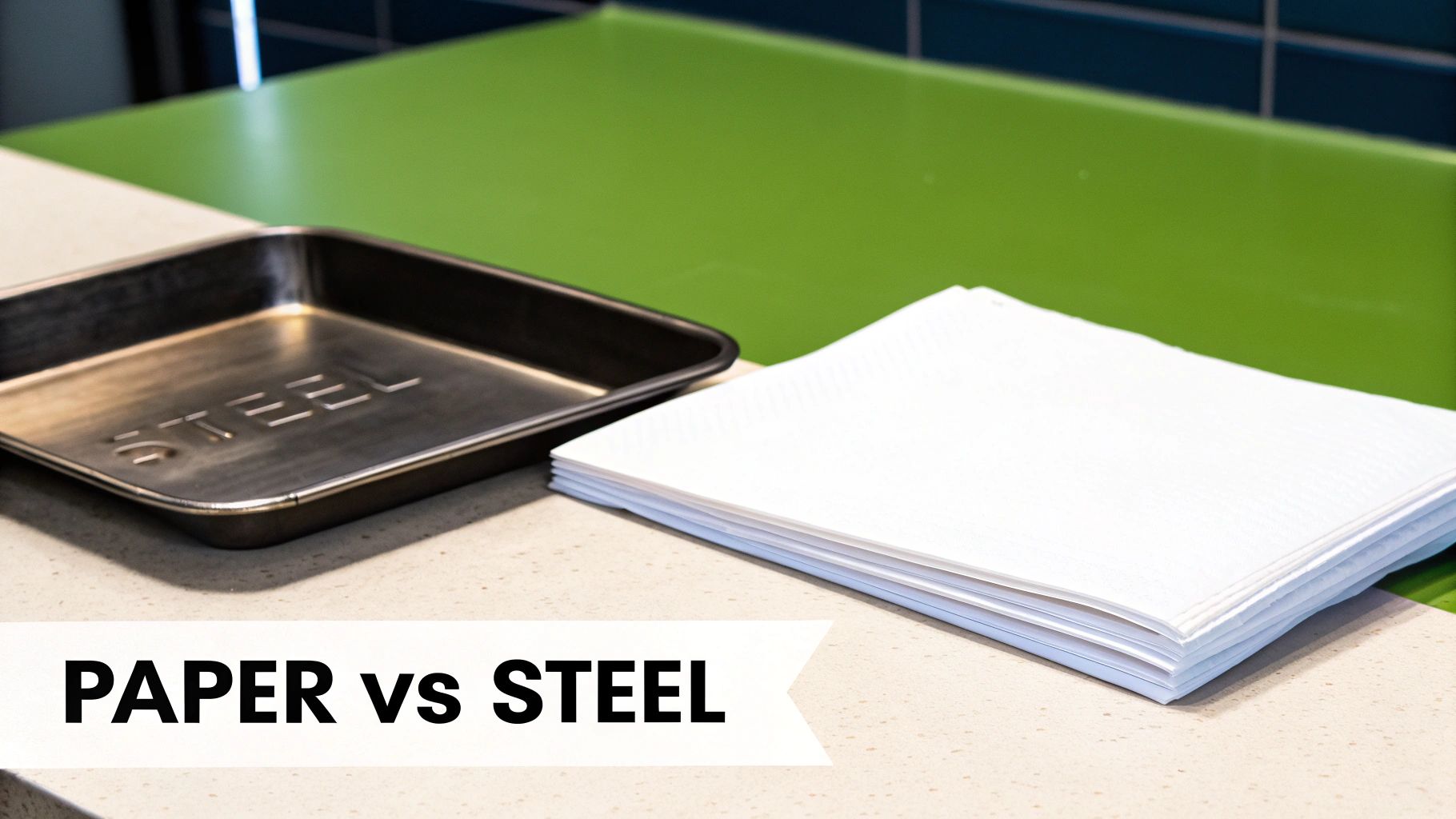
Think about all the things that can go wrong with paper. A plumbing leak, a house fire, or even just a spilled cup of coffee can completely wipe out your master key. Over years, the ink can fade into a blurry, unreadable mess. This isn't just theory; it's a genuine risk.
The Inevitable Move to Metal Storage
Because paper is so flimsy, the crypto community has wisely shifted toward metal backups. These aren't just fancy gadgets; they're purpose-built tools designed to survive the very disasters that would destroy a paper recovery sheet.
Metal is quickly becoming the standard. In fact, an estimated 40–45% of serious hardware wallet owners are now using steel or titanium plates to secure their seed phrases. Products like Cryptosteel have been tested to withstand temperatures over 1350°C (2461°F)—well beyond a typical house fire—without losing a single word.
The rule of thumb I live by is this: Your backup needs to be more durable than your house. If the absolute worst happens and your home is leveled, a solid metal backup should be sitting in the rubble, ready to be recovered.
This isn't about being paranoid. It's about accepting that physical threats are just as real and devastating as any digital hack.
Stamping vs. Etching: A Critical Difference
When you start looking at metal plates, you'll see two main ways to record your words: stamping and etching. They sound similar, but in a crisis, the difference is night and day.
-
Etching: This is where you use a tool, often an electric engraver, to scratch the words onto the surface. It’s quick and doesn't require much force, but the markings are shallow. They can be easily worn down by corrosion or literally melted away in a high-temperature fire.
-
Stamping: This is the old-school, industrial method. You use a hammer and a set of individual letter punches to physically drive each character into the metal. It takes more time and effort, but the deep indentations are incredibly resilient to fire, impact, and just about anything else you can throw at them.
For anyone serious about long-term security, stamping is the only way to go. That physical deformation of the metal is what ensures your seed phrase will still be there decades from now.
Choosing the Right Metal: Steel or Titanium?
The final piece of the puzzle is the material itself. The two best options on the market are stainless steel and titanium, and each has its own pros and cons.
| Material | Key Advantages | Considerations |
|---|---|---|
| Stainless Steel (304/316L) | Highly resistant to rust and heat. It's relatively affordable and easy to work with when you're stamping. | Its melting point is lower than titanium's, but it's still more than enough to survive a catastrophic house fire. |
| Titanium | The ultimate in durability. Has an absurdly high melting point of around 1668°C (3034°F) and is immune to corrosion. | It's more expensive and a real pain to stamp. You need a lot more force to make a clear impression. |
Honestly, for most people, a good 304-grade stainless steel plate offers fantastic protection without breaking the bank or your wrist. If you want to dive deeper, we've reviewed a bunch in our guide to the best metal seed phrase storage solutions.
No matter which you choose, upgrading from that flimsy piece of paper to a solid metal plate is one of the single biggest security improvements you can make.
The Digital Dangers That Can Cost You Everything
Once you’ve got a solid physical backup, the next thing to master is what not to do. It’s so tempting to use digital storage for convenience, but when it comes to your Ledger’s seed phrase, that’s a catastrophic mistake just waiting to happen.
The golden rule is absolute: your 24-word seed phrase must never touch any device that is, or ever will be, connected to the internet.
This isn't just about being paranoid; it's about slamming the door on the most common and devastating attacks that drain wallets every single day. One slip-up for the sake of convenience can lead to a lifetime of financial regret.
Why Your Phone's Camera Roll Is a Hacker's Goldmine
Snapping a quick photo of your recovery sheet feels like a smart, easy backup. In reality, it’s one of the most dangerous things you can do.
That photo doesn’t just sit on your phone. More often than not, it gets automatically uploaded to cloud services like Google Photos or iCloud.
The moment your seed phrase hits the cloud, you've lost control. A data breach at Google, a successful phishing attack on your email, or a piece of malware on your phone is all it takes for an attacker to get that image. They don't need your Ledger device—they just need that picture to clone your wallet and take everything.
Storing your seed phrase digitally is like leaving a signed, blank check on a public park bench. You're just hoping nobody with bad intentions walks by.
This warning goes beyond just photos. Any form of digital seed phrase storage creates a juicy target for attackers who are constantly scanning for exactly these kinds of mistakes.
The Most Common Digital Storage Blunders
The ways people accidentally expose their seed phrases are endless, but they all share the same fatal flaw—they create an attack surface where none should exist.
- Saving in a .txt or Word Document: This is malware's bread and butter. Many scripts are specifically designed to scan hard drives for word patterns that look like a seed phrase. They find it, they send it, and your crypto is gone.
- Storing in a Password Manager: While they're great for website logins, password managers are fundamentally online services. If your master password gets cracked or the service itself is compromised, your seed phrase is exposed along with everything else.
- Emailing It to Yourself: Sending your seed phrase in an email creates multiple copies on various servers, totally outside of your control. It becomes a permanent, searchable record of your master key, open to anyone who can get into your email account.
- Saving in a "Secure" Notes App: Apps like Evernote or Notion sync across devices and live on company servers. This introduces the same third-party risks as cloud photo storage.
- Pasting into a Clipboard: Even for a second, this is a bad idea. Sophisticated malware known as "clipboard hijackers" can monitor and steal anything you copy, sending it straight to an attacker.
Every single one of these methods breaks the fundamental rule of cold storage. Your Ledger is designed to keep your private keys completely offline. The moment you type those 24 words into an online device, you’ve undone all of its security benefits.
The only safe storage is physical, offline, and secure. Period.
Advanced Strategies for Fort Knox Level Security
Once you've got the basics down, it's time to think bigger. We're moving beyond a single paper or metal backup and into the realm of truly advanced security. For anyone serious about holding crypto long-term, the goal isn't just to protect a seed phrase—it's to build a resilient system that can take a punch, or even several, and still stand.
This means designing a setup with no single point of failure. You want redundancies that let you sleep at night, knowing your assets are safe. This is where strategies like geographic distribution and seed phrase splitting come into play. They might sound intimidating, but the concepts are actually pretty simple and can be scaled to fit your needs.
Geographic Distribution Is Your First Line of Defense
The easiest and most powerful advanced strategy you can implement is geographic distribution. It’s exactly what it sounds like: you create several identical backups of your full seed phrase and store them in separate, secure locations that are physically far apart.
Think about it this way: you could keep one stamped steel plate in a fireproof safe at home and a second one in a bank's safe deposit box across town. Just by doing that, you’ve instantly neutralized some of the most common disasters.
- A fire or flood at your house won't touch the copy at the bank.
- A legal issue freezes your safe deposit box? No problem, you still have the one at home.
- If your home is burglarized, the bank copy remains secure.
The real key here is to pick locations that aren't likely to be hit by the same regional disaster. Stashing one backup at your house and another at your downtown office is a decent start. But putting one in another state with a trusted family member? That's even better.
The core idea is simple: a single disastrous event should never be able to wipe out all of your backups simultaneously. This strategy turns your ledger seed phrase storage from a single point of failure into a distributed and resilient network.
The Shamir Secret Sharing Scheme
For those who want to completely eliminate the risk of a single backup falling into the wrong hands, the next level up is splitting your seed phrase. The gold standard for this is the Shamir's Secret Sharing Scheme (SSSS), which has been adapted for crypto wallets under the SLIP-39 standard.
Instead of making multiple full copies of your seed phrase, SSSS breaks it into a set number of unique "shares." To get your wallet back, you only need to bring a certain number of those shares together.
Here’s a common "3-of-5" setup:
- Your original seed phrase is split into five unique shares.
- You then hide each share in a different location.
- To recover your wallet, you only need to find any three of the five shares.
The image below really drives home why keeping your seed phrase offline and using methods like Shamir is so critical in today's world.
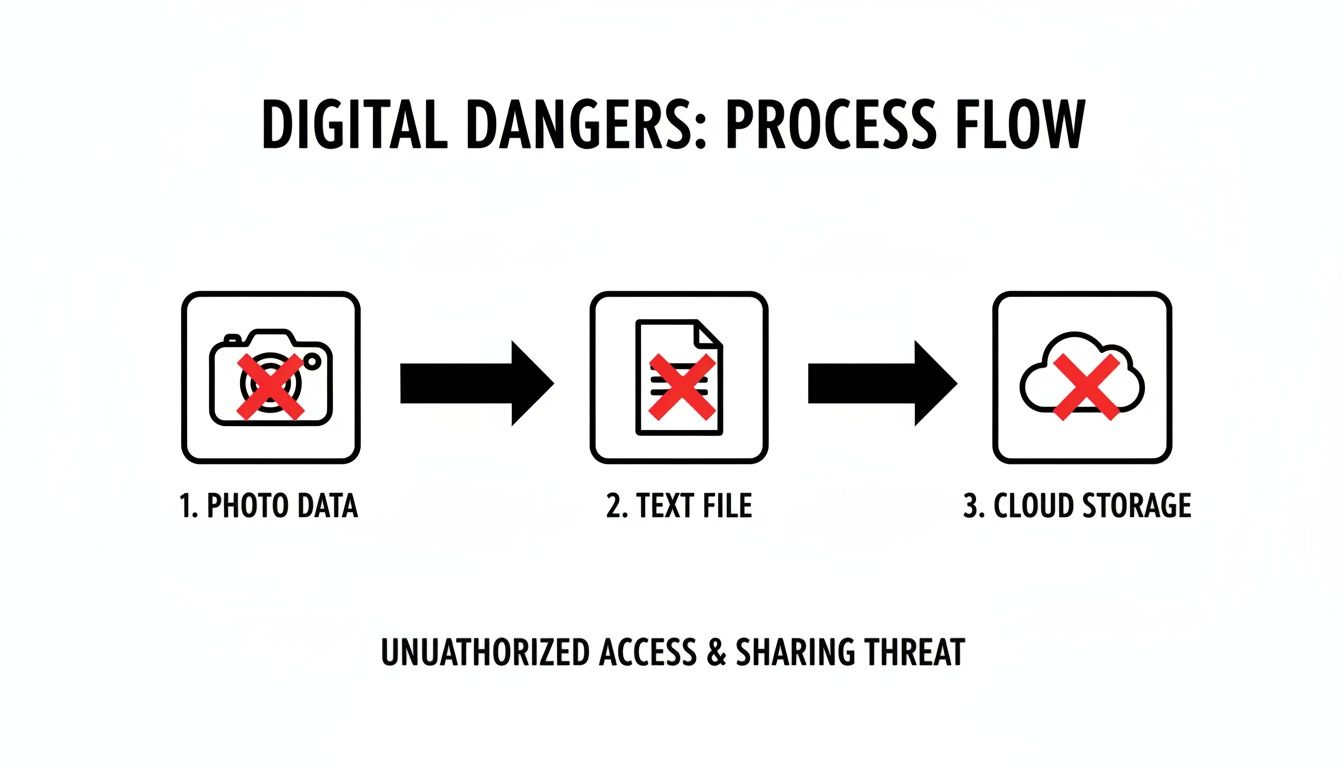
It’s a stark reminder that digital copies—whether they’re photos on your phone, notes in the cloud, or a simple text file—are a massive liability.
The beauty of a Shamir backup is that finding a single share is completely useless to an attacker. A thief could find one, or even two, of your shares and get absolutely nothing. It also gives you incredible redundancy. If you lose two of your five shares in a fire or a move, you can still recover your funds without breaking a sweat.
While old-school paper backups are flimsy, metal plates offer far better durability, which is why 40–45% of users are making the switch. But even a metal plate can be stolen. That’s why experts recommend storing backups in multiple physical locations, like fireproof safes or bank boxes, to protect against everything from theft to malware. Dig into the consumer security habits yourself—the data is clear. This kind of multi-layered approach is what separates an amateur setup from a truly professional one.
A Practical Guide to Seed Phrase Recovery
Let's start with the hard truth that keeps every crypto owner up at night. If your seed phrase is truly gone—no backups, no notes, no memory of a single word—your funds are almost certainly lost forever. That's the brutal, unforgiving nature of self-custody.
But here’s the thing: many situations that feel like a total loss are anything but. More often than not, a "lost" phrase is actually just incomplete, damaged, or partially remembered. This is where a methodical approach, and sometimes professional help, can turn a potential disaster into a successful recovery.
Taking Stock of What You Have
Before panic sets in, it’s time to do a systematic inventory of every scrap of information you might possess. The goal is to find any thread, no matter how small, that could help reconstruct your master key.
-
Partial Phrases: Do you have a list with a few words missing? Did you write down the first 12 words but not the rest? Even a partial list slashes the possibilities from astronomical numbers down to something potentially solvable.
-
Damaged Backups: Did you save it digitally against all advice? A corrupted text file or a physically damaged USB drive isn't a dead end. Data recovery specialists can often pull fragments from seemingly hopeless devices.
-
A List of Possible Words: Maybe you don’t have the phrase itself, but you jotted down 50 or so words in a notebook that you might have used. Believe it or not, that's a huge head start for a targeted recovery attempt.
Any of these pieces are infinitely more valuable than nothing. Trying to brute-force a solution on your own is usually a waste of time and can even introduce more risk.
The difference between permanent loss and a successful recovery often hinges on the small details you've overlooked. A water-stained piece of paper or a list of misspelled words is a lifeline.
When to Call in a Professional Recovery Service
If you've got anything to work with—a partial list, a damaged backup, or a list of potential words—it's time to seriously consider a professional service. These experts aren't magicians, but they have the serious computational power and advanced algorithms needed to test millions of combinations based on the clues you provide.
Vetting a service is absolutely critical. Look for a team with a transparent process, a clear fee structure (it's often a percentage of the recovered funds), and a proven track record.
They'll need every piece of information you can give them: the exact order of the words you do remember, any words you're unsure about, and the public addresses associated with your wallet. The more you provide, the higher the odds of success.
For example, if you're stuck with a missing or out-of-order word in a 24-word phrase, you can explore how recovery tools approach the problem to get a sense of the technical complexity involved. This isn’t about chasing false hope; it's about having a concrete, last-resort action plan for a worst-case scenario.
Got Questions About Your Ledger Seed Phrase? Let's Talk.
When you're taking control of your own crypto, a lot of questions pop up. It's totally normal. Getting the right answers is what turns a good security plan into a great one—something you can actually rely on for years to come.
Let's dive into some of the most common things people ask when they're figuring out how to store their Ledger seed phrase.
Should I Bother With a Passphrase (25th Word)?
A passphrase, which you'll often hear called the "25th word," is a powerful, advanced security feature. It's an extra word or phrase that you add on top of your 24-word seed phrase to create an entirely separate, hidden wallet.
Think of it this way: if someone broke into your house and found your 24-word backup, they'd get nothing. The real funds are tucked away in that passphrase-protected wallet, completely invisible to them.
But with great power comes great responsibility. If you forget that passphrase, it's gone. There is absolutely no way to recover it. The assets in that hidden wallet are lost forever. So, only use this if you have an ironclad method for remembering or storing it separately from your main seed phrase.
What About Using a Bank Safe Deposit Box?
A bank safe deposit box can be a smart move, but it has to be part of a bigger strategy. It’s a fantastic way to protect a copy of your seed phrase from a disaster at home, like a fire, flood, or robbery. It gives you geographic separation, which is key.
The big mistake is relying on it as your only backup. Remember, you're limited to banking hours, and in some extreme legal situations, access could be frozen. Use it to store one of two or three backups, never your sole copy.
Can't Ledger Just Help Me if I Lose My Seed Phrase?
In a word: no. Ledger can't help you recover a lost seed phrase, and that's actually a good thing. As a non-custodial wallet, Ledger never knows or stores your 24 words. That's a fundamental principle of self-custody.
You are the only one in control. This puts all the responsibility for protecting your seed phrase squarely on your shoulders. It’s why building durable, redundant backups isn't just a suggestion—it's absolutely essential for anyone serious about securing their crypto.
If you've lost access to your wallet because of a forgotten password or a damaged backup, all is not necessarily lost. Wallet Recovery AI specializes in these situations. We use AI-driven techniques to help you securely and discreetly get back control of your assets. Learn more at https://walletrecovery.ai.
Leave a Reply