
It's a gut-wrenching moment. That instant you realize you can't get into your crypto wallet. But before you let the panic set in, take a deep breath. In many cases, those funds aren't gone forever—they're just temporarily out of reach. We're here to guide you through the practical, actionable steps to get them back.
Just How Common is This Problem?

If you're in this situation, you're far from alone. The issue of lost or inaccessible crypto is a massive one, and it has a real impact on the total supply of digital currencies. While your situation feels personal, it's a part of a much larger story. Knowing this helps put things in perspective and reinforces why a methodical approach is so critical.
The Staggering Scale of Lost Coins
The amount of cryptocurrency locked away in inaccessible wallets is mind-boggling. As of early 2025, it's estimated that somewhere between 2.3 million and 3.7 million Bitcoins are permanently lost. That's a huge chunk—roughly 11% to 18%—of the total 21 million that will ever exist. Some research from sources like Ledger.com even suggests the number could be closer to 4 million BTC.
This isn't just a technical problem; it effectively shrinks the real-world supply of Bitcoin, which underscores the financial weight of losing access.
This guide is designed to make sure your assets don't end up as another statistic. We'll walk through the most effective recovery methods for different scenarios—whether it's a forgotten password, a misplaced seed phrase, or a busted hardware wallet, there's a path forward.
Key Takeaway: Your crypto isn't in your wallet. It's on the blockchain. Your wallet just holds the private keys that prove you own it. This is the single most important concept to grasp, as it's the foundation for every recovery method we'll discuss.
To help you jump to the right section, I've put together this quick-reference table. Find the scenario that matches yours to see the best place to start.
Common Wallet Loss Scenarios and Primary Recovery Paths
| Scenario | Primary Recovery Method | Key Requirement |
|---|---|---|
| Forgotten Software Wallet Password | Brute-Force or Dictionary Attack | Access to the original wallet file (e.g., wallet.dat) |
| Lost or Damaged Device | Seed Phrase Restoration | Your 12, 18, or 24-word recovery phrase |
| Corrupted Wallet File | File Repair Utilities | A copy of the corrupted file |
| Partial or Jumbled Seed Phrase | Mnemonic Reconstruction Tools | Most of the words from your original phrase |
Now that you've identified your starting point, let's dive into the specifics for each recovery path.
Finding Your Way Back into a Software Wallet
It’s a stomach-dropping moment: you’ve forgotten the password to a software wallet. We’ve all been there. But if you still have the wallet file itself—maybe an old wallet.dat file from a Bitcoin Core client tucked away on a hard drive—your crypto is rarely gone for good.
This isn’t about just guessing a few old passwords. We’re talking about using specialized tools that can systematically blast through thousands of potential combinations, all guided by clues you provide. It's less of a blind guess and more of a guided, high-speed memory jog.
The Right Tools for the Job
When you’re locked out, open-source programs like BTCRecover or Hashcat are your best friends. These aren't simple "click-and-recover" apps, but they turn a monumental challenge into a methodical, solvable puzzle. You feed them your encrypted wallet file and a list of possible passwords (your wordlist), and they get to work, testing each one at lightning speed until they hit the right one.
But here’s the secret: the software isn't the magic ingredient. The quality of your wordlist is.
Here's a peek at what it looks like to run BTCRecover from a command line. It might look technical, but it shows how the tool gets to work once you give it the right information.
The image shows the tool firing up, loading the wallet, and beginning its automated search. Once you’ve done the prep work, the process is pretty hands-off.
How to Build a Killer Wordlist
A generic list of a million common passwords won't cut it. Your best shot comes from building a custom dictionary based on your own memory triggers. Think of yourself as an archaeologist digging through your own life for clues.
Your wordlist needs to be a highly personal collection of data points.
- Your People: Start with names of family, pets, and close friends. Don't forget nicknames and variations.
- Key Dates: Birthdays, anniversaries, or important years. Try different formats (
05101992,May1092,100592). - Places: Old street names, cities you've lived in, or that unforgettable vacation spot.
- Your Vibe: Names of bands, movies, book characters, or sports teams you love.
- Password Habits: Think about old passwords you've used elsewhere. We all have patterns we fall back on.
Now, mix and match these with common separators (!, @, #, _) and numbers. If your dog was "Buddy" and you lived on "Maple" street, your list could include things like Buddy!Maple, Buddy1995, or Maple_Buddy!. The more personal and detailed you get, the faster you'll find that match.
A well-crafted personal wordlist can shrink a recovery process that might take years down to just a few hours or even minutes. It's the single most important thing you can do.
What if the Wallet File is Corrupted?
Sometimes the password isn't the problem—the file itself is. This can happen from a sudden power outage, a failing hard drive, or a malware attack. You go to open your wallet, and you’re hit with an error message, or the app just crashes.
The good news is that many wallet clients have built-in first-aid kits. Bitcoin Core, for example, has a -salvagewallet command-line option that can often pull your private keys out of a corrupted file.
Here's a quick breakdown of how to approach these issues:
| Issue | What to Use | The Golden Rule |
|---|---|---|
| Forgotten Password | BTCRecover or Hashcat | The strength of your custom wordlist is everything. |
| Corrupted File | Wallet's built-in repair tool | Always work on a copy of the corrupted file. |
| Damaged Hard Drive | Forensic data recovery service | This gets expensive fast, so it's a last resort. |
Before you try anything, make a backup of the corrupted file. Seriously. If one repair attempt fails or makes things worse, you can always go back to the original and try something else.
Keeping your wallet files secure during this process is non-negotiable. In the first half of 2025 alone, losses from crypto wallet hacks skyrocketed, with estimates ranging from $1.7 billion to $2.5 billion globally. Wallet-related security breaches accounted for roughly 69% of the total value lost in that period, which shows just how critical it is to handle recovery with extreme care. You can learn more about the latest crypto hacking statistics on Deepstrike.io to understand the current threat landscape.
Using Your Seed Phrase to Regain Control
Think of your seed phrase as the ultimate master key. It's the failsafe that unlocks your crypto directly on the blockchain, and it’s by far the most powerful tool in your recovery arsenal. If you have this sequence of 12, 18, or 24 words, you can get everything back, even if your phone is at the bottom of a lake or your laptop is fried.
The standard recovery process itself is surprisingly straightforward. You just grab a new device, install a compatible wallet, and look for the "import" or "restore from backup" option. From there, you carefully type in your seed phrase. In moments, the wallet uses that phrase to mathematically regenerate your private keys, and your balance reappears. It feels like magic, but it’s just solid cryptography doing its job.
This flowchart gives you a bird's-eye view of the first things to consider when you're locked out of a software wallet.
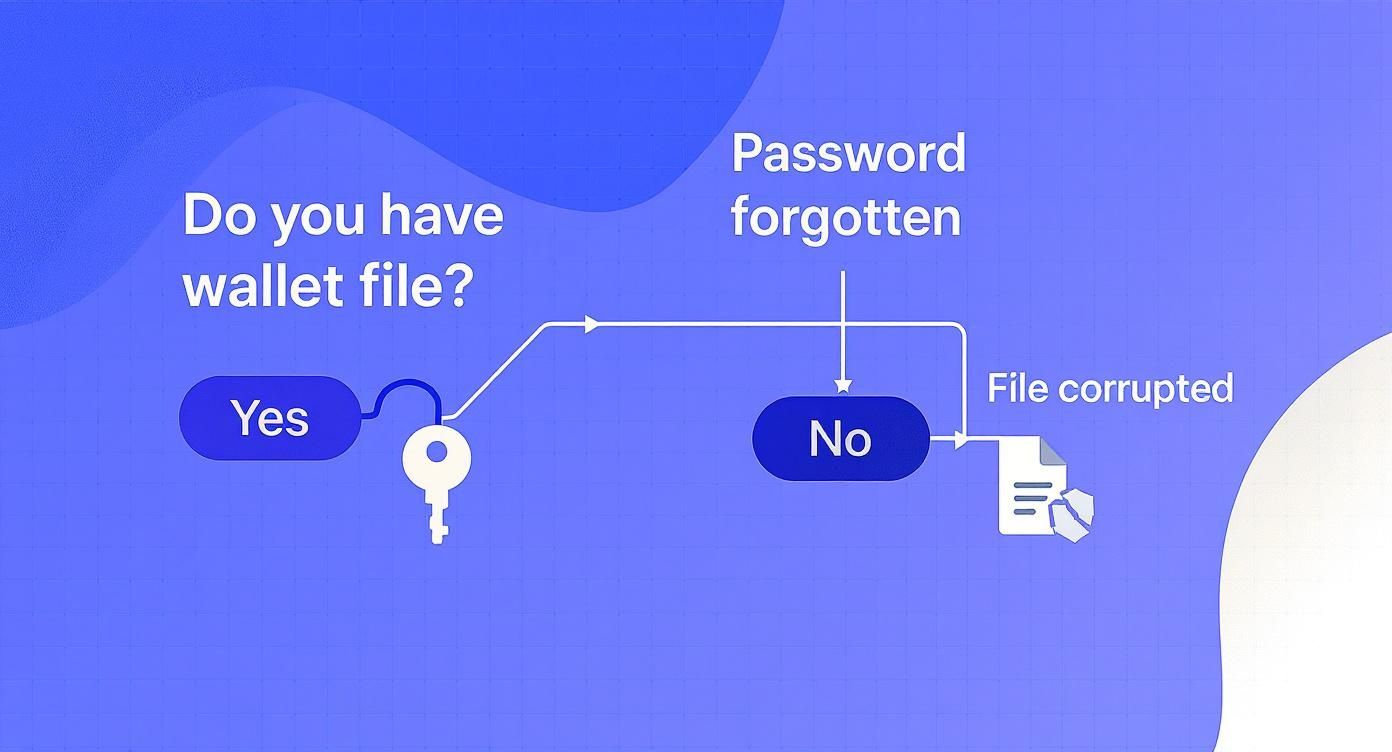
As you can see, the path forward often depends on whether you have the original wallet file. But if you have your seed phrase? You get to bypass all of that trouble completely.
The Magic Behind the Scenes: The BIP39 Standard
So, what makes this all possible? The secret sauce is a universal standard called BIP39. This protocol establishes a specific dictionary of 2048 English words and a method for turning a random string of data into a human-readable mnemonic phrase. It's like a universal translator for crypto wallets.
Thanks to BIP39, a seed phrase you generated on a Ledger can be used to restore your funds on a Trezor, Exodus, or pretty much any other modern wallet. This interoperability is a massive feature, ensuring you're never chained to a single piece of hardware or a specific app that might one day disappear.
There's another clever trick built in: the final word of your phrase is a checksum. It’s not random—it’s mathematically derived from all the preceding words. This acts as a powerful, built-in spell-checker. If you misspell a word or mix up the order, the checksum won't match, and the wallet will instantly reject the phrase.
Crucial Tip: Never, ever type your seed phrase into a random website, Google Doc, or sketchy app that promises to "validate" it. This is a classic scam to steal your funds. The only place you should ever enter your seed phrase is within the official, verified wallet software you're using for the recovery.
When Your Seed Phrase Is a Mess
The real headache begins when you find a partial phrase on an old notepad or a jumbled list of words you’re not sure are in the right order. This is where most people throw their hands up, but it's often a solvable problem if you approach it methodically.
A single missing word isn't a dead end. Since we know the BIP39 wordlist only has 2048 words, a script or a specialized tool can brute-force the problem. It will simply test every possible word in that blank spot until it finds the one that creates a valid checksum.
The same logic applies if the order is scrambled. The number of possible combinations for a 12-word phrase is an astronomical 479 million, which sounds impossible. But for a computer, it's a task it can churn through, especially since you're providing all the correct words to narrow the search.
Tools That Can Reconstruct a Damaged Phrase
For these more complex cases, a standard wallet's "import" function won't cut it. You'll need to turn to open-source tools designed specifically for this kind of reconstruction.
Here’s a general idea of how they work:
- Input What You Know: You feed the tool the list of words you have, marking any blank spots or words you're unsure about.
- Set the Parameters: You tell it whether you're looking for a 12, 18, or 24-word phrase.
- Run the Search: The tool gets to work. It starts iterating through every possibility—either trying all 2048 words in the missing slot or rearranging the words you gave it.
- Validate with the Checksum: With each new combination, it calculates the checksum. If it's valid, it flags a potential match.
- Check the Blockchain: A valid phrase is then used to derive potential wallet addresses. The tool can then check these addresses on a public blockchain explorer to see if they hold a balance or have a transaction history.
This process turns what feels like a hopeless guessing game into a solvable computational puzzle. For a deeper dive into these mechanics, exploring a detailed guide to a wallet recovery phrase can shed more light on the process. It's meticulous, but when significant funds are on the line, it represents a powerful last resort.
Navigating Hardware Wallet Recovery
So, your hardware wallet took a nosedive. Maybe it went through the wash, got crushed, or simply won't power on. That sinking feeling in your gut is completely normal—the immediate fear that everything is gone.
But here’s the most important thing to burn into your memory: your crypto is not stored on the physical device.
That little gadget is just a hyper-secure key ring. It holds your private keys and signs transactions, but your actual assets live on the blockchain. This means even if your device is a pile of plastic dust, your funds are perfectly safe. All you need is your recovery seed phrase.
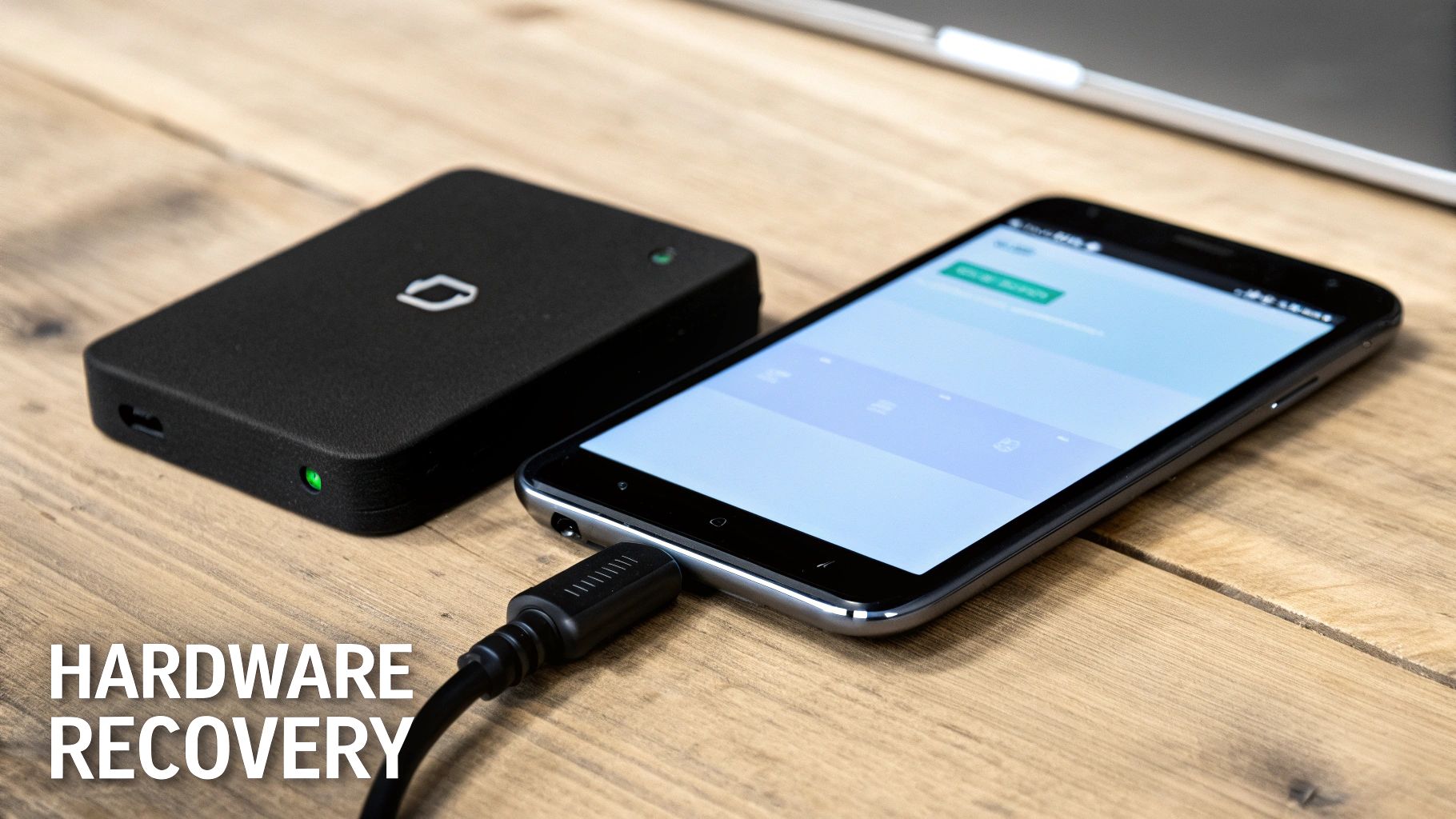
This setup, similar to what's shown on the Trezor website, is designed with one core principle: the device is replaceable, but your seed phrase is not. It’s the entire foundation of self-custody.
The Universal Key to Your Crypto
When your hardware wallet is lost, stolen, or broken, getting back in is surprisingly straightforward. You grab a new hardware wallet, start it up, and choose the "Restore" or "Recover" option. The device will then walk you through entering your 12, 18, or 24-word seed phrase.
And here’s the best part. Thanks to a widely adopted standard called BIP39, you’re not locked into a single brand. Most major players like Ledger, Trezor, and KeepKey use this same standard.
- Lost your Ledger? No problem. You can restore your wallet on a brand-new Trezor.
- Trezor gave up the ghost? A new Ledger or KeepKey will get you back in business.
This interoperability is a massive safety net. It means you can always regain access to your funds, regardless of what happens to a specific company or its products.
Golden Rule: Never, ever type your hardware wallet’s seed phrase into a computer keyboard, a website, or a software wallet. The whole point of a hardware wallet is to keep that phrase completely offline. Always enter it directly into the new hardware device itself.
When Firmware Updates Go Sideways
Another heart-stopping moment is the botched firmware update. You start the update, and it freezes, fails, or leaves your device completely unresponsive—a "bricked" state.
It’s stressful, but the fix is the same. A failed update can corrupt the device’s operating software, but it can’t touch your private keys, which are stored in a separate, secure chip. If the device is truly unusable, you just treat it like it was lost and restore your seed phrase on a new one.
Even with the robust security of hardware wallets, user error remains a huge risk. Shocking survey data reveals that 20–30% of users admit to not having a reliable backup of their keys. Those who use durable backups, like steel plates, have a drastically higher recovery success rate than those who just jot it down on paper. You can discover more insights about cold wallet statistics on CoinLaw.io to see why a solid backup strategy is non-negotiable.
Cross-Brand Recovery and What to Expect
While restoring your seed phrase on a different brand of hardware wallet is usually seamless because of the BIP39 standard, there are a few things to keep in mind. The ability to migrate between platforms is a huge benefit for users, ensuring you're never locked into a single ecosystem.
Here’s a quick look at how that cross-compatibility works in practice.
Hardware Wallet Recovery Compatibility
| Original Wallet Brand | Recovery on a New Device (Same Brand) | Recovery on a New Device (Different Brand) | Key Consideration |
|---|---|---|---|
| Ledger | Seamless | Yes (e.g., on a Trezor or KeepKey) | Derivation paths might need adjustment in the new wallet's software for some altcoins. |
| Trezor | Seamless | Yes (e.g., on a Ledger or Coldcard) | Generally straightforward, as most wallets auto-detect standard BIP39 paths. |
| KeepKey | Seamless | Yes (e.g., on a Ledger or Trezor) | Similar to others; the standard seed phrase works across compatible wallets. |
| Coldcard | Seamless | Yes (e.g., on a Trezor or Specter) | Known for advanced security options, ensure the new wallet supports the same derivation paths if you used non-standard settings. |
The main takeaway is that your BIP39 seed phrase is your universal passport. While minor tweaks might be needed, you aren't stuck if one brand goes under or a device fails. The most common hiccup you might encounter is something called a "derivation path"—it's basically the address format that tells the wallet how to find your specific accounts on the blockchain.
Most wallets use the same standard path, but if you've dabbled in advanced features or niche coins, you might need to manually specify the correct path in the new wallet’s software. It’s a bit technical, but it's often the simple fix if your balance looks wrong after a cross-brand restoration.
When to Call in a Professional Recovery Service
Let's be honest. You've tried everything. You've exhausted every software tool, mentally reconstructed every password variation you've ever used, and stared at a jumbled mess of seed phrase words until your eyes crossed. At some point, you have to ask: is it time to call in the pros?
This isn't a decision to take lightly. The crypto recovery world is a minefield of legitimate experts and outright scammers. Knowing when to wave the white flag on your own efforts is key. Most common issues, like using a correct seed phrase or running a simple password cracker with a solid wordlist, are things you can handle.
But some problems are just on another level.
Scenarios That Demand Expert Help
Some recovery situations require serious firepower or a very particular set of skills—the kind the average crypto holder just doesn't have. Handing over sensitive information is a huge leap of faith, but for these specific cases, a professional service might be your only shot.
It’s probably time to bring in an expert if you're dealing with:
- Heavy-Duty Password Brute-Forcing: You have a decent idea of your password—maybe you remember parts of it—but you can't nail it down. A professional service has access to massive server farms with the raw computing power to chew through trillions of combinations at speeds your home computer could only dream of.
- Forensic Data Recovery: This is for when disaster strikes. Your hard drive is physically toast—clicking, shattered, or even fire-damaged. Specialists use sterile clean-room environments and forensic tools to physically lift the wallet file from damaged platters. This is something you absolutely cannot do at home.
- Complex Mnemonic Phrase Reconstruction: You’ve got most of your seed phrase words, but you're clueless about the order or you're missing a few. While some tools can help with simple permutations, experts often use proprietary software that can test mind-bogglingly complex variations and non-standard derivation paths.
Spotting Red Flags and Dodging Scams
The most critical part of this entire process is vetting the service you choose. One wrong move doesn't just mean you fail to get your funds back; it could mean you're handing them directly to a thief.
The golden rule of crypto recovery is simple: a legitimate service will never ask for your seed phrase or demand payment before they recover your funds. Their fee is always a cut of the recovered crypto, paid after you have access again.
Here are the biggest red flags to watch for:
- They Want Upfront Fees: Scammers love to ask for a "deposit" or "processing fee." A real service gets paid from a successful recovery. No success, no fee. It's that simple.
- They Demand Your Seed Phrase: Your seed phrase is the ultimate master key. Giving it away is like handing over a signed blank check. Legitimate pros work with encrypted data or have you sign the final transaction yourself.
- They Guarantee Success: Recovery is never, ever 100% certain. Anyone who guarantees a positive result is lying to you, preying on your desperation.
- They're Vague or Anonymous: Look for a company with a public-facing team, a real physical address, and a registered business history. Anonymity is a massive warning sign in this space.
How the Fee Structure Should Work
Reputable wallet recovery services all work on a success-based fee model. This lines up their interests with yours—they don't get paid unless you get paid.
Typically, the fee is a percentage of the total value of the recovered assets, usually falling somewhere between 10% and 20%. The final percentage often depends on how complex the job is and how much crypto is at stake. For larger recoveries, the percentage might be on the lower end, while smaller, more difficult cases might command a higher rate.
As you weigh your options, take some time to review what a professional recovery service should really offer. This will help you compare different providers and make sure you're partnering with a team that's serious about security and transparency. The right partner will make you feel confident, not pressured.
Common Wallet Recovery Questions
After going through all the recovery methods, you're probably left with a few nagging questions. It's totally normal. The world of crypto recovery can feel like a maze, so let's clear up some of the most common uncertainties people run into.
This is your final debrief—tackling the tough questions about success rates, why some wallets are gone for good, and how to make sure you never end up in this spot again.
What Are the Real Chances of Success?
This is the big one, and I'll be straight with you: it depends entirely on what information you still have. Recovery isn't about luck; it's about data.
If you have your complete and correct 12 or 24-word seed phrase, your success rate is pretty much 100%. That phrase is the master key, built for exactly this kind of emergency.
On the other hand, if you're trying to brute-force a password on a wallet file, your odds are all over the place. A simple password made from your dog's name and birthday might be cracked in a few hours. A long, random one with symbols? That could be next to impossible.
The hard truth: The single biggest factor in getting your crypto back is having a securely stored backup of your seed phrase or private keys. Without that, your chances plummet.
Can I Recover a Wallet with Just the Public Address?
Sadly, no. This is a huge misconception. Your public wallet address works just like your email address—you share it so people can send you stuff. It gives you zero control over the crypto inside.
Think of it as a locked mailbox with a slot. Anyone can see the address and slide letters (or crypto) in, but only the person with the physical key (your private key) can open it and take anything out. The funds are visible on the blockchain, but they're completely locked away without that key.
Why Is Recovery Impossible Without a Seed Phrase or Private Key?
Blockchain security is built on something called one-way cryptography. It's designed to be incredibly easy to generate a public address from a private key, but mathematically impossible to go the other way.
This one-way street is what keeps the entire network safe. If you could reverse-engineer a private key from a public address, anyone could steal funds from anyone else, and the whole system would collapse. That's why losing your seed phrase is so final—there’s simply no backdoor.
I've put together a quick FAQ table to make sense of the most common questions we see.
Common Wallet Recovery Questions
| Question | Answer |
|---|---|
| Can I recover my wallet with just the public address? | No. The public address is only for receiving funds. You need the private key or seed phrase to access them. |
| What if I have the wallet file but forgot the password? | Recovery is possible but not guaranteed. It requires a brute-force attempt, and success depends on the password's complexity and the quality of the clues you provide. |
| Is a 12-word seed phrase as secure as a 24-word one? | Both are extremely secure. A 24-word phrase offers a higher level of cryptographic security, but a 12-word phrase is more than sufficient for protecting your assets. |
| What happens if I lose my hardware wallet device? | As long as you have your seed phrase backup, you can buy a new device (from any compatible brand) and restore your wallet completely. |
| Are my funds gone forever if I lose my seed phrase? | If you have no other backup (like an encrypted wallet file and a password you can remember), then yes, the funds are likely inaccessible forever. |
Hopefully, this clears things up. The key takeaway is that your seed phrase is everything.
How Can I Prevent This from Happening Again?
The best recovery strategy is prevention. Once you get access back—or if you're setting up a new wallet—your absolute top priority is securing that seed phrase. Don't just scribble it on a sticky note and call it a day.
Here’s what I tell everyone:
- Go Metal: Stamp your seed phrase onto a steel plate. It'll survive fire, floods, and pretty much anything else you can throw at it.
- Create Redundancy: Store copies in at least two different, secure, and geographically separate locations. Think of a safe at home and a safe deposit box at a bank.
- Stay Offline: Never, ever take a photo of your seed phrase, save it in a text file, or store it in a cloud-based password manager. This is analog-only territory.
Treat your seed phrase like it's a bar of gold, because it basically is. Do that, and you’ll never have to go through this stressful mess again.
If you've hit a wall and tried every method here, specialized help might be the answer. Wallet Recovery AI uses advanced, AI-driven techniques for the toughest recovery cases, from forgotten passwords to damaged wallet files. Our team offers a secure and discreet process to help you regain control of your assets. Find out if we can help by visiting our website to start your confidential assessment.


Leave a Reply