The best metal seed phrase storage devices are your last line of defense—fireproof, waterproof, and tough enough to survive almost anything you throw at them. Most top-tier options are forged from high-grade stainless steel or titanium, materials chosen specifically to shield the 12 or 24 words that unlock your entire crypto portfolio.
This isn't just another gadget. Think of it as the ultimate insurance policy for your digital life.
Why Metal Storage Is Your Crypto Lifeline
It’s a scary thought, but what if your entire net worth was tied to a single slip of paper? For millions of people in crypto, that’s exactly the situation they're in. A paper backup of your seed phrase is fragile, easily destroyed in a house fire, a flood, or even by a spilled cup of coffee. It can fade, get thrown out by accident, or just get lost.
This isn't some far-fetched scenario. The crypto world is sitting on a mountain of lost and inaccessible funds. By 2025, it's estimated that somewhere between 2.3 million and 3.7 million Bitcoin will be lost forever. That's a staggering amount of wealth just gone, with some putting the total value of these orphaned assets at over $250 billion. Metal seed phrase storage is a direct, no-nonsense solution to this very real problem.
Embracing Physical Permanence
The whole point of the best metal seed phrase storage is to achieve physical permanence. We spend so much time worrying about online hacks and digital threats, but it’s often the real-world disasters that are the most indiscriminate. A solid metal backup is your failsafe against both.
Here’s why making the switch from paper to metal is one of the smartest moves you can make as a crypto owner:
- Disaster-Proofing Your Wealth: A good metal plate can laugh off temperatures that would turn paper to ash, often surviving over 2500°F (1370°C). It’s also completely immune to water damage and corrosion.
- Eliminating Human Error: Paper gets lost. It gets shredded, mistaken for trash, or damaged in a thousand different ways. A chunk of metal is deliberate. It’s permanent. You’re not going to accidentally throw it away.
- Long-Term Confidence: It’s about peace of mind. You’ll know your master key is safe and sound, ready for you—or your family—whenever it’s needed.
A wallet seed phrase is the ultimate master key to your crypto funds. Treating its backup with anything less than maximum security is like storing gold bars in a cardboard box. You can learn more about the critical role of a wallet seed phrase in our detailed guide.
At the end of the day, investing in a metal backup turns your security from a hopeful "what if" into a confident "even if." It’s the physical anchor for your digital assets, making sure that no matter what happens, you always hold the key.
When you decide to back up your seed phrase on metal, you're making a huge leap in security. But not all metal backups are created equal. The specific material you choose and how you record your words on it are the two things that will determine whether it survives a real-world catastrophe.
Think of it like building a fireproof safe. The type and thickness of the steel matter just as much as the lock mechanism. Get either one wrong, and you've just created a false sense of security.
The most common choices you'll run into are stainless steel and titanium. Each one offers a different trade-off between protection, longevity, and what you'll pay for it. Getting this right is the first and most important step.
This simple graphic really drives the point home—the difference between flimsy paper and solid metal is the difference between losing everything and having a lifeline.
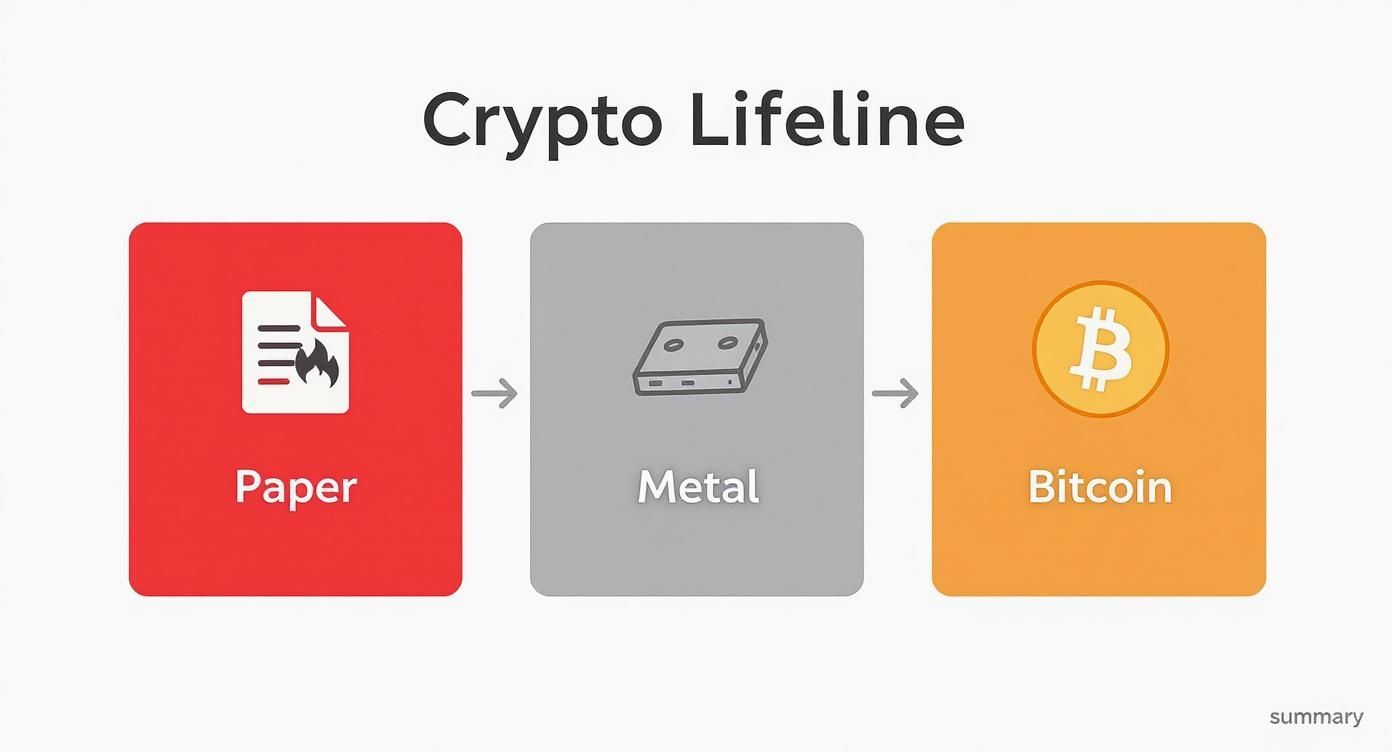
Paper is an obvious liability in any common disaster. A proper metal backup, on the other hand, is engineered to withstand exactly those events, making sure your crypto is never permanently lost.
The Foundation of Strength: Stainless Steel vs. Titanium
When you're looking at stainless steel, you'll mostly see two grades: 304 and 316L.
Grade 304 is the industry workhorse. It’s tough, it’s affordable, and with a melting point of around 2,550°F (1,400°C), it will easily survive a typical house fire, which rarely gets hotter than 1,500°F. For most people, it's more than enough.
But 316L stainless steel is a step up. It has molybdenum added to the alloy, which makes a massive difference in its ability to resist corrosion. If you live near the coast where salt is in the air, or you're worried about chemical exposure over decades, 316L is the smarter choice.
Then you have titanium. It's the top-tier option, boasting a melting point over 3,000°F (1,650°C) and near-total immunity to corrosion. The catch? It costs more, and it's a real pain to work with—stamping or engraving your words into it requires serious effort.
Here's a quick breakdown of how these materials stack up.
Metal Storage Material Comparison
| Material | Melting Point | Corrosion Resistance | Typical Cost | Best For |
|---|---|---|---|---|
| 304 Stainless Steel | ~2,550°F / 1,400°C | Good | $ | General-purpose fire protection on a budget. |
| 316L Stainless Steel | ~2,550°F / 1,400°C | Excellent | $$ | The best all-around balance of fire and corrosion resistance. |
| Titanium | ~3,034°F / 1,668°C | Exceptional | $$$ | Maximum durability for the most extreme threat models. |
For the vast majority of users, 316L stainless steel is the clear winner. It delivers phenomenal fire and corrosion protection for a reasonable price, covering the most probable disasters without the overkill (and cost) of titanium. It’s the sweet spot.
How Your Words Are Recorded: Stamping vs. Engraving
The metal itself is only half the equation. The way you get your words onto that metal is just as critical. There are a few ways to do it, and they are not all the same.
1. Stamping Your Seed Phrase
This is the old-school, tried-and-true method. You take a set of steel letter punches, line one up, and give it a good whack with a hammer. You physically drive the letter into the metal.
- Pros: It creates deep, permanent impressions that are incredibly resistant to fire, crushing force, and abrasion. This is the most durable method you can do yourself.
- Cons: It's loud and takes some physical effort. One bad swing of the hammer and you could make a mistake.
2. Engraving and Etching
These methods work by removing material from the surface. An engraver uses a sharp tool to carve out the letters, while etching uses chemicals or lasers to burn them onto the surface.
- Pros: Much quieter and less physically demanding than stamping. Laser etching, in particular, can be very precise.
- Cons: The marks are almost always shallower than stamped impressions. A shallow engraving can easily become unreadable if the metal gets warped or pitted in a fire.
When it comes to long-term survival, deeper is always better.
A stamped letter will remain readable even if the surface of the metal is gouged or melted, because the impression goes far below the surface. A lightly etched word, however, could easily be wiped out by the heat and distortion of a serious fire.
The Most Common Crypto Backup Mistakes to Avoid
Getting a metal plate for your seed phrase is a huge leap forward in securing your crypto, but even a slab of titanium won't save you from a simple human error. The biggest threat to your coins often isn't some shadowy hacker—it's the seductive pull of digital convenience.
Some of the most devastating losses in crypto history weren't caused by a device failing. They came from well-meaning people making critical mistakes with how they handled their master key. These blunders feel innocent enough at the moment, but they punch massive holes in your security.
The Digital Screenshot: The Ultimate Unforced Error
Taking a quick photo or screenshot of your seed phrase is one of the most common and dangerous things you can do. It feels fast, a simple way to get a "backup" made. But in reality, you've just turned your offline secret into a digital file that's a sitting duck.
The moment that image exists, it's probably already syncing to cloud services like Google Photos or iCloud. From there, it’s vulnerable to data breaches, malware on any of your connected devices, or anyone who manages to get into your cloud account.
Storing your seed phrase digitally is like making a thousand copies of your house key and scattering them all over the internet. It completely defeats the purpose of offline, cold storage security.
Why Your Password Manager Is a Terrible Choice
Password managers are fantastic for website logins, but they are absolutely the wrong place for your crypto seed phrase. These services are prime targets for hackers. And while they have robust security, a breach could expose the one master password to your entire vault.
Worse, saving your seed phrase in a password manager consolidates all your risk into one place. If that single account gets compromised, a thief doesn't just get your crypto keys—they get the keys to every single account you've stored. It turns a single point of failure into a life-altering disaster.
The Siren Song of Cloud Storage
At first, the logic seems reasonable: "I'll just encrypt my seed phrase file and toss it on Dropbox or Google Drive." This is a deeply flawed strategy that opens you up to massive risk. Cloud services are under constant attack, and your file is just one successful phishing email away from being stolen.
Alarming survey data from 2025 shows just how common this misunderstanding is. Research found that roughly 31% of crypto users admitted to using cloud storage for their seed phrases, despite constant warnings. This points to a dangerous gap between what’s convenient and what’s secure—a gap that has cost people a fortune. The same data reveals that 20-30% of users have no reliable backup at all, leaving them one mistake away from total loss. You can find more insights on user habits in this in-depth crypto wallet statistics report.
To actually protect your assets, you have to resist these digital shortcuts. Here’s a quick breakdown of why physical, offline storage is the only real option:
- It's Immune to Remote Attacks: A hacker on the other side of the world can't touch a piece of metal hidden in your home.
- It's Not Connected: Malware, spyware, and keyloggers on your computer are completely useless against a backup that never goes online.
- It Puts You in Full Control: Your security doesn't rely on a cybersecurity team at some giant tech company. It's entirely in your hands.
Ultimately, the guiding principle is simple but powerful. Your seed phrase must stay entirely offline, from the second it's generated to the moment it's stamped into metal. Any digital exposure, no matter how brief or "secure" it might seem, breaks that chain of custody and puts everything you own at risk.
Alright, you've picked out your metal backup device and you're ready to get this done. This is the moment where theory becomes reality—the final, critical step of actually getting your seed phrase permanently etched into metal.
Let's be clear: getting this part right is everything.
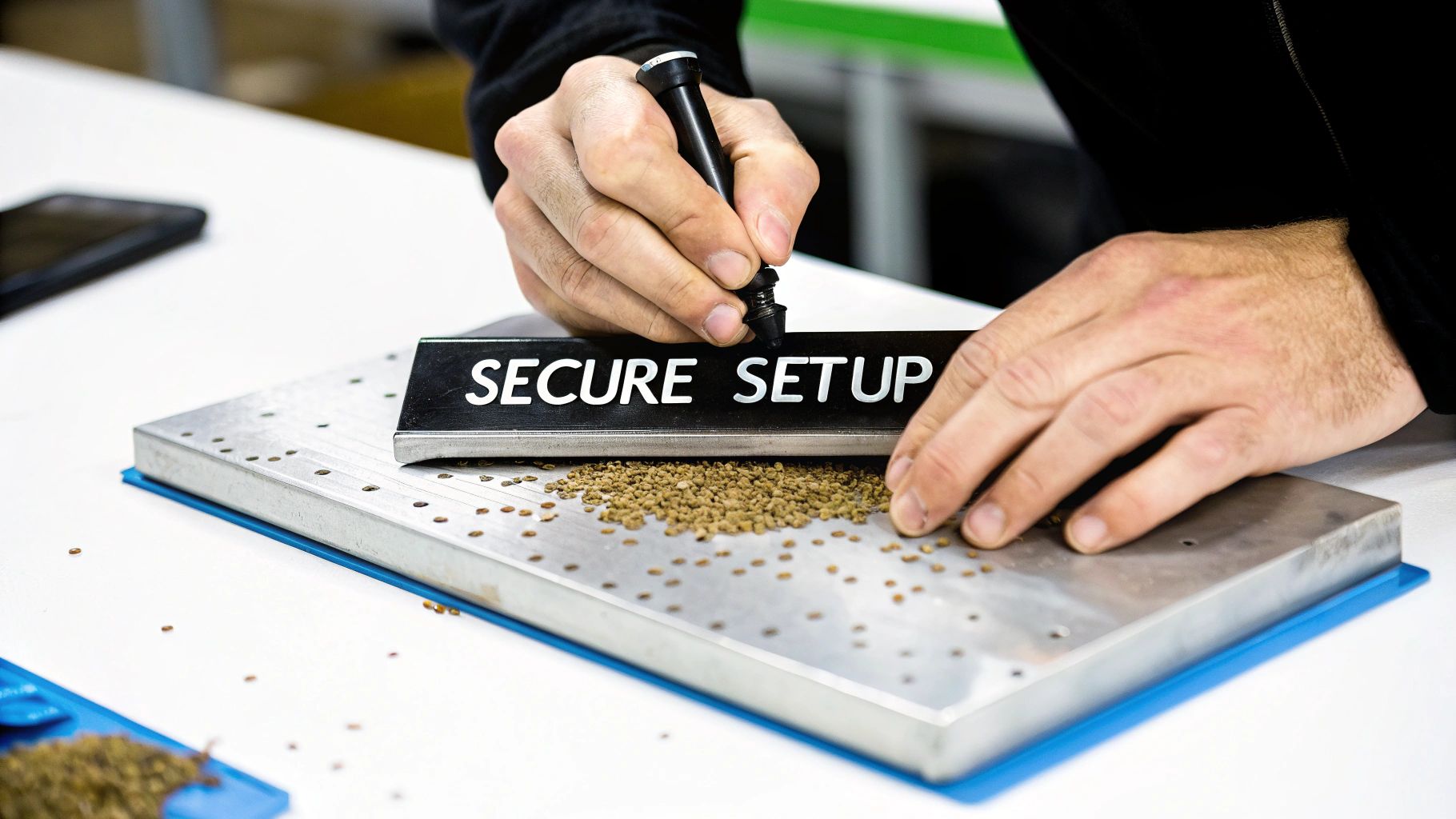
Treat this process like you're handling a bar of gold, because in the digital world, that's exactly what your seed phrase is. It demands your full attention, a private space, and absolute precision. A single sloppy mistake here can make all your hard work worthless.
Creating a Secure Transfer Environment
First things first, you need to prepare your workspace. Think of it as creating a sterile "clean room" for your most important secret. The goal here is simple: eliminate any and all chances of your seed phrase being seen, heard, or recorded by anything digital.
Here’s how you build your secure zone:
- Go Completely Dark: Kill the Wi-Fi. Turn off Bluetooth. Better yet, get your phone, laptop, smart watch, and anything with a microphone or camera out of the room entirely.
- No Prying Eyes: Check for cameras. This means no webcams, no security cams, no baby monitors—nothing. If you absolutely have to have a laptop in the room, put a piece of tape over the camera.
- Work in Total Privacy: Find a time and a place where you know you won't be disturbed. Lock the door. Make sure you are completely alone.
- Analog Only: Work directly from your original, hand-written paper backup. Do not pull it up on a screen. Once you're done, you'll need a plan to securely destroy that paper copy if the metal plate is its replacement.
This is what we call OpSec, or operational security. It’s the difference between a backup that feels secure and one that actually is secure.
The Stamping and Verification Process
With your secure space set up, it's time to do the transfer. Go slow. Be methodical. Rushing is your enemy, because one wrong word will make your entire backup useless.
- Check Your Words Twice: Lay out your paper seed phrase next to your metal plate. It's a good idea to have the BIP39 word list handy to triple-check the spelling of each word.
- Stamp or Engrave with Confidence: Transfer each word, one by one. If you're using stamps, give it a firm, solid strike to make a deep, clean impression. If you mess up, don't try to fix it. It's much safer to just start over on a fresh plate than to risk having an unreadable word later.
- Verify, Then Verify Again: Once you've stamped all the words, read them back off the metal plate and compare them, character by character, to your paper copy. If you have someone you trust implicitly—and I mean implicitly—you could have them double-check, but know that this introduces another layer of risk.
The most important part of this whole process isn't the stamping itself—it's the verification that comes after. A backup that might be correct is no backup at all. You need absolute certainty.
After you've visually confirmed every word, there's only one way to be 100% sure it works: a live recovery drill.
The Dry Run Recovery Test
A "dry run" is exactly what it sounds like. You're going to test your new metal backup to prove it works before you ever need it in an emergency.
- Wipe a Device: Grab a hardware wallet and perform a factory reset on it, or use a new software wallet you can easily delete. The point is to start with a completely blank slate.
- Run the Recovery: Start the wallet's recovery process. When it asks for your seed phrase, enter the words exactly as they appear on your shiny new metal plate.
- Confirm It Worked: If the wallet restores successfully and shows a zero balance, you've done it. Your backup is perfect. You now have undeniable proof that it's ready for action.
This is a fundamental part of any serious Bitcoin wallet backup strategy, and it applies to any crypto you're protecting. Don't even think about hiding your metal backup until you've successfully completed this test.
Storing Your Metal Backup Securely
Congratulations, you now own a physical asset that's potentially worth a fortune. Hiding it properly is the last piece of the puzzle. Obvious spots like your desk drawer or a small safe are the first places a thief will look, so get creative.
A great pro-tip is to use tamper-evident bags. If someone finds your backup and opens the bag, you'll know immediately. It’s an early warning system for your security.
Pick a hiding spot that's not just discreet, but also safe from environmental threats like fire or water. Think about your personal situation and who might be looking for it. Your diligence in these final steps is what truly secures your crypto for the long haul.
Advanced Security: Redundancy and Distribution
Alright, you've stamped your seed phrase into metal. That's a huge step. You've built a vault that can survive a fire or flood. But for anyone with serious skin in the game, a single backup—no matter how tough—is still a single point of failure.
True self-sovereignty is about designing a system where no single event can wipe you out. This is where we level up from basic security to advanced strategies like redundancy and geographic distribution.
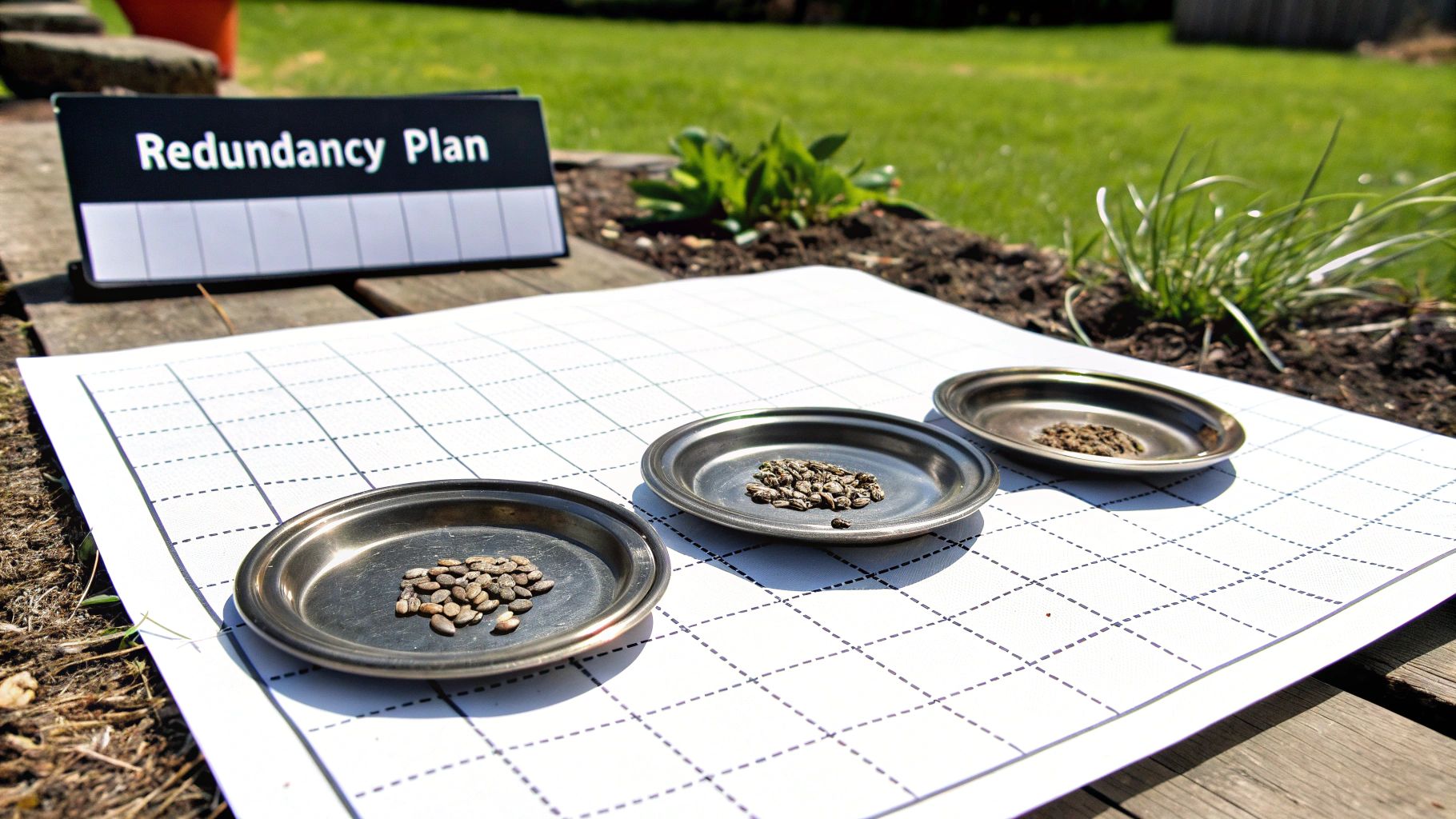
We're talking about building a recovery plan so resilient it can handle theft, disaster, or even a personal emergency without you ever losing access to your funds. This is how the pros do it.
The 3-2-1 Backup Rule for Crypto
In the IT world, there’s a classic rule for protecting data called the 3-2-1 backup rule. It’s a battle-tested framework, and we can easily adapt it to crypto to create a nearly bulletproof recovery system.
Here's the breakdown:
- Have three total copies of your seed phrase.
- Store them on at least two different types of media.
- Keep one copy in a secure, off-site location.
So, what does this look like in practice? Your main backup could be your best metal seed phrase storage plate, tucked away securely at home. Your second copy might be a properly laminated paper backup, and the third could be another metal device. Using different formats protects you if one type of storage method fails for some unforeseen reason.
A single key is a single point of failure. A distributed system of backups, however, transforms your security from a fragile lock into a resilient web of protection that can withstand multiple threats simultaneously.
That last part—storing one copy off-site—is critical. By keeping a backup at a trusted relative’s house or in a bank's safe deposit box, you insulate yourself from a localized disaster. If your house burns down, you won't lose everything. You'll always have a path back to your crypto.
Eliminating Single Points of Failure with Shamir's Secret Sharing
For the ultimate security setup, you can take things a step further and eliminate the risk of a single complete backup ever falling into the wrong hands. This is done with a clever cryptographic scheme called Shamir's Secret Sharing (SSS).
Instead of making multiple full copies of your seed phrase, SSS splits your master key into several unique pieces, often called "shards."
A common setup looks like this:
- Create a "3-of-5" Scheme: Your seed phrase is broken into five distinct shards.
- Set a Recovery Threshold: You decide that any three of those five shards are needed to put the original seed phrase back together.
- Distribute the Shards: You then hide each shard in a completely separate and secure location.
This approach is a game-changer. A thief would now need to find three of your hidden shards to compromise your wallet. If one or even two shards are lost, stolen, or destroyed? It doesn't matter. You can still recover your funds with the remaining three. It completely erases the catastrophic risk of a single backup being compromised.
The threat here isn't hypothetical. Attacks targeting private keys and seed phrases accounted for nearly 70% of all stolen crypto funds in 2024. We're talking about over $2.5 billion lost to security breaches in just the last few years. These numbers aren't meant to scare you; they're meant to show what's at stake. You can find more insights on crypto security threats and storage methods to understand the landscape. Using a strategy like SSS is a direct countermeasure to the single biggest threat vector out there.
Got Questions About Metal Seed Storage? We've Got Answers.
Even after diving deep into crypto security, it's totally normal to have a few lingering questions. This last section is all about tackling those common, practical concerns you might have before pulling the trigger on a metal seed phrase backup. Think of it as a final gut check to help you move forward with confidence.
We'll get straight to the point on the questions that really matter when you're making a choice. From how you physically record your words to advanced security setups, these answers should clear things up.
Should I Stamp, Etch, or Engrave My Seed Phrase?
How you get your seed phrase onto a metal plate has a huge impact on whether it will survive a disaster. They're all a massive step up from paper, but they are not created equal.
Stamping is the undisputed champion for DIY security. You take a hammer, a set of letter punches, and physically drive the characters deep into the metal. These impressions are incredibly tough and can easily withstand intense fire, crushing force, and abrasion. It’s the most durable, hands-on method.
Etching, usually done with a small electric tool, is a quieter and less forceful option. The problem is that it only scratches the surface. In a serious house fire where the metal might warp or get pitted, those shallow marks could easily become unreadable.
Laser engraving is precise, but it almost always means you have to pay a third-party service to do it for you. This introduces a giant security hole—you’d have to hand over your master secret key to a company or a stranger. For that reason alone, we never recommend it.
The Bottom Line: For the best possible mix of security and sheer physical toughness, stamping is the way to go. It ensures your seed phrase will be legible even after going through the hell of a house fire.
Is It Safe to Buy Metal Storage Plates Online?
Yes, buying a blank metal seed phrase plate online is generally very safe. The key thing to understand is that you're just buying a piece of metal. It contains zero sensitive information and has absolutely no link to your crypto until you put your words on it.
The security of the whole setup is 100% in your hands. You just need a private, offline space to do the stamping. Always buy from a well-known brand with plenty of good reviews to make sure you're getting quality material, like 316L stainless steel, and not a cheap knock-off.
Just remember these simple rules:
- The plate is just a blank tool. It's not a security risk on its own.
- Your security depends on what you do. Keep the stamping process private.
- NEVER, EVER use a service that offers to pre-stamp or pre-engrave your seed for you.
The device itself is inert. The risk isn't in the product; it's in the process. As long as you're the only one who ever sees your seed phrase, you're secure.
What Is Shamir's Secret Sharing and Should I Use It?
Shamir's Secret Sharing (SSS) is a clever cryptographic scheme for splitting one secret—your seed phrase—into multiple unique parts, or "shards." The real magic here is that you don't need all the shards to get your secret back, only a specific number of them.
For example, you could set up a "3-of-5" scheme. This splits your seed phrase into five unique shards. To recover your wallet, you would only need to bring any three of those five shards together.
This setup brilliantly solves the single-point-of-failure problem. If one or two shards are lost in a move, destroyed in a fire, or even stolen, it’s not the end of the world. You can still get your funds back with the remaining pieces. On the flip side, a thief would have to find and steal at least three of your shards to do any damage.
You should give SSS serious thought if you're protecting a significant amount of crypto. It’s a bit more complex to manage, but it provides a far higher level of security against theft, loss, and disaster.
Where Is the Best Place to Hide My Metal Backup?
Finding the perfect hiding spot is an art form—a blend of security, creativity, and common sense. You're looking for a place that's safe from fire and water, impossible for a burglar to find, but still accessible to you or your family when it's needed.
First off, avoid the obvious places. Desk drawers, filing cabinets, and small safes are the first place a thief will look. Think outside the box. Look for spots that require tools and real effort to get to.
Here are a few ideas to get your mind working:
- Creative Concealment: Inside a hollowed-out book on a packed shelf, within the frame of a heavy piece of furniture, or bolted to a structural beam in a crawlspace or attic.
- Weatherproof Burial: Seal the plate in a high-quality waterproof container (like a small Pelican case) and bury it somewhere on your property you'll never forget.
- Geographic Distribution: For ultimate security, split up your backups. Keep one at home and store a second one in a bank's safe deposit box or with a trusted relative in another state. This protects you from a fire or flood at a single location.
Always think about your personal threat model. Are you more worried about a home invasion or a natural disaster? The "best" spot is the one that defends against your biggest fears.
If you've lost access to your crypto wallet and feel like you've hit a wall, professional help is out there. Wallet Recovery AI offers specialized, confidential services to help you regain control of your assets using secure, AI-powered techniques. Whether it's a forgotten password or a damaged hardware wallet, our team can guide you through the recovery process safely and privately. Learn more about how we can help at https://walletrecovery.ai.
Leave a Reply