The core difference between Trust Wallet and MetaMask boils down to this: Trust Wallet is a mobile-first, multi-chain powerhouse built for managing a diverse portfolio on the go. MetaMask, on the other hand, is the quintessential browser-based gateway to the Ethereum ecosystem and its sprawling network of compatible chains, making it the go-to for DeFi power users and dApp enthusiasts.
Which Crypto Wallet Is Right for You
Choosing between Trust Wallet and MetaMask isn't about crowning one as the "best" wallet. It’s about picking the right tool for the job. Both are top-tier non-custodial wallets, meaning you—and only you—hold the keys to your crypto. If you want a deeper dive into what that means for your security, check out our guide on custodial and non-custodial solutions.
The decision really comes down to how you interact with crypto. Are you mostly on your phone, juggling a bunch of different altcoins? Or are you chained to your desk, deep in the world of Ethereum-based DeFi?
Their user numbers tell part of the story. Trust Wallet reports a staggering 7.4 million daily active users, while MetaMask sits at around 22.6 million monthly active users. Despite the difference in user count, MetaMask's deep integration with DeFi protocols means it facilitates a massive volume of high-value transactions, especially through its built-in swap feature.
Trust Wallet vs MetaMask At a Glance
To cut to the chase, here’s a quick breakdown of where each wallet shines.
| Feature | Trust Wallet | MetaMask |
|---|---|---|
| Primary Platform | Mobile-first (iOS & Android) | Desktop-first (Browser Extension) |
| Best For | Managing diverse assets on-the-go | Interacting with dApps & DeFi |
| Network Support | 100+ native blockchains (Bitcoin, Solana) | Ethereum & EVM-compatible networks |
| Ease of Use | Extremely simple and beginner-friendly | Requires manual network setup |
| NFT Handling | Superior for multi-chain NFTs | Primarily focused on Ethereum NFTs |
So, what's the verdict? Trust Wallet is your all-in-one pocket solution for holding a wide array of tokens from dozens of different ecosystems. It just works. But for anyone seriously engaging with the decentralized web on a desktop—think DeFi protocols, NFT marketplaces, and Web3 games—MetaMask remains the undisputed king, offering unparalleled access and integration.
Comparing Core Design and Platform Experience
To really get to the heart of the Trust Wallet vs. MetaMask debate, you have to look at where they came from. One was built for your desktop browser, the other for your phone, and that fundamental difference still defines how they feel and what they’re best at today.
MetaMask started its life as a browser extension. It was the original gateway connecting your browser to the early world of Ethereum. This is why it became the go-to wallet for DeFi power users, NFT minters, and anyone deeply involved in Web3 from their computer. Its desktop-first DNA makes interacting with complex protocols like Aave or Uniswap feel completely natural.
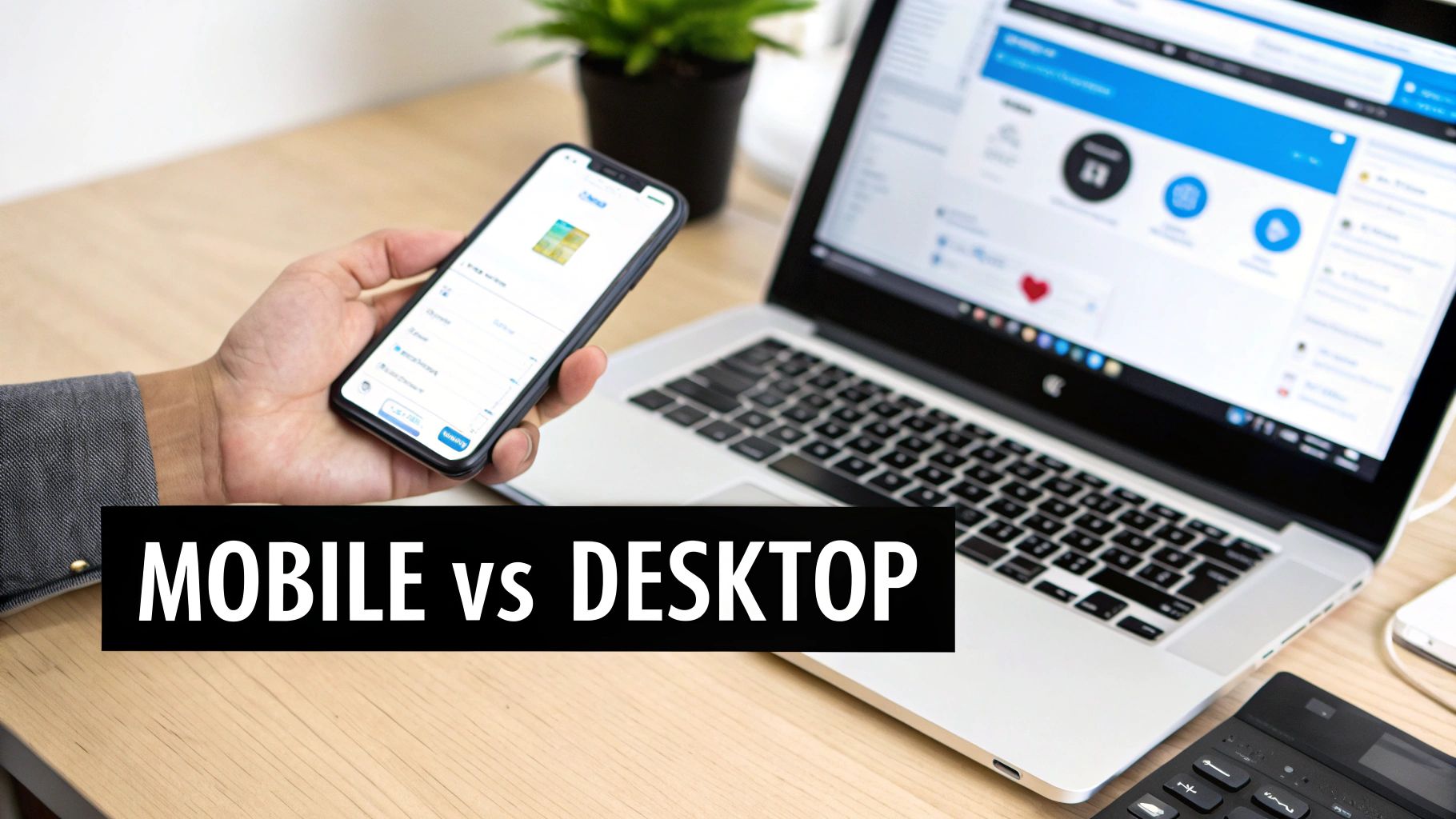
While MetaMask now has a solid mobile app, its soul is in the browser. That's where it shines, offering deep, seamless integration with a massive ecosystem of dApps.
Mobile Native vs. Desktop Centric
On the flip side, Trust Wallet was built from day one to be a mobile app. Its entire design is streamlined for the on-the-go user who needs to manage a wide variety of crypto assets with just a few taps. The interface is clean, intuitive, and built around the idea of having one simple app to handle everything.
Both wallets are now available on mobile and desktop, but their origins dictate their core strengths. MetaMask is the undisputed champion for desktop DeFi power users. Trust Wallet delivers a superior, all-in-one experience for managing a diverse portfolio on your phone.
This isn't just a surface-level difference. MetaMask grew up with Ethereum and EVM chains, becoming the default connector for countless dApps. Trust Wallet, however, positioned itself as the universal crypto pocket knife, supporting over 70 blockchains, including big names outside the Ethereum ecosystem like Solana, Cosmos, and Ripple. You can find more details on their chain support in this cointracking.info comparison.
Hardware Wallet Integration
For anyone serious about security, hardware wallet support is non-negotiable. Here again, their different philosophies are clear.
- MetaMask: It’s built for the security-conscious DeFi user. It plays nice with industry leaders like Ledger and Trezor, making it easy to secure your assets in cold storage while still interacting with dApps.
- Trust Wallet: The integration is more focused, primarily supporting Ledger devices. This works perfectly well for most people but gives you fewer options than MetaMask's broader compatibility.
At the end of the day, MetaMask’s desktop roots provide a powerful, deeply integrated experience for serious dApp interaction, especially when paired with a hardware wallet. Trust Wallet, on the other hand, wins on mobile convenience and its incredible multi-chain asset support, making it the perfect portfolio tracker to carry in your pocket.
When you're trying to pick between Trust Wallet and MetaMask, it really boils down to one simple question: what are you trying to do, and where? A crypto wallet is only as good as the networks it can connect to, and this is where the two take completely different paths.
Trust Wallet’s entire philosophy is built on breadth. It’s designed to be your one-stop-shop for everything crypto, supporting a massive list of over 100 blockchains right out of the box. That means you can hold your Bitcoin, Ethereum, Solana, Ripple, and dozens of other Layer-1 assets in one place without messing around with manual configurations.
If you’re an investor looking to spread your bets across many different crypto ecosystems, this is a huge advantage.
The All-in-One vs. The Specialist
MetaMask, on the other hand, is a specialist. It grew up with Ethereum and its heart is still there. While it has branched out to support other EVM-compatible chains like Polygon, Arbitrum, and Base, its DNA is pure Ethereum. Anything that works like Ethereum, MetaMask can handle.
Getting it to work with these other networks usually means adding them manually, which can feel a bit technical if you're just starting out. But this tight focus is also its biggest strength. If you’re deep into DeFi, flipping NFTs, or playing games on EVM chains, MetaMask offers a smooth, reliable, and deeply integrated experience that nothing else really matches.
Here's the short version: if you hold non-EVM assets like Solana (SOL) or Bitcoin (BTC), Trust Wallet is the only choice between these two. If you live and breathe inside the Ethereum world and its Layer-2s, MetaMask was built just for you.
You can see Trust Wallet's "one wallet for all" approach reflected on their website, where they showcase a huge variety of different coins.
This visual instantly tells you their goal is to be a universal crypto hub, which is a core difference from MetaMask's EVM-first design.
How Asset Support Plays Out in the Real World
The sheer number of assets supported is where Trust Wallet pulls away. Its multi-chain nature allows it to hold an estimated 4.5+ million coins and tokens. For comparison, MetaMask supports around 450,000+ digital assets. That massive difference, however, can also introduce more complexity when it comes to managing keys and network settings. For a deeper dive into their asset lists, the comparison on CoinTracking is a great resource.
To help make this tangible, let’s look at two scenarios:
-
Scenario 1: The Solana NFT Collector
An investor wants to start collecting NFTs on the Solana network. MetaMask is a non-starter here—it simply can't connect to Solana. Trust Wallet, however, is perfect. They can manage their ETH, BTC, and new SOL NFTs all from a single app. -
Scenario 2: The Arbitrum Yield Farmer
A DeFi pro wants to provide liquidity to a brand-new protocol on Arbitrum to earn yield. They’ll almost certainly reach for MetaMask. Its browser extension is the industry standard for dApp integration, making it incredibly easy to connect to new platforms and sign transactions on a desktop. While Trust Wallet does support Arbitrum, the desktop experience with MetaMask is just better suited for complex DeFi tasks.
Understanding Security and Recovery Protocols
When you're weighing Trust Wallet vs. MetaMask, security is everything. Both are non-custodial wallets, which is just a fancy way of saying you—and only you—hold the keys to your crypto. This is the whole point of decentralization, giving you total control over your assets.
This control comes from a 12-word secret recovery phrase that your wallet gives you during setup. Think of it as the master key to your digital vault. It's critical to grasp that neither Trust Wallet nor MetaMask has a copy of this phrase. They can't see it, they don't store it, and they absolutely cannot help you if you lose it.
The Role of the Secret Recovery Phrase
That 12-word phrase is your ultimate safety net. It’s what lets you restore your entire wallet on a new phone or computer if your old one gets lost, stolen, or just stops working. Lose the phrase, and you lose your crypto. It's that simple, and it’s permanent.
Most of the horror stories you hear aren't from wallets getting "hacked" in the traditional sense. They start with how someone stored their phrase. Scribbling it on a sticky note that gets thrown away or saving it in a text file on your desktop are rookie mistakes that cost people dearly. A corrupted browser or a busted phone is just a minor inconvenience if you have your phrase. But if that phrase falls into the wrong hands, it's game over.
The real security debate isn't about the wallet software itself. It’s about you. Your keys, your crypto. The biggest risk is always how you, the user, decide to manage that all-important secret recovery phrase.
Recovery Nuances and Chain Complexity
While the 12-word phrase concept is the same for both wallets, how they're built leads to different recovery experiences. MetaMask keeps things simple. It uses a single recovery phrase to manage every account you create across Ethereum and all other EVM-compatible chains. One phrase brings everything back online. If you ever worry your phrase has been compromised, digging into the specifics of the MetaMask recovery phrase is your first critical step.
Trust Wallet’s approach is a bit different. Because it supports over 70 completely separate blockchains, that one recovery phrase is used to generate private keys for each one. This is super convenient for day-to-day use, but it can make recovery a little more complex. When you restore your wallet, you have to be sure your assets on networks like Bitcoin, Solana, and Ethereum all show up correctly, which sometimes requires a bit more legwork.
To keep your assets safe, you need a solid backup plan. Here are a few proven strategies:
- Go Analog: Write your phrase down on paper or, even better, engrave it on a metal plate. Store it in a few secure, separate locations.
- Offline Digital: Save your phrase in an encrypted file on a USB drive that never, ever touches an internet-connected computer.
- Password Manager: This is convenient, but you have to be careful. Only trust a top-tier, zero-knowledge password manager, and lock it down with a ridiculously strong master password and two-factor authentication.
At the end of the day, choosing between Trust Wallet and MetaMask on security grounds comes down to personal discipline. MetaMask’s single-phrase-for-EVM is a bit easier to manage. Trust Wallet’s massive multi-chain support just means you need to be extra diligent when checking your balances after a recovery.
Making the Right Choice for Your Use Case
Specs and feature lists are one thing, but the real test of a wallet is how it performs in the wild. The whole Trust Wallet vs. MetaMask debate comes down to what you actually do with your crypto day-to-day.
Let's cut through the theory and look at a few common crypto personas. See which one fits you best, and you'll have a clear answer on which wallet to pick.
The DeFi Power User
This person is deep in the trenches of decentralized finance. We're talking about constant interaction with lending protocols, yield farms, and DEXs across EVM-compatible networks like Ethereum, Arbitrum, and Base. They live on their desktop and need flawless dApp integration for high-stakes transactions.
- Recommendation: It has to be MetaMask.
- Justification: The browser extension is the gold standard for a reason. It’s the key that unlocks almost every dApp out there, providing a smooth, predictable experience for even the most complex DeFi strategies. When you pair it with a hardware wallet like a Ledger or Trezor, you get the security you need to sleep at night.
The Diversified Altcoin Investor
This investor's portfolio is a colorful mix that goes way beyond Ethereum. They're holding Bitcoin (BTC), Solana (SOL), Ripple (XRP), and a bunch of other tokens from different Layer-1 blockchains. For them, the priority is a single, clean mobile app to track everything without a headache.
For anyone juggling assets across multiple, non-compatible blockchains, simplicity is everything. You need a wallet that just works, bringing all your coins under one roof without forcing you to manually add networks for every new chain you explore.
- Recommendation: Trust Wallet is the obvious choice here.
- Justification: With native support for over 100 blockchains, Trust Wallet lets you see and manage your entire collection from one simple interface. It completely removes the need to jump between different wallet apps, making it the perfect pocket companion for a diverse portfolio.
This decision tree visualizes the first step in wallet recovery, a critical consideration when choosing where to store your assets.
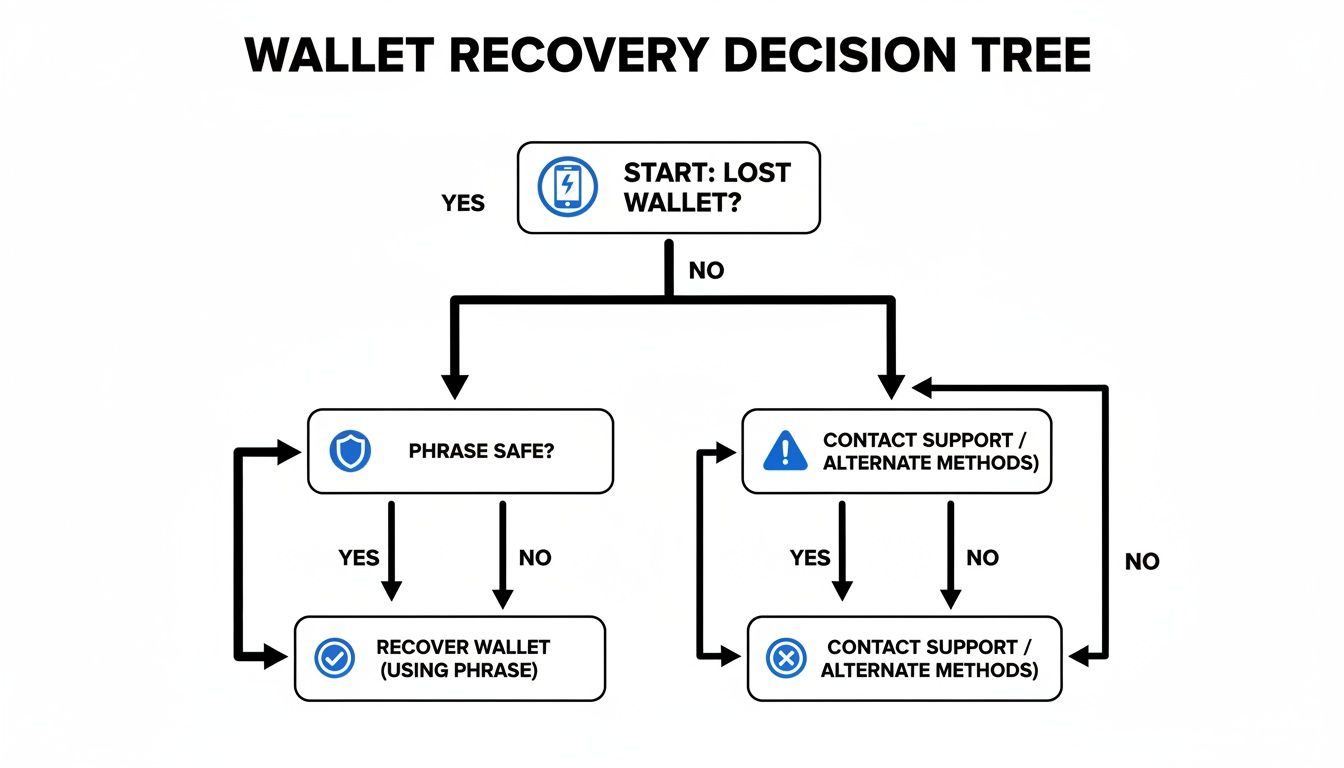
The flowchart makes one thing crystal clear: no matter which wallet you use, your secret recovery phrase is your only lifeline.
The Multi-Chain NFT Collector
This user is all about digital art and collectibles, and they aren't limiting themselves to Ethereum. One day they're minting on Polygon, the next they're scooping up a new piece on Solana. They need a wallet that can beautifully display and manage an NFT collection that spans multiple chains.
- Recommendation: Trust Wallet delivers a much better experience.
- Justification: MetaMask is fantastic for Ethereum-based NFTs, but its multi-chain support feels like an afterthought. Trust Wallet, on the other hand, was built for a multi-chain world. It provides a far more comprehensive and visually appealing gallery for your NFTs, no matter which blockchain they live on.
This split in user focus has real-world consequences for asset recovery. For a business like ours, it means we see a high volume of Trust Wallet recovery cases simply due to its massive user base. But the MetaMask cases often involve much higher values because of the deep on-chain activity and DeFi engagement common among its users. You can learn more about MetaMask user statistics on CoinLaw.io.
When you look past the features and dive into how these wallets fit into the bigger crypto picture, their reputations tell a compelling story. It's not just about which one is "better," but where each one has carved out its territory. In the Trust Wallet vs. MetaMask matchup, we're looking at two titans that dominate completely different corners of the market.
MetaMask, with its 30 million monthly active users, is the undisputed king of the Web3 and DeFi space. For developers, hardcore DeFi users, and anyone spending significant time interacting with dApps on a desktop, MetaMask is practically the default choice. Its name is synonymous with the on-chain economy.
Then you have Trust Wallet. It boasts an incredible 115 million users, making it a giant in the world of mobile crypto. Its reputation is built on being easy to pick up and use, which has made it the first crypto wallet for millions of people managing their portfolios on the go. This massive user base gives it huge sway, especially in emerging markets and with everyday retail investors.
Where Their Influence Really Lies
So, how do you measure their influence? It's not just about user count.
MetaMask’s power is deeply embedded in the Ethereum ecosystem. It has immense influence over on-chain value and is the first tool developers think of for dApp integration. Trust Wallet’s influence, however, comes from its sheer scale—it’s the engine driving mainstream, mobile-first adoption across the globe.
Think of it this way: MetaMask is the established gateway for high-value DeFi traders and developers, while Trust Wallet is the on-ramp for global, everyday crypto ownership. Their reputations perfectly mirror their core missions.
You can even see this play out in online discussions. A 2025 AI visibility analysis revealed that MetaMask was mentioned 327 times across 330 instances where a wallet was recommended, often praised for its security and dApp compatibility. Trust Wallet, while clearly popular with its users, only appeared 63 times in the same analysis.
If you're curious about the data, you can read the full visibility analysis on Mention.network to see how AI tools rank their prominence.
Frequently Asked Questions
Even after a deep dive, you might still have some specific questions nagging at you. Let's clear up a few of the most common ones people ask when picking between Trust Wallet and MetaMask.
Can I use both Trust Wallet and MetaMask at the same time?
You absolutely can, and frankly, many crypto pros do just that. It's pretty common to import the same secret recovery phrase into both wallets. This lets you manage all your EVM-compatible assets—think Ethereum, Polygon, or Avalanche—from either your desktop or phone.
This strategy gives you the best of both worlds. You can use MetaMask’s browser extension for heavy-duty dApp work on your computer, then switch to Trust Wallet's slick mobile app when you're on the go. Just remember, assets on non-EVM chains like Bitcoin or Solana that you hold in Trust Wallet won't show up in MetaMask.
Which wallet is actually more secure?
Both are top-tier non-custodial wallets, which is just a fancy way of saying you—and only you—are in charge of your private keys. The real security factor isn't the software itself; it's you. How you protect that 12-word secret recovery phrase is what truly keeps your crypto safe.
Security isn't some built-in feature you can just turn on. It comes down to your personal discipline. Neither wallet can touch your funds or see your phrase, so the buck stops with you.
If you’re looking for an extra layer of protection, MetaMask has a slight edge with its support for both Ledger and Trezor hardware wallets. Trust Wallet also works great with Ledger. Your choice here should be less about the wallet and more about your commitment to solid security habits.
What happens if I lose my phone or computer?
As long as you have your 12-word secret recovery phrase, losing a device is just a temporary headache, not a catastrophe. That phrase is your master key to everything.
Keep it written down and tucked away somewhere safe and offline. If your device gets lost, stolen, or broken, you just grab a new one, download your wallet of choice, and use the "Import" or "Restore" option. Punch in your phrase, and all your assets will reappear like magic. Lose the phrase, and you lose your crypto. It's that simple.
If you've lost your wallet password and don't know where to turn, Wallet Recovery AI specializes in helping people get back into their accounts. Check out our secure recovery services at https://walletrecovery.ai to see how we can help.
Leave a Reply