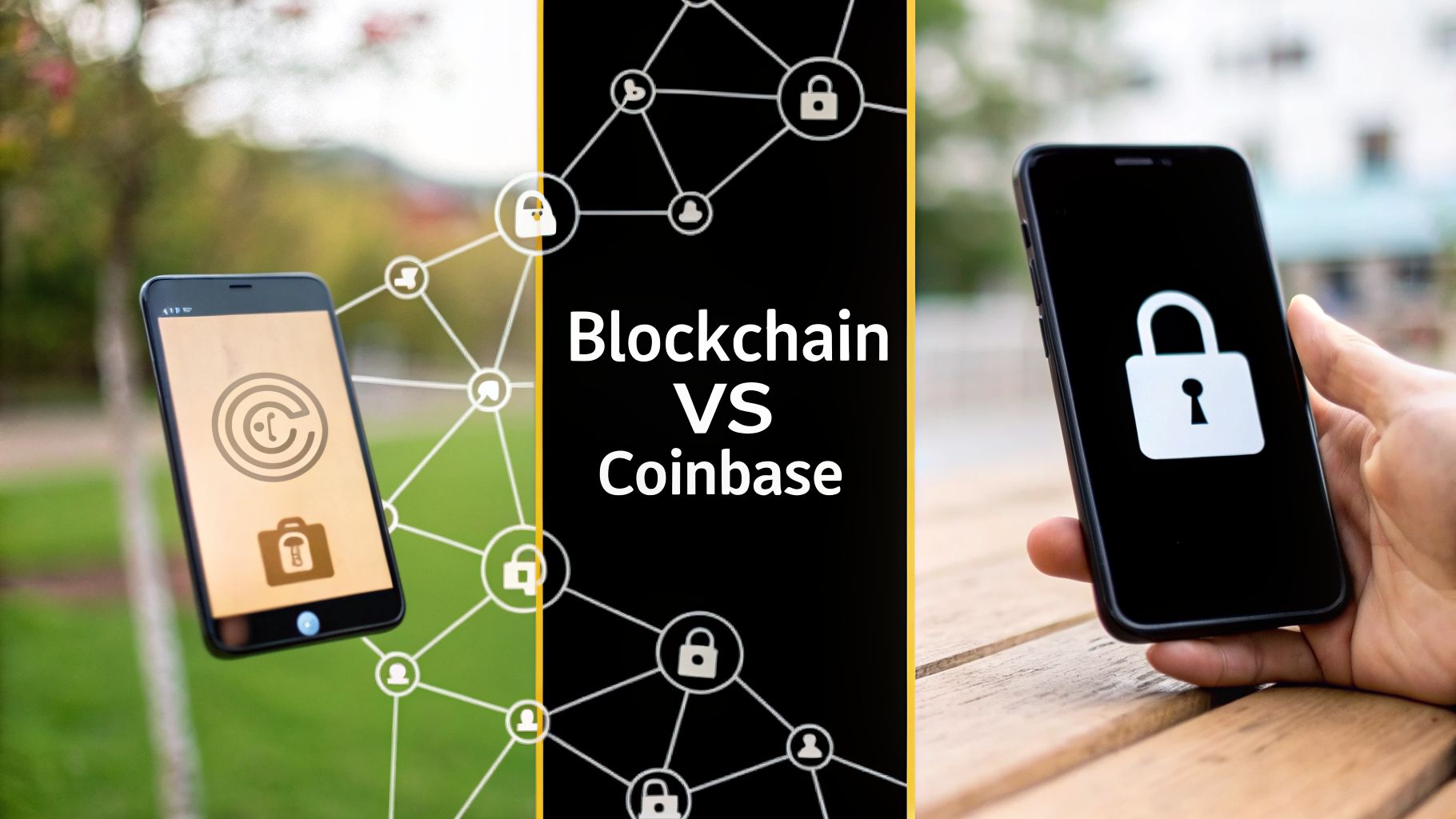
When people talk about blockchain vs. Coinbase, they're often confusing the road for the car. The simplest way to think about it is this: blockchain is the fundamental technology that makes cryptocurrency work, while Coinbase is a well-known company that offers services using that technology.
Think of the blockchain as the entire public highway system—a decentralized network anyone can build on. Coinbase, in this analogy, is like a convenient, full-service gas station and mechanic shop built right off the main highway.
Understanding The Core Concepts Of Blockchain vs Coinbase

As you dig a little deeper, the real difference boils down to control and who holds your digital assets. A blockchain is a distributed, unchangeable public ledger. No single person or company owns it, which is the entire point. It's the groundwork for a massive crypto market, estimated to be worth $2.4 trillion as of November 2024.
Coinbase, on the other hand, is a centralized exchange. It’s a private company designed to make buying, selling, and storing crypto incredibly simple for the average user.
The most critical distinction is how your funds are managed. When you use the main Coinbase platform, you're in a custodial service. This means Coinbase holds the private keys to your crypto for you, acting much like a bank does with your cash.
Interacting directly with a blockchain, however, means using a non-custodial wallet like MetaMask or a Ledger hardware device. In that scenario, you and you alone hold the private keys. This gives you absolute ownership and control, but it also makes you completely responsible for keeping those keys safe.
Blockchain vs Coinbase At a Glance
To make this even clearer, let's break down the key differences in a simple table. This helps visualize where the two stand on core attributes like control and custody.
| Attribute | Blockchain (Technology) | Coinbase (Platform) |
|---|---|---|
| Type | Decentralized, distributed network | Centralized, privately owned company |
| Control | No single point of control; run by nodes | Controlled by the Coinbase corporation |
| Asset Custody | Self-custody (You hold your own keys) | Custodial (Coinbase holds your keys) |
| Analogy | A personal safe you own and control | A bank vault that holds your assets for you |
This is a vital concept to grasp, especially since the naming can be confusing. Coinbase offers both its main custodial platform and a separate, non-custodial product called "Coinbase Wallet." Understanding this difference is crucial, and you can learn more about Coinbase vs. Coinbase Wallet in our guide.
Ultimately, the path you choose here defines your entire relationship with your crypto and your level of personal responsibility.
Custodial vs Non-Custodial Who Really Controls Your Crypto

When people compare blockchain vs. Coinbase, what they’re really getting at is a fundamental question of control: who actually holds the keys to your digital assets? This difference comes down to custodial and non-custodial services, a choice that deeply impacts your security, privacy, and financial freedom.
A platform like Coinbase operates almost entirely as a custodial service. You can think of it like a bank, but for your crypto. After you create an account and deposit funds, Coinbase takes over, managing all the complex security behind the scenes. They hold the private keys on your behalf.
The appeal here is obvious convenience. Logging in feels familiar—just an email and password. If you forget that password, you can go through a standard account recovery flow. This simplicity is precisely why centralized exchanges like Coinbase became so popular; they made crypto accessible to millions.
The Power of Self-Custody
The other side of the coin is the non-custodial approach, which is the native way to interact directly with a blockchain. When you use a non-custodial wallet, like MetaMask or a hardware wallet, you are the one and only keeper of your private keys. These are typically backed up and secured by a seed phrase, a unique 12 or 24-word recovery phrase.
This is where the famous crypto mantra comes to life: “Not your keys, not your coins.” With a non-custodial wallet, you have absolute, final authority over your funds. No company can freeze your account, and no third party can block your transactions. This is the true financial sovereignty that blockchain was built to deliver.
The trade-off is clear: Coinbase offers convenience by acting as a custodian, while non-custodial wallets offer complete control at the cost of personal responsibility. Your choice depends entirely on your comfort level with managing your own security.
To put it another way, Coinbase is like a bank vault where an employee lets you in. A non-custodial wallet is like a personal safe in your house—only you know the combination. You can explore the nuances of these two models in our detailed comparison of custodial vs. non-custodial wallets.
Comparing Custody Models
Let’s put these two approaches side-by-side to see the practical differences for an average user holding some Bitcoin.
| Feature | Coinbase (Custodial) | Non-Custodial Wallet (Blockchain) |
|---|---|---|
| Private Key Holder | Coinbase manages the keys for you. | You hold and protect the keys. |
| Account Access | Standard username and password. | A cryptographic private key or seed phrase. |
| Recovery Process | "Forgot Password" link and support team. | You are 100% responsible for your seed phrase. |
| Control Level | High convenience, but indirect control. | Absolute control and financial sovereignty. |
Deciding on the right model is arguably the most important decision you'll make in crypto. It defines your relationship with your assets and determines who is ultimately in charge.
How Security, Privacy, and Recovery Differ
When you’re deciding between using a platform like Coinbase and interacting directly with the blockchain, you're making a fundamental choice. It's not just about features; it’s about who holds the keys and who bears the risk. The whole blockchain vs Coinbase debate boils down to a simple question: do you trust a corporation to safeguard your assets, or do you trust yourself?
Coinbase operates like a digital bank for your crypto. As a publicly traded U.S. company, they pour millions into institutional-grade security. They keep most user funds in offline cold storage, insure your USD balances up to $250,000 through FDIC, and enforce multi-factor authentication (MFA). It’s a security model designed to protect you from large-scale hacks on their platform.
On the other hand, a non-custodial wallet puts you in complete control. That sounds great, but it also means you’re the one solely responsible for security. The safety of your crypto hangs on one thing: your seed phrase or private key. There’s no corporate security team to back you up, no insurance on your crypto, and no one to call if you make a mistake. Your security is entirely up to your own personal diligence.
The Tradeoff Between Privacy and Compliance
This is where the two paths really split. Because Coinbase is a regulated financial service, it has to follow strict Know Your Customer (KYC) and Anti-Money Laundering (AML) laws. This means you have to upload a government ID and prove you are who you say you are. Every transaction is tied directly to your real-world identity.
Working directly on the blockchain gives you a layer of pseudonymity. Your transactions are public, sure, but they’re linked to a string of characters—your wallet address—not your name and address. It's not perfect anonymity, but it keeps a central company from having a complete record of your financial life.
The real question on privacy is whether you're okay with a regulated company keeping a detailed ledger of your crypto activity. For many, that's a fair price for convenience. For others, it completely undermines the point of using decentralized technology in the first place.
Coinbase has cemented its role as a critical bridge between old-school finance and the crypto world. Holding a 6.1% market share, it’s not only a major global player but also America's largest exchange, serving as a primary on-ramp for institutional money. This regulated status is a double-edged sword: it brings legitimacy but demands user data, a reality highlighted in reports on top crypto exchanges and their market influence.
Comparing Security, Privacy, and Recovery
To really grasp the differences, it helps to see them side-by-side. The table below breaks down what you can expect from a custodial service like Coinbase versus managing your own non-custodial wallet.
| Feature | Coinbase (Custodial) | Non-Custodial Wallet (Direct Blockchain) |
|---|---|---|
| Asset Custody | Coinbase holds your private keys. | You hold your own private keys. |
| Security Model | Relies on corporate security, cold storage, and insurance (for USD). | Relies entirely on your ability to protect your seed phrase. |
| Privacy | Low. Requires full KYC identity verification. Transactions are linked to your name. | High (Pseudonymous). Transactions are linked to a wallet address, not your identity. |
| Account Access | Standard login with username and password. | Access is controlled by your seed phrase or private key. |
| Recovery Process | "Forgot Password" link and customer support to verify identity. | No recovery process. If you lose your seed phrase, funds are gone. |
| Who to Trust | You trust Coinbase to secure your funds and your data. | You trust only yourself. |
This table makes it clear: with Coinbase, you're trading control for convenience and a corporate safety net. With a non-custodial wallet, you're taking on full responsibility for unparalleled control and privacy.
Asset Recovery: The Most Critical Difference
Nowhere is the contrast sharper than when you lose access to your funds. The playbook for getting your money back is completely different for each system.
Coinbase Recovery (Custodial)
- Process: It’s a familiar routine. If you forget your password, you just use the "forgot password" link to get a reset email.
- Support: Locked out for another reason? You can open a ticket with the Coinbase support team. They’ll guide you through identity verification to restore your access.
- Outcome: As long as you can prove you own the account, getting back in is almost always possible.
Non-Custodial Wallet Recovery (Blockchain)
- Process: Your seed phrase is your one and only backup. There is no "forgot password" button. There is no central company to help.
- Support: The blockchain has no support team. If your seed phrase is lost, your funds are cryptographically locked away forever.
- Outcome: A lost seed phrase means your funds are permanently inaccessible. The only remaining hope is if you used a password-protected wallet file and can remember parts of the password. This is the exact scenario where you'd need a specialized wallet recovery service as a last resort.
Choosing Your Path With Real-World User Scenarios
Figuring out whether to use a service like Coinbase or interact directly with the blockchain isn't just a technical puzzle. It’s a practical choice that really depends on what you want to achieve with your crypto. The whole blockchain vs Coinbase question boils down to your personal goals.
Let's walk through a few common scenarios to see which path makes the most sense.
The New Investor
Meet Sarah. She's new to crypto and wants to buy some Bitcoin and Ethereum for the long haul, but the technical side of things feels overwhelming. She’s worried about security, but even more worried about making a simple mistake that could cost her everything.
For someone like Sarah, the priority is a smooth, familiar experience. She needs an easy way to buy crypto with her bank account and a login process that feels safe and recognizable. She isn't ready to be her own bank, which means she needs a safety net if she forgets a password.
In this case, Coinbase is the clear winner. It’s designed for beginners, offering a user-friendly app that feels more like a modern banking platform than a complex piece of tech. The custodial setup means she doesn't have to worry about managing her own private keys, which is exactly what she needs to get started comfortably.
The DeFi Explorer
Now consider Alex. He's been investing for a bit and is ready to dive into Decentralized Finance (DeFi). He wants to experiment with lending protocols, yield farming, and decentralized exchanges (DEXs) to get more out of his assets.
To do this, Alex needs total control. He has to interact directly with smart contracts and dApps, move his funds whenever he wants, and access new tokens that aren't available on big exchanges yet. He gets the principle of "not your keys, not your coins" and is willing to take on the responsibility of securing a seed phrase in exchange for true financial freedom.
The right tool for Alex is a non-custodial wallet for direct blockchain interaction. Something like MetaMask or Trust Wallet gives him the keys to the kingdom—literally. He can connect to any dApp without needing permission from a central company like Coinbase.
Your choice isn't just about technology; it's about aligning your tools with your financial strategy. Convenience often comes at the cost of control, and vice versa.
The decision tree below gives you a visual guide to how recovery options change based on the path you take.

As you can see, the road to getting your funds back looks completely different depending on whether you’re with a custodial service or flying solo.
The Long-Term Holder
Ben has a sizable amount of Bitcoin that he plans to hold for years—a classic "HODLer." His one and only priority is making sure his investment is as secure as humanly possible from theft, hacks, and accidental loss. He has no intention of trading regularly.
His goal is simple: lock it down. He wants ironclad security, zero exposure to exchange hacks, and absolute ownership over his coins. While he's technically savvy, he wants to eliminate every external risk he can.
For a serious long-term holder, the answer is a non-custodial hardware wallet, which allows direct blockchain management. Nothing provides better security than a device from Ledger or Trezor. These wallets keep private keys completely offline, making them untouchable by online attacks and giving Ben the ultimate peace of mind.
The Privacy Advocate
Finally, there’s Maria. She believes in financial privacy and is deeply uncomfortable with the idea of a corporation tracking her transaction history and linking it to her real-world identity.
Maria’s goal is to remain pseudonymous. She wants to avoid Know Your Customer (KYC) requirements and transact freely without a central party watching her every move. She understands this means trading convenience for privacy and is fully prepared to handle the security that comes with self-custody.
For Maria, a non-custodial wallet is the only option. By managing her own keys, she completely sidesteps the mandatory identity verification that platforms like Coinbase require. This allows her to keep her financial activity completely separate from her personal data.
What to Do When You Lose Access to Your Crypto Wallet

Losing access to your crypto is a gut-wrenching feeling that every investor dreads. The good news is, you might have a path to recovery. That path, however, depends entirely on the type of wallet you chose.
This is where the blockchain vs Coinbase distinction becomes crystal clear. It all boils down to whether you trusted a company with your assets or took on that responsibility yourself. Let's walk through the two very different playbooks for getting back into your account.
The Coinbase Recovery Playbook
If you get locked out of your Coinbase account, the process feels a lot like recovering access to your bank or email. It’s a familiar, guided procedure, which is a big part of why many people choose a custodial exchange in the first place.
Here's what that typically looks like:
- Use the "Forgot Password" Link: Head to the login screen and click the standard password reset option. This triggers a verification link sent to the email address you registered with.
- Verify Your Identity: To prove it's really you, Coinbase will almost certainly require you to complete a two-factor authentication (2FA) step. This usually means entering a code from an app like Google Authenticator or one sent via SMS.
- Contact Customer Support: If the automated steps don't work, you'll need to open a support ticket. Get ready to provide proof of ownership, which can include a government-issued ID and a selfie holding that ID.
Since Coinbase is a custodial service, they have the final say on account access. As long as you can prove you’re the legitimate owner, their support team has the power to get you back in.
The Non-Custodial Wallet Recovery Challenge
For a non-custodial wallet—think MetaMask, Ledger, or Trezor—the script is flipped entirely. There’s no company to call and no "forgot password" button to save you. You are the custodian.
Your wallet is secured by a private key or seed phrase, and that’s the only thing that can unlock it.
The stark reality of self-custody is this: your seed phrase is your wallet. If you lose it, the blockchain has no mechanism to return your funds. They are cryptographically locked, and without the key, they are permanently inaccessible by normal means.
This is the high-stakes trade-off for true ownership. There is no customer support hotline for the Bitcoin or Ethereum network itself.
When to Seek Professional Help
So, what happens if you’ve lost the password to a non-custodial wallet but still have the encrypted wallet file? Or maybe you just have a partial memory of the password. Don't give up just yet.
First, try a few things on your own:
- Brainstorming: Take the time to seriously jog your memory. Write down every password variation you've ever used, common phrases, important dates, or anything else that might have been part of it.
- Avoid Random Guesses: Manually trying hundreds of different passwords is rarely effective. Worse, it could potentially corrupt the wallet file, making recovery impossible.
If you’ve exhausted all options and are still locked out, it's time to consider a professional crypto recovery service. These specialists use powerful computational methods to run through millions or billions of password combinations, guided by the memory hints you provide.
This approach offers the best shot at unlocking wallets from platforms like MetaMask, Blockchain.com, Ledger, or Trezor when the password is the only thing standing in your way. It’s a last resort, but a very real one for these complex situations.
Frequently Asked Questions About Blockchain and Coinbase
Even with a clear breakdown, the distinction between a decentralized network and a centralized platform can bring up some lingering questions. Let's tackle a few of the most common ones to make sure the difference between using the blockchain and using Coinbase is crystal clear.
Can I Use The Blockchain Without a Platform Like Coinbase?
Absolutely. In fact, interacting directly with the blockchain is how crypto was originally designed to be used. You do this with a non-custodial wallet.
Tools like MetaMask, Trust Wallet, or hardware wallets from Ledger put you in the driver's seat. They give you your own private keys, letting you manage your assets and connect with decentralized apps (dApps) without anyone in the middle. While Coinbase is great for buying crypto with dollars or euros, a non-custodial wallet gives you true ownership.
Is The Coinbase Wallet App Different From The Main Coinbase Platform?
Yes, and it's one of the most important distinctions to understand. The main Coinbase platform at Coinbase.com is a custodial service. Think of it like a bank—they hold your crypto and manage your private keys for you. It’s built for convenience.
The separate 'Coinbase Wallet' app, on the other hand, is a non-custodial wallet. When you use it, you are the one who holds the private keys, secured by a secret recovery phrase. This gives you full control and responsibility, opening the door to the world of DeFi much like MetaMask does.
The name can be confusing, but the function is what matters. Coinbase.com is a service that holds your crypto; Coinbase Wallet is a tool you use to hold your own crypto.
Why Do People Use Coinbase If It Means Giving Up Control?
It really comes down to simplicity and a familiar user experience. Coinbase makes it incredibly easy for beginners to turn their fiat money (like US Dollars or Euros) into cryptocurrency. They also handle the intimidating process of key management and offer customer support.
For someone new to the space, the thought of securing a 12 or 24-word seed phrase is daunting. Coinbase provides a bank-like model with password resets and account recovery, which feels safer to many users, even if it means sacrificing direct control over their digital assets.
If I Lose My Non-Custodial Wallet Password, Is It Gone Forever?
Not always, but getting it back is a highly technical challenge. With a non-custodial wallet, there's no "forgot password" button because no company has access to your keys. Recovery isn't about resetting anything; it's about reconstruction.
This is precisely where a professional recovery service can make a difference. By using your memories of the password—even partial ones—advanced algorithms can methodically test millions or billions of combinations in a completely secure, offline environment. It creates a pathway to regain access when you thought all hope was lost.
If you've lost access to a password-protected non-custodial wallet, don't assume your funds are gone for good. Wallet Recovery AI specializes in securely restoring access to a wide range of wallets, including MetaMask, Ledger, and Blockchain.com, using AI-driven techniques to test password variations based on your memory. Find out if we can help by submitting an inquiry at https://walletrecovery.ai.
Leave a Reply