
A cross-chain wallet is your master key to the entire crypto world. It’s a single, unified interface that lets you manage, send, and receive assets across completely separate blockchain networks. Instead of juggling one wallet for Bitcoin, another for Ethereum, and a third for Solana, you get one secure dashboard for everything.
Think of it as your universal financial passport for digital assets. It simplifies everything.
Why a Cross-Chain Wallet Is Essential Today
Picture this: you're backpacking across Europe, but for every country you enter, you need a completely separate physical wallet filled with that specific currency. One for Euros in France, another for Swiss Francs in Switzerland, and yet another for Polish Złoty in Poland. It’s a logistical nightmare, and the chances of losing one of them are pretty high.
That’s exactly what navigating the crypto world feels like without a cross-chain wallet.
The digital asset space isn't one big, happy family. It's more like a collection of independent "blockchain nations," each with its own currency, rules, and local apps. This separation creates some serious headaches for anyone trying to explore what different ecosystems have to offer.
The Problem of a Fragmented Ecosystem
Before these advanced wallets came along, managing assets on different chains was a real chore. You might have Bitcoin (BTC) on the Bitcoin network, Ether (ETH) on Ethereum, and Solana (SOL) on its own chain. Each one was stuck in its native environment, locked away in a separate wallet with a unique private key or seed phrase you had to protect.
This fragmentation causes a few key problems:
- Asset Isolation: Your funds are basically trapped on their home chains. Want to use your BTC in a DeFi app on Ethereum? Get ready for a complex, multi-step ordeal.
- Terrible User Experience: Keeping track of multiple wallets, passwords, and recovery phrases is a recipe for disaster. The more wallets you have, the higher the odds of losing access to one of them.
- Major Security Risks: Every time you use a centralized exchange to move assets between chains, you're trusting a third party with your crypto and introducing another potential point of failure.
A cross-chain wallet cuts through all that complexity. It gives you a single, secure command center to see and interact with your entire portfolio, no matter which blockchain your assets live on.
The need for this kind of unified tool is exploding. The global crypto wallet market was valued at around $12.2 billion in 2025, with over 820 million active wallets in use worldwide. This massive growth screams for better infrastructure to make moving between chains seamless and safe. You can dig deeper into the numbers behind cryptocurrency wallet adoption on sqmagazine.co.uk.
A Simple Solution to a Complex Problem
To really drive home the value, let’s look at the old way versus the new way a cross-chain wallet makes possible. The table below breaks down the common frustrations crypto users face and shows how a cross-chain wallet tackles them head-on.
| Problem in a Multi-Chain World | How a Cross-Chain Wallet Solves It |
|---|---|
| Asset Fragmentation | Provides a unified dashboard to see all your assets from different chains in one place. |
| Complex Management | Requires you to remember only one primary recovery phrase for multiple chains. |
| High Friction for Swaps | Enables direct swaps between assets on different chains without needing a centralized exchange. |
| Security Blind Spots | Reduces the number of third parties you need to trust by facilitating decentralized transfers. |
At the end of the day, a cross-chain wallet is more than just a nice-to-have. It’s a fundamental tool for anyone serious about participating in the modern, multi-chain digital economy. It bridges the gaps between isolated networks, creating a more fluid and user-friendly experience for everyone involved.
How Cross-Chain Wallets Actually Work
A cross-chain wallet doesn’t just magically teleport your crypto from one blockchain to another. Think of it more like a skilled orchestra conductor. It stands in front of a dozen different, complex instruments—the underlying technologies—and directs them to play in perfect harmony, creating a simple, seamless experience for you.
To really get what's happening when you click "send," you need to understand the core mechanics working behind the scenes. These wallets rely on a few clever methods to achieve this multi-chain magic, each acting like a different kind of transport system designed to move value from one blockchain "nation" to another.
The whole point of this tech is to solve some major headaches in the crypto world: assets getting stuck on one chain, clunky user experiences, and a whole lot of security risks.
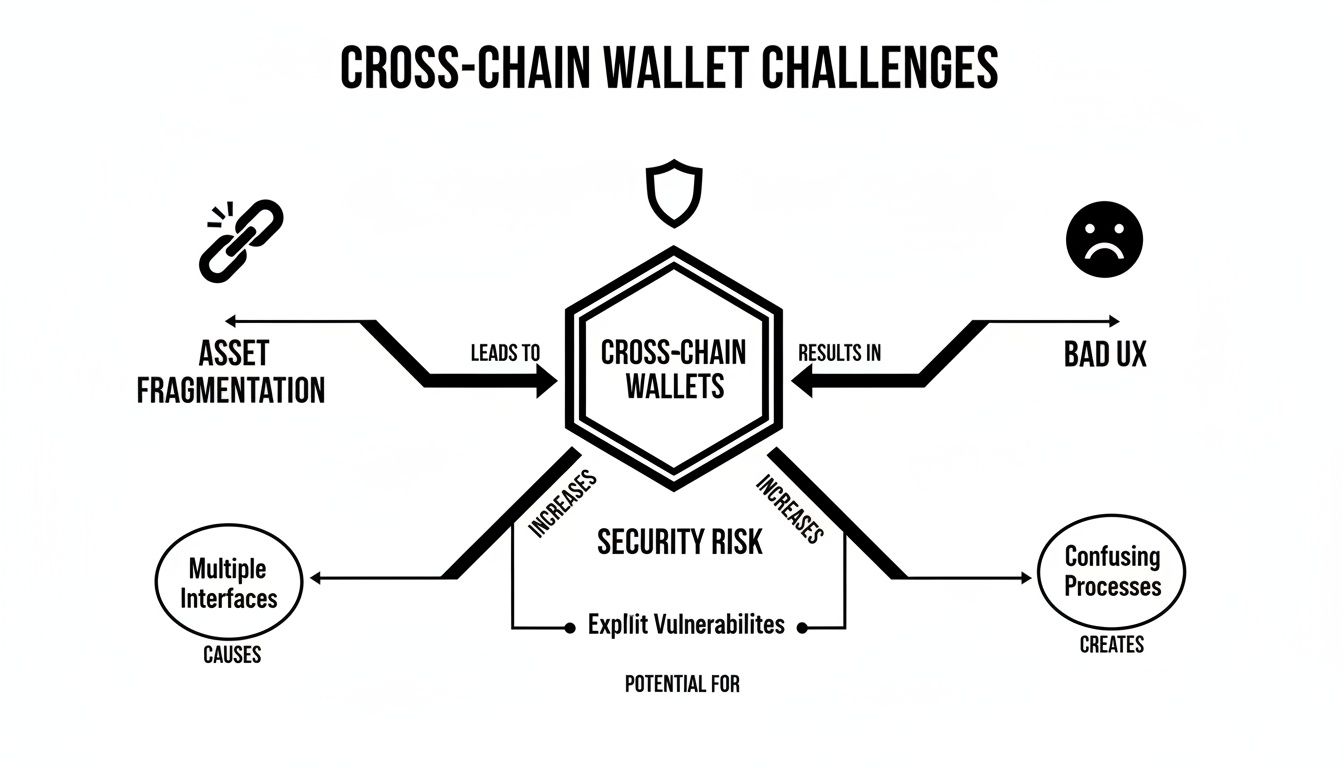
This is why a single, secure, and intuitive interface is so critical. It’s the key to unlocking the true potential of a multi-chain future.
Blockchain Bridges: The Digital Currency Exchange
By far, the most common piece of tech you'll encounter is a blockchain bridge. The best analogy is a currency exchange counter at an international airport. You hand over your US Dollars (an asset on Chain A) and get back an equivalent amount of Euros (an asset on Chain B) to spend in your new destination.
Here's how it works in the crypto world:
- Locking: You send your tokens, like USDC on Ethereum, to the bridge's smart contract. The contract then locks them up, taking them out of circulation on the original chain.
- Minting: The bridge then creates an equal number of new, "wrapped" tokens on the destination chain (say, USDC on Polygon) and sends them right to your wallet address there.
This gives you a synthetic version of your original asset that works perfectly in the new ecosystem. When you want to go back, the process just reverses: the wrapped tokens are "burned," and your original assets are unlocked for you.
Atomic Swaps: The Trustless Handshake
Another powerful, though less common, method is the atomic swap. Imagine you and a stranger agree to trade a rare Pokémon card for a valuable comic book. You’re both paranoid the other person will snatch your item and run. An atomic swap is the digital solution.
It creates a kind of digital escrow that only completes the trade if both of you fulfill your end of the bargain at the exact same time. If one person doesn't send their asset within a set timeframe, the smart contract automatically cancels the whole deal and returns everyone's stuff.
This technology allows for direct, peer-to-peer trades across different blockchains without needing a middleman like a centralized exchange or even a bridge. It’s a truly trustless, "all-or-nothing" transaction.
While incredibly secure, this method usually requires both blockchains to have specific technical features, which is why you don't see it as often in everyday wallets.
Interoperability Protocols: The Blockchain Superhighways
Finally, we're seeing a new wave of advanced solutions: interoperability protocols. If bridges are the local roads and atomic swaps are direct hand-to-hand deals, then protocols like LayerZero and Circle's Cross-Chain Transfer Protocol (CCTP) are the superhighways connecting entire blockchain economies.
These protocols go way beyond just swapping one asset for another. They create a universal messaging layer that lets different chains talk to each other directly. This opens the door to far more complex actions, like:
- Swapping native assets without needing to wrap them.
- Voting in a DAO on Ethereum using tokens you hold on Avalanche.
- Buying an NFT on Solana using ETH straight from your wallet.
For instance, some of these protocols use a mix of off-chain verification and on-chain proof to confirm transactions, which drastically cuts down on fees and can settle a transfer in less than a second.
A good cross-chain wallet bundles these protocols into its interface, making these powerful, complex actions feel as simple as clicking a single button. It handles all the heavy lifting for you.
Comparing Cross Chain Security and Trust Models
When you pick a cross-chain wallet, you're doing more than just choosing a convenient app. You're buying into a specific security philosophy. The way a wallet handles your private keys is the single most important factor determining who truly has the final say over your assets.
It all boils down to one simple question: who holds the keys? Your answer puts you into one of three main camps, each with a different trade-off between security, personal responsibility, and ease of use.
The Custodial Model
A custodial wallet is a lot like your bank account. You give your money to the bank, and you trust them to keep it safe. In the crypto world, this means a third-party service—usually an exchange or a dedicated wallet company—holds your private keys for you.
This is the path most beginners take because it’s simple. You get a familiar username and password, and if you forget them, you can usually just reset them. But this convenience comes with a huge catch: you don't actually control your crypto. You’re placing your complete trust in the custodian to have perfect security and good intentions.
The bottom line: With a custodial wallet, you're trusting someone else. It's convenience over control, a perfect example of the old crypto saying, "Not your keys, not your coins."
The Non-Custodial Model
On the other end of the spectrum, a non-custodial wallet is like having cash in your pocket. You, and only you, are in possession of the private keys, which are protected by a 12 or 24-word seed phrase. This gives you total, uncompromising control. No one can freeze your account, block a transaction, or lose your funds in a data breach.
That absolute power, however, comes with absolute responsibility. If you lose that seed phrase, it’s game over. There’s no support desk to call and no "forgot my password" link. Your crypto is gone, probably forever. Getting comfortable with these differences is crucial, and you can learn more about custodial and non-custodial options to figure out what's right for you.
The Multi-Party Computation Model
A newer, more sophisticated option is Multi-Party Computation (MPC). This approach aims to give you the best of both worlds—the security of a non-custodial wallet with the user-friendliness of a custodial one. Instead of a single private key, MPC technology splits the key into multiple pieces, or "shards." These shards are then stored in different places, often controlled by different parties (like you, the wallet provider, and a trusted third party).
Think of it like a bank vault needing three different people with three different keys to open it. An MPC wallet is similar. To sign a transaction, a certain number of these shards have to work together, but—and this is the magic part—the full private key is never reconstructed in one place. This slashes the risk of theft because a hacker would need to compromise several independent systems at the same time, which is incredibly difficult.
Cross Chain Wallet Trust Models Compared
So, which wallet is right for you? It really depends on your comfort with technology and how much risk you’re willing to take on personally. To make it clearer, here’s a straightforward comparison.
| Feature | Custodial Model | Non-Custodial Model | MPC Model |
|---|---|---|---|
| Key Control | Third party holds the keys | You hold your own keys | Keys are split into shards, no single controller |
| Security | Relies on the custodian's security infrastructure | Depends entirely on how you secure your seed phrase | High; eliminates single points of failure |
| User Responsibility | Low | Very High | Moderate |
| Convenience | High (password resets, customer support) | Low (no safety net if keys are lost) | High (often allows for social recovery options) |
| Best For | Beginners, frequent traders on exchanges | Experienced users who want 100% control | Users and teams who want high security with usability |
Ultimately, there's no single "best" model—only the one that best aligns with your needs. Understanding these fundamental differences is the first step toward managing your cross-chain assets safely and confidently.
Navigating Common Risks and Pitfalls
A cross-chain wallet is your master key to the entire crypto ecosystem. That’s its power. But with that connectivity comes new avenues for risk, and navigating this multi-chain world means understanding both the outright security threats and the subtle user-experience traps that can put your funds in jeopardy.
Think of it like this: a standard, single-chain wallet is a house with one locked front door. A cross-chain wallet is more like a mansion with doors opening to a dozen different streets. It’s a lot more convenient, sure, but you have to be way more vigilant about which doors you open and what you let through.
Learning to spot these pitfalls ahead of time is the key. It turns that feeling of anxiety into confident, informed awareness.
Security Threats in a Multi-Chain World
The very tech that makes cross-chain magic happen—like bridges—is often ground zero for attacks. These protocols have to lock up huge pools of assets to function, making them a massive honeypot for hackers. It's no surprise that over $2.5 billion has been swiped from bridge exploits alone. That number is a stark reminder to stick with reputable, well-audited protocols.
Then there are the more personal attacks, like sophisticated phishing scams. A scammer might create a slick-looking fake DeFi site or airdrop you a malicious token that seems legit. When you connect your wallet to interact with it, you might be signing a transaction that gives them permission to drain your assets across multiple chains at once.
You have to operate with a bit of healthy skepticism. Here’s a simple defensive playbook:
- Vet Your Bridges: Before you send a dime across a bridge, check its history. Look for security audits and see how much volume it handles. Battle-tested bridges with a long track record are always a safer bet than some new, unaudited protocol that just launched.
- Bookmark Everything: Don't click on links from random DMs, emails, or sketchy social media posts. Ever. Go directly to the official websites you’ve already bookmarked yourself.
- Use a "Burner" Wallet: For trying out new dApps or anything you're not 100% sure about, keep a separate wallet with just a small amount of funds in it. This compartmentalizes the risk and keeps your main stash safe if things go sideways.
User Experience Pitfalls to Avoid
Beyond the crooks and hackers, plenty of funds are lost to simple user error. Moving assets between totally different blockchain environments is complex, and it’s easy to make a costly mistake. These aren't malicious attacks; they're just accidents that can be every bit as painful.
One of the most common blunders is sending assets to the wrong network. For instance, sending native USDC on Ethereum directly to a Solana address that isn't set up to receive it is a recipe for disaster. Those funds can be lost forever, and the wallet interface won't always stop you from making that mistake.
Always double-check—and then triple-check—that the destination address supports the exact token and the specific blockchain network you’re sending from. This one habit can save you from a world of hurt.
Misjudging gas fees is another classic trip-up. A cross-chain swap is often a two-part process: a transaction on the source chain and another on the destination chain. If you only account for the first fee, your transaction could get stuck or fail, especially if the network gets busy and gas prices spike.
Finally, there are the delays that cause sheer panic. A cross-chain transfer isn't always instant. Depending on the bridge's technology and how congested the networks are, it can take minutes or even hours to complete. Freaking out and trying to "fix" it by sending more transactions usually just digs a deeper hole and costs you more in fees. Just be patient and use a block explorer to keep an eye on your transaction's progress.
A Practical Guide to Securing Your Cross Chain Wallet
Let's be clear: real security in the multi-chain world comes from smart habits, not just fancy tech. Keeping your cross-chain wallet safe is an active job, and it starts with understanding your role in the process. The good news? The most powerful security measures are simple, straightforward habits you can build right now.
This isn't about becoming a cryptography expert overnight. It's about a practical framework for protecting your assets, from the absolute basics of handling your seed phrase to knowing when and how to use a hardware wallet—and what to do if things go sideways.
Master Your Seed Phrase
Your seed phrase—sometimes called a recovery phrase—is the single most critical piece of information you will ever own in crypto. It’s the master key to everything. With it, you can restore your entire wallet and all its assets on any device.
Treating it with the seriousness it deserves is non-negotiable. Think of it like the deed to your house; you wouldn’t snap a picture of it and upload it to the cloud. The same exact logic applies here.
Here are the non-negotiable rules for managing your seed phrase:
- Write It Down Immediately: The second your wallet gives you those 12 or 24 words, write them down. On paper. Or better yet, engrave them on a metal plate.
- Never, Ever Store It Digitally: Don't put it in a text file, a notes app, or your password manager. Don't take a screenshot. Any digital copy is a prime target for hackers.
- Store It Securely and Offline: A fireproof safe, a bank's safety deposit box, or a well-hidden spot only you know about. That's where it belongs.
- Create Redundancies: Keep a copy in at least two different, secure physical locations. This protects you from a single point of failure, like a fire or flood.
Embrace Cold Storage with a Hardware Wallet
A software wallet is great for everyday transactions, but if you're holding any significant amount of funds, they belong in cold storage. This means using a hardware wallet. It’s a small physical device that keeps your private keys completely offline, far away from the reach of online threats.
When you need to make a transaction, you plug the device into your computer and physically press a button to give your approval. This creates an "air gap" that makes it virtually impossible for malware or a remote hacker to get their hands on your keys. It is hands down the best investment you can make in your crypto security.
There's a reason demand for these devices is exploding. The cryptocurrency hardware wallet market is growing at a staggering 21% CAGR, which tells you that serious users are prioritizing offline security. This trend is only getting stronger as hardware wallets add more cross-chain features, letting you manage a diverse portfolio from one ultra-secure device. To see the data behind this growth, you can explore the findings on researchnester.com.
Navigating Wallet Recovery Scenarios
Even if you do everything right, accidents can happen. A forgotten password, a lost phone, a corrupted backup file—it’s a part of life. Knowing how to react is a key piece of your security plan.
First, stay calm and assess the situation. Do you have your seed phrase? If the answer is yes, you can almost always get your funds back by simply importing that phrase into a new wallet. But if the problem is more complicated, trying to fix it yourself can be a very bad idea.
If you've forgotten the password to an encrypted wallet file but still have the file, or you're dealing with a corrupted backup, stop. A wrong move here could lead to permanent data loss. This is the moment you need a professional.
For these kinds of specific issues, a specialized service like Wallet Recovery AI offers the safest path forward. We use advanced techniques to recover passwords or repair damaged files—all without your seed phrase ever leaving your possession. For a deeper look at building a solid security foundation, check out our guide on how to secure your crypto wallet. Our approach takes the risk out of your hands and gives you the best possible chance of a successful recovery, turning a potential disaster into a solved problem.
Got Questions About Cross-Chain Wallets? We've Got Answers.
As you start exploring the world of cross-chain wallets, you're bound to have some questions. It’s a big shift from the single-chain world, after all. Thinking about security, transaction fees, and what happens when things go wrong looks a little different now.
We've gathered the most common questions we hear from users and answered them directly. The goal is to cut through the noise, build on what you've learned, and give you the practical know-how to navigate the multi-chain world safely.
Are Cross-Chain Wallets Less Secure Than Single-Chain Wallets?
Not necessarily, but they do have different weak points you need to be aware of. The wallet's own security hinges on its fundamental design—whether it's non-custodial (you hold the keys) or custodial—and the technology it uses to talk to other chains.
The real risk usually isn't the wallet software itself. It's the external bridges and protocols you use to move assets. Think of it like this: your wallet might be a steel vault, but you're sending assets across a bridge to another vault. If that bridge is rickety, it doesn't matter how secure the vaults are. This is where the danger lies, and bridge exploits have led to billions in lost funds.
The Gold Standard: Pair a non-custodial cross-chain wallet with a hardware wallet. When you make it a habit to only interact with reputable, heavily audited bridges and protocols, you're building a security setup that's every bit as strong as sticking to a single chain.
What Happens If I Send My Crypto to the Wrong Blockchain?
This is a gut-wrenching moment for any crypto user. Sending a token to a network that doesn't support it often means those funds are gone for good. For example, if you send native Bitcoin (BTC) straight to a standard Ethereum address, there's almost no chance of getting it back.
But don't panic just yet—recovery is sometimes possible, especially if you're working within the ecosystem of EVM-compatible chains.
- A Common Scenario: Let's say you accidentally sent USDC on the Polygon network to your Ethereum address in MetaMask. Because both chains use the same underlying address format, your funds are likely safe. The fix is often as simple as adding the Polygon network to your wallet. Once you switch over, your USDC should be right there waiting for you.
If you're in a more complicated jam, do not start experimenting. Mashing buttons or trying random recovery tactics can turn a recoverable mistake into a permanent loss.
Do I Need to Pay Gas Fees on Both Chains for a Cross-Chain Transaction?
Yep, you almost always will. A cross-chain transfer isn't one single event; it's a series of separate transactions, and each one has its own fee.
Here’s a simplified breakdown of what happens under the hood:
- Source Chain Fee: You pay a gas fee on the first blockchain to kick things off. This usually involves locking your original asset in a smart contract.
- Destination Chain Fee: You pay another fee on the destination chain to have the new, equivalent asset created (or "minted") and delivered to your wallet address there.
Some of the newer cross-chain protocols try to make this smoother by bundling all the costs into a single fee you see upfront. But make no mistake, you're still paying for both actions. Always check the transaction details before you confirm anything so you know exactly what the total cost will be.
Can I Manage NFTs Across Different Chains with a Cross-Chain Wallet?
Absolutely, and this is one of the most exciting developments. Many of the best cross-chain wallets now act like a unified gallery for your entire NFT collection, letting you see your art from Ethereum, Solana, Polygon, and more, all in one place.
But there’s a catch. Viewing them is one thing; moving them is another. Transferring an NFT from one blockchain to another is a specialized process that requires a dedicated NFT bridge.
Before you even think about moving a valuable NFT, do your homework. Double-check that your wallet and the bridge you plan to use fully support the specific NFT collection and the chains you're working with. A few minutes of research can save you from a major headache and potentially losing your asset.
Facing a lost password or a corrupted wallet file is a nightmare, especially when multiple chains are involved. If you're locked out and the simple fixes aren't working, Wallet Recovery AI offers a professional way forward. Our AI-powered approach is built to handle these complex situations without ever asking for your seed phrase, giving you the best possible chance to recover your funds. Contact us today for a confidential assessment.
Leave a Reply