
Ever find yourself digging through a dozen different folders, Slack channels, and cloud drives just to find the right version of the company logo? It's a frustratingly common scenario. Now, imagine that same chaos applied to every valuable digital file your company owns: product designs, marketing videos, legal documents, and even the credentials for corporate crypto wallets.
That’s where enterprise digital asset management (DAM) comes in. Think of it as a highly intelligent, fortified vault for all your company's digital content. It's a central hub that organizes, secures, and distributes everything from a single source of truth, ending the wild goose chase for good.
Unlocking Your Digital Asset Strategy

Without a DAM, most companies operate in a state of digital disarray. Files are scattered across personal hard drives, tangled network folders, and a patchwork of different cloud accounts. Finding one specific asset feels less like a professional task and more like a treasure hunt with no map.
This disorganization isn't just an annoyance; it hits the bottom line hard. Studies have shown that creative and marketing teams can waste up to one-third of their time simply searching for files. That lost time adds up to delayed projects, missed market opportunities, and a serious drain on payroll.
The Pain Points of Digital Chaos
When there's no system in place, a predictable set of problems starts to emerge, chipping away at efficiency and introducing serious risks. An enterprise digital asset management platform is built to tackle these issues head-on.
Here’s what happens when asset management is an afterthought:
- Wasted Time and Resources: How often have teams recreated a graphic or video because they couldn't find the original? This redundant work is a huge, unnecessary expense. A simple request for a logo can spiral into a multi-day search party.
- Brand Inconsistency: When employees grab whatever they can find—outdated logos, off-brand colors, or unapproved images—it weakens your brand's identity and confuses customers. A DAM ensures everyone is working from the same approved playbook.
- Security and Compliance Risks: Storing sensitive intellectual property or customer data on unsecured, scattered platforms is a massive liability waiting to happen. A DAM gives you granular control over who can see and use what, complete with audit trails for accountability.
- Irreplaceable Asset Loss: Critical files can vanish in an instant, whether through accidental deletion or when an employee leaves the company. For unique, high-value assets, that loss can be catastrophic.
The core problem is simple: a misplaced marketing file represents lost potential revenue, just as an inaccessible crypto wallet represents a direct financial loss. Both are preventable failures in asset security and management.
Drawing Parallels to Modern Digital Wealth
Let's put this in terms of modern finance. An enterprise holding millions in crypto would never dream of storing its private keys in a shared Google Sheet. They'd use a secure, controlled system with multi-signature protocols, strict access controls, and robust recovery plans. It's just common sense.
You should view your company’s brand and marketing materials the same way. These assets represent millions of dollars in investment and future revenue. An enterprise DAM applies those same battle-tested principles of security, control, and accessibility to these files. It treats your brand assets with the seriousness they deserve and creates the single source of truth your entire organization needs to thrive.
The Real-World Payoff of a DAM System

Let's be clear: bringing in an enterprise digital asset management (DAM) system isn't just another IT project. It’s a core business decision that delivers a serious return. The value here goes way beyond just getting organized—it fundamentally impacts your efficiency, brand strength, and ability to manage risk.
At its heart, a DAM is a productivity powerhouse. Think of all the hours your team wastes digging through shared drives, old email chains, and random cloud accounts just to find a single file. A DAM gives that time back, turning frustrating administrative scavenger hunts into productive, high-value work.
Supercharging Your Operations
The first thing you'll notice is how much faster everything moves. When every single person on your team knows exactly where to find the latest, approved version of an asset, workflows don't just speed up—they transform.
The magic is in having one central, searchable library. Imagine launching a marketing campaign. Without a DAM, it’s a chaotic mess of file requests, people accidentally using the wrong version, and endless delays.
With a DAM, the story changes completely:
- Find Anything in Seconds: Smart tagging and search mean your team can pinpoint the exact image, video, or document they need instantly. No more guesswork.
- Stop Recreating Work: Teams can easily find and reuse existing assets, which cuts down on the huge cost of recreating content you already own.
- Seamless Teamwork: Your creative, marketing, and sales teams can finally work together on assets in real-time, with version control that prevents expensive mistakes.
This isn't just a small improvement. It's a fundamental shift that lets you get campaigns to market faster and react to opportunities with genuine agility.
Protecting Your Brand Across the Globe
Your brand is one of your most valuable assets, but keeping it consistent when you have teams spread all over the world is a massive headache. A DAM acts as your brand’s automated guardian, making sure every piece of content that goes out is perfectly on-brand.
Whether it’s a social media post from your team in Tokyo or a sales presentation in New York, a DAM ensures consistency. It becomes the single source of truth for your logos, official colors, fonts, and approved imagery.
By controlling exactly who can use which assets—and how—a DAM ensures your brand’s voice and look stay powerful and consistent at every single customer touchpoint.
This control stops the brand dilution that happens when people use old logos or unapproved images. The result is stronger customer trust and better brand recognition in a noisy market. The industry gets it, too. Projections show the enterprise digital asset management market rocketing from $3.078 billion in 2019 to a forecasted $10.018 billion by 2026. This boom is driven by cloud-based systems that give modern companies the flexibility they need. You can discover more insights about the DAM market's rapid expansion.
Locking Down Critical Security Risks
Beyond speed and branding, a DAM delivers an essential layer of security. If your company deals with high-value intellectual property—and that absolutely includes sensitive crypto asset data—you can't afford weak access controls.
A DAM uses precise permission settings to dictate who can view, edit, download, or share specific files. This is how you prevent unauthorized eyes from seeing sensitive product designs, confidential financial reports, or the private keys and seed phrases for your corporate wallets.
Even better, a good DAM creates a detailed audit trail of every action taken. This log provides total accountability and is crucial for compliance, helping you shut down both internal and external threats before they can do any damage.
What Really Powers an Enterprise DAM?
Think of an enterprise digital asset management (DAM) system as less of a filing cabinet and more of a central nervous system for your brand. It’s not just a fancy cloud folder; it’s a powerful engine built to bring order, speed, and airtight security to your entire world of content. To understand how a DAM goes from simple storage to a true operational powerhouse, you have to look under the hood at its core features.
It all starts with centralized storage. This means creating a single, unified home for every digital file your company owns or creates. Gone are the days of hunting for assets scattered across random hard drives, email chains, and forgotten file-sharing links. Instead of digital chaos, you get one source of truth everyone can rely on.
This central hub is brought to life by metadata, which is essentially a "digital fingerprint" for every single asset. Much like a blockchain transaction is packed with details like the sender, receiver, and amount, metadata enriches each file with descriptive keywords, usage rights, creation dates, and campaign codes. This layer of data transforms your library from a messy pile into a smart, searchable database.
Making Assets Findable in an Instant
Good metadata is what unlocks the real value of your assets. Instead of trying to guess a vague filename like Final_Logo_v3_updated.png, your teams can search using terms that actually make sense to them. This is where you see the first big win in efficiency.
Let's say your marketing team needs a specific product photo from last year's summer campaign in Europe. Without a DAM, that request kicks off a painful string of emails and Slack messages. With a DAM, a quick search for "summer campaign," "Europe," and "2023" instantly pulls up the exact asset they need, complete with all the info on its usage rights. This is a lot like using a blockchain explorer to pinpoint specific transaction details on a distributed ledger. If you're curious, you can learn more about how they work in our guide on what is a blockchain explorer.
Advanced Capabilities for Total Control
Beyond just finding things, a true enterprise DAM gives you powerful tools to manage the entire lifecycle of your assets. These are the features that separate it from basic cloud storage and are absolutely critical for any large-scale operation.
Here’s a breakdown of the key features that give you this level of control.
| Core Feature | Description | Primary Business Benefit |
|---|---|---|
| Version Control | Tracks all revisions of an asset, clearly marking the most current, approved version while keeping a full history. | Prevents costly mistakes, like using an old logo or an outdated sales proposal. Ensures brand consistency. |
| Workflow Automation | Automates the review and approval process by routing new assets to the right people in the right order. | Slashes the time it takes to get campaigns to market by streamlining collaboration and removing bottlenecks. |
| Digital Rights Management | Embeds licensing info and expiration dates directly into assets, automatically restricting access when rights expire. | Avoids expensive copyright infringement and legal troubles by ensuring full compliance with licensing agreements. |
| Advanced Search | Uses metadata, tags, and even AI-powered visual recognition to help users find assets instantly. | Dramatically boosts team productivity by eliminating the time wasted hunting for files. |
These features work together to create a system that doesn’t just store files, but actively manages them.
An enterprise DAM isn’t about storage; it's about owning and controlling your entire content supply chain. It provides the governance, automation, and security needed to manage your brand assets at a global scale, making sure every touchpoint is consistent and compliant.
The market’s explosive growth is a testament to this value. The enterprise DAM market, valued at $4.11 billion in 2023, is projected to soar to $18.23 billion by 2032. This isn't just hype; it's driven by businesses that are tired of content chaos and recognize the need for a sophisticated command center. Many are even pairing their DAM with project management tools like Asana and Jira to build a fully integrated operational hub. As tokenization becomes more common, DAMs are also evolving to manage the visual side of digital assets like NFTs, making them increasingly vital for blockchain-focused companies. You can read more about the explosive growth of the DAM market on SkyQuestt.com.
Applying DAM Principles to Crypto Asset Security
The very same principles that make an enterprise digital asset management system a powerhouse for protecting brand IP are exactly what's needed to secure a company’s crypto. It might seem like marketing materials and crypto wallets are worlds apart, but they share a dangerous vulnerability: without a formal management system, they're sitting ducks for loss, theft, and simple human error.
Applying DAM logic to crypto isn't just a clever idea—it's an essential security protocol for any serious organization in this space.
Think about the core of any DAM platform: a secure central repository, strict access controls, and a crystal-clear audit trail. Now, let’s map that to corporate crypto wallets. The "assets" are no longer JPEGs and PDFs. They’re private keys, seed phrases, and wallet credentials—the literal keys to your digital kingdom.
Bridging the Gap Between Brand and Blockchain
For most companies, the biggest crypto risk comes from pure disorganization. A terrifyingly common approach is to toss critical wallet information into a password manager, a shared spreadsheet, or worse, leave it in the hands of a single executive. This creates a massive single point of failure. What happens when that one person leaves the company, gets hit by a bus, or has their laptop stolen?
This is precisely where a Crypto Asset Management Framework, built on battle-tested DAM principles, becomes non-negotiable. It forces you to treat wallet credentials with the same discipline you’d apply to mission-critical intellectual property.
- Centralization: Forget scattered credentials. All sensitive information goes into a single, heavily encrypted vault. This becomes the one and only source of truth for accessing corporate funds.
- Controlled Access: Granular permissions mean only specific, authorized people can access wallet info, often requiring multi-person approval for anything significant. This shuts down unauthorized transfers and internal threats.
- Succession and Recovery: A formal plan dictates exactly how access is transferred or recovered in an emergency. It eliminates the blind panic that follows when a key holder suddenly goes dark.
The diagram below shows how these core DAM components work together to create a secure, organized system.
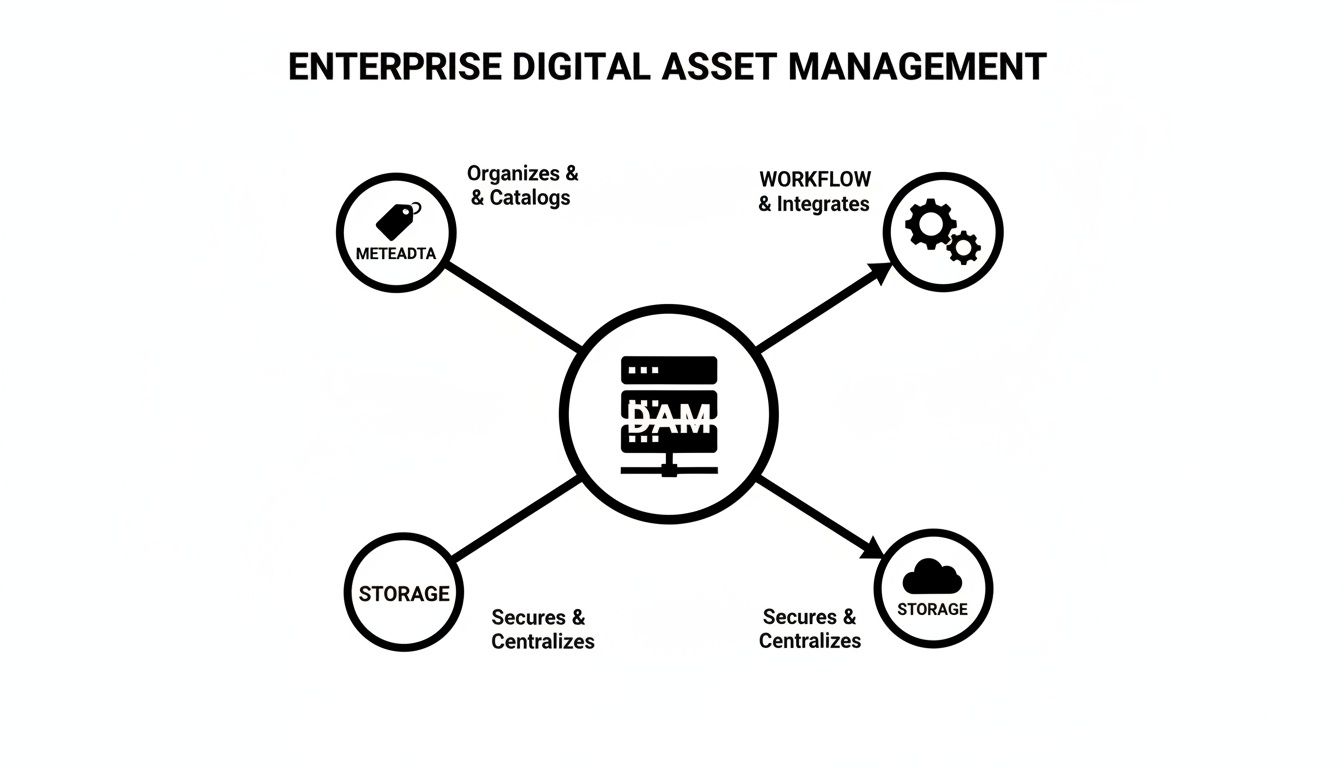
This web of interconnected functions—metadata, workflow, and storage—is exactly what you need to securely manage the complex data tied to your crypto assets.
Building a Fortified Crypto Management Framework
A truly effective framework goes way beyond just storing keys. It creates a complete operational security process where access and recovery are governed by strict rules, not by one person's judgment. This is often where specialized services come in, acting as a critical disaster recovery layer for your crypto.
Think of a specialized crypto recovery service as the ultimate off-site backup for your digital treasury. It provides a secure, audited, and expert-driven fail-safe for when internal processes fail, ensuring that corporate assets are never truly lost, even in a worst-case scenario.
This approach transforms wallet management from a reactive, high-stakes gamble into a proactive, governed business function. By meticulously documenting and securing every scrap of access information, you build institutional resilience. You’re no longer betting the company on the memory or integrity of one or two people. This strategy is the bedrock for any business wanting to learn how to store cryptocurrency safely at scale.
The end goal is a unified, security-first mindset that protects every form of digital wealth you own. Whether it’s the company logo or a multi-million dollar Bitcoin wallet, the principles of secure, centralized, and controlled management are universal. By applying the proven logic of enterprise digital asset management to your crypto, you’re building a durable shield against the unique and unforgiving risks of the blockchain world.
How to Choose the Right DAM Vendor
Picking a partner for your enterprise digital asset management system is one of those big business decisions, not just another IT purchase. Think of them as an extension of your team. The right vendor will supercharge your operations and protect your brand; the wrong one can saddle you with a clunky system, frustrated teams, and a very expensive migration down the line.
To get it right, you need a checklist that cuts through the marketing fluff and focuses on what really matters: scalability, security, and how well it plays with the tech you already have.
Evaluate Scalability and Performance
First things first: an enterprise DAM needs to be built for serious scale. Your asset library is only going to get bigger. You need a platform that can handle hundreds of thousands—or even millions—of files without grinding to a halt, especially when you have teams spread across the globe.
Ask potential vendors to get specific about their architecture. A cloud-native platform is almost always the right call for big organizations. It gives you the elasticity to handle huge demand spikes, like a massive product launch or a global campaign, without anyone noticing a slowdown.
- User Capacity: Can it handle an unlimited number of users across every department and region? No weird licensing caps.
- Storage and Processing: Does it offer petabyte-scale storage? Can it process assets in real-time to avoid bottlenecks for your international teams?
- Global Delivery: Is it using a Content Delivery Network (CDN)? This is non-negotiable for ensuring fast access for everyone, everywhere.
You’re not just buying a tool for today. You’re investing in infrastructure that needs to last you the next decade.
Scrutinize Security and Compliance
For any enterprise, security isn't just a feature; it's the foundation. Your digital assets—from confidential product designs to customer data—are a goldmine for cybercriminals. Your DAM vendor absolutely must have an ironclad commitment to security, backed by certifications you can verify.
Don't just look for basic encryption. You need a multi-layered security framework, and this should be one of the very first things you dig into.
A vendor’s security posture is a direct reflection of how seriously they will treat your most valuable assets. Don't settle for anything less than enterprise-grade, verifiable security measures that protect you from both external threats and internal misuse.
Here’s what to look for on the security front:
- Industry Certifications: The platform must meet tough standards like SOC 2 Type II, GDPR, and ISO 27001. These aren't just acronyms; they're proof of rigorous, independent security audits.
- Granular Access Controls: You need to be able to set ultra-specific permissions—who can view, download, edit, and share assets, right down to the individual user or a single file.
- Audit Trails: The system has to keep detailed logs of every single action taken on an asset. This is critical for accountability and makes compliance checks a breeze.
Assess Integration and Future-Proofing
Your DAM can't be an island. It has to talk to the other tools your teams rely on every day, whether that's your CRM, project management software, or your marketing and content systems. A platform with a solid API and a library of pre-built integrations is essential for breaking down silos and creating a truly connected workflow.
Beyond today's needs, look at the vendor's roadmap. Are they ready for what's next? This is especially important for companies in tech and finance that are starting to manage assets like NFTs or tokenized securities. A forward-thinking partner will have a clear plan for innovation, ensuring your investment doesn't become obsolete in a few years.
The enterprise digital asset management market is expected to hit $25.58 billion by 2035, a massive jump that shows just how central these systems are becoming. Much of that growth is fueled by the need for expert support to handle complex integrations—another reason why choosing a truly capable partner is so critical. You can discover more insights about the DAM market’s future on Research Nester.
Here is the rewritten section, crafted to sound completely human-written and natural, following all your requirements.
Common Questions About Enterprise DAM
If you're new to the world of enterprise-grade digital asset management, you probably have a few questions. That's a good thing. It's important to understand the nuts and bolts of these systems, especially when comparing them to tools you might already be using. Let's clear up some of the most common points of confusion.
Isn't a DAM Just Fancy Cloud Storage?
It's a fair question, but the answer is a firm no. Think of tools like Dropbox or Google Drive as a digital garage—a great place to park your files. An enterprise DAM, on the other hand, is more like an automated, high-tech warehouse with a logistics expert running the show.
While cloud storage simply holds files, an enterprise digital asset management system brings order, intelligence, and control to your entire content library.
- Smart Metadata: Instead of just filenames, you can search for assets based on campaign, usage rights, content, or even the colors in an image. It's incredibly powerful.
- Version Control: No more wondering if you're using the "final_final_v3.jpg". The DAM ensures everyone has the latest, approved version, period.
- Automated Workflows: Assets can be automatically routed from creation to review to final approval, cutting down on endless email chains and manual check-ins.
- Airtight Permissions: You get to decide exactly who can see, touch, download, or share specific assets. This is non-negotiable for protecting brand integrity and sensitive data.
At its core, a DAM isn't just about storage; it's a management platform built for the speed and scale of a modern business.
How Long Does It Take to Get a DAM Up and Running?
The timeline really depends on the scale of the project. If you're a mid-sized team rolling out a straightforward cloud-based DAM, you could be operational in just a few weeks. But for a global enterprise, it’s a more strategic undertaking.
The big variables are the number of assets you need to migrate, how complex your workflows are, and how many other systems—like your CRM or marketing platforms—you need to integrate. A full-scale enterprise deployment can take several months, but any good vendor will map out a clear plan with realistic milestones to keep things on track.
The most successful rollouts I've seen happen in phases. Start with a single brand or department, work out the kinks, and score some quick wins. This builds momentum and makes the company-wide expansion much smoother.
Can a DAM Really Help with Compliance?
Absolutely. In fact, it's one of its most critical functions. For regulations like GDPR and CCPA, a DAM isn't just helpful—it's an essential tool for your compliance arsenal. It gives you the power to manage consent, control asset usage rights, and maintain a bulletproof audit trail of every single action taken.
You can set automatic expiration dates on assets, define who has access to content with personal data, and track exactly how and where your assets are being used. This proactive approach automates your governance policies, dramatically cutting the risk of a costly compliance breach.
When your most valuable digital assets include crypto wallets, the need for ironclad security and recovery protocols is paramount. Wallet Recovery AI offers specialized, AI-powered services designed to help organizations and individuals regain access to lost or locked crypto assets. We ensure your digital wealth is never out of reach. Find out more about our secure recovery solutions.
Leave a Reply