
That sinking feeling when you check your wallet and see a zero balance is something no one should experience. When your crypto is stolen, every second counts. Your first moves aren't just about damage control; they're about laying the essential groundwork for any chance at recovery. You need to immediately isolate any compromised devices, lock down your remaining assets, and start gathering every scrap of evidence—transaction hashes, wallet addresses, everything. This is the foundation of your fight back.
Your Crypto Was Stolen What to Do Right Now
The shock can be paralyzing, but you have to push through the panic. A clear, methodical response in these first few hours can make all the difference. The mission is two-fold: stop the bleeding and build a case. You have to assume your entire digital life is compromised and act decisively to cut off the attacker's access.

This isn't just about the funds that are already gone. It's about protecting what you still have. Hackers are opportunistic; once they're in one account, they'll try to pivot to others. Moving fast severs their connection and prevents a bad situation from getting much, much worse.
Immediate Action Checklist for Crypto Theft
When a theft occurs, you need a quick reference guide. The table below outlines the first critical steps to take, why they're so important, and what you'll need to get them done. This isn't the time for hesitation—act on these items immediately.
| Action Item | Why It Is Critical | What You Will Need |
|---|---|---|
| Isolate the Device | Prevents the attacker from accessing more data or wiping their tracks. | The suspected computer or phone. Just disconnect it from Wi-Fi/cellular. |
| Change Critical Passwords | Locks the attacker out of your email, exchanges, and other key accounts. | A separate, clean device (phone or computer) and access to your accounts. |
| Move Remaining Funds | Protects any assets the thief hasn't already taken. | Access to your wallets from a secure device and a new, clean wallet address. |
| Start a Documentation Log | Creates an evidence trail for law enforcement and recovery experts. | A notepad or text document, and access to a blockchain explorer. |
Following these steps methodically will help you regain a sense of control and significantly improve your chances of a positive outcome.
Securing Your Digital Footprint
Your absolute first priority: get the compromised device offline. If you think your laptop is the source of the breach, disconnect it from the internet right now. Don't turn it off, though. Shutting it down can erase crucial evidence that lives in the computer's volatile memory, which forensic experts might need later.
Next, grab a completely different, trusted device—like your phone or a family member's computer—and start changing passwords for everything connected to your crypto life. This isn't just about your wallet. Think bigger:
- Email Accounts: This is the skeleton key. If they have your email, they can reset passwords for almost everything else.
- Exchange Logins: Immediately change your password and, if you haven't already, enable the strongest multi-factor authentication (MFA) you can. An authenticator app is far better than SMS.
- Cloud Storage: Did you ever store a seed phrase or private key in a note or document online? Change that password.
- Social Media Accounts: Scammers often start their attacks with social engineering on these platforms. Lock them down.
Let's be brutally honest: getting stolen crypto back is a long shot. Industry reports from 2025 showed that only about 4.2% of stolen crypto assets were recovered in the first half of the year. This grim statistic hammers home why your immediate response is so critical. You can learn more about the challenges by looking at security statistics from recent crypto exchange hacks.
Documenting the Incident
As you're locking down your accounts, you need to be a detective. Start building a detailed record of the entire incident. Stress can make memories fuzzy, so write everything down as you find it.
Create a clear timeline of events. When did you first notice the funds were gone? What were you doing right before? Then, dive into a blockchain explorer to pull the hard data. You'll need:
- Transaction IDs (Hashes): The unique fingerprint for each fraudulent transaction.
- Thief's Wallet Address(es): The destination addresses where your crypto landed.
- Your Wallet Address(es): The specific addresses the funds were stolen from.
- Exact Amounts and Timestamps: Note the specific coin or token, the exact amount stolen, and the precise time of the transaction.
This documentation is your most valuable asset now. It transforms a panicked report of "my crypto is gone!" into a concrete data trail that law enforcement and forensic specialists can actually use. Without these details, any hope of tracing the funds basically disappears.
Reporting the Theft and Building Your Case
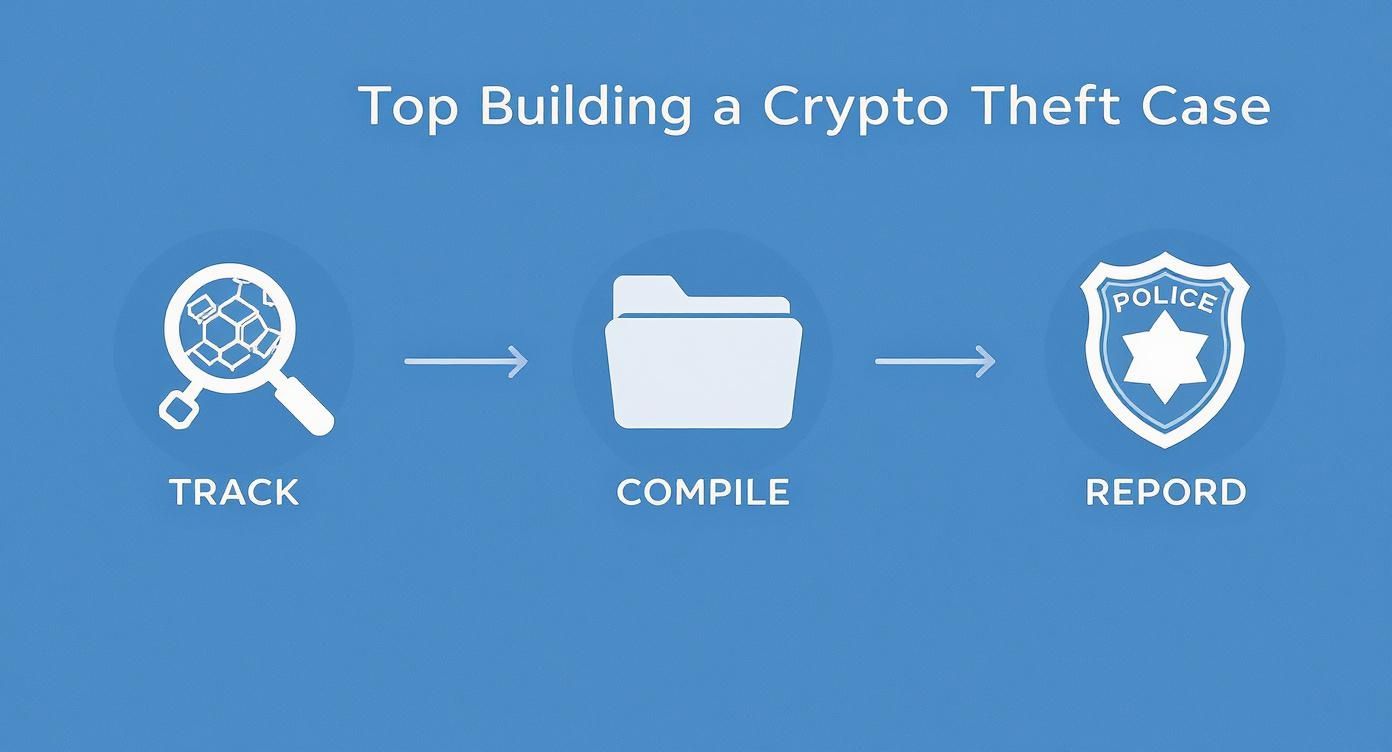
Once you've stopped the bleeding and secured your remaining crypto, the mission changes. It's no longer about damage control; it's about building a rock-solid case. Honestly, without a clear, well-documented trail of evidence, any hope of getting your crypto back is pretty much zero. This is where you put on your detective hat and start methodically compiling proof.
Your notes are the starting point, but now it's time to follow the money on the blockchain itself. This is where you get your hands dirty. Using a public explorer like Etherscan for anything Ethereum-based or Blockchain.com for Bitcoin, you can trace the exact path your funds took from your wallet to theirs.
Just pop the transaction ID (the hash) from the theft into the explorer. It will lay out the whole story: your wallet, the thief's wallet, and every single move they've made since. Take clean, full-page screenshots of this entire journey. This kind of visual evidence is gold, especially for authorities who might not live and breathe crypto like we do.
Where to File Your Official Reports
Knowing where the funds went is one thing, but making it official is another. You have to report the crime to the right agencies to create a paper trail and alert the people who track these things globally.
For anyone in the United States, your first stop should be the FBI's Internet Crime Complaint Center (IC3). If you're in Europe, you'll want to look at agencies like Europol.
When you file, be ready to give them the goods. A report is only as strong as the information in it. Make sure you include:
- Your Info: Full name, contact details, and where you're located.
- The Story: A step-by-step account of what happened. Include dates, times, and any conversations you had with the scammer.
- The Financials: The exact crypto stolen (BTC, ETH, SOL, etc.), the amount, and what it was worth in dollars or euros when it was taken.
- All Your Evidence: This is crucial. Provide the transaction hashes, the thief's wallet addresses, your wallet addresses, and every single screenshot you took from the blockchain explorer.
Lay it all out clearly. Skip the complex jargon and just stick to the facts. Your goal is to hand an investigator a complete package so they can understand the crime without having to come back with a dozen questions.
Notifying Cryptocurrency Exchanges
This next move is probably one of the most powerful things you can do to corner a thief. To actually use your stolen crypto, hackers almost always have to send it to a centralized exchange to cash out into fiat currency. This is their weak spot.
Your job is to immediately get in touch with the support or security teams at the major exchanges. Give them the same evidence package you gave to law enforcement, making sure to highlight the thief's wallet addresses. These exchanges have sophisticated monitoring tools and are legally required to fight money laundering.
When you report a theft with concrete evidence, you’re not just asking for help—you’re giving the exchange the power to act. They can flag or even freeze accounts tied to those addresses, trapping the funds before they can be withdrawn. It's a critical chokepoint.
Don't just hit up one exchange. Scammers are smart; they spread funds around. Proactively notify the big players—Coinbase, Binance, Kraken, and others—even if you don't personally have an account there. The more roadblocks you throw up, the better your chances. This single step could be the difference-maker, but you have to be fast. Every minute you wait is another minute the thief has to disappear.
Using Blockchain Forensics to Trace Funds
Following the money on a public ledger is a pretty technical job, but the right tools can cut through the noise and show you exactly where your funds went. This is the world of blockchain forensics, where specialized software connects the dots between seemingly random wallet addresses to map out the path of stolen crypto. It's a non-negotiable step in any serious recovery effort.
These investigations are usually driven by heavy-hitting platforms like Chainalysis, Elliptic, and TRM Labs. These companies are the bloodhounds of the blockchain world. They maintain massive databases that connect sketchy addresses to known bad actors—think sanctioned wallets, darknet markets, or specific hacking groups. Their software visualizes complex transaction webs, making it much easier to follow the trail.
Take a look at this dashboard from Chainalysis. It gives you an idea of the horsepower these tools bring to the table for law enforcement and big institutions.
This kind of visualization turns raw, messy transaction data into actionable intelligence. This is often the exact puzzle piece law enforcement needs to connect a digital theft to a real person.
The Role of Professional Forensic Tools
Let's be realistic—you probably won't get your hands on these high-end tools directly. They're typically sold to government agencies, financial institutions, and cybersecurity firms with hefty budgets. But knowing what they do is crucial. When you file a report with the FBI, this is the type of software they’ll be using to dig into your case.
Here’s what these platforms can do:
- Flag High-Risk Wallets: They instantly spot addresses already linked to criminal activity.
- Peel Back Anonymity: They can connect pseudonymous addresses to centralized exchanges where a user’s real-world identity might be on file.
- Follow Funds Through Mixers: Even when thieves use services like Tornado Cash to scramble the trail, these tools can often trace the assets.
A report from one of these platforms is powerful evidence. It’s a clean, visual map of the crime that helps authorities build a case, issue subpoenas to exchanges, and hopefully freeze the assets before the thief cashes out.
The real magic of these tools is their ability to add context to on-chain data. A random string of characters is meaningless. But an address linked to a North Korean hacking syndicate's last heist? That tells a story.
What You Can Do with Public Tools
Even without a million-dollar software subscription, you can do some of your own detective work. Public blockchain explorers are free tools that let anyone look up transactions on a network. Think of them as Google for the blockchain.
If you want to get your hands dirty, our guide on what is a blockchain explorer walks you through how to use them, step-by-step. Using explorers like Etherscan (for Ethereum) or Blockchain.com (for Bitcoin), you can manually trace your stolen funds from the moment they left your wallet.
Start with the transaction hash of the theft and start clicking. See where the crypto landed. Jot down every address it moves through. Does it just sit in one wallet? Does it get split into tiny amounts and blasted out to dozens of new wallets? Does it end up at a known deposit address for an exchange?
Every bit of information you gather is a breadcrumb. This early legwork you do with public tools provides the raw material for the entire process. When you finally talk to law enforcement or a recovery service, you’ll be able to show them you’ve done your homework and give them a solid head start.
When you've been hit by crypto theft, the idea of a professional recovery service can seem like the only light at the end of a very dark tunnel. These firms claim they can pull off the impossible—track down your stolen digital assets and bring them home.
But here's the hard truth: this industry is a minefield. For every genuine expert out there, you'll find a dozen predators just waiting to cash in on your panic. You have to move with extreme caution.
Real, reputable recovery companies don't work magic. They're a potent mix of high-tech blockchain tracing, legal savvy, and deep-rooted connections with law enforcement agencies and major exchanges across the globe. Their approach is methodical and data-driven, not based on wishful thinking. They follow the money trail, pinpointing the choke points where a thief might try to cash out, and then use legal avenues to get accounts frozen.
The problem is, the entire field is dangerously unregulated. This has turned it into a breeding ground for a particularly nasty kind of fraud: the recovery scam. These scammers target victims of theft, dangling the promise of guaranteed results for an upfront fee. Once you pay, they vanish, and you've been victimized all over again.
Red Flags That Scream "Scam!"
Learning to spot the tell-tale signs of a recovery scam is your best defense. These fraudsters tend to follow a depressingly predictable script. Be on high alert for anyone who slides into your DMs with unsolicited offers of help, especially on places like Telegram or Twitter right after you’ve publicly shared your story.
Keep an eye out for these classic warning signs:
- Guaranteed Returns: Let's be crystal clear: no legitimate service can guarantee they'll get your crypto back. The whole process is a tangled mess of variables far outside their control. Anyone promising a 100% success rate is lying to you.
- Upfront Fees: This is the bread and butter of their playbook. A firm that demands payment before a single satoshi is recovered is almost certainly a fraud. The pros work on a contingency basis—they take a percentage of the recovered funds after they've succeeded.
- Vague, Unverifiable Claims: Scammers love to boast about their secret connections to "blockchain developers" or "insiders at major exchanges." If they can't point to specific, verifiable case studies or be found through trusted cybersecurity sources, walk away.
- High-Pressure Tactics: If a "service" is trying to rush you, saying things like "you have to pay now or the trail will go cold," they're playing on your fear. A real investigation takes time and diligence; a few hours won't make or break the case.
A common trick is for the scammer to show you a slick-looking (but fake) wallet dashboard that supposedly holds your recovered funds. They’ll tell you that you just need to pay a small "withdrawal fee" or "gas fee" to unlock them. As soon as you send that payment, they're gone.
How to Properly Vet a Recovery Company
Finding a partner you can actually trust takes serious due diligence. You need to investigate any firm you're considering with the same intensity they'll apply to tracking your stolen funds. Don't let your emotions rush you into another bad decision.
First things first, look for a professional and transparent online footprint. A legit company will have a well-built website, list a physical address, and be open about its leadership team. Search for reviews on independent platforms, not just the cherry-picked testimonials on their own site. A quick Google search for the company's name plus words like "scam" or "review" can tell you a lot about what the community really thinks.
A credible firm will also be totally transparent about its methods. They should be able to walk you through their process without hiding behind a wall of confusing technobabble. Don't be afraid to ask pointed questions:
- What specific blockchain analytics tools do you use?
- Do you have an in-house legal team or formal partnerships with law enforcement?
- What is your fee structure? (Always insist on a contingency-based model).
Some firms have managed to build a solid reputation in this tough space. By 2025, companies like Xpress Hacker Recovery (XHR) have earned significant trust, reporting an impressive 94% success rate in asset recovery. They've returned over $11 billion to victims, including funds from massive, high-profile hacks like Mt. Gox and Axie Infinity. You can find more insights into why victims trust firms like XHR on i-ric.org.
This vetting process is non-negotiable. You're looking for an ally who operates with the diligence you’d expect from a top-tier law firm or financial advisor. To get a better handle on what a legitimate operation looks like, our overview of a professional cryptocurrency recovery service can give you some much-needed context. The goal is to find a partner, not another predator.
Of course, here is the rewritten section with a more natural, human-expert tone, following all your specific instructions.
Building Your Crypto Security Fortress
Knowing how to recover stolen crypto is one thing, but the best move you can ever make is to prevent the theft from happening in the first place. Solid security isn't about a single killer password or one fancy tool. It's about building layers of defense—creating a digital fortress around your assets where every single wall and gate is designed to stop an attacker dead in their tracks.
Trust me, the proactive steps you take today are infinitely more valuable than the frantic, reactive measures you’ll be forced into after a hack. The data doesn't lie. According to a 2024 Chainalysis report, private key compromises accounted for a staggering 43.8% of stolen crypto value this year. This tells us that hackers are still getting in through the front door because of basic security slip-ups.
Hot Wallets Versus Cold Storage
The very first concept you need to master is the difference between hot and cold storage. It's the foundation of your entire security strategy.
A hot wallet is anything connected to the internet. Think browser extensions like MetaMask or mobile apps like Trust Wallet. They're super convenient for day-to-day transactions and DeFi, but that constant online connection makes them a prime target.
On the flip side, a cold storage solution is completely offline. The undisputed champion here is a hardware wallet—a small physical device from companies like Ledger or Trezor. These devices sign transactions offline, so your private keys never touch an internet-connected computer. This one simple fact absolutely slashes your risk.
Think of it this way: a hot wallet is like the cash you keep in your pocket—easy to spend, but also easy to lose. A hardware wallet is your personal bank vault. It's less convenient for buying a coffee, but it's exactly where you should store your life savings.
For almost everyone, a hybrid approach is the way to go. Keep a small, disposable amount of crypto in a hot wallet for active use, and lock down the vast majority of your holdings in cold storage. If your hot wallet ever gets hit, the damage is contained.
Recognizing Modern Threats
Forget the old clichés about hackers guessing simple passwords. Today's attacks are sophisticated, subtle, and built to manipulate your psychology just as much as your software.
You've got to learn how to spot these newer, more dangerous traps:
- Phishing Scams: These aren't the misspelled emails from a Nigerian prince anymore. Scammers now create pixel-perfect clones of exchange login pages or wallet connection prompts. They deliver them through DMs, Discord pings, and even paid Google ads. Always triple-check the URL before you click or type anything.
- Social Engineering: This is the art of deception. An attacker will pose as a helpful support agent on Telegram or X, offering to "fix" an issue you're having. Their real goal is to coax you into revealing your seed phrase or giving them remote access to your computer. Remember this forever: No legitimate support staff will ever ask for your private keys or seed phrase. Ever.
- Malicious Smart Contracts: In DeFi, you don't just send coins; you grant permissions to smart contracts. A cleverly coded contract can hide functions that drain your wallet the moment you give it approval. Always use a wallet that offers transaction simulations and be brutally skeptical about the permissions you grant.
Best Practices for Everyday Security
Good security isn't a one-time setup; it's a habit. It's the small, consistent actions you take every day that build a truly resilient defense over the long haul.
Make these fundamentals non-negotiable:
- Implement Strong Multi-Factor Authentication (MFA): Ditch SMS-based 2FA. It's vulnerable to SIM-swapping. Instead, use an authenticator app like Google Authenticator or, even better, a physical security key like a Yubikey for all your exchange accounts.
- Use a Dedicated Device: This is a pro move. If you can, use one computer or phone only for crypto. No general web surfing, no random downloads, no personal email. By isolating your crypto activity, you drastically reduce its exposure to malware.
- Perform Regular Security Audits: At least once a quarter, go through the smart contract approvals you've granted to different dApps. Use a tool like Revoke.cash to cancel any permissions you no longer actively need. Think of it as spring cleaning for your wallet's security—you're taking back old keys you handed out so they can't be used against you later.
When you've been hit by crypto theft, the questions start swirling immediately. It’s a gut-wrenching, stressful situation, and the uncertainty can feel overwhelming. I've been there, and I've helped countless others navigate this mess. Let's walk through some of the most common questions that come up.
My goal here is to cut through the noise, manage your expectations, and give you a clear-eyed view of the road ahead.
How Long Does a Crypto Recovery Take?
This is the big one, and the honest answer is: it varies wildly. We're talking anywhere from a few weeks to, in some tough cases, several years. It all boils down to how complex the theft was and which agencies get involved.
Think of it this way: if a clumsy thief moves your funds directly to a major, cooperative exchange and you report it instantly, there's a slim chance it can be frozen quickly. But let's be real—most of these criminals are savvy. They use mixers, hop across different blockchains, and funnel the crypto through a maze of wallets to muddy the waters. That kind of digital gymnastics adds a ton of time to the investigation.
The hard truth is that you have to be patient. Law enforcement investigations are meticulous but painfully slow. They often cross international borders and require legal hoops like subpoenas. Settle in for a marathon, not a sprint.
Can I Deduct My Stolen Crypto on My Taxes?
Tax rules around stolen crypto are a minefield, and it really depends on where you live and the exact nature of the theft. For those in the United States, the IRS has offered some guidance, but it's not the answer most people want to hear.
A 2025 IRS Chief Counsel memo clarified that you might be able to claim a theft loss deduction under IRC § 165, but the conditions are incredibly strict. The key is that the loss has to be from a "transaction entered into for profit," which typically means an investment scam. This leaves victims of personal cons, like romance or imposter scams, out in the cold—those losses usually don't qualify under current tax law.
It’s a tough pill to swallow for many victims. My best advice? Find a qualified tax professional who actually understands cryptocurrency. They can look at your specific situation and tell you if you have a realistic shot at a theft loss deduction.
Is It Really Possible to Recover Stolen Crypto?
Yes, it is possible—but you have to keep your expectations grounded. The odds are not in your favor. Just look at the numbers: Chainalysis reported that $2.2 billion was swiped from crypto platforms in 2024 alone. That’s the scale of the battlefield we're on.
When recoveries do happen, they almost always have a few things in common:
- Speedy Reporting: The victim sounded the alarm with exchanges and law enforcement within hours, not days.
- A Crystal-Clear Paper Trail: They had a complete record of transaction hashes and wallet addresses ready to go.
- A Scammer Slip-Up: The thief got sloppy and sent a big chunk of the funds to a centralized exchange with robust KYC/AML policies.
While it's true that many cases go cold, things are getting better. Blockchain forensic tools are becoming more powerful, and law enforcement agencies are starting to work more closely with exchanges. Every report you file contributes to a massive web of data that helps investigators connect the dots on these criminal networks. Your case might just be the piece that helps bring down a much bigger operation.
If your crypto isn't stolen but is locked away behind a forgotten password or a broken device, the feeling of loss can be just as intense. At Wallet Recovery AI, we focus specifically on these situations. We use advanced, AI-powered methods to help you get back into your wallets, all while keeping your data secure and private. Find out how we can help.
Leave a Reply