

Think of your seed phrase as the one master key that can unlock your entire crypto world. It's a list of 12 to 24 simple, seemingly random words that hold the power to restore every single one of your assets if you ever lose the device holding your wallet. It's your ultimate backup.
What Is a Seed Phrase and Why Does It Matter?
Imagine your crypto wallet isn't just a single safe, but a massive bank vault filled with thousands of individual safe deposit boxes. Each box has its own unique key (what we call a "private key"), and trying to manage all of them would be a nightmare. This is where the seed phrase comes in.
This master key—often called a recovery phrase or mnemonic seed—is the very blueprint of your wallet. It's not just a password. It's the source code from which every single one of your private keys is mathematically generated. So, if your hardware wallet gets run over by a car or your phone takes a swim, this phrase is your only lifeline. You can punch it into any compatible wallet, and just like that, your entire portfolio is back.
The Foundation of Self-Custody
The seed phrase is what makes self-custody possible, embodying the famous crypto mantra: "not your keys, not your coins." When you're the only one who has this phrase, you become your own bank. No one can freeze your account, block a transaction, or lose your funds in a hack. You have total and complete control.
Of course, that kind of power comes with serious responsibility. Lose your seed phrase, and you lose everything. There’s no "Forgot My Password" link to click. The stats are pretty sobering; some surveys show that 24-30% of crypto users have lost access to their funds at some point, with misplaced seed phrases and private keys being a leading cause. You can get a better sense of how often this happens from the latest wallet access loss statistics.
Key Takeaway: Your seed phrase isn’t a login credential—it is your wallet's core identity. Protecting it is the single most important job you have as a crypto owner.
To avoid a common and costly mix-up, it's crucial to understand how a seed phrase differs from the password you use to open your wallet app.
Seed Phrase vs Wallet Password at a Glance
| Characteristic | Seed Phrase (Recovery Phrase) | Wallet Password (PIN) |
|---|---|---|
| Primary Purpose | Master backup and recovery for all assets | Unlocks the wallet app for daily use |
| Format | 12 to 24 words from a specific list (BIP39) | Alphanumeric characters, symbols, or a PIN |
| Origin | Generated once when you create a wallet | Set and can be changed by the user |
| When to Use It | Only in an emergency (lost/broken device) | Every time you open your wallet software |
| Security Impact | If lost, funds are gone forever. If stolen, funds are stolen. | If forgotten, you can restore with the seed phrase. |
One is for recovery, the other is for convenience. Never confuse the two.
Restoring Your Digital Life
The real-world importance of your seed phrase snaps into focus when things go wrong. Think about these all-too-common scenarios:
- Device Failure: Your laptop's hard drive dies, or your phone gets bricked.
- Loss or Theft: You misplace your Ledger or Trezor hardware wallet, or it gets stolen.
- Software Glitches: A wallet app update goes haywire, or you're simply upgrading to a new phone.
In every single one of these cases, the seed phrase is the universal skeleton key that brings your wallet back from the dead on a new device. It restores full access to your Bitcoin, Ethereum, and every other coin you hold. Without it, those assets are just data on the blockchain—yours in name, but locked away forever.
How a Simple Phrase Generates Infinite Keys
It seems almost like a magic trick: how can a simple list of 12 or 24 words possibly secure a massive crypto portfolio? This isn't magic, though. It’s a brilliant system of cryptography designed to be both secure and user-friendly, built on a universal standard called Bitcoin Improvement Proposal 39 (BIP39).
Think of your seed phrase as the DNA for a gigantic financial tree. That phrase is the seed. When you "plant" it into any compatible wallet, it deterministically—meaning, in a predictable and perfectly repeatable way—grows into a massive, complex structure of keys and addresses.
From Seed to Master Key
The first thing that happens is your sequence of words gets converted into a single, powerful piece of data: the master seed. This conversion is a one-way street. You can easily turn the words into the master seed, but reversing the process is practically impossible.
This master seed is the root of your entire wallet. From there, another protocol, BIP32, takes over. It uses that one master seed to generate a nearly endless hierarchy of private keys, public keys, and wallet addresses. Each key pair is like a branch on your tree, and every receiving address is like a leaf on one of those branches.
The Power of Standards: The BIP39 standard is exactly why you can take a seed phrase generated on a Ledger and restore your entire wallet on a completely different brand, like a Trezor. It’s a universal language that all major wallets speak, giving you true freedom and control over your assets.
Why This Method Is a Game-Changer
This hierarchical deterministic (HD) wallet structure gives you two huge advantages: security and privacy.
Because you can generate a brand-new, unique address for every single transaction you receive, you make it incredibly difficult for anyone to trace your financial activity on the blockchain. Using a fresh address for each payment is a fundamental privacy practice. It stops observers from easily linking all your funds together just by looking at a public block explorer. Your seed phrase is the quiet engine making this seamless privacy possible, generating new "leaves" on demand.
The chart below illustrates this hierarchy, showing how the seed phrase is the foundational key to everything—the wallet itself and all the coins it holds.
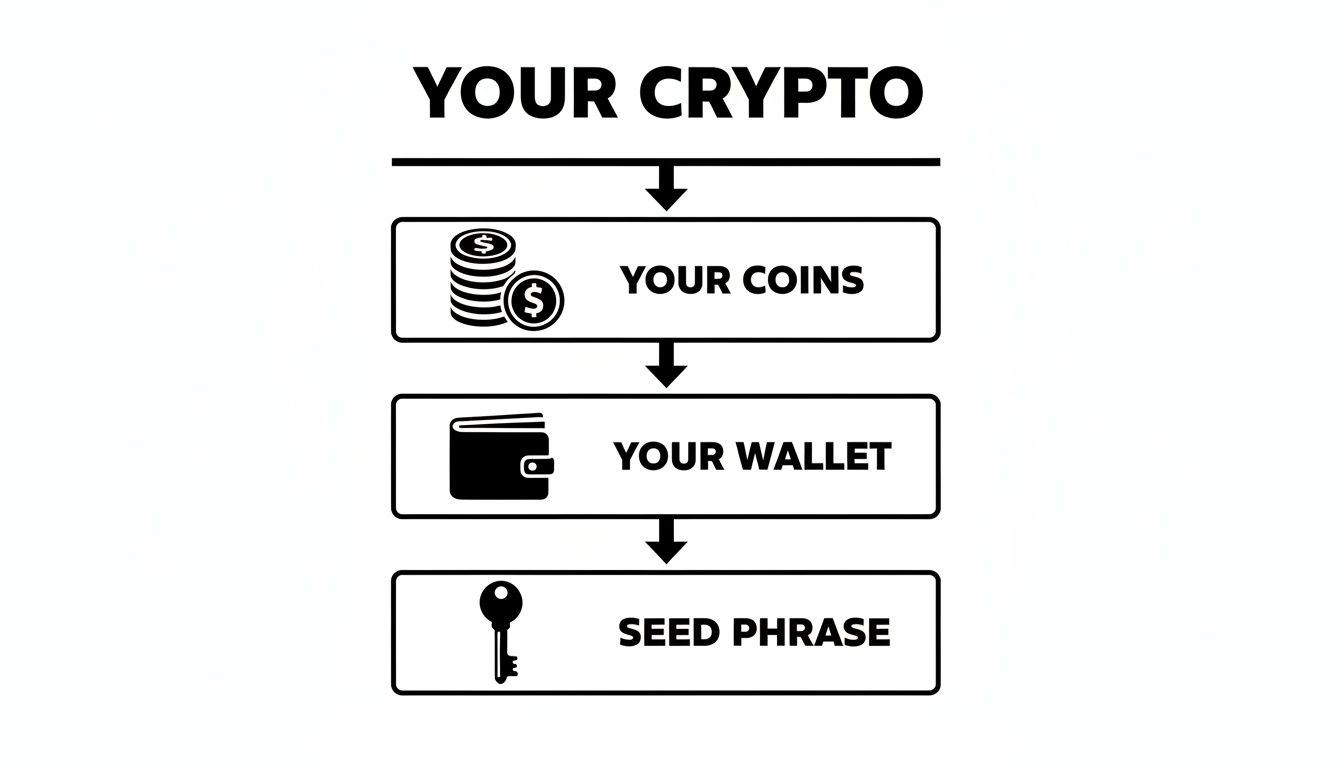
As you can see, it all flows from that one phrase. If you lose it, the wallet and the coins become completely inaccessible.
Even the official BIP39 word list is cleverly designed. It contains 2,048 carefully chosen English words. A key feature is that each word is uniquely identifiable by its first four letters, which drastically cuts down on errors when you're painstakingly re-entering your phrase to restore a wallet.
If you want to see the technical relationship between the words and the code they represent, you can play around with a mnemonic code converter to see how it all works under the hood. The entire system is built to ensure a simple, human-readable phrase can securely manage a lifetime of complex digital transactions.
Common Threats That Put Your Seed Phrase at Risk
Your seed phrase is the master key to your entire crypto portfolio, and for that reason, it’s the number one target for attackers. Knowing how they operate is the first step to building a rock-solid defense. While simply losing your phrase is a huge risk, the active threats you face are far more sophisticated, spanning both the digital and physical worlds.
Protecting this master key requires a security-first mindset. Once it's compromised, your funds can be drained in seconds. In this game, prevention isn't just the best defense—it's the only one.

Digital Threats Hiding in Plain Sight
In the digital world, thieves use deception and malware to trick you into handing over your seed phrase. These methods are clever, often looking legitimate and preying on a simple moment of inattention.
- Phishing Scams: Think fraudulent emails, text messages, or websites impersonating trusted names like Coinbase, Ledger, or MetaMask. They create a false sense of urgency—warning you that your account is locked or needs a critical "upgrade"—then funnel you to a fake site that asks for your seed phrase.
- Malware and Keyloggers: Malicious software can quietly infect your computer or phone, secretly recording every single keystroke. This includes your seed phrase. It's precisely why you should never type your seed phrase into any internet-connected device after the initial wallet setup.
- Clipboard Hijacking: Some nasty bits of malware monitor your clipboard. When you copy your seed phrase to paste it somewhere (which you should never do!), the malware instantly replaces it with the attacker's wallet address.
Crucial Warning: Never, ever take a screenshot or a digital photo of your seed phrase. The moment it exists as a file on a connected device, it's a sitting duck for hackers or can be accidentally synced to the cloud.
The goal of all these attacks is simple: get you to expose your phrase online, even for a split second. The instant it touches the internet, you have to assume it's compromised.
Physical Dangers in the Real World
Threats to your seed phrase aren't just lurking online. The physical paper or metal plate where you store your backup is just as vulnerable—and in some ways, even more so.
Simple household theft is a big one. A burglar might not know what a list of 12 random words means, but if they steal the safe or lockbox it's in, your crypto is gone right along with it. Even a nosy visitor could snap a quick photo of your phrase if it's stashed in a poorly chosen hiding spot.
Beyond theft, you have to plan for the unexpected.
- Fire: A house fire will turn a paper backup to ash in minutes.
- Floods: Water damage can make ink run, smudging your carefully written words into an unreadable mess.
- Deterioration: Over the years, ink fades and paper degrades, especially if it isn't stored properly.
These real-world risks show exactly why relying on a single, flimsy piece of paper in one location is a recipe for disaster. For those of us who live by the mantra 'not your keys, not your crypto,' the stats are frightening: 20-30% of self-custody users admit they have no reliable backup, essentially gambling with permanent loss. You can find more insights on the state of crypto backups on sqmagazine.co.uk.
The Most Common Mistake: Digital Storage
The single most common—and catastrophic—mistake people make is storing their seed phrase backup in any digital format. This is a non-negotiable "don't."
- Cloud Storage (Google Drive, Dropbox, iCloud): These services are a hacker's playground. One data breach or a compromised email account is all it takes for an attacker to get their hands on your master key.
- Password Managers: While they're great for website logins, they are still online services. Storing your seed phrase in one centralizes your most critical secret in a place that could be hacked.
- Encrypted Files or USB Drives: Encryption is a good layer, but it isn't foolproof. The device itself can be lost, become corrupted, or fall victim to malware designed to sniff out and steal files.
Any digital copy creates an "attack surface"—a potential way in for a thief. The core principle of seed phrase security is to keep it 100% offline, from day one and forever. This completely eliminates the threat of remote theft and forces any would-be attacker to gain physical access to your backup, a much, much harder task.
Proven Methods for Storing Your Seed Phrase Securely
Knowing the risks is half the battle. Now, let’s talk about building your fortress.
How you generate and store your seed phrase is hands-down the most critical step you'll take to protect your crypto. The guiding principle is simple but absolute: your seed phrase must stay 100% offline, forever.
This starts the very second your wallet comes into existence. Your best move is to generate your phrase using a trusted hardware wallet, like a Ledger or Trezor. These little devices are specifically designed to create your phrase in a secure, isolated environment, making sure it never even touches an internet-connected computer where malware could be lurking.
Embrace Physical Storage Solutions
Let me be blunt: digital storage is a dead end. Don't even think about screenshots, text files, or cloud backups. The only truly reliable way to secure your phrase is with a physical backup—something you can actually touch.
This means writing it down or etching it onto a tangible object that you can then hide away from both digital threats and prying eyes.
The most basic approach is to use the recovery card that comes with your hardware wallet. It’s a good start, but paper is incredibly fragile. It’s vulnerable to fire, water damage, or just plain falling apart over time. A small upgrade is to laminate the card and lock it in a fireproof document bag or a safe deposit box.
But if you want real, lasting peace of mind, nothing beats metal.
The Gold Standard: Metal Plates
Investing in a fireproof, waterproof, and crush-proof metal storage plate is the ultimate security upgrade. These things are built to withstand just about any disaster you can imagine, ensuring your seed phrase survives when everything else might not. You typically use a small punch tool to permanently stamp or etch your words onto plates made of steel, titanium, or copper.
This isn't just about being tough; it's about giving yourself the best chance of recovery. People who take the time to etch their phrases onto metal plates have recovery success rates over 80%. Compare that to the dismal sub-50% rate for those with no backups at all. The data doesn't lie.
Expert Tip: When you're writing or stamping your phrase, check it once. Then check it again. And then a third time. A single misspelled word or wrong number will make the entire phrase useless. Make sure you number the words correctly, from 1 to 12 or 1 to 24.
Deciding on the right storage can be tough with all the options out there. To help you choose, we’ve put together a guide on the best metal seed phrase storage solutions that fit different needs and budgets. It's a small upfront cost for what amounts to an insurance policy on your entire portfolio.
Choosing the right storage method involves a trade-off between security, durability, and how easy it is to access. Here’s a quick breakdown to help you decide what’s best for you.
Seed Phrase Storage Methods Security vs Convenience
| Storage Method | Security Level | Durability | Recommendation |
|---|---|---|---|
| Paper Backup | Low | Low | A temporary solution at best. Highly vulnerable to fire, water, and physical decay. |
| Laminated Paper | Low-Medium | Medium | Better than plain paper but still offers no protection against fire or extreme damage. |
| Metal Plate | High | High | The gold standard. Resistant to fire, water, and corrosion. The top choice for long-term security. |
| Split Backup | High | Varies | Splitting a phrase across multiple locations adds security but increases management complexity. |
| Shamir's Sharing | Very High | Varies | The ultimate in security, removing single points of failure. Best for large holdings. |
Ultimately, metal storage offers the best combination of security and durability, making it our top recommendation for anyone serious about protecting their assets.
Implement Strategic Redundancy
Never, ever rely on a single backup in a single location. Think about it—what happens if that one backup is lost in a fire, stolen in a burglary, or simply misplaced?
Strategic redundancy is your answer. It means creating multiple physical backups and storing them in secure locations that are geographically separate from one another. This creates a powerful fail-safe system.
Consider a multi-layered approach for your backup locations:
- Primary Location: A high-quality fireproof safe in your home.
- Secondary Location: A trusted bank's safe deposit box.
- Tertiary Location: With a deeply trusted family member or a secure legal professional.
The whole point is to distribute your risk. A house fire won't touch your bank vault, and a banking issue won't affect your home safe. This strategy drastically reduces the chances of a single disaster wiping out your only key.
Advanced Security with Shamir's Secret Sharing
For those who want to take their security to the absolute highest level, there’s an advanced cryptographic method called Shamir’s Secret Sharing (SSS).
Instead of creating identical copies of your seed phrase, SSS splits it into multiple unique "shards." You can set a rule, for instance, that you need any 3 out of 5 total shards to reconstruct the original phrase.
You could then store each shard in a completely different location. The genius here is that if a thief finds one or even two of your shards, they're useless. No single piece contains enough information to grant access, providing incredible protection against both theft and accidental loss.
Okay, here is the rewritten section, designed to match the expert, human-written style you're looking for.
Your Emergency Plan for a Lost or Compromised Seed Phrase
Panic is the enemy of clear thinking. And when your crypto is on the line, a clear head can mean the difference between saving your assets and losing them forever. The second you even suspect your seed phrase is lost or in the wrong hands, you need to act. This isn't a "wait and see" situation.
Your next move depends entirely on the scenario you're facing. Is the phrase simply missing, or do you have reason to believe a thief has it? Either way, the goal is the same: get your funds to safety before they vanish.
Scenario 1: You Lost Your Phrase But Still Have Wallet Access
This is the less dire, but still urgent, of the two scenarios. Maybe you've misplaced the paper you wrote it on, but you can still open your wallet app or plug in your hardware wallet and see your funds. You’re safe for now, but you’re living on borrowed time—one dead phone or corrupted hard drive away from total loss.
Don't put this off. The mission is to move everything to a new, secure wallet that has a brand-new seed phrase.
- Generate a New Wallet: On a secure device you trust, create a completely new crypto wallet. This will generate a fresh, uncompromised seed phrase crypto backup. Write this new phrase down immediately and get it secured offline.
- Grab a Receiving Address: In this new wallet, copy a receiving address for each crypto asset you own. You'll need one for your Bitcoin, another for your Ethereum, and so on.
- Transfer Your Assets: Head back to your old wallet—the one with the lost seed phrase—and start sending your funds to the new addresses you just copied. It’s always a good idea to send a small test amount first, just to be sure everything is working as expected.
- Confirm and Decommission: Once all your crypto has safely landed in the new wallet, you can abandon the old one. It’s now just an empty, insecure shell.
By doing this, you've made that lost seed phrase completely worthless. It now unlocks an empty wallet, and you've just dodged a massive bullet.
Scenario 2: You Suspect Your Phrase Is Compromised
This is a five-alarm fire. If you think an attacker has a copy of your seed phrase—maybe you typed it into a phishing site by mistake or discovered malware on your computer—you are in a direct race against them. They will drain your wallet. It's not a question of if, but when.
Critical Action: You have to be faster than the thief. Hackers often use automated bots that can sweep a wallet clean in seconds. Every single moment counts.
The steps are nearly identical to the first scenario, but you have to execute them with blistering speed.
- Create a New Secure Wallet: Immediately generate a new wallet, ideally on a completely different, clean device. This reduces the risk that the attacker is watching what you're doing.
- Transfer Everything Out: Send every last asset from the compromised wallet to the new, safe one. Don't be cheap with network fees (like gas on Ethereum). Paying a higher fee to push your transaction through quickly is a tiny price to pay to save your entire stack.
When Manual Recovery Fails
Sometimes, it’s not so black and white. What if you only have 11 of your 12 words? Or you have all the words but can't remember the passphrase—the "13th word"—that unlocks everything? In these situations, trying to guess your way back in is often a dead end.
This is where specialized recovery services can become a real lifeline. Services like Wallet Recovery AI step in here, using computational power to help people regain access to wallets from Ledger, Trezor, Electrum, and others, all without ever asking for your sensitive info upfront. They've been the last hope for countless investors who thought their funds were gone for good. You'd be surprised how common this is; you can get a sense of the scale by looking at some recent cryptocurrency cold wallet statistics on sqmagazine.co.uk. These services take the partial information you have and run through millions of possible combinations, creating a chance to recover your funds where none existed before.
So, you’ve hit a brick wall. Your carefully stored seed phrase crypto backup isn’t working. Maybe a word is missing, the order is scrambled, or that wallet password you were so sure you’d remember has vanished from your mind. It’s a gut-wrenching feeling, and the manual guesswork often leads nowhere, making you think the funds are gone for good.
But for these complex, seemingly hopeless situations, there's a potential last resort: specialized wallet recovery services.
These aren't for simple cases. This is the realm of deep digital forensics. Instead of you spending weeks manually typing in endless combinations, these services use immense computational power to do the heavy lifting. You give them the partial information you have, and their systems get to work trying to solve the cryptographic puzzle.
How Specialized Recovery Actually Works
The whole process is built on a foundation of logic and, most importantly, security. A legitimate, professional service will never ask for your complete seed phrase. That's not how they work. Instead, they use the fragments and clues you can provide to try and piece the puzzle back together.
Here’s a breakdown of what that looks like:
- You Provide the Clues: This could be anything. Maybe you have 11 of the 12 words, or you have a list of all 24 words but know the order is wrong. Even a strong hunch about a forgotten password can be a starting point.
- They Start the Systematic Search: The service then uses powerful algorithms to test millions—or even billions—of potential combinations based on the clues you provided. They’re looking for that single correct combination that unlocks your wallet.
- It’s a Security-First Approach: The core principle is that you never hand over full control. The service is working on the problem (the missing pieces), not with your full set of keys. This ensures they can't simply access your funds without a successful recovery that you ultimately authorize.
This approach turns an impossible manual task into a manageable computational one, which can dramatically increase your odds of success.
A legitimate recovery service’s value is in their computational power and cryptographic expertise, not in holding your secrets. If a service asks for your full seed phrase upfront, it's a major red flag.
Setting Realistic Expectations
Now, it’s crucial to be realistic. Success is never guaranteed. The outcome depends entirely on the quality and quantity of the information you can provide. A single missing word from a 12-word phrase, for instance, presents a finite (though very large) number of possibilities for a computer to check. A completely forgotten, complex password, on the other hand, might be nearly impossible to crack.
These services are a lifeline for situations where every other option has been exhausted. They represent a calculated shot at reclaiming assets from wallets on networks like Ethereum or Bitcoin, or from devices like a Ledger or Trezor, that would otherwise be permanently locked away.
With cold wallet ownership surging 34% year-over-year among retail investors and a staggering 51% for institutions expected in 2025, the need for reliable backup and recovery plans has never been more critical. You can dig into these trends in the latest cryptocurrency ownership reports.
Ultimately, these platforms provide hope and a structured, professional approach to what can be an incredibly stressful and high-stakes problem.
Got Questions? We’ve Got Answers.
When you're stepping into the world of self-custody, it's completely normal to have questions pop up. Taking full control of your own crypto is a big deal, and getting the details right is crucial. Here, we'll tackle some of the most common things people ask about seed phrases, bust a few myths, and give you the straight scoop.
Think of this as a quick-reference guide to help you manage your master key with confidence. Let's get into it.
Can I Change My Seed Phrase on an Existing Wallet?
In a word, no. You can't change the seed phrase for a wallet that's already been created. The phrase isn't just a password; it is the wallet's master key, baked into its cryptographic DNA from the moment it was generated.
If you think your current phrase has been compromised and you need a new one, the only way forward is to create a brand-new wallet. Once that's done, you'll need to send all of your crypto from the old wallet to the new one. It's a clean break, and it's the right way to secure your assets if you have any doubts.
Is It Safe to Store My Seed Phrase in a Password Manager?
It definitely seems like a step up from a plain text file on your desktop, but storing your seed phrase in a password manager is a risk we do not recommend taking. Why? Because these tools are always connected to the internet, making them a juicy target for hackers.
The gold standard for seed phrase security is keeping it 100% offline. We’re talking about a physical backup—a piece of paper tucked away in a safe deposit box or, even better, stamped into a metal plate. This one simple move takes online theft completely off the table.
What Happens if My Wallet Provider Shuts Down?
Absolutely nothing happens to your crypto. This is the whole point of self-custody and one of the most powerful features of using a seed phrase.
Your funds live on the blockchain, not in the wallet app or on some company's servers. Your seed phrase is generated using a universal standard (BIP39), which means you can take your 12 or 24 words, pop them into any other compatible wallet, and get instant access to your funds. You're never locked into a single provider, giving you total control and freedom.
If you're facing a problem that's more complicated—like a few missing words from your phrase, a forgotten password locking you out, or a corrupted wallet file—trying to fix it yourself might be impossible. Wallet Recovery AI offers a secure, specialized service to help you get back into your wallet. Find out more about our secure recovery services.
Leave a Reply