
Think of a blockchain explorer as your personal search engine for the crypto world. Just like you'd use Google to find a website, you use a blockchain explorer to look up transactions, check wallet balances, and peek inside the blocks that make up a network. It’s the tool that makes all that complex data on a blockchain transparent and accessible to regular people.
Your Window Into the Blockchain
Trying to make sense of a blockchain without an explorer is like trying to read a book written in code. The information is there, but it's a jumble of cryptographic hashes and raw data that isn't exactly human-readable. You can see things are happening, but you can't easily understand what they are.
This is where an explorer steps in. It takes all that messy, technical data and presents it through a clean, searchable interface. It’s your go-to tool for answering simple but critical questions, like "Did my Bitcoin payment go through?" or "How much ETH is in this wallet?" It turns the abstract idea of a public ledger into something you can actually see and use.
Core Functions of a Blockchain Explorer
At its core, an explorer is built to give you a real-time, unfiltered view of everything happening on the network. It's all about providing clarity and proof.
Here are the main things you can do with one:
- Track Transactions: Got a transaction ID (also known as a hash)? Pop it into the search bar to see everything about that transfer—who sent it, who received it, the amount, and how many confirmations it has.
- Inspect Wallet Addresses: You can look up any public wallet address to view its entire history of transactions, the tokens it currently holds, and any smart contracts it has interacted with.
- Verify Blocks: Curious about a specific block? An explorer will show you every transaction it contains, who mined or validated it, and its exact timestamp, proving its place in the chain.
A blockchain explorer is what makes the promise of transparency a reality. It means you don't have to take anyone's word for it—you can check the public record for yourself. This power to self-verify is what builds trust and empowers everyone in the ecosystem.
Here’s a quick breakdown of what these powerful tools allow you to do.
Core Functions of a Blockchain Explorer at a Glance
| Function | What You Can Discover | Why It's Important |
|---|---|---|
| Transaction Tracking | Sender/receiver addresses, transfer amount, transaction fees, and confirmation status. | Provides definitive proof that a payment was sent and received successfully. |
| Wallet Inspection | Complete transaction history, current token balances, and smart contract interactions. | Allows for transparent auditing of public funds or checking your own balance history. |
| Block Verification | All transactions within a block, the miner/validator, the block reward, and its timestamp. | Confirms the integrity of the blockchain and the validity of the transactions it contains. |
| Network Health | Current hash rate, transaction fees (gas prices), and overall network difficulty. | Gives you a real-time snapshot of the blockchain's security and activity levels. |
In short, these explorers are your all-access pass to the inner workings of a blockchain, making it easy for anyone to find the information they need.
How an Explorer Translates Blockchain Data
At its core, a blockchain is just a massive, decentralized network of computers, what we call nodes. These nodes are constantly working, recording, and verifying every single transaction. But here's the catch: the raw data they produce is a tangled mess of technical code, completely unreadable to the average person.
This is where a blockchain explorer comes in. It acts as a sophisticated interpreter, plugging directly into those nodes to pull out information as it happens.
Think of it like a specialized librarian for a chaotic, constantly expanding library. An explorer doesn't just read the books (the blocks); it meticulously catalogs every transaction, every address, and every little piece of data. It then organizes all that chaos into a clean, searchable database.
This indexing process is the real magic. It’s what lets you paste a long, nonsensical transaction hash into a search bar and instantly get back a simple, human-readable report. Without it, trying to find a specific transaction you made months ago would be like finding a needle in a digital haystack.
From Raw Data to Readable Insights
The explorer’s main job is to transform all that cryptographic gibberish into something you can actually use. This involves a few key steps that open up the blockchain for everyone, from seasoned developers to someone just making their first transaction.
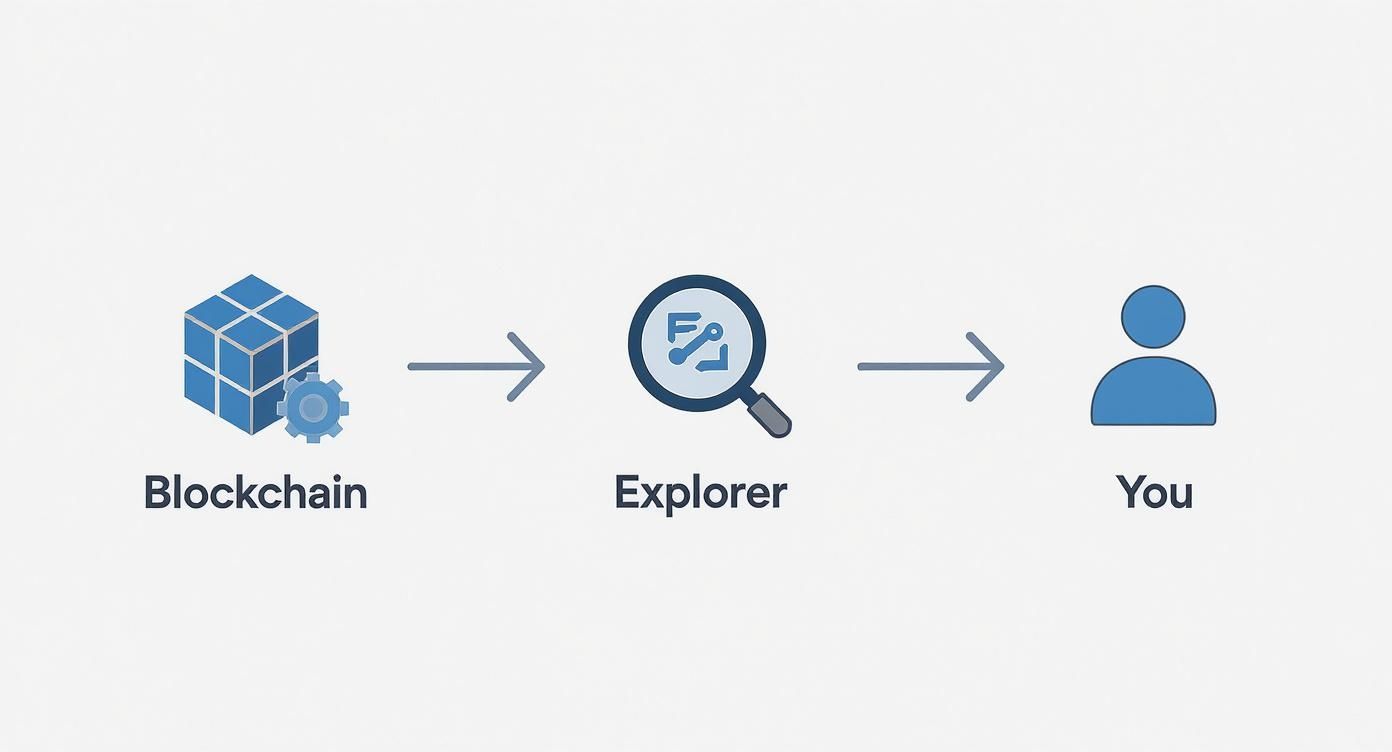
This entire flow simplifies an incredibly complex system, letting you search a blockchain just like you’d search Google. That kind of accessibility is what builds trust and brings more people into the crypto world.
By translating raw node data into an organized and queryable format, a blockchain explorer makes transparency a practical reality. It empowers users to independently verify information without needing deep technical knowledge.
This is a critical function, especially when you consider how fast crypto is growing. For the 400 million global cryptocurrency users out there, blockchain explorers are the go-to tool for tracking their assets and checking on network activity. With the user base jumping by nearly 40 million in just six months as of late 2024, these tools are under immense pressure to be fast, clear, and reliable. You can dig into these numbers yourself over at Statista's global user base report.
Getting Around: A Tour of a Blockchain Explorer's Key Features
Alright, let's move from theory to practice and get our hands dirty. Firing up a blockchain explorer for the first time can feel a bit overwhelming—it’s a wall of data, long strings of text, and real-time updates flying by. But once you know what you’re looking at, it’s surprisingly straightforward.
Your main entry point for almost everything is the search bar.
Think of it as your universal key to the blockchain. You can paste a transaction ID (hash), a wallet address, or even a specific block number into it. That one simple action unlocks a treasure trove of verifiable data from the public ledger.
This screenshot from Etherscan, a go-to explorer for the Ethereum network, gives you a feel for a typical layout. You’ve got the search bar front and center, with the latest network activity right below.
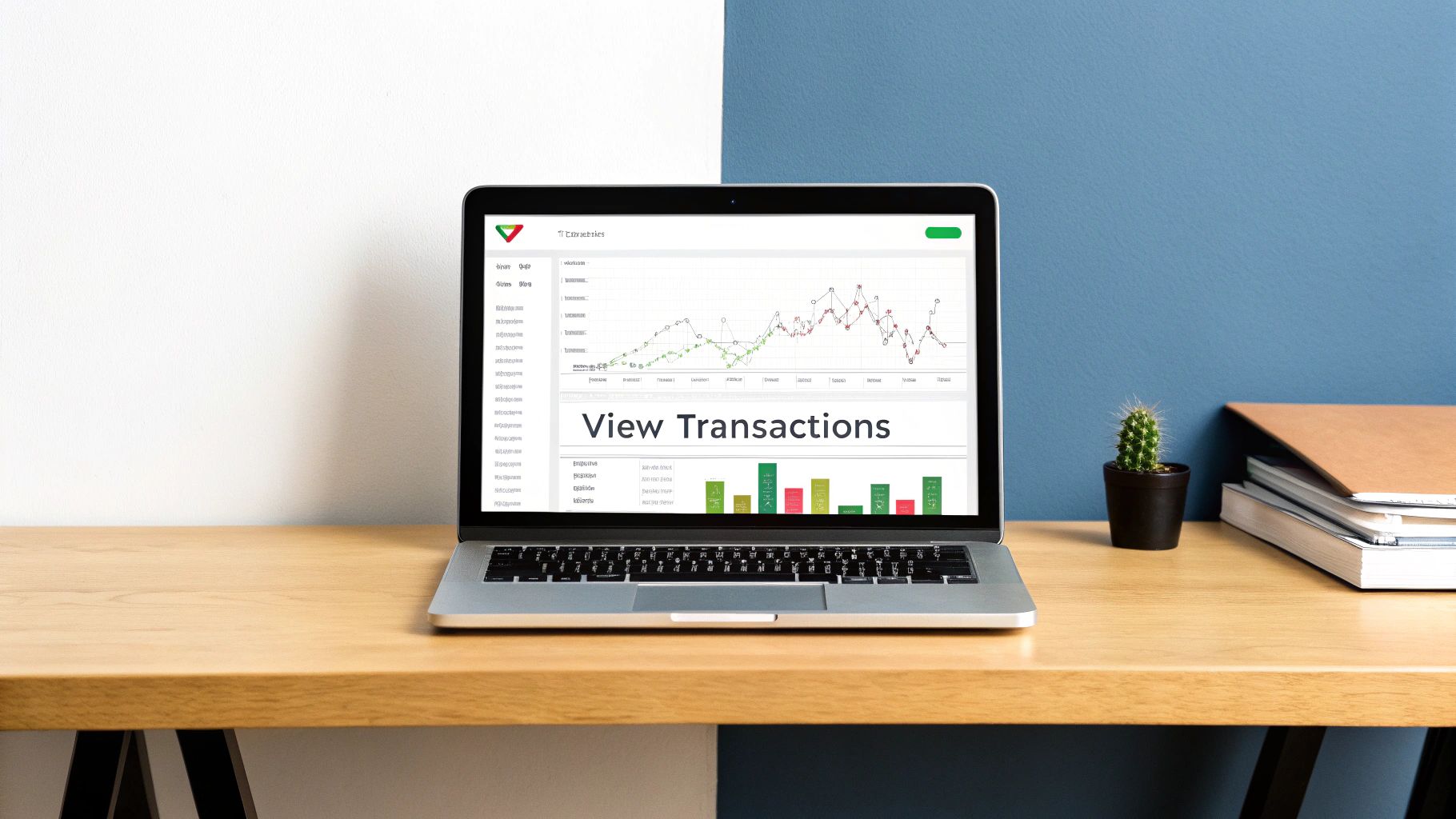
This dashboard is a live snapshot, showing you the newest blocks being added and transactions getting processed in real-time.
How to Read Transaction Details
When you search for a specific transaction, the explorer pulls up a detailed report. It looks like a lot, I know, but you only need to focus on a few key pieces of information to get the full story. Nailing these down is crucial to using an explorer effectively.
Here’s what to look for:
- Transaction Hash: This is your transaction’s unique fingerprint. It's the digital receipt you can use to track its journey and prove it happened.
- Status: This little tag tells you if the transaction was successful, is still pending, or failed. It’s the first thing you’ll want to check if you’re worried a payment didn’t go through.
- From & To: These are the sender and receiver wallet addresses. The cool part is you can click on either address to see its entire transaction history—every send, every receive.
- Value: Simple enough, this just shows the amount of crypto that was transferred.
- Transaction Fee (Gas): This is the fee paid to the network's miners or validators to get your transaction processed and added to a block.
By looking at these details, you can confirm exactly what happened, when it happened, and who was involved. This granular, on-the-record view provides the ultimate proof of on-chain activity, giving you total confidence and control over your assets.
Comparing Popular Blockchain Explorers
Just as different cities have their own maps, different blockchains have their own specialized explorers. While they all serve the same core purpose, their features and user interfaces can vary.
Here's a quick look at how some of the most popular explorers for Bitcoin, Ethereum, and Solana stack up.
| Explorer Feature | Bitcoin (Blockchain.com) | Ethereum (Etherscan) | Solana (Solscan) |
|---|---|---|---|
| Primary Focus | Tracking BTC transactions and network health (hash rate, difficulty). | Deep dives into smart contracts, tokens (ERC-20, NFTs), and gas fees. | High-speed transaction tracking, SPL token monitoring, and staking/validator data. |
| Smart Contracts | Not applicable (Bitcoin's scripting is limited). | Core feature. Can read/write contracts and view source code. | Full support. Shows contract interactions and on-chain programs. |
| Token Tracking | Limited to basic asset layers like Ordinals. | Extensive support for all Ethereum-based tokens with rich data. | Comprehensive tracking for all SPL tokens, including price and market cap. |
| User Interface | Simple and beginner-friendly, focused on core stats. | Data-dense and powerful, geared towards developers and advanced users. | Clean and modern, designed to handle Solana's high throughput clearly. |
Each explorer is fine-tuned for its specific blockchain, offering tools that make sense for that network's architecture. What you use will simply depend on which chain you’re interacting with.
Putting Your Explorer to Work in the Real World
So, we've covered the what and the how, but what does using a blockchain explorer actually look like for the average person? It's more than just a tool for developers; it's your personal window into the blockchain, and it solves some very common problems.
Let's get practical.
The most frequent, everyday use case is simply confirming a transaction. Imagine you’ve just sent some crypto to a friend. That nail-biting wait is over. Instead of bugging them with "Did you get it yet?", you just copy the transaction hash, pop it into an explorer, and see its status instantly.
It's your own digital receipt, providing that crucial peace of mind that your funds are where they should be. This is also a lifesaver if you're panicking that you may have sent crypto to the wrong address. An explorer will show you exactly where it went, no guesswork involved.
Beyond Simple Transactions
For anyone dabbling in Decentralized Finance (DeFi) or looking at new tokens, an explorer becomes an indispensable detective tool. Before you even think about connecting your wallet to a new project, you can grab its contract address and do some digging.
A quick search can tell you:
- Token Supply: See the total and circulating supply to get a feel for its economics.
- Holder Distribution: Are the tokens concentrated in just a few wallets? That can be a major red flag for a potential pump-and-dump.
- Contract Code: You can check if the smart contract code is public and has been audited, which adds a huge layer of security.
An explorer is a specialized tool allowing users to view, search, and verify detailed blockchain information transparently. The concept originated with Bitcoin when the need arose to track transactions independently, and it's now integral to auditing, compliance, and forensic investigations.
A Tool for Security and Due Diligence
This brings us to the more advanced stuff. For security-minded investors, an explorer is their go-to for due diligence. You can literally trace the flow of funds from a project's main wallet to see how they're spending their money. It's all about public accountability.
This investigative power gets right back to the original purpose of these tools. When they first appeared around 2009-2010, they gave people a way to verify everything happening on-chain without needing to trust a central party. To see just how far things have come, you can check out these insightful blockchain statistics and facts.
Ultimately, an explorer empowers you to be your own digital detective.
Why Explorers Are the Cornerstone of Trust in Crypto
At its core, a blockchain explorer takes the abstract promise of "decentralization" and makes it real—something you can actually see and touch. It’s the tool that enforces the whole "trustless" idea by making every single piece of data public and verifiable by anyone, at any time. This radical transparency is what truly separates blockchain from the old world of finance.
Think about it. Instead of blindly trusting a bank to tell you a transaction went through, you can pull up the public ledger and see the proof for yourself. This open-book policy creates a new standard for accountability, putting you in the driver's seat with full visibility over your own assets. No hidden books, no private ledgers—it’s all right there.
Building Confidence Through Verifiability
This ability to check the facts for yourself is what builds trust across the entire crypto world. It gives you the confidence to jump in, knowing you can track your funds, inspect a smart contract, or hold a project's team accountable for their claims.
By getting rid of the need for a trusted middleman, blockchain explorers put the power squarely back into your hands. This is the fundamental shift that makes a decentralized system work—it’s built on verifiable proof, not blind faith.
And that trust is fueling some incredible growth. The global blockchain market was valued at USD 31.28 billion in 2024 and is expected to rocket past USD 1,431 billion by 2030. That massive expansion is happening precisely because of the transparency that explorers provide. You can dive deeper into these numbers with Grand View Research's market analysis.
Unfortunately, this transparency also means that when things go wrong, the evidence is often right there on the blockchain. If you ever suspect you've been a victim of a scam, knowing how to use an explorer is your first line of defense. We cover how to spot and deal with these situations in our guide on crypto fraud recovery.
At the end of the day, a blockchain explorer is so much more than a search engine. It’s a watchdog that keeps the network honest, transforming you from a passive user into an informed, empowered participant.
Of course. Here is the rewritten section, crafted to sound human-written and match the expert tone from your examples.
Common Questions About Blockchain Explorers
As you start getting the hang of blockchain explorers, a few questions always seem to come up. It's totally normal. Nailing down these details is what separates a casual user from someone who can really use these tools effectively.
Let’s walk through some of the most common points of confusion.
Are All Blockchain Explorers the Same?
Nope, not at all. Think of it this way: you can't use a map of New York City to find your way around Tokyo. Each explorer is built specifically for one blockchain network.
While they all share basic features, like letting you look up transactions, they aren't interchangeable. An explorer like Etherscan is designed to read the Ethereum blockchain. It understands things like smart contracts and gas fees, but it's completely useless for searching the Bitcoin network.
Different chains have totally different designs. A Solana explorer like Solscan will show you data about its super-fast transaction speeds because that's a core feature of Solana. You won't find that on a Bitcoin explorer because the networks are fundamentally different.
Is It Safe and Anonymous to Use an Explorer?
Using an explorer is perfectly safe. It’s a "read-only" tool. You're just looking at public data, kind of like browsing a public library's online catalog. You can't accidentally send crypto, sign a contract, or mess up your wallet just by searching an address.
But is it anonymous? Not exactly. Your activity is pseudonymous, meaning it's tied to a wallet address, not your name.
Think about it: if you keep Googling the same rare topic from your home computer, Google knows someone at that IP address is interested. It’s the same with explorers. If you constantly check the same wallet from the same connection, the service provider could theoretically connect the dots. For most people, this is a non-issue, but it’s a good reminder that everything you do on-chain is out in the open.
Can I Find Out Who Owns a Crypto Wallet?
For the most part, no. You can see a wallet address and its entire history—every transaction it ever made or received. What you can't see is the real person behind it. Wallets are designed to keep that information private.
The only real exception is when an address is already publicly associated with someone. For example, we know the wallet addresses for major exchanges like Coinbase, big companies like Tesla, or crypto personalities who have shared their addresses online. Blockchain analysis firms often label these "known" wallets, but the vast majority remain anonymous.
An explorer shows you the 'what' and 'how' of every transaction, but it intentionally hides the 'who'. It brings transparency to the network's actions without breaking user privacy.
This is a critical balance. The whole point is to have a public, verifiable ledger of transactions, not to unmask every user. It’s about accountability for the network, not surveillance of individuals.
If you've lost access to your wallet and need a hand sorting through your on-chain history, Wallet Recovery AI offers secure, expert help. Our AI-powered methods can help you get back into your accounts safely and without broadcasting it to the world. You can learn more about our specialized recovery services here.
Leave a Reply