
Think of a 24-word seed phrase as the one and only master key to your entire crypto life. It's a simple list of English words that acts as the ultimate backup, letting you restore full access to your funds if your wallet is ever lost, broken, or stolen.
What a 24-Word Seed Phrase Really Is
Imagine your crypto portfolio is locked away in a digital fortress. Your everyday password might open the front gate, but your 24-word seed phrase is something far more powerful—it's the original architectural blueprint for the entire fortress.
With that blueprint, you can rebuild the whole thing from scratch. The walls, the gate, every single key for every single treasure chest inside… everything. It doesn't matter if the original fortress is gone. Lose the blueprint, though, and the fortress and all its contents are lost to you forever.
This is the very essence of self-custody. It gives you absolute, sovereign control over your assets, free from any bank or third party. But with that power comes a heavy dose of responsibility.
The Universal Language of Wallets
How can words generated by a Ledger wallet be understood by a Trezor or MetaMask wallet? The magic behind this is an industry standard called Bitcoin Improvement Proposal 39 (BIP39).
Think of BIP39 as a shared dictionary that almost all modern crypto wallets have agreed to use. This standard created a universal language, turning long, complex strings of random numbers into a list of words a human can actually write down, read, and secure. It ensures your backup isn't locked to one specific device or brand.
At its core, your seed phrase is the cryptographic DNA from which every private key and public address in your wallet is born. If you have the phrase, you have total control. If you lose it, you lose it all.
The Mind-Boggling Security Behind the Words
The security of a 24-word seed phrase isn't just strong—it's almost incomprehensibly vast. Each phrase represents a 256-bit number, which opens up an astronomical number of possible combinations. We're talking about 2^256 possibilities, a number that looks something like 1.16 x 10^77.
To give you a little context, that number is orders of magnitude larger than the estimated number of atoms in the known universe. This is precisely why brute-forcing or guessing a properly generated 24-word seed is utterly impossible with any technology we have today or can even imagine. As crypto security experts often point out, losing your seed phrase is the same as losing your assets, making its protection your single most important job.
How One Seed Phrase Generates Infinite Wallet Addresses
It seems like magic, doesn't it? The idea that one single 24-word seed phrase can secure a whole portfolio of different assets—Bitcoin, Ethereum, you name it—and keep spitting out new, clean addresses whenever you need one. This isn’t magic, though. It’s a brilliant piece of cryptographic engineering that works a lot like a tree.
Think of your 24-word phrase as the seed. Plant that seed in any compatible crypto wallet, and it sprouts into the trunk of a massive tree. This trunk is your master private key and a corresponding master chain code—the core foundation from which everything else grows.
From this sturdy trunk, the wallet can grow a nearly infinite number of branches. Each branch might represent a specific cryptocurrency or a separate account. And from those branches, countless leaves can emerge, with each leaf being a unique wallet address you can use. The best part? The whole structure is completely predictable and incredibly secure.
The Standards That Make It Work
This elegant system is all thanks to a trio of industry standards known as Bitcoin Improvement Proposals (BIPs). They work together seamlessly to turn your list of 24 words into a fully functional, multi-currency wallet.
- BIP39: This is the "dictionary" part of the system. It lays out the rules for turning random data into a memorable list of words (your seed phrase). More importantly, it specifies how to reverse the process, converting those words back into the binary seed needed to grow the key tree.
- BIP32: This is the "gardening" standard that defines the Hierarchical Deterministic (HD) wallet structure. It’s the blueprint for the tree itself, allowing the master key to deterministically—meaning predictably and repeatably—generate an endless hierarchy of child keys and addresses.
- BIP44: Think of this as the "addressing system" for the tree. It creates a standardized path structure, so a wallet looking for your Bitcoin will always check the same branch, and one looking for Ethereum will know exactly where to go. This organization is why a single seed phrase can manage all your different coins without getting them mixed up.
This diagram shows how your seed phrase sits at the very top of this powerful hierarchy, acting as the single source of truth for all your keys.
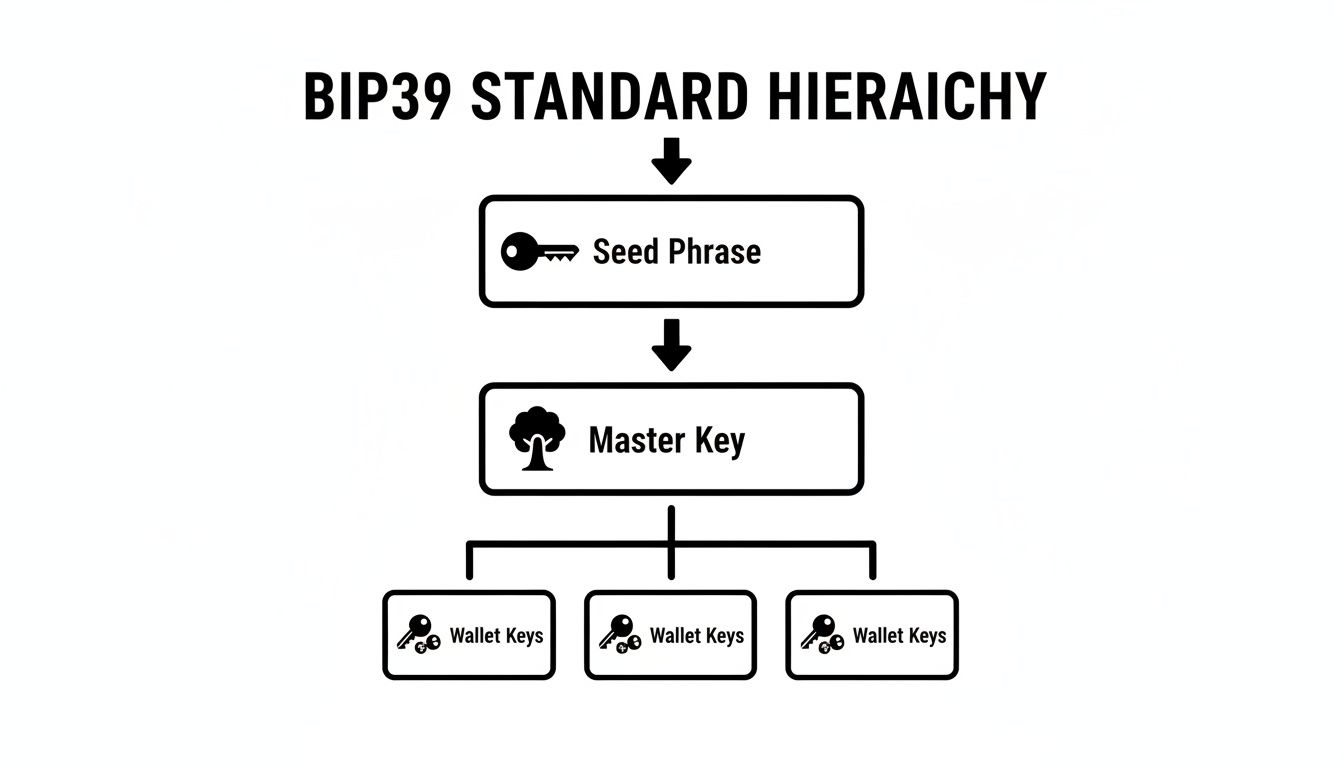
As you can see, it's a one-to-many relationship: your single seed phrase generates the master key, which then branches out to produce a massive number of individual wallet keys.
Derivation Paths Explained
So how does your wallet find a specific address in this giant tree? It uses something called a derivation path. It looks a bit like a computer file path, for example, m/44'/0'/0'/0/0, where each number guides the wallet down a specific branch to find the right key.
This structure is what makes modern crypto wallets so powerful. It means you only have to back up one thing: your original 24-word phrase. As long as you have that seed, you can always regrow the entire tree—every branch, every leaf, and every address—on any BIP39-compatible wallet.
Your 24-word seed isn't just a simple backup; it's a portable, self-contained key-generation engine. It holds the power to create every private key you will ever need for any supported crypto, now and in the future.
This deterministic system is also what allows certain tools to work their magic. If you're curious about the technical link between your mnemonic and the keys it generates, you can use a trusted offline tool to see it in action. For those who want to peek under the hood, a mnemonic code converter can show you exactly how these standards translate your words into keys.
At the end of the day, the relationship between your seed phrase and your addresses provides the best of both worlds: convenience and security. It simplifies your entire backup process down to a single, critical asset while enabling you to manage a complex and ever-expanding crypto portfolio.
Common Threats to Your Seed Phrase and How to Beat Them
Your 24-word seed phrase is the master key to your crypto kingdom. That kind of power, unfortunately, makes it a juicy target for both attackers and simple accidents. To build a security plan that actually works, you have to understand the real-world dangers you're up against—and they exist in both the digital and physical worlds.
We're at a point where seed phrase security failures are the new frontier of financial crime. Hackers are getting frighteningly clever in their tactics to separate you from your crypto. Personal wallet compromises have skyrocketed, and a huge chunk of them trace back to phishing scams, malicious browser extensions, and bogus "recovery" tools designed to trick you into giving up your 12- or 24-word seed. This has fueled a staggering flow of funds into illicit wallets, a figure now in the billions. You can discover more insights about these crypto crime trends to get a sense of just how big this problem is.
Digital Dangers and How to Spot Them
Digital threats are sneaky. They’re built on deception, aiming to get you to willingly hand over your seed phrase. Knowing what to look for is your best defense.
- Sophisticated Phishing: Imagine getting an urgent email that looks like it’s from your wallet provider. It warns of a security breach and rushes you to a "verification" page. That page is a pixel-perfect clone of the real thing, but its only job is to steal the seed phrase you type in.
- Clipboard Malware: This one is particularly nasty. A piece of malware quietly runs in the background, watching your clipboard. The moment you copy your seed phrase, it recognizes the format and instantly sends it straight to the attacker.
- Fake Wallet Apps: Scammers cook up counterfeit versions of popular wallet apps and get them onto app stores or websites. You download what you think is the real deal, enter your seed to "recover" your wallet, and you’ve just handed them the keys.
Pro Tip: Never, ever type your 24-word seed into a website, Google Doc, or any online form. Your recovery phrase should only be entered directly into your trusted hardware or software wallet during a legitimate recovery process. Period.
Physical Threats That Can Destroy Your Backup
Even if you're a digital security ninja, you can still get tripped up by the real world. A simple piece of paper is a fragile thing.
- Theft: This one's obvious but can't be overstated. If someone finds your piece of paper, they have complete and irreversible control of your funds. It’s that simple.
- Disasters: A house fire will turn that paper to ash in minutes. A flood or even a burst pipe can make the ink bleed until it's unreadable. Over time, ink fades and paper just breaks down, leaving you with a useless backup right when you need it most.
- Accidental Loss: It happens. People misplace things. Your seed phrase could easily get tossed out with old papers during spring cleaning or get lost in the chaos of a move.
To fight back against these physical risks, many people are turning to more permanent solutions. Engraving your seed onto a steel plate offers incredible protection against fire and water damage. You can check out our guide on the best metal seed phrase storage to see different options that blow paper out of the water. Sticking that plate in a safe or a bank deposit box adds yet another layer of security.
The Ultimate Defense: The 25th Word
For those who want the absolute highest level of security, the BIP39 standard has a killer feature: an optional passphrase, often called the "25th word." This isn't one of the words from your seed; it’s a password that you create and, ideally, memorize.
When you add a passphrase to your 24-word seed, it completely changes the master key that gets generated. This creates an entirely new, hidden wallet. If a thief gets their hands on your 24-word backup, entering it into a wallet without that passphrase will just show them an empty or decoy wallet. Your real funds are totally safe, locked behind that secret 25th word. It makes a stolen seed phrase completely worthless on its own.
A Step-by-Step Guide to Recovering Your Wallet
The moment you actually need your 24-word seed phrase is almost never a calm one. Maybe your phone met an untimely demise, or you simply need to pull up your funds on a new laptop. The good news? If you have your seed phrase, getting your crypto back is straightforward and secure—as long as you do it right.
Think of it like restoring a backup to a brand-new computer. Your seed phrase holds all the raw data a compatible wallet needs to mathematically rebuild your private keys and find your assets on the blockchain.
Let’s walk through the most common scenario: importing your wallet to a new device.
First Things First: Setup and Verification
Before you even think about typing a single word from your seed phrase, your absolute first priority is to make sure the wallet software you're using is the real deal. Scammers are brilliant at creating fake wallet apps that look identical to the official ones, designed to snatch your seed phrase the instant you enter it.
- Download the Official Software: Always go directly to the official website of the wallet provider, like MetaMask.io or Exodus.com. Never, ever click on links from emails, social media posts, or search engine ads. These are prime hunting grounds for phishing attacks.
- Verify the Application: For desktop wallets, some providers offer a checksum you can use to confirm the file you downloaded is authentic. For mobile apps, take a second to check the developer's name and the download count in the app store—a fake app will usually have very few downloads and a slightly misspelled developer name.
This initial check is your most critical line of defense. Rushing this part is how people lose everything.
The Five Steps to Restore Your Wallet
With the verified software installed, you're ready to go. This is when you retrieve your securely stored 24-word seed. Ideally, you should do this on a device you trust is clean from malware. For an extra layer of security, you can even disconnect from the internet while you type the words in.
Here’s how it usually goes:
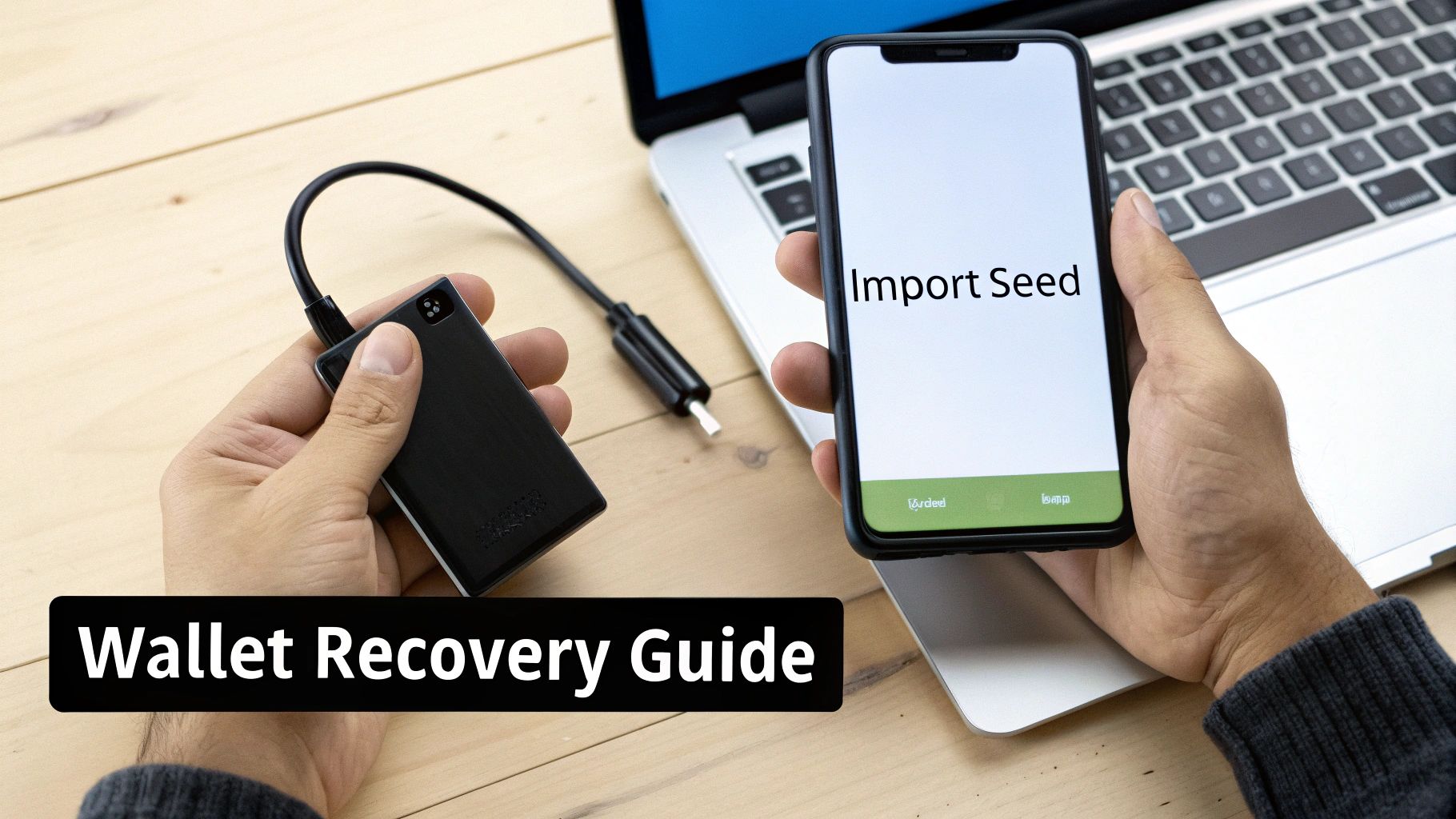
- Launch the Wallet: Open the app you just installed. You’ll be presented with a choice: "Create a New Wallet" or something like "Restore Wallet," "Import Wallet," or "I already have a seed phrase." You want the import option.
- Input Your 24-Word Seed: The wallet will show you 24 blank fields. This is the moment of truth. Carefully type each word from your backup, in the exact order you wrote them down. Spelling and order are everything. One tiny mistake will generate a completely different—and completely empty—wallet.
- Enter Your Passphrase (If You Used One): If you added an optional passphrase (often called the "25th word") for extra security, you’ll need to enter it now. This option is frequently tucked away under an "Advanced" or "Options" menu. If you forget this step, you'll restore the base wallet, not the hidden one where your funds are actually stored.
- Set a New Password: The wallet will then prompt you to create a new password. This is just a local password to encrypt the wallet on this specific device. It has nothing to do with your seed phrase.
- Confirm and Sync: Once you hit confirm, the wallet gets to work. It uses your seed to derive all your keys and starts scanning the blockchain to find your transaction history and balances. Give it a few minutes to sync up.
Remember, the 24-word seed is the master key to your entire crypto life. It should only ever be typed directly into trusted, verified wallet software during a recovery. Never enter it into a website, a Google doc, or send it to anyone over a chat app.
Here’s the rewritten section, crafted to sound like it was written by an experienced human expert.
What to Do When Standard Recovery Fails
So, you’ve tried to recover your wallet. You painstakingly entered your 24-word seed, checked it twice, even a third time… and nothing. The wallet is empty, or worse, it throws an error. It’s a gut-wrenching moment, but don't panic just yet. This doesn't necessarily mean your funds are gone for good. It usually just means you’ve run into a problem that's more complex than a simple typo.
At this point, you're moving beyond a straightforward import and into something more like cryptographic forensics. The most common culprits are issues that seem small but have massive consequences.
The Challenge of Partial or Incorrect Seed Phrases
Let's say you're missing just one word from your 24-word seed, or you have a nagging feeling that two of the words are swapped. It feels like you're so close you can almost taste it. But in mathematical terms, you're still a world away from the right combination.
- One Missing Word: If you have 23 of the 24 words, you aren't just looking for one word. You're looking for one specific word out of a list of 2,048 possibilities, and it could be in any of the 24 positions. This alone creates thousands of potential seeds to test.
- Two Swapped Words: Got all 24 words but think two are out of order? You have to check every single possible swap. For 24 words, that's 276 different pairs (
24 * 23 / 2). - One Wrong Word: If you think one of the words on your list is just plain wrong, you have to try substituting it with every other word from the BIP39 dictionary. This creates tens of thousands of combinations to check.
While these scenarios are a huge headache to do by hand, they are often solvable with specialized tools that can cycle through every valid permutation at high speed. The problem, however, becomes exponentially harder—and often impossible—if you're missing more than one word or have multiple words jumbled.
The complexity of piecing together a partial or jumbled seed phrase grows at an alarming rate with each unknown variable. What starts as a solvable puzzle can quickly become a computationally impossible task, even for the most powerful computers.
The Forgotten Passphrase Problem
One of the most common and heartbreaking reasons for a failed recovery is the BIP39 passphrase, often called the "25th word." You might enter your 24-word seed with perfect accuracy, only to stare at a wallet with a zero balance.
This happens because a passphrase acts as a secret ingredient that completely transforms the master key derived from your seed. Your 24 words alone create a "base" wallet. But your 24 words plus your passphrase create an entirely separate, hidden wallet. If your funds are stored there, just entering the seed phrase will only ever show you the empty base wallet. Without that exact passphrase, your crypto is locked away, even if you have the correct 24 words right in front of you.
When to Call a Professional Recovery Service
When you've hit a wall—you’ve checked for typos, tried different wallet software, and considered a forgotten passphrase—it might be time to bring in an expert. Professional recovery services have advanced, proprietary software built to tackle these complex problems at a massive scale.
They can step in for scenarios that are just not realistic for an individual to solve on their own:
- Brute-forcing a single missing or incorrect word.
- Systematically testing thousands of different word orders.
- Attempting to recover a forgotten passphrase based on clues you can provide.
- Restoring wallets from corrupted files or damaged hardware.
These services are a lifeline when a technical mistake has frozen your assets on the blockchain. When the problem is solvable, they can get it done. For instance, one specialist firm reported restoring over $2.5 million from otherwise inaccessible non-custodial wallets. You can learn more about these large-scale recovery efforts and see just how much value they can bring back to users.
But it’s important to be realistic. No service can magically guess a seed phrase with multiple missing words or brute-force a completely forgotten passphrase from scratch. Any reputable service will be upfront about what is and isn't possible before you ever commit to anything.
Got Questions About Your 24-Word Seed Phrase? We’ve Got Answers.
As you start using and securing your own crypto, a few key questions always pop up. It's totally normal. Let's tackle some of the most common ones to make sure you're feeling confident about how this all works.
Think of this as your go-to cheat sheet for mastering the ins and outs of your recovery phrase.
Can I Change My 24-Word Seed Phrase?
The short answer is a hard no. Your seed phrase is mathematically baked into your wallet's private keys from the moment it’s created. You can't just swap out a word here or there—doing so would point to a completely different, and totally empty, wallet.
So, how do you "change" it? You have to create a new wallet from scratch and move your assets over.
- First, generate a brand-new wallet on a secure device. This will give you a fresh, unique 24-word seed phrase.
- Write down and double-check your backup of this new phrase.
- Manually send all of your crypto from your old wallet to the new addresses generated by your new seed.
That's the only way. Once your funds are safely in the new wallet, the old seed phrase is effectively retired—it no longer has any power over those assets.
Is a 24-Word Seed Really Safer Than a 12-Word One?
Yes, and the difference is mind-boggling. While both 12-word (128-bit security) and 24-word (256-bit security) phrases are completely unbreakable with today's technology, the 24-word phrase is built for a future we can't yet predict.
A 256-bit key is 2^128 times stronger than a 128-bit key. That’s not just a little more secure; it's an exponential leap that makes the 24-word seed the undisputed gold standard for anyone serious about protecting their assets for decades to come.
This isn't just about today; it's about making your wallet future-proof against things like quantum computing.
What if Two People Generate the Same Seed Phrase?
This is a great thought experiment, but in the real world, it's a statistical impossibility. The number of possible combinations for a 24-word seed phrase is around 1.16 x 10^77.
To give you an idea of how massive that number is, it’s orders of magnitude larger than the estimated number of atoms in the entire known universe. You genuinely have a better chance of winning the lottery every single day for the rest of your life. For all practical purposes, every properly generated seed phrase is one-of-a-kind.
Are you facing a complex recovery scenario with your wallet? The expert team at Wallet Recovery AI uses advanced, secure methods to help you regain access to your funds when standard recovery fails. Contact us today for a confidential consultation.
Leave a Reply