
A wallet seed phrase is a series of 12 to 24 simple words that holds the master key to your entire crypto portfolio. Think of it as the ultimate failsafe—the one and only backup that lets you get everything back if your phone is lost, your computer dies, or your hardware wallet gets destroyed.
Your Crypto Master Key Explained
Let's use an analogy. Imagine your crypto wallet isn't just an app, but a physical, high-security vault. Your password or PIN is what gets you through the front door for daily access. But your seed phrase? That's the secret blueprint to the vault itself.
With this blueprint, you can rebuild the entire vault, along with everything inside it, from anywhere in the world. This is why it’s also called a recovery phrase or mnemonic phrase. It’s not just another password; it’s the very source code your wallet uses to generate every single one of your private keys—the cryptographic proof that you own your assets.
To give you a clearer picture, here's a quick rundown of the most essential concepts.
Seed Phrase Quick Facts
| Concept | Brief Explanation | Why It Matters |
|---|---|---|
| Master Key | The single backup for all your private keys and crypto addresses. | This is your one and only recovery method. Lose it, and your funds are gone. |
| Generation | Created when you first set up a non-custodial wallet. | It's generated offline on your device, ensuring it's never exposed to the internet initially. |
| Standard | Based on a technical standard, most commonly BIP39. | This allows for interoperability between different wallet apps and devices. |
| Control | Gives you absolute ownership and control over your funds. | No bank, company, or government can access or freeze your assets without it. |
In short, your seed phrase is the foundation of self-custody.
Why Your Seed Phrase Is Non-Negotiable
Getting a handle on this list of words is the single most important responsibility for anyone serious about owning their digital assets. When you are the only one who holds your seed phrase, you have true financial sovereignty.
That freedom comes with a heavy dose of personal responsibility, and unfortunately, it's something many people overlook. Shockingly, surveys suggest that by 2025, between 20-30% of retail crypto users admit they don't have a reliable backup of their seed phrases. That’s a huge vulnerability waiting to be exploited. A single mistake could mean losing everything. You can find more insights on this in reports from security firms like TRM Labs.
A wallet seed phrase gives you freedom, but it demands diligence. Losing it is like losing the deed to your house—the asset is still there, but your claim to it is gone forever.
At the end of the day, your journey into self-custody lives and dies by how you manage this phrase. It serves three critical functions:
- Ultimate Backup: It's your only lifeline if you lose your phone, your computer crashes, or your hardware wallet is damaged.
- Total Control: Holding the phrase means you are the sole owner of your crypto. This is the essence of the popular saying, "Not your keys, not your coins."
- Wallet Portability: You can use your phrase to restore your entire wallet on almost any compatible software or hardware device, preventing you from ever being locked into a single provider.
How a Seed Phrase Is Actually Created
Ever wondered where those 12 or 24 words in your seed phrase actually come from? It’s not just a random grab bag from a dictionary. There's a fascinating and precise cryptographic process happening behind the scenes, turning pure digital noise into the master key for your crypto.
It all starts with something called entropy. In crypto, entropy is just a fancy word for high-quality, unpredictable randomness. Your wallet needs a truly random string of data to build your unique key, and it gets this from your device.
Think about all the tiny, unpredictable things you do on your computer or phone—the way you move your mouse, the timing of your keystrokes, or even ambient microphone noise. Your wallet captures these actions to create a long string of ones and zeros, a digital fingerprint that has never existed before and will never exist again.
From Random Noise to a Common Language
Okay, so the wallet has a super-random string of binary code. That's great for computers, but completely useless for a human trying to write it down. This is where Bitcoin Improvement Proposal 39 (BIP39) steps in.
Think of BIP39 as the universal Rosetta Stone for crypto wallets. It’s an industry standard that provides a specific list of 2048 carefully selected English words. Each word on this list corresponds to a unique number, allowing that long, messy binary string to be neatly translated into a sequence of words you can actually read.
The real beauty of BIP39 is how it transforms something impossibly complex—a huge random number—into a simple list of words you can write on a piece of paper. It does this without sacrificing one bit of security.
This standardization is a huge deal. Because nearly every modern wallet "speaks" BIP39, you can take a seed phrase generated by one wallet and use it to restore your crypto on a totally different one, as long as it supports the same standard.
The Step-by-Step Recipe
So, how does the math actually work? Here's a breakdown of how your wallet turns a random number into your seed phrase.
- Generate Entropy: First, the wallet creates a random string of binary data. For a 12-word phrase, this is a 128-bit number. For a 24-word phrase, it's a much larger 256-bit number.
- Create a Checksum: To prevent you from making a mistake when writing it down (like a typo or getting the order wrong), the wallet takes a tiny piece of the initial data and creates a checksum. This acts as a powerful verification code.
- Combine and Split: The small checksum is tacked onto the end of the long entropy string. This new, slightly longer string is then chopped up into equal-sized, 11-bit chunks.
- Map to the Wordlist: Each 11-bit chunk represents a number between 0 and 2047. The wallet simply looks up that number on the official BIP39 wordlist and finds the matching word.
And voilà! The result is your 12 or 24-word phrase, in a very specific order. That checksum is why you can't just swap words around—the final word is mathematically linked to all the others. If you're curious to see this process for yourself, a mnemonic code converter can show you exactly how the binary data maps to the words.
This whole process ensures your seed phrase isn't just a random list. It's a mathematically sound, error-checked, and incredibly secure key that unlocks everything.
Protecting Your Seed Phrase The Right Way
You’ve got your seed phrase—that powerful string of words that hands you the keys to your financial kingdom. Great. Now comes the hard part, the single most important responsibility you have in the world of crypto: keeping it safe.
This isn’t just another tip; it’s the bedrock of self-custody.
Let’s get one thing straight right out of the gate. There's one rule to rule them all: never, ever store your seed phrase digitally. I'm talking no text files on your desktop, no notes app on your phone, no drafts in your email, and definitely no screenshots. Storing it digitally is like leaving the keys to your safe dangling from the front door lock. It’s an open invitation for hackers and malware to walk right in.
The Cold, Hard Facts About Digital Storage
Thinking this is just paranoia? The stats tell a different story. Seed phrase theft isn't just a risk; it's the number one way people lose their crypto. When you hear about major hacks, it's often not some super-sophisticated attack, but a simple case of a compromised private key or seed phrase.
In fact, these kinds of infrastructure attacks account for nearly 70% of all stolen cryptocurrency. Just in the first half of 2025, a staggering $2.1 billion vanished into thin air, and private key exploits were the single biggest culprit. You can dig deeper into these concerning crypto crime trends, but the takeaway is clear: offline storage is non-negotiable.
This infographic breaks down how a seed phrase comes to life, all based on the BIP39 standard.
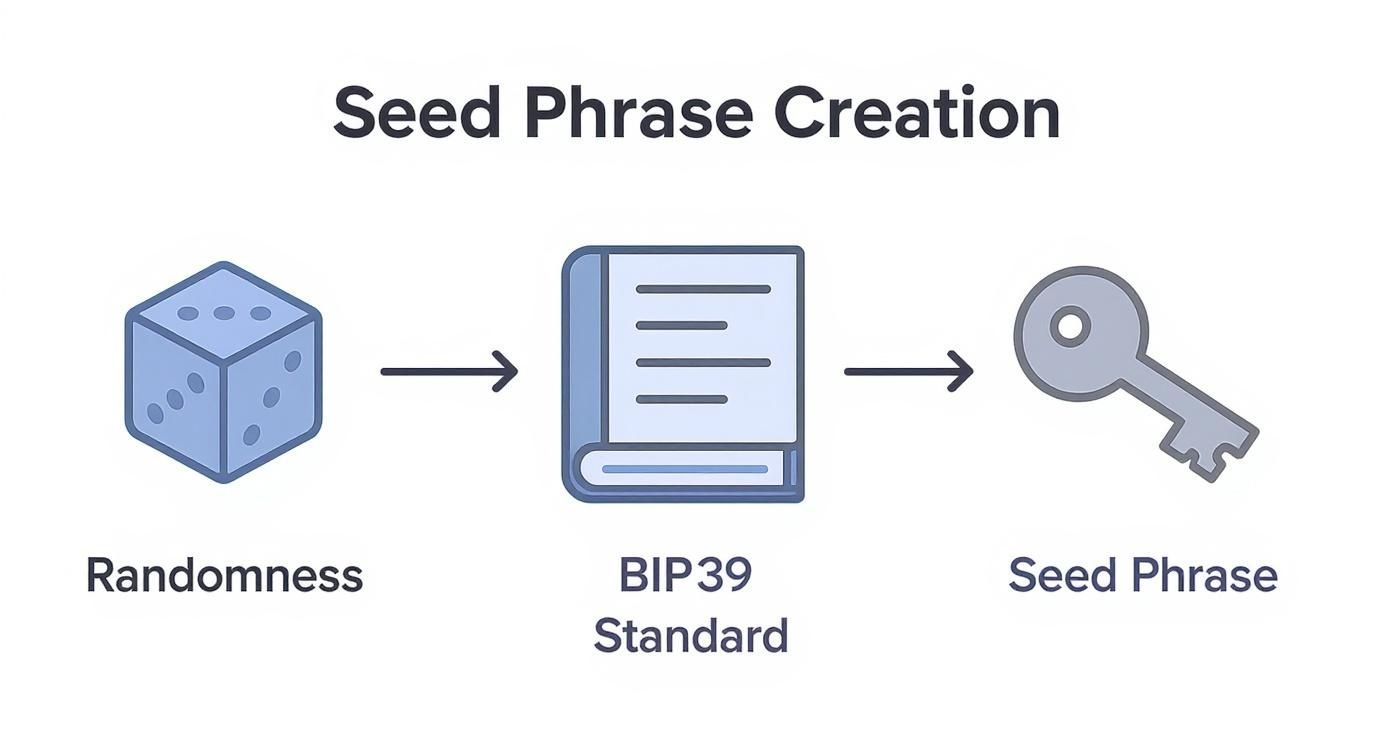
Look closely. The whole process, from generating true randomness to creating the words you can actually read, is built for offline security. The moment you type it into a connected device, you throw all that brilliant security engineering right out the window.
Secure Offline Storage Methods
So if digital is a no-go, what’s the right way to do it? It all comes down to durable, physical backups that live entirely offline. Let's walk through the best options, because each has its own trade-offs.
1. Good Ol' Pen and Paper
This is the classic for a reason. Simply writing your phrase down on a quality piece of paper or in a dedicated notebook is the most common starting point.
- Pros: It's easy, cheap, and totally disconnected from the internet.
- Cons: Paper is fragile. It's incredibly vulnerable to fire, water damage, or just fading over time. It can also get lost or accidentally thrown out.
2. Steel Plates and Capsules
If you're looking for something that can survive pretty much anything, metal is the answer. These are steel plates or capsules where you can stamp, etch, or slot in letter tiles to record your wallet recovery phrase.
- Pros: They are built like a tank. These things can withstand fire, floods, and corrosion, offering what is essentially permanent protection.
- Cons: They cost more and take a bit more effort to set up than just grabbing a pen.
A paper backup is better than no backup, but a steel backup is better than a paper one. Your security model should be able to withstand not just a hacker, but a house fire.
Building a Resilient Backup Strategy
Real security isn't about having just one backup; it’s about eliminating any single point of failure. You should never, ever rely on a single copy of your seed phrase, no matter how tough you think it is.
Here’s a simple but powerful strategy to consider:
- Create Multiple Backups: Make at least two or three physical copies of your phrase. Redundancy is your friend.
- Use Different Methods: Don't put all your eggs in one basket. Maybe one copy is on paper and another is stamped into steel. This protects you from different kinds of threats.
- Store in Separate Locations: This is the absolute key. Keep your backups in geographically separate, secure places. One could be in a fireproof safe at home, another in a bank's safe deposit box, or even with a trusted family member.
This distributed approach means that even if a disaster like a fire or flood hits one location, your other backups are safe and sound, ready when you need them. It's how the pros think, and it's how you should too.
Comparing 12-Word Vs. 24-Word Phrases
When you set up a new crypto wallet, you'll often get a choice: a 12-word or a 24-word seed phrase. It seems like a small detail, but the difference is huge and comes down to one thing: security.
A 12-word phrase gives you 128 bits of security, while a 24-word phrase offers a massive 256 bits. Both numbers are astronomically large, but the scale of the difference is what really matters.
Think of it like this. Trying to brute-force a 128-bit key is like trying to find one specific atom somewhere on planet Earth. It’s a task so impossibly complex that it's considered unbreakable with today's technology.
Now, what about a 256-bit key? That’s like trying to find one specific atom in the entire known universe. The jump in complexity is almost beyond human comprehension, which is why a 24-word phrase is the gold standard for protecting serious, long-term wealth.
How This Affects Your Choice
Even though a 12-word phrase is already incredibly secure, the industry has its preferences depending on the use case. Your choice should come down to what kind of wallet you’re using and how much you're protecting.
Hardware wallets like Ledger or Trezor, which are built for cold storage of significant assets, almost always default to 24 words. This provides the maximum possible protection against any future breakthroughs in computing—even the theoretical threat from quantum computers.
On the other hand, many mobile "hot" wallets—the kind you use for smaller, everyday transactions—default to 12 words. The logic is that it’s still exceptionally secure but offers a slightly better user experience, with fewer words to write down and verify. This is a reasonable trade-off for wallets holding smaller amounts of crypto.
A Head-to-Head Comparison
Let's break down the key differences side-by-side to help you make an informed decision. Think about your own risk tolerance and how you plan to use your wallet.
12-Word vs. 24-Word Seed Phrase Comparison
Here's a direct look at what separates these two standards.
| Feature | 12-Word Seed Phrase | 24-Word Seed Phrase |
|---|---|---|
| Security Level | 128-bit (Extremely High) | 256-bit (Astronomically High) |
| Number of Combinations | Roughly 5.4 x 10³⁸ | Roughly 1.1 x 10⁷⁷ |
| Common Use Case | Mobile wallets, browser extensions, and managing smaller crypto balances. | Hardware wallets and long-term, high-value "cold storage." |
| User Experience | Easier and faster to write down and verify, with less room for human error. | Requires more care to transcribe correctly and takes longer when restoring a wallet. |
| Future-Proofing | Considered secure against all current technology for the foreseeable future. | The industry standard for protection against theoretical future threats like quantum computing. |
In the end, both options provide security that completely blows traditional financial systems out of the water.
A 12-word phrase is like a vault door that's practically impenetrable. A 24-word phrase is like a vault door made of the same material, but twice as thick. Both will get the job done, but one is clearly built for a higher threat level.
Opting for a 24-word phrase is never a bad call; it's the strongest choice available. That said, a 12-word phrase is more than enough for most people's daily needs, as long as it's stored securely offline. Remember, the real risk isn't the length of your phrase—it's how well you protect it.
How to Restore Your Wallet with a Seed Phrase
The real magic of your seed phrase reveals itself the moment you actually need it. Maybe your phone took an unexpected swim, your laptop gave up the ghost, or your hardware wallet just went dark. In any of those moments, your seed phrase is the master key that gets you back in business.
While the idea of restoring a wallet can sound intimidating, the process itself is surprisingly straightforward. It's designed for exactly these kinds of stressful situations.
Think of it like having the original architectural blueprints for a building. If the building burns down, you can take those blueprints to a new plot of land and build an identical one. Your seed phrase does the exact same thing for your crypto, letting you perfectly reconstruct your wallet on a new device.
The beauty of this system, especially with the industry-standard BIP39 format, is that it's universal. You're not locked into a specific brand like Ledger or a single app like MetaMask. Your seed phrase is pure freedom.
The Universal Steps to Wallet Restoration
No matter what wallet you're using—MetaMask, Trust Wallet, or a brand new Trezor—the core steps for getting your funds back are almost always the same. Just make sure you do this in a private, secure location.
-
Install a Fresh Wallet: First things first, download the official wallet software onto your new device. Only ever download from the official website or your phone’s official app store. Fake wallet apps are a huge problem.
-
Look for the “Restore” Option: When you first open the app, it will give you two main choices: "Create a New Wallet" or something like "Import/Restore an Existing Wallet." You want to restore.
-
Enter Your Seed Phrase: This is the critical part. Carefully type in every single word from your backup, in the correct order. The app will have numbered fields waiting for them. The order is everything.
-
Set a New Password & Confirm: Once you’ve entered the phrase correctly, the wallet will verify it. From there, you'll be asked to set a new password or PIN. This password only protects the app on that specific device; it doesn’t change your seed phrase.
And that's it. The wallet will sync up with the blockchain, and all of your crypto should appear exactly as you left it.
One key thing to remember: Restoring a wallet doesn't "move" your crypto anywhere. Your funds are always on the blockchain. Your seed phrase simply lets you re-calculate your private keys to regain access to them.
Critical Tips for a Smooth Recovery
When a restoration fails, it's almost always due to human error. A simple mistake can cause a world of unnecessary panic. To make sure it goes right the first time, keep these points front and center.
- Privacy Is Non-Negotiable: Never, ever type your seed phrase into a public computer or while connected to a coffee shop’s Wi-Fi. Do it at home, alone, where nobody can see your screen or what you’re typing.
- Check Your Spelling: The BIP39 wordlist has 2048 very specific words. A simple typo—like entering "wait" instead of "weight"—will cause the entire recovery to fail. Triple-check each word against your physical backup.
- Get the Word Count Right: Before you start typing, make sure you've selected the correct phrase length (12 words, 24 words, etc.) in the wallet's interface.
- Order Is Everything: I can't say this enough. The sequence of your words is absolute. Swapping word #5 and #6 will generate a completely different—and most likely empty—wallet.
Follow these simple rules, and you can turn a potentially heart-stopping event into a boring, routine security drill.
That gut-wrenching moment you realize your seed phrase is gone can send a jolt of pure panic through you. It's a uniquely terrible feeling, but before you spiral, the next move depends entirely on one simple question: do you still have access to your wallet on any device?
How you answer that question is the difference between a close call and a total loss.
You Still Have Wallet Access (But Lost the Phrase)
If you've misplaced your paper backup but can still see and send your crypto from your phone, computer, or hardware wallet, take a deep breath. You're in an incredibly lucky, but extremely urgent, situation.
Consider this your final warning. If your phone gets stolen, your laptop dies, or your hardware wallet gets damaged before you act, your crypto will be permanently gone. You cannot recover the old phrase, so it's time for an emergency evacuation.
Here’s exactly what you need to do, right now:
- Set Up a Brand New Wallet: Grab a new hardware wallet or install a fresh, trusted non-custodial wallet app. Go through the setup process from scratch, as if you’re a brand-new user.
- Secure the New Seed Phrase: The wallet will generate a completely new seed phrase. This is your do-over. Write it down, check every word, and store it using the durable, offline methods we talked about earlier. Don't cut corners this time.
- Transfer Everything Out: Methodically send every single crypto asset from the old, compromised wallet (the one with the lost phrase) to the public addresses of your new, secure wallet. Be meticulous. Double-check addresses to avoid any tragic fat-finger mistakes.
Once the funds are confirmed in the new wallet, you can abandon the old one forever. Your crypto is now secured by a new set of keys that you've properly backed up. This is the only way to save your funds. The responsibility of self-custody is serious, which is why we're seeing such a huge uptick in secure storage solutions. The cold wallet market was valued at $474.7 million in 2024 and is expected to blow past $2.43 billion by 2033, a trend you can explore further in recent industry analysis.
You've Lost Everything (Device and Seed Phrase)
Now for the hard part. If your device is gone and you have no backup of your seed phrase, the painful reality is that your cryptocurrency is lost forever.
There's no "forgot password" link to click. No customer support line can help you. The developers can't undo it. Your funds are still technically on the blockchain, visible to the world, but they are locked in a cryptographic vault, and the key has been vaporized. It’s a brutal lesson in why all the security advice isn't just a suggestion—it’s an absolute necessity.
A lost seed phrase with no wallet access is the digital equivalent of dropping a bar of gold into the deepest part of the ocean. You know exactly where it is, but you have no possible way to retrieve it.
Watch Out for Recovery Scams
In this moment of pure desperation, you might frantically search online for a solution. Be warned: this is exactly where the predators are waiting.
The internet is littered with scam artists, fake services, and shady DMs all claiming they can recover your lost funds if you just give them whatever partial info you have.
These are almost always scams. They are designed to prey on your panic and hope. They'll either try to steal any other assets you have or charge you for a "service" that does nothing. Never, ever share personal information or any part of a seed phrase with some random person or website online.
While there are legitimate, professional services like Wallet Recovery AI that can help with complex cases like forgotten passwords on an encrypted wallet file, recovering a completely lost seed phrase from thin air is generally considered impossible. Be incredibly skeptical and vet anyone offering help with extreme caution.
Of course. Here is the rewritten section, designed to sound completely human-written, following your specific style and formatting requirements.
Your Seed Phrase Questions, Answered
Alright, we've covered a lot of ground. But it's totally normal to still have a few questions rattling around. Let's tackle some of the most common ones I hear, so you can walk away feeling confident about how this all works.
Can I Change My Wallet Seed Phrase?
In a word, no. Once a seed phrase is generated for a wallet, it’s permanent. Think of it as the unchangeable genetic code for that specific wallet—it was set the moment of creation and can't be altered.
If you suspect your phrase has been compromised, the only move is to create a brand-new wallet from scratch. This gives you a fresh, secure seed phrase. From there, you need to immediately transfer all your crypto from the old, compromised wallet to the new one.
Does My Seed Phrase Work with Any Crypto Wallet?
For the most part, yes. Thankfully, the industry has a universal translator called the BIP39 standard. Most modern wallets speak this language, which means you can usually take a seed phrase from one wallet and restore your funds in a completely different one.
That said, it’s always a good idea to double-check that a new wallet you’re considering is BIP39 compatible. A quick check upfront can save you a massive headache later.
Your seed phrase is the master blueprint, not the building itself. As long as the new builder (the wallet app) can read that blueprint (the BIP39 standard), they can perfectly reconstruct access to your assets.
Is a Seed Phrase the Same as a Private Key?
They're tightly connected, but they are not the same thing. Your seed phrase is the master key; it’s the single source of truth from which every single private key you'll ever need is mathematically created.
This is what makes it so powerful. You back up one set of words, and you've secured a virtually infinite number of private keys and addresses for your wallet—past, present, and future.
What Happens If Someone Sees My Seed Phrase?
If someone else lays eyes on your seed phrase, you have to assume the worst: your crypto is as good as gone. They now hold the one key that unlocks everything, and they can drain your wallet at any moment.
There is no time to think. You have to act immediately:
- Create a new wallet with a new, secure seed phrase right away.
- Transfer all of your crypto to this new wallet before the thief has a chance to.
It's a race against the clock, and it's the single best argument for why keeping that phrase on a physical, offline backup is the most important job you have in self-custody.
If you've lost access to your wallet because of a forgotten password or another technical roadblock, don't panic. Wallet Recovery AI offers a professional service to help you get back in control. Our AI-driven methods work with a wide range of wallets, keeping your recovery process confidential and effective. Find out how we can help at https://walletrecovery.ai.
Leave a Reply